







Abstract
The novel fluorinated polyacrylate latex was successfully prepared by emulsion polymerisation of perfluorononylene allyl ether (PFAE) with butyl acrylate (BA) and methyl methacrylate (MMA) initiated by potassium persulphate (KPS) in the water with different surfactants. PFAE was synthesised from the intermediate perfluoro nonene and 3-allyl alcohol as staring reactants. Films of the novel fluorinated polyacrylate latex were prepared by coating the latex directly on the clean glass sheet and allowed to dry at 80°C in a bake oven. The structure of the novel fluorinated polyacrylate latex was investigated by Fourier transform infrared spectrometry. Surface difference of novel fluorinated polyacrylate latex prepared with different surfactants was studied. Results show that the latex prepared with sodium dodecyl benzene sulphonate surfactant has smaller particle size, contact angle and lower surface tension. The latex prepared with sodium 2-hydroxy-3-(methacryloyloxy) propane-1-sulphonate surfactant has larger particle size, higher surface tension and larger contact angle.
Introduction
Fluorinated acrylate latexes, which are produced with acrylic monomers and fluorinated monomers via emulsion polymerisation to provide latexes with desirable properties, are becoming increasingly important due to their environmental compliance. Cheng et al.1 synthesised core–shell latex with polyacrylate rich in core and fluoropolymer rich in shell by semicontinuous emulsion polymerisation in the presence of mixed emulsifying agents of OS-15 mixed with SDS. Cui et al.2 prepared the core–shell interpenetrating polymer network fluorinated polyacrylate latex particles with fluorine rich in shell by emulsifier-free seeded emulsion polymerisation with the water as the reaction medium. Cui et al.3 also synthesised core–shell fluorine-containing polyacrylate latex particles with fluorine-containing polymer rich in shell by emulsifier-free seeded emulsion polymerisation. Zhang and Chen4 prepared the fluorinated polyacrylate latexes with core–shell structure by two-stage semi-continuous emulsion polymerisation, using a mixed emulsifier system composed of a reactive emulsifier and a small amount of anionic emulsifier. Gao et al.5 synthesised a novel fluorine-containing polymer emulsion with core–shell structure by a two-stage emulsion polymerisation technique. Cui et al.6 synthesised the core–shell polyacrylate latex nanoparticles containing fluorine and silicon in shell by emulsifier-free seeded emulsion polymerisation with the water as the reaction medium. Xiong et al.7 prepared a series of core–shell acrylic copolymer latexes containing fluorine enriched in the shell by emulsion polymerisation of a variety of hydrocarbon monomers with (perfluoroalkyl)methyl methacrylate and vinyltriethoxysilicone. Cheng et al.8 prepared the interpenetrating polymer network fluorine-containing polyacrylate latex with core–shell structure by semi-continuous emulsion polymerisation of fluorine-containing acrylate and acrylate monomers in an aqueous medium composed of mixed emulsifiers. Chen et al.9 prepared emulsifier-free latexes of fluorinated acrylate copolymers by semi-continuous polymerisation method, with perfluoroalkylethyl methacrylate (Zonyl TM) as a fluoromonomer. Huang et al.10 prepared the fluorinated copolymer emulsions containing different monomers with the reactive groups using emulsion polymerisation technique. Chen et al.11 prepared core–shell acrylate latexes containing fluorine in the shell by semi-continuous emulsion polymerisation. Surfactants are commonly used during emulsion polymerisation to produce latexes, stable dispersions of polymer particles in an aqueous environment.12 The latexes produced from this process are used in applications such as adhesives, paints and other coating applications.13 – 15 For many of these applications very distinct requirements have to be met. This refers to the surface properties of emulsion as well as the properties of the final polymer film.
Generally, the surface and polymer properties are determined by type of fluorinated monomer and monomer composition, crosslinking and molecular weight of the polymer, surfactant system, initiators and by the polymerisation process.16 All of these topics have been a matter of intensive research in our laboratories and many of the results including influence of monomer variation, type of crosslinking agent and of polymerisation process, have already been published.17 – 19 To our knowledge, there is no other example, in the open literature, of the study of surface difference of the fluorinated acrylate latex prepared with different surfactants.
In the present paper, using the intermediate perfluoro nonene and 3-allyl alcohol as the staring reactants (see Fig. 1), we would like to report a convenient method to synthesise new fluorinated polyacrylate latex with two different surfactants such as sodium dodecyl benzene sulphonate (SDBS) and sodium 2-hydroxy-3-(methacryloyloxy) propane-1-sulphonate (HMPAS). For the sake of uniform conditions, latexes comprising primarily poly (methyl methacrylate-co-butyl acrylate-co-perfluorononylene allyl ether) (MMA-co-BA-co-PFAE) (see Fig. 2) were prepared via semi-continuous seeded emulsion polymerisation with the same recipe. In this paper, A stands for the latex prepared with the conventional surfactant SDBS; B stands for the latex prepared with polymerisable surfactant HMPAS. The emphasis is put in the present work on the surface difference of the prepared latexes.
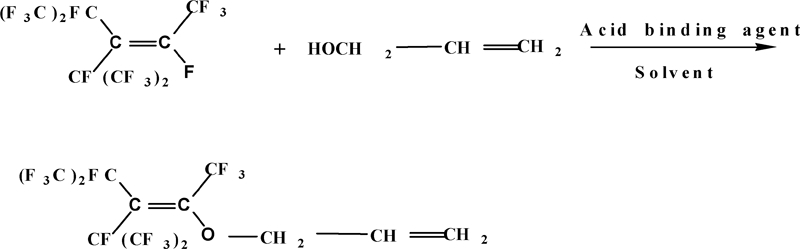
Synthesis of PFAE used perfluoro nonene and 3-allyl alcohol as staring reactants
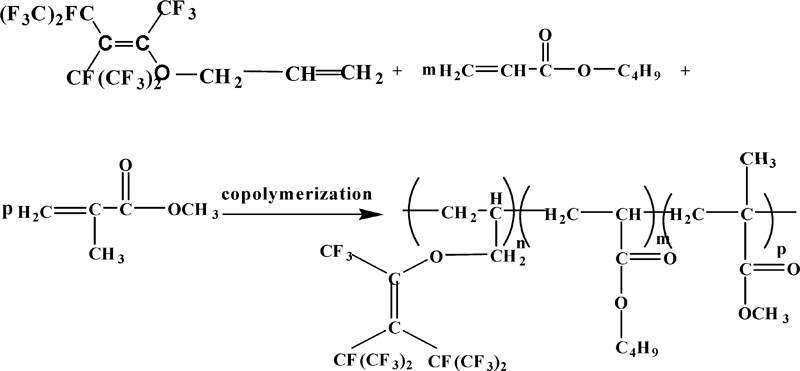
Synthesis pathway of fluorinated polyacrylate latex
Experimental
Materials
BA and MMA were distilled under reduced pressure prior to polymerisation. PFAE was prepared in our laboratory (see Fig. 1). Potassium persulphate (KPS) and sodium bicarbonate (NaHCO3) were used as received. The water used in this experiment was distilled followed by deionisation. Different surfactants such as SDBS and HMPAS were industrial grade.
Synthesis of fluorinated monomer PFAE
3-allyl alcohol and triethylamine were introduced into a three-necked flask with the stirrer. Acetone was then added into the flask and the stirrer was agitated for 5 min. Perfluoro nonene was added dropwise within 3 h at room temperature. The reaction continued for 5 h after perfluoro nonene was dripped completely. The resulting mixture was dissolved in 2·5% HCl solution to separate the mixture. The lower liquid was washed with 5% HCl solution and then with the distilled water. The obtained liquid was dried with Na2SO4. Finally, the liquid was purified further with reduced pressure distillation. Thus, PFAE was obtained for next soap-free emulsion polymerisation. Fourier transform infrared (FTIR) spectrum of PFAE was shown in Fig. 3. The characteristic stretching peak of C = C bond was 1613 cm−1; the stretching and flexural vibration peaks of C–H bond were 1428, 966 and 753 cm−1; the characteristic stretching peak of C–F bond was 1230 cm−1; the stretching vibration peak of C–O bond was 1030 cm−1; the rocking vibration peak of –CH2 was 719 cm−1. 1H-NMR of PFAE showed the following spectra: 1H-NMR (CDCl3, δ in ppm): 5·90–5·82 (1H, CH), 5·37–5·28 (2H, CH2), 4·52–4·29 (2H, CH2). Both Fig. 3 and data of 1H-NMR certified that PFAE had been prepared.
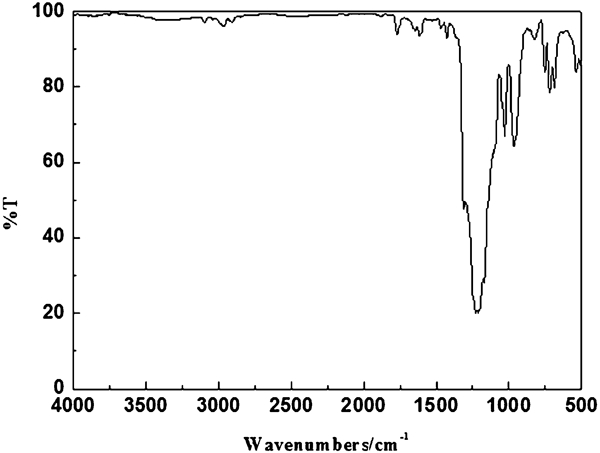
Fourier transform infrared spectrum of PFAE
Preparation of fluorinated polyacrylate latexes
The mixed monomers consisted of BA, MMA and PFAE. A homogeneous aqueous solution containing deionised water, NaHCO3, and surfactant was charged into a 250 mL four-neck flask equipped with reflux condenser, mechanical stirrer, dropping funnels and heated with the water bath. The stirring speed was maintained at 200 rev min−1 throughout the runs. The reactor temperature was increased to 80°C within 30 min. An initiator solution containing KPS and deionised water and a monomer mixture containing BA, MMA and DFMA were charged to the reactor to form the seed latex within 15 min. The seeded polymerisation was continued for an additional 10 min. At that point, the initiator and monomer emulsion stock solutions were added slowly to the reactor using two separate dropping funnels. The feeding time for the initiator and the monomer emulsion stock solutions were 3·5 and 3·0 h respectively. After the feed was completed, the temperature was raised to 90°C and maintained for another 30 min to increase monomer conversion. The latex was then cooled to below 40°C, and NH4OH (25 wt-%) was added to increase the pH to about 8·0. Finally, the mixture in the flask was cooled and filtered. Thus, the fluorinated acrylate latex was obtained.
Characterisation
Fourier transform infrared spectrometric analyser (Thermo Nicolet AVATAR370, USA) was used to analyse the chemical structures of the latex films. 1H-NMR spectrum was recorded with Bruker AVANCE III 500 MHz (Switzerland) spectrometer. CDCl3 was used as internal reference for chemical shift of 1H. The film of latex is obtained from coating the latex on the clean glass and drying at 80°C for 2 h in a bake oven. The contact angle between the film and the water was determined with a DataPhysics contact angle meter (OCA-20, Germany) at room temperature. The particle size of the latexes was determined by a Zetatrac dynamic light scattering detector (Microtrac Limited Corporation, USA) at 25°C. The power and the wavelength of the diode laser used in the dynamic light scattering measures were 3 mW and 780 nm respectively. The surface tension of latex was measured with a contact angle-surface tension determinator (DCA-315, Thermo Cahn, USA) at 25°C.
Results and discussion
Fourier transform infrared data of latexes
Table 1 shows the Fourier transform infrared data of the prepared latexes. For sample B, the characteristic stretching peaks of C–H (CH3,CH2) were 2957 and 2873 cm−1, the stretching vibration peak of C = O was 1731 cm−1, the distortion vibration peak of −COO− was 1455 cm−1, and the stretching vibration peak of C–F bond was 1237 cm−1. The characteristic absorption peaks of SO3Na were 1164 and 1067 cm−1. The stretching vibration absorption peak of C = O in the acrylic group was 843 cm−1. Fourier transform infrared data of latex show that three kinds of BA, MMA, PFEA and reactive surfactant HMPAS all took part in the copolymerisation reaction and fluorinated polyacrylate latex was prepared. In comparison with sample B, sample A has four additional wave numbers: 1598 cm−1, 1583 cm−1 and 1498 cm−1 were the vibration peaks of the skeleton of the benzene ring and 756 cm−1 was the deformation vibration peak of C–H in benzene ring. Fourier transform infrared data of sample A indicate that BA, MMA and PFEA were copolymerised and SDBS still remained in the film of sample A.
Fourier transform infrared data of prepared latexes

Contact angle of film
The hydrophobic property of a polymeric material can be estimated in terms of contact angle (CA) measurement by depositing a water drop on the surface of film and the value of CA depends on the chemical compositions of film surface. 20 20,21 Contact angles are shown in Fig. 4. Figure 4 shows that the CA of the film of latex prepared with HMPAS is higher than that of the latex prepared with SDBS. This is caused by the fact that HMPAS is copolymerised with the monomers during the course of the emulsion polymerisation, in which desorption of surfactants from the particles of the latex and their migration in the film of the latex are avoided.
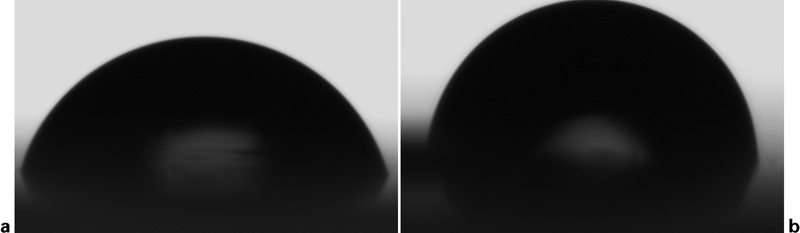
Contact angle of film: a 76·2°; b 89·8°
Surface tension of latexes
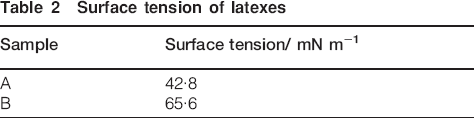
Usually, the surface tension of HMPAS and SDBS at 20°C is 54·0 and 34·2 mN m−1 respectively. Surface tension of the latexes is shown in Table 2. Compared with the surface tension of latex prepared with SDBS, the surface tension of latex prepared by HMPAS surfactant is much higher and close to that of the water (72·0 mN m−1), indicating a low concentration of HMPAS in the aqueous phase. The reason for this may be the chemical anchoring of HMPAS to the particles. In contrast, the surface tension of latex prepared by SDBS is close to that of SDBS itself surface tension. This indicates an extremely high concentration of SDBS in the aqueous phase in that the SDBS is anchored onto the particle surface. Surface tension value can be used to judge whether the emulsifier has joined to polymerisation with monomers or not. According to Uaulina et al.22 and Abele et al.'s23 work, if the surface tension of the prepared emulsion is close to that of the water (72·0 mN m−1), the polymerisable surfactant has completely joined to polymerisation with monomers; otherwise, the surfactant is only anchored on the surface of the emulsion particles. Because the surface tension of the latex prepared with HMPAS surfactant is 65·6 mN m−1, which is not far from that of the water, it can be illustrated that most HMPAS surfactants are joined polymerisation with monomers, only few HMPAS surfactants are anchored on the surface of the latex particles. Whereas the surface tension of the latex with SDBS is much lower than that of the water, it can be illustrated that the SDBS surfactant is completely anchored on the surface of the latex particles.
Surface tension of latexes
Particle size of latexes
Figure 5 shows the particle size and its distribution of latexes. From Fig. 5, it can be seen that the particle size of the latex prepared with the polymerisable surfactant HMPAS is larger than that with SDBS. This is due to the fact that the nucleation mechanism of the latex prepared with HMPAS is different from that with SDBS during the course of the emulsion polymerisation. The nucleation mechanism of the latex prepared with SDBS is the micelle nucleation, i.e. the surfactant is formed to micelles and the site of the emulsion polymerisation–reaction centre is formed after the part of the micelles obtains the free radicals which are decomposed from the initiator. However, HMPAS has good hydrophilicity but bad lipophilicity. It is difficult to form the micelles in the aqueous solution. Thus, the nucleation mechanism of the latex prepared with HMPAS is homogeneous nucleation, i.e. a small amount of monomers dissolved in the water is copolymerised with HMPAS to precipitate the high molecular polymers, which is not dissolved in the water. They collide with the precipitated polymers around to form the reaction centre. They collide and grow to form the particle of the latex.24,25 The proportion of homogeneous nucleation of the latex is larger because of the smaller proportion of the micelles nucleation of the latex. Therefore, the number of particles of the latex is fewer and the particle size of the latex is larger.
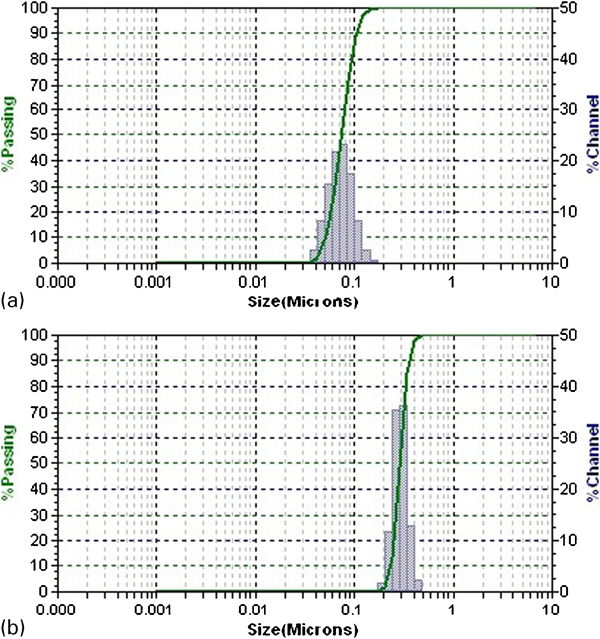
Particle size and its distribution of latex: a Mv = 0·0762 μm, SD = 0·02103; b Mv = 0·2836 μm, SD = 0·0462
Conclusion
Novel fluorinated polyacrylate latex was prepared with different surfactants, that is, BA, MMA and PFAE were used as the copolymerised monomers, and KPS as the initiator, and SDBS or HMPAS as the emulsifier to produce the latexes with different surface properties. The latex prepared with SDBS surfactant has the smaller particle size, contact angle and lower surface tension, whereas the latex prepared with HMPAS surfactant has the larger particle size, higher surface tension and larger contact angle.
Footnotes
Acknowledgements
This work has been supported by the Science and Technology Department of Zhejiang Province under Grant No. 2010C31040. In addition, the financial supports of Zhejiang Provincial Natural Science Foundation of China (No. Y4100152) and Zhejiang University of Technology Natural Science Foundation (No. 20100202) are gratefully acknowledged. We are very grateful to all the members of our discussion group for their beneficial comments.