






Abstract
In this article, a protective Ni–Co alloy coating was prepared on AZ91D magnesium alloy which was pretreated with electroless plating. The surface morphologies, microstructure and chemical composition of the coatings were studied using environmental scanning electron microscope, X-ray diffraction and energy dispersive spectroscopy respectively. The surface morphologies and microstructure analysis showed that the Ni–Co alloy coating possessed cone shaped grain congeries and formed face centred cubic solid solution. The energy dispersive spectroscopy analysis revealed that the content of cobalt element in the alloy coating was ∼31 wt-%. Potentiodynamic polarisation curves and electrochemical impedance spectroscopy were employed to investigate the corrosion resistance of different corrosive systems in neutral 3·5 wt-%NaCl and 0·5 mol L–1 Na2SO4 solutions, which were chosen to simulate the effects of marine and industrial environments respectively. The results showed that the corrosion resistance of the AZ91D magnesium alloy was obviously improved by the Ni–Co alloy coating.
Keywords
Introduction
Owing to its excellent properties, such as high strength/weight ratio, low density, high dimensional stability and damping characteristics, magnesium alloys have been widely applied to the fields of automobile, electronic products, aerospace, etc.1, 2 Unfortunately, the high reactive nature of magnesium makes itself highly susceptible to corrosion under most ambient conditions, which severely hindered its wide applications in many fields.3, 4 Various surface treatment techniques, such as plating, anodising, conversion coating, gas phase deposition, laser surface alloying and polymer coating, have been applied to the corrosion protection of magnesium alloys, and each method has its own advantages and disadvantages.5 – 10 These methods have been reviewed in detail by Gray and Luan.11 The electrodeposited Ni–Co alloy coating, which possesses high strength, good wear resistance, good adhesion, high thermal stability, high heat conductivity and high electrocatalytic activity properties, has attracted much attention.12 – 15 Through review of researches on the Ni–Co alloy coating, it can be found that most of these works are focusing on its preparation, mechanical properties, thermal stability, and so on, while the available information with respect to its corrosion protection properties is limited. Furthermore, so far, no work has reported on the researches of the Ni–Co alloy coating prepared on magnesium alloys.
It is well known that magnesium alloys are ‘difficult to plate metal’,16 so it is vital to choose an appropriate pretreatment method for magnesium alloy before electroplating. Generally speaking, electroless plating and conversion coating are the simplest and frequently used pretreated techniques, and it has been found that electroless plating exhibits a certain degree of corrosion resistance and excellent conductivity, but the thickness of electroless coating is limited and could not provide the effective protection for substrates. The main disadvantage of conversion coating is the toxicity of the treatment solutions, which is harmful to the human body and the environment.11 Thus, we have chosen electroless plating as the pretreatment for the following electrodeposition.
In this study, Ni–Co alloy coating was successfully applied to AZ91D magnesium alloy, which was pretreated with electroless Ni–P coating. The main aim of this study is to understand the microstructure characteristics and corrosion protection properties of Ni–Co alloy coating provided for AZ91D magnesium alloy in the simulated marine (chloride) and industrial (sulphate) environments and provide some references for the expansion of its applications.
Experimental
Materials
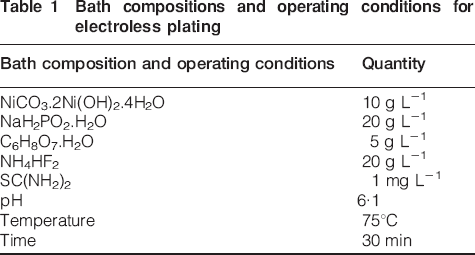
Die casted AZ91D magnesium alloys, whose main chemical composition is Mg–8·77Al–0·74Zn–0·18Mn (wt-%), were used for the present investigation. The AZ91D magnesium alloys with the size of 20×20×5 mm were cut and then mechanically polished by emery papers of successively finer grit down to 2000 grit before the pretreatment process. The composition and operating conditions of the pretreatment process of electroless Ni–P coating are listed in Table 1.
Bath compositions and operating conditions for electroless plating
Electrodeposition process
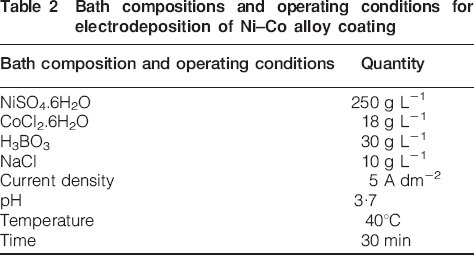
The Ni–Co alloy coating was electrodeposited under direct current conditions. The optimised bath compositions and other parameters obtained from large numbers of orthogonal experiments are given in Table 2.
Bath compositions and operating conditions for electrodeposition of Ni–Co alloy coating
Tests
The surface morphologies and compositions of the coatings were studied using a Quanta 200 environmental scanning electron microscope (FEI Co., Ltd, The Netherlands) coupled with an INCA energy dispersive analyser system (Oxford Co., Ltd, UK). The phase structure of the coatings was analysed by a D8 DISCOVER X-ray diffractometer (Bruker AXS Co., Ltd, Germany) operated at 40 kV and 40 mA with Cu Kα radiation.
Electrochemical corrosion tests were carried out using a classical three-electrode cell with platinum as counter electrode, saturated calomel electrode (SCE) [+0·242 V(SHE)] as reference electrode and the samples with an exposed area of 1 cm2 as working electrode. The neutral 3·5 wt-%NaCl solutions and 0·5 mol L–1 Na2SO4 solutions (open to air at 20±2°C) were used as corrosive media. The PAR system, which included an M273A potentiostat, an M5210 lock in amplifier and the PowerSuite software, was used for measuring the potentiodynamic polarisation curves with a constant voltage scan rate of 1 mV s–1 and electrochemical impedance spectroscopy (EIS). The employed amplitude of the sinusoidal signal for EIS test was 5 mV, and the frequency range studied was from 105 to 10–2 Hz. The acquired data were curve fitted and analysed using ZsimpWin 3·20 software. All the corrosion tests were normally repeated three times under the same conditions, checking that they presented reasonable reproducibility.
Results and discussion
Morphology and composition analysis
The surface morphologies of the electroless Ni–P coating and Ni–Co alloy coating are displayed in Fig. 1. Figure 1a shows that the surface of the magnesium alloy is fully covered by the Ni–P coating, which is conducive to the following electrodeposition process. Many cauliflower-like particles are observed in the high magnification SEM images of the Ni–P coating, as shown in Fig. 1b. The typical EDS plot of the Ni–P coating shown in Fig. 2a reveals that the content of phosphorus element in the Ni–P coating is ∼5·6 wt-%. Figure 1c and d indicates that the Ni–Co alloy coating possesses uniform surface morphologies, and grain congeries are marked with a cone shaped structure. The typical EDS plot of the Ni–Co alloy coating is shown in Fig. 2b, from which the existence of a cobalt element in the alloy coating is observed. The EDS examination shows that the content of cobalt element in the alloy coating is ∼31 wt-%. From the cross-section morphologies, as shown in Fig. 3, it can be identified that the total thickness of the coatings is ∼30 μm. No obvious breaks or cracks are observed along the interfaces between the coatings and the magnesium alloy substrate. In addition, because there is no boundary between the Ni–P and Ni–Co alloy coatings, the thicknesses of different coatings cannot be differentiated from the cross-section morphologies, whereas EDS line scanning reveals that the thicknesses of the Ni–P and Ni–Co alloy coatings are approximately 11 and 19 μm respectively.
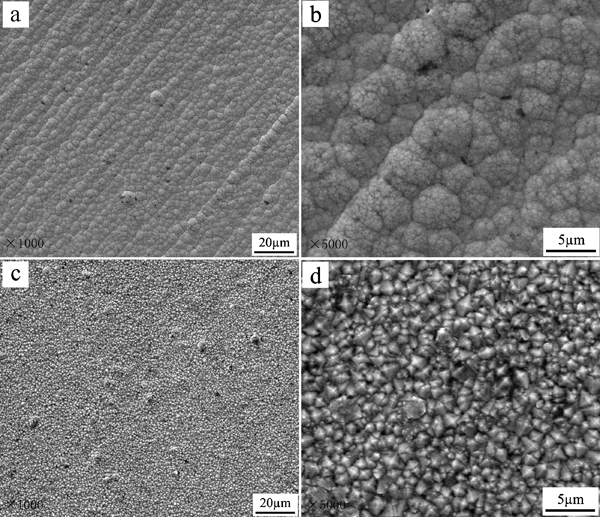
Surface morphologies of a, b electroless Ni–P coating and c, d Ni–Co alloy coating prepared on AZ91D magnesium alloy
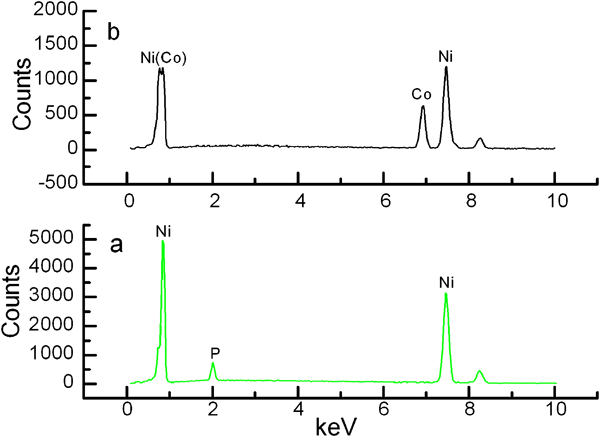
Typical EDS plots of a Ni–P coating and b Ni–Co alloy coating prepared on AZ91D magnesium alloy
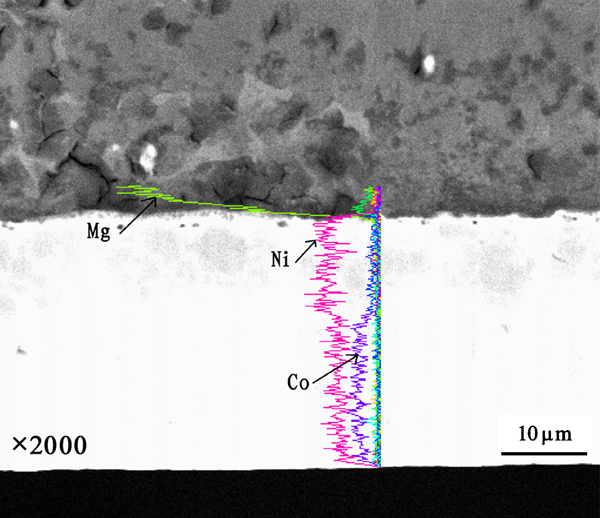
Cross-section morphologies of coatings prepared on AZ91D magnesium alloy
Microstructure analysis
The X-ray diffraction pattern of the Ni–Co alloy coating is shown in Fig. 4. It can be seen from Fig. 4 that the Ni–Co alloy coating exhibits a single phase of Ni matrix with face centred cubic crystal structure (PDF number 04-0850), and the peaks corresponding to the Co phase are not found in the spectra, which could be ascribed to the fact that the crystal lattice in the Ni matrix perhaps have been replaced by Co partly and formed solid solution.14 It is apparent that the Ni–Co alloy coating exhibits intense (1 1 1) preferred orientation and presents three acutely peaks centred 2θ at 44, 51 and 76°, indicating the crystal nature of the alloy coating.
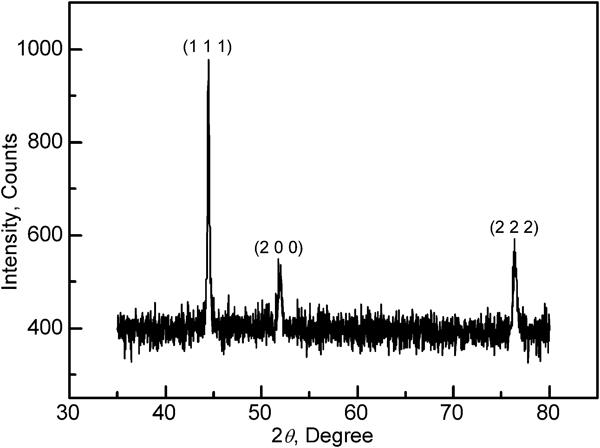
X-ray diffraction pattern of Ni–Co alloy coating prepared on AZ91D magnesium alloy
Corrosion analysis
The anticorrosive properties of the bare magnesium alloy, pretreated magnesium alloy with electroless plating and Ni–Co alloy coating coated magnesium alloy in the simulated marine (neutral 3·5 wt-%NaCl solutions) environment and the industrial (0·5 mol L–1 Na2SO4 solutions) environment are studied and compared using potentiodynamic polarisation technique (Fig. 5) and EIS method (Figs. 6 and 7).
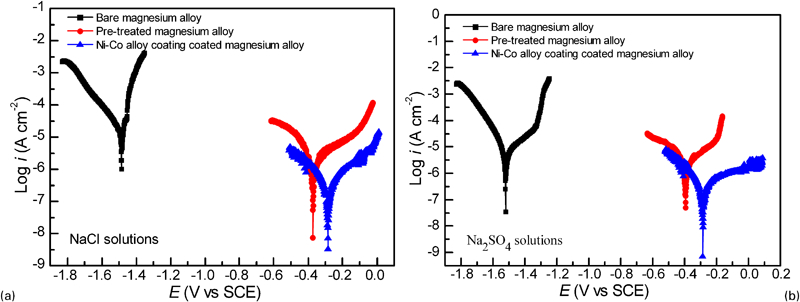
Typical potentiodynamic polarisation curves of bare magnesium alloy, pretreated magnesium alloy and Ni–Co alloy coating coated magnesium alloy in two kinds of corrosive media: a 3·5 wt-%NaCl solutions; b 0·5 mol L–1 Na2SO4 solutions
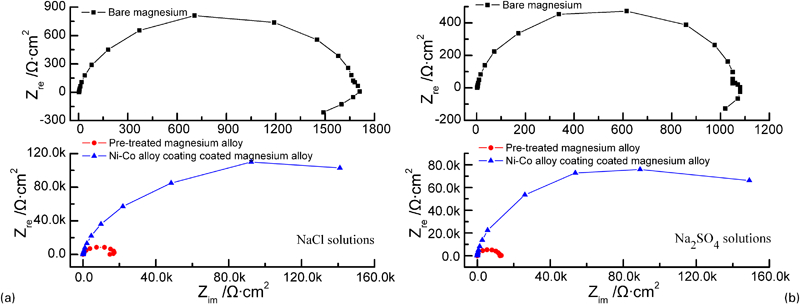
Typical Nyquist plots of bare magnesium alloy, pretreated magnesium alloy and Ni–Co alloy coating coated magnesium alloy in two kinds of corrosive media: a 3·5 wt-%NaCl solutions; b 0·5 mol L–1 Na2SO4 solutions
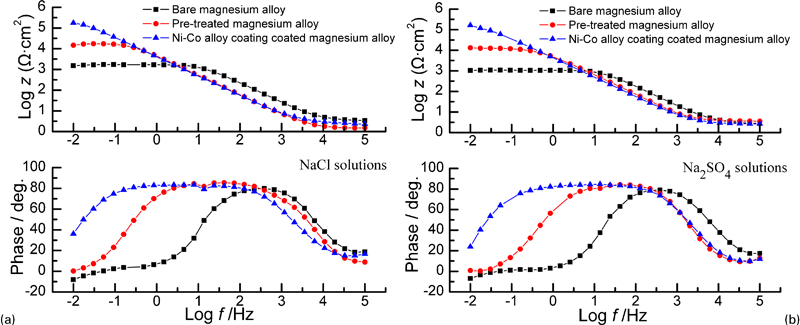
Typical Bode plots of bare magnesium alloy, pretreated magnesium alloy and Ni–Co alloy coating coated magnesium alloy in two kinds of corrosive media: a 3·5 wt-%NaCl solutions; b 0·5 mol L–1 Na2SO4 solutions
Potentiodynamic polarisation
The typical potentiodynamic polarisation curves of the different corrosive systems in neutral 3·5 wt-%NaCl solutions and 0·5 mol L–1 Na2SO4 solutions are presented in Fig. 5a and b respectively. Different parameters, such as corrosion current density icorr and corrosion potential Ecorr, derived from Fig. 5 using the Tafel extrapolation, are summarised in Table 3.
Electrochemical parameters calculated from potentiodynamic polarisation curves

From the polarisation tests in neutral 3·5 wt-%NaCl solutions, it can be found that, with pretreatment of the Ni–P coating on the surface of the bare magnesium alloy, the Ecorr of corrosive system is 1113 mV nobler than that of the bare magnesium alloy, and the icorr of the corrosive system is
 that of the bare magnesium alloy, suggesting a certain extent corrosion protection for magnesium alloy. With further electrodeposition of the Ni–Co alloy coating, the Ecorr of the corrosive system distinctly shifts to a more positive direction up to −284 mV, which is 88 and 1201 mV nobler than that of the pretreated magnesium alloy and bare substrate respectively, and the icorr of the corrosive system is reduced to 2·6×10−7 A cm−2, which is approximately
 and
and
 that of the pretreated magnesium alloy and bare magnesium alloy respectively.
According to the typical potentiodynamic polarisation curves in 0·5 mol L–1 Na2SO4 solutions, it can be educed that the Ni–Co alloy coating coated magnesium alloy exhibits the noblest Ecorr with a value of −285 mV and the lowest icorr with a value of 2·2×10−7 A cm−2, while the bare magnesium alloy shows the lowest Ecorr with a value of −1521 mV and the highest icorr with a value of 6·3×10−6 A cm−2, which suggests that the Ni–Co alloy coating coated magnesium alloy exhibits the best anticorrosive properties. The Ecorr and icorr of the pretreated magnesium alloy with electroless plating are measured to be −394 mV and 2·1×10−6 A cm−2 respectively.
From the analysis mentioned above, it can be concluded that both the Ni–P coating as a pretreatment and the Ni–Co alloy coating could provide corrosion protection for AZ91D magnesium alloy, while nobler Ecorr and much lower icorr for the Ni–Co alloy coating indicate better corrosion protection for the magnesium alloy.
Electrochemical impedance spectroscopy
The typical Nyquist plots of the different corrosive systems in neutral 3·5 wt-%NaCl solutions and 0·5 mol L–1 Na2SO4 solutions are presented in Fig. 6a and b respectively. A low frequency inductive loop, whose shape is characterised with a retractile real part, is observed in the Nyquist plots of the pretreated magnesium alloy in neutral 3·5 wt-%NaCl solutions and bare magnesium in two kinds of corrosive media. The appearance of the low frequency inductive loop may originate from the pitting corrosion on the electrode surface.17 It can be seen from Fig. 6a that the diameter of the capacitance loop of the Ni–Co alloy coating coated magnesium alloy is exceedingly larger than that of the pretreated magnesium alloy, indicating that the Ni–Co alloy coating could provide better and more effective corrosion protection for magnesium alloy compared with that of the pretreated magnesium with electroless plating.
The typical Bode plots of the different corrosive system in neutral 3·5 wt-%NaCl solutions and 0·5 mol L–1 Na2SO4 solutions are presented in Fig. 7a and b. From the Bode plots (impedance modulus |Z| as a function of frequency), it can be detected that the impedance value of the Ni–Co alloy coating coated magnesium alloy in two kinds of corrosive media increases by approximately more than two orders of magnitude and one order of magnitude compared with that of the bare magnesium alloy and pretreated magnesium alloy respectively. This result indicates that the corrosive system of the Ni–Co alloy coating coated magnesium alloy possesses the best anticorrosive properties, and the Ni–Co alloy coating could provide the best corrosion protection for magnesium alloy. The changes of the Bode plots (phase angle as a function of frequency) indicate that there is only one time constant for the Ni–Co alloy coating coated magnesium alloy in two kinds of corrosive media and pretreated magnesium alloy in 0·5 mol L–1 Na2SO4 solutions over the whole frequency range studied, which reflects one relaxation process, i.e. dissolution of working electrode during the corrosion process.
In order to further and quantificationally study the corrosion process of different corrosive systems, a more detailed interpretation of the EIS measurement is performed by fitting the experimental plots using the electrochemical equivalent circuit depicted in Fig. 8. The electrochemical equivalent circuit displayed in Fig. 8a is proposed to account for the EIS data of the pretreated magnesium alloy in neutral 3·5 wt-%NaCl solutions and bare magnesium in two kinds of corrosive media. Figure 8b is used to fit the EIS data of the Ni–Co coating coated magnesium alloy in two kinds of corrosive media and the pretreated magnesium alloy in 0·5 mol L–1 Na2SO4 solutions. The circuit, which is presented in Fig. 8a, consists of parameters, namely, solution resistance Rs, charge transfer resistance Rct, inductance resistance RL, inductance L and a constant phase element (CPE) that replaces the capacitance of the double layer Cdl. The circuit, which is displayed in Fig. 8b, is composed of parameters, namely, solution resistance Rs, charge transfer resistance Rct and a CPE. A CPE replaces the capacitance of the double layer Cdl due to the roughness and inhomogeneity of the electrode surface, as reported elsewhere.18,
19 The impedance of the CPE is given by the following equation18


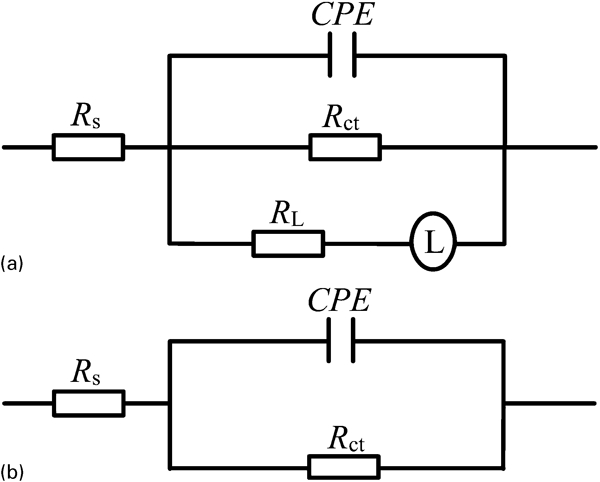
Electrochemical equivalent circuits used for fitting EIS data of a pretreated magnesium alloy in neutral 3·5 wt-%NaCl solutions and bare magnesium in two kinds of corrosive media and b Ni–Co coating coated magnesium alloy in two kinds of corrosive media and pretreated magnesium alloy in 0·5 mol L–1 Na2SO4 solutions
From the corrosion analysis mentioned above, it can be seen that both the pretreatment of electroless plating and the electrodeposition of Ni–Co alloy coating could provide corrosion protection for the AZ91D magnesium alloy in the simulated marine (chloride) and industrial (sulphate) environments, and the effect of the former is limited, which is consistent with the potentiodynamic polarisation analysis. The electrodeposition of the Ni–Co alloy coating on the pretreated magnesium alloy could remarkably enhance the anticorrosive properties of the AZ91D magnesium alloy.
Conclusion
In summary, the following conclusions can be drawn from the present investigation:
The protective Ni–Co alloy coating was successfully applied to the corrosion protection of the AZ91D magnesium alloy.
The environmental SEM and EDS analysis showed that the Ni–Co alloy coating possessed cone shaped grain congeries, and the content of cobalt element in the alloy coating was ∼31 wt-%.
The X-ray diffraction analysis indicated that the Ni–Co alloy coating presented a single phase of Ni matrix with face centred cubic crystal structure and had formed the solid solution.
The results of electrochemical corrosion tests showed that the Ni–Co alloy coating could provide good corrosion protection for the AZ91D magnesium alloy in the simulated marine (chloride) and industrial (sulphate) environments.