







Abstract
Ag based low emissivity film was deposited on glass by vacuum magnetron sputtering and then post-treated in the glass tempering tempering furnace at 650–700°C for 4, 5 and 6 min respectively. The structural and electrical properties have been investigated as a function of post-treatment time. The results show that with increasing heated time, the structure of the film gradually crystallises and Ag2O (111) appears. The resistivity and sheet resistance have a sharp increase from as deposited to heat treated films and then decrease with increasing time. The calculated emissivity is 0·16 for the as deposited film, increases to 0·39 heated for 4 min and decreases to 0·14 heated for 6 min.
Introduction
Silver based low emissivity glass (low-E glass) has promising properties with high transparency in the visible region and high reflectance in the far infrared region. The low-E films are usually prepared by a magnetron sputtering method with dielectric metal–dielectric type of multilayer structures. Ag layer was often sandwiched within dielectric layers to show high spectral reflection and low thermal emissivity, and the dielectric layers are often metal oxide to protect Ag layer from oxidisation, such as SnO2,1,2 ZnO,3 ZAO(Al doped ZnO),4,5 TiO2,6 – 8 diamond-like carbon,9 and so on. It attracts much attention to enhance the optical properties1,10 and the moisture durability4,5 by controlling cathode voltage,3 the addition5 and gas pressure, or changing the thickness of every layer. Therefore, the films with the same materials but deposited under different conditions would possess different electrical and optical properties. Sahu et al.11 found that Ag based films obtained a relatively lowest electrical resistivity when post-heated at 400°C for 2 h in vacuum atmosphere. With increasing demands of safety glass in buildings, heat treatment is required to achieve the tempered glass with high strength.12 The preparation processing of tempered glass is that when heated near to the softening point in the glass tempering furnace, the flat glass receives a rapid and even cooling treatment on its surface, with the compression stress in outer part and tension stress inner part, to increase the glass strength. However, less knowledge is available about how to obtain a safety glass with Ag based low-E films, as well as the effect of heat treatment time on the properties of the Ag based low-E glass.
In this study, Ag based low-E films with a layer construction of top-Si3N4/SnO2/NiCrOx/Ag/ZnO/NiCrOx/TiO2/under-SiOxNy were deposited on unheated soda–lime–silicate glass substrates of 6 mm in thickness by vacuum magnetron sputtering technique. The effects of heat treatment time on the structural and electrical properties of the low-E films were investigated.
Experimental procedure
Sample preparation
Ag based low-E film with a layer construction of top-Si3N4/SnO2/NiCrOx/Ag/ZnO/NiCrOx/TiO2/under-SiOxNy was deposited by vacuum magnetron sputtering technique on unheated soda–lime–silicate glass substrates (2540×3300×6 mm). During the preparation, Si3N4 layer was deposited in N2 gas using a Si target, and Ag layer was deposited in Ar gas with a pure Ag target. Sn, NiCr, Zn and TiO were used as the cathode materials for the oxide films in O2 gas respectively. The base pressure and gas pressure were 5×10⁻⁴ and 1·5×105 Pa respectively. Argon with purity of 99·996% was used as working gas, while nitrogen and oxygen with purity of 99·99% were used as reactive gas. The layers were deposited sequentially according to the layer construction. In the multilayers, Si3N4/SnO2/NiCrOx layers are used to protect Ag layer from oxidation by O2 during the deposition and heat treatment processes. The thickness of each layer was deposited by adjusting the substrate conveyance speed. At last, the Ag based low-E films were prepared with the total thickness of 300 nm. Then low-E films as deposited were treated according to the preparation processing of the tempered glass. The Ag based low-E glass was heat treated in the glass tempering furnace at 650–700°C for 4, 5 and 6 min respectively.
Characterisations
The structure of as deposited and post-heat treated low-E films were obtained by X-ray diffraction (D/MAX-2500HB+/PC) using the Cu Kα radiation (λ = 0·15406 nm).
The structure of silver oxide in the low-E films as deposited and heated for 6 min was investigated by X-ray photoelectron spectroscopy (XPS, PHI5300 system). The excitation source was the Kα radiation of an Al anode (hυ = 1486·6 eV). The X-ray gun was operated at 13 kV and 250 W. The C 1s binding energy of adventitious carbon was used as energy reference.
The electrical properties were performed with Physical Property Measurement System (PPMS-9), which applied van der Pauw technique to measure the resistivity and four-wire method for the Hall coefficient of the low-E films.
For van der Pauw's method, an advantage is no restriction on sample shape, which will influence the measurement of the resistivity. Figure 1 shows the schematic diagram of resistivity measurement and can obtain the resistance RAB, CD. RBC, DA can be measured in the same way. The electrical resistivity is calculated by equation (1)


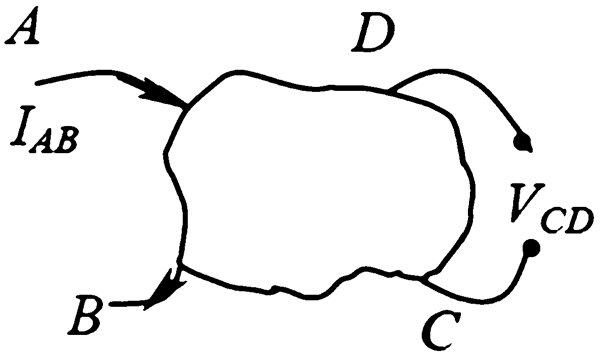
Schematic diagram of resistivity measurement using van der Pauw's method
Results and discussion
Structure analysis
The X-ray diffraction patterns of the as deposited and post-treated low-E films at 650–700°C for different times were shown in Fig. 2. The patterns show that no obvious peaks appear in the as deposited film and the films are amorphous. With the treating time prolonging, the film crystallises gradually. When the post-treating time is 4 min, there are only two main peaks, namely, ZnO (002) at 34·479° and Ag (111) at 64·518° respectively. When the post-heating time reaches to 6 min, there are six main orientations of crystal growth, together with ZnO peaks. Five peaks are assigned to Ag and obtained a preferred growth of the Ag (111) planes parallel to the float glass substrate. One is for Ag2O (111). Perhaps, with the time prolonging in an atmospheric oven, oxygen gradually diffuses into the Ag layer and make it oxidised. On the other hand, the small Ag atoms diffuse into ZnO layer or the oxygen atoms of ZnO layer diffuse into Ag layer, leading to the oxidation.13
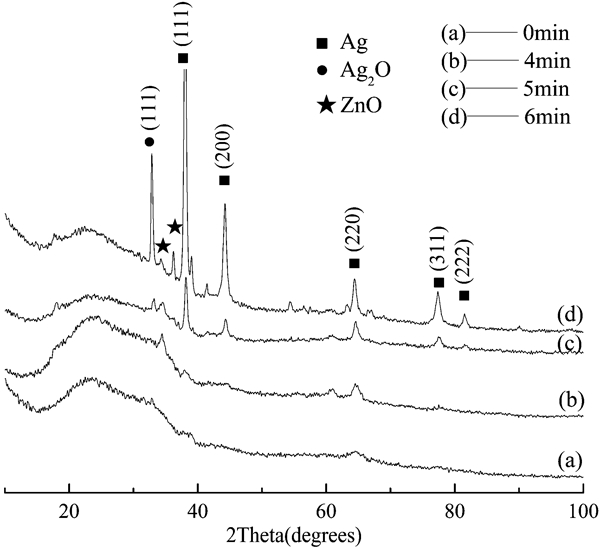
X-ray diffraction patterns of Ag based low-E films as deposited and heat treated for 4, 5 and 6 min at 650–700°C
Figure 3 shows the XPS spectra of Ag 3d core level of the Ag based low-E films as deposited and heated for 6 min at 650–700°C. It can be seen that the Ag 3d core levels of the as deposited films exhibited constant binding energy at 374·0 eV for Ag 3d3/2 and 368·0 eV for Ag 3d5/2. With increasing heating time, the binding energy moved to lower energy. Tjeng et al.14 reported values of the Ag 3d5/2 binding energy of Ag and Ag2O were 368·0 and 367·6 eV respectively. Therefore, the XPS results indicates that the as deposited low-E films only contained Ag without any oxides, and Ag and Ag2O coexisted in the low-E films heated for 6 min, which is in good agreement with the results of X-ray diffraction.
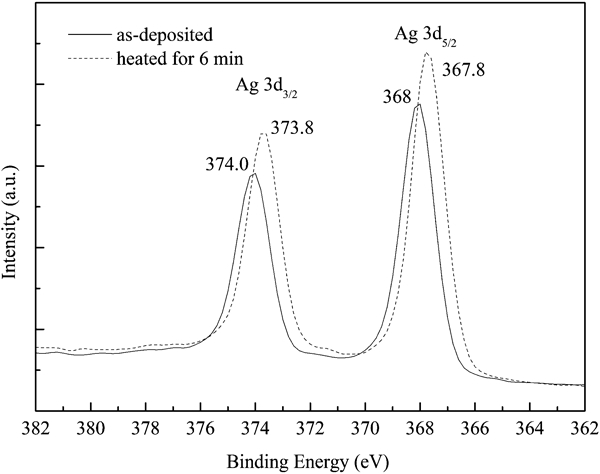
XPS spectra of Ag 3d core level of Ag based low-E films as deposited and heated for 6 min at 650–700°C
Electrical properties
The Hall coefficients at T = 300 K in perpendicular fields obtained from the pulsed magnet are shown in Fig. 4, a plot of resistivity ρ versus the applied magnetic field should yield a straight line, whose slope is Hall coefficient Rh (in unit of Ω cm Oe−1 = 108 cm3 C−1). The carrier concentration n, Hall mobility μ and sheet resistance Rs can be calculated from Rh and ρ by the following equations


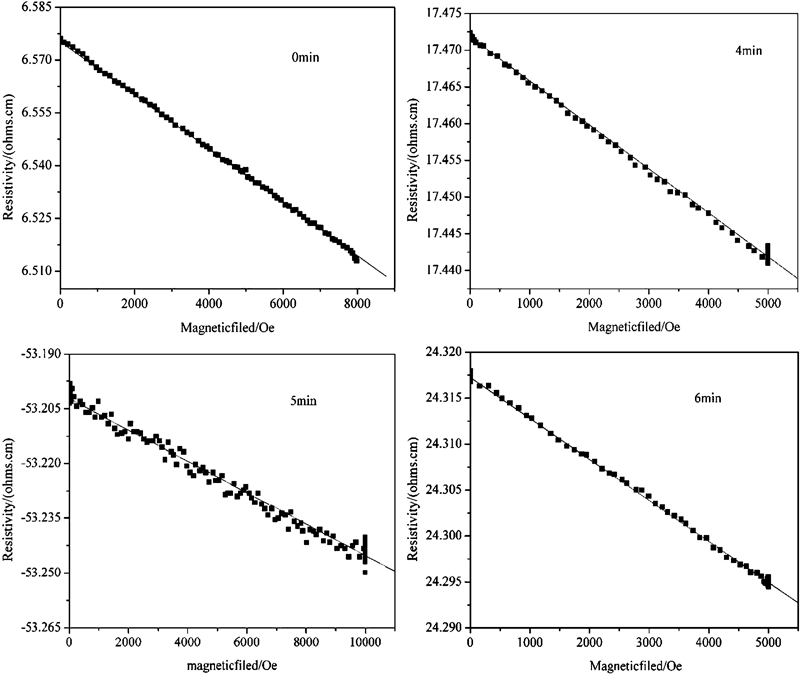
Hall coefficients of low-E films as deposited and heat treated for 4, 5 and 6 min at 650–700°C
Table 1 shows the electrical parameters of the as deposited films and heat treated films for different times. The resistivity ρ of the as deposited films is 38·97×10−4 Ω cm, increases to 114·48×10−4 Ω cm after heat heated for 4 min and then decreases to 35·67×10−4 Ω cm when the heating time is 6 min. The sheet resistance Rs increases from 12·99 Ω sq−1 for the as deposited film to 38·16 Ω sq−1 for films heated for 4 min, then decreases to 11·89 Ω sq−1 for films heated for 6 min. The carrier concentration n increases from 0·82×1020 cm−3 for the as deposited film to 1·40×1020 cm−3 when the heating time is 6 min. Hall mobility μ decreases to 5·23 cm2 V−1 s−1 when the films are heated for 4 min, and then increases about 139·0% to 12·50 cm2 V−1 s−1 with the heating time prolonging to 6 min, but all of the values are lower than that of the as deposited films (19·51 cm2 V−1 s−1).
Electrical parameters of Ag based low-E films heat treated for different times

When heat treated in an air atmosphere, the high partial pressure of oxygen in the air leaded the diffusion of oxygen atoms into the films, or the oxygen atoms diffused through the ZnO layer, and partly oxidised the Ag layer. The electrical properties of low-E films were affected by a combination of the coexistence of Ag and Ag2O. Some researchers15 found that mixed phase Ag2−xO samples had several orders of magnitude higher resistivity than most TCOs at room temperature. Therefore, after heat treatment for 4 min in this study, the resistivity and sheet resistance were sharply higher than that of as deposited films due to the partial oxidisation of the functional layer (Ag layer), although the content of the oxidisation was too little to be present in the X-ray diffraction results. The resistivity of a metal Ag is caused by the electron scattering on structure defects. The as deposited low-E films were amorphous with many defects. When the heating time prolonged to 6 min, the films gradually crystallised, and the increasing crystallinity and structural ordering could reduce grain boundary scattering, and then increased the conductivity of the low-E films. As a result, the resistivity and sheet resistance of the low-E films heated for 6 min decreased to the minimum.
The infrared reflectivity RIR and the measured emissivity ϵ of the coated glass can be calculated with the sheet resistance Rs and may be written as follows


Conclusion
Ag based low-E films were deposited by vacuum magnetron sputtering technique on glass. The structure and crystallinity have significant effects on the properties of Ag based films. The as deposited films are amorphous. With the heating time prolonging to 6 min, the structure gradually crystallises and Ag2O (111) phase appears in the films. The resistivity ρ of the as deposited films is 38·97×10−4 Ω cm, increases to 114·48×10−4 Ω cm after heat heated for 4 min and then decreases to 35·67×10−4 Ω cm when the heating time is 6 min. The calculated emissivity decreases to 0·14 when the heating time is prolonged to 6 min.
Footnotes
Acknowledgements
The work was financially supported by the National Natural Science Foundation of China (no. 50972126). Also we want to thank the State Key Laboratory of Metastable Materials Science and Technology in China for the measurements.