







Abstract
The Pr lean Pr2Fe14B/Fe3B nanocomposite alloys were prepared by melt spinning method and subsequent thermal annealing. The effect of annealing temperature on the magnetic properties and the microstructure of these magnets has been investigated. The results show that the optimal magnetic property of Pr2Fe14B/Fe3B nanocomposite alloy with a high coercivity Hc = 211·4 kA m−1, a large remanence Mr = 1·18 T and a large energy product (BH)max = 73·9 kJ m−3 has been obtained by controlling the annealing temperature in the amorphous alloy. The enhanced (BH)max is mainly attributed to the increase in the intergrain exchange coupling effect due to the refined nanocrystal microstructure. This demonstrates that the control of the nanocrystal microstructure in the amorphous alloys plays a significant role for the further improvement of the magnetic properties of these magnets.
Introduction
Nanocomposite magnets consisting of a fine mixture of soft and hard magnetic phases have attracted considerable attention for a variety of applications.1 – 3 According to the micromagnetic calculations, it was predicted that the highest maximum energy product (BH)max can reach 1 MJ m−3 due to the strong intergrain exchange coupling effect.1 Although many nanocomposite alloys, including Nd2Fe14B/α-Fe,4,5 Nd2Fe14B/Fe3B6 and Sm2Fe17Nx/Fe,7 have been extensively studied, the obtained (BH)max in nanocomposites is in the range of 80–200 kJ m−3 only, therefore far away from the theoretical value.
Recently, Pr lean Fe3B/Pr2Fe14B alloys with high boron concentrations (16–20 at-%) have been attracting considerable attention because of the relatively low rare earth contents and high chemical stability. Moreover, the magnetocrystalline anisotropy field HA = ∼6·96 kA m−1 of Pr2Fe14B crystal is much larger than that of Nd2Fe14B (HA = 5·36 kA m−1),3 and also the Pr2Fe14B phase exhibits no spin reorientation phenomenon at a temperature below 150 K, which occurs in Nd2Fe14B phase. Thus, PrFeB based magnets are expected to possess high coercivity and better squareness in demagnetisation curve of the ribbons at room temperature as well as at a low temperature. However, up to today, melt spun PrFeB based magnets are generally characterised by low coercivity Hc<560 kA m−1, and the obtained (BH)max is far below the theoretical prediction also. The reason may be attributed to the difficulty in obtaining the optimum microstructures used in the theoretical models, where a homogeneously distributed nanocrystal with a small grain size is assumed. Therefore, the control of the nanocrystal microstructure in the amorphous alloys is of particular significance for the further improvement of the magnetic properties of those magnets. In this paper, the effect of annealing treatment on the microstructure and magnetic properties of the Pr lean Pr2Fe14B/Fe3B nanocomposite alloys is determined. The aim is to obtain the fine and uniform nanocrystal microstructure in melt spun Pr2Fe14B/Fe3B alloys with good magnetic properties by controlling the annealing temperature.
Experimental
The samples were fabricated using the following technique. The ingredients of the Pr4·5Fe77B18·5 were initially alloyed by threefold arc melting in order to obtain a homogeneous composition. Melts of Pr and Fe with purity of 99·9% and FeB (B, 19·3 at-%) were used. Alloy ribbons were obtained by melt spinning in an Ar atmosphere at a roll speed of 28 m s−1. The as quenched ribbons were isothermally treated in a tube furnace at temperatures ranging from 585 to 800°C for 10 min under vacuum better than 4·5×10−4 Pa.
The crystalline texture and microstructure studies were characterised by X-ray diffraction (XRD) using Cu Kα radiation and TEM. The crystallisation behaviour of the as spun ribbons was determined using an SDT-Q600 differential thermal analyser (DTA) at a heating rate of 10°C min–1. Magnetic properties of the ribbons were measured using a vibrating sample magnetometer. The width of the ribbons was ∼2 mm, length ∼6 mm and thickness ∼30 μm. Magnetic measurements were made with the magnetic field direction in plane of the ribbons, and thus, the demagnetisation factor of the sample was ∼0. To analyse the magnetisation reversal behaviour of the samples after saturation, recoil loops were measured also.8
Results and discussion
Figure 1 shows the XRD patterns of the as quenched and annealed Pr4·5Fe77B18·5 samples at different annealing temperatures. A detailed analysis of the XRD pattern of Fig. 1 indicated that as quenched PrFeB alloys possess an entire amorphous microstructure. After a proper thermal annealing at 626°C, the crystallised alloys mainly consist of two phases [a hard magnetic phase of Pr2Fe14B (space group P42/mnm) and a soft magnetic phase of Fe3B (P42/n)] and that no other phase is identified from XRD patterns. This result is further confirmed from DTA experiments (Fig. 2), and only two exothermal peaks appear in the DTA curve. The first exothermal peak at 578°C is confirmed to be Fe3B phase, whereas the second exothermal peak at 592°C corresponds to Pr2Fe14B phase. With increasing annealing temperature from 625 up to 800°C, as shown in Fig. 1, the intensities of the pattern peak increase drastically, indicating the growth of the grain size in the annealed alloys. The mean grain size is estimated to increase from ∼9 up to ∼15 nm by using the Williamson–Hall method according to the broadening of their diffraction peaks.9 In addition, TEM images in Fig. 3 demonstrate a large size nanocrystal formation in the Pr4·5Fe77B18·5 alloys annealed from 625 up to 800°C. The indexing of corresponding selected area electron diffraction patterns indicates that the annealed alloy is composed of Pr2Fe14B phase and Fe3B phases. This result is good consistent with the results of XRD (Fig. 1).
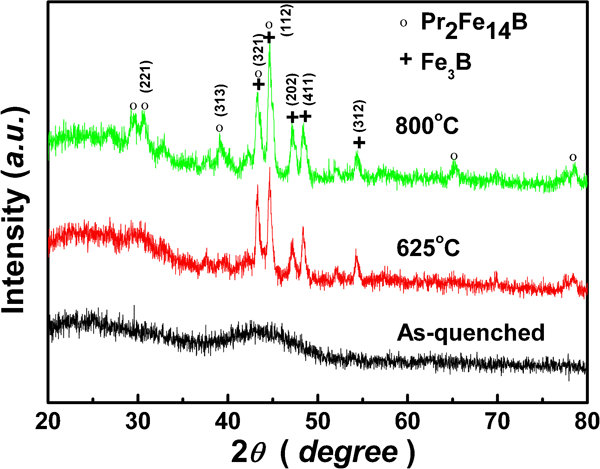
X-ray diffraction patterns for as quenched and annealed Pr4·5Fe77B18·5 samples at different heat treatment temperatures
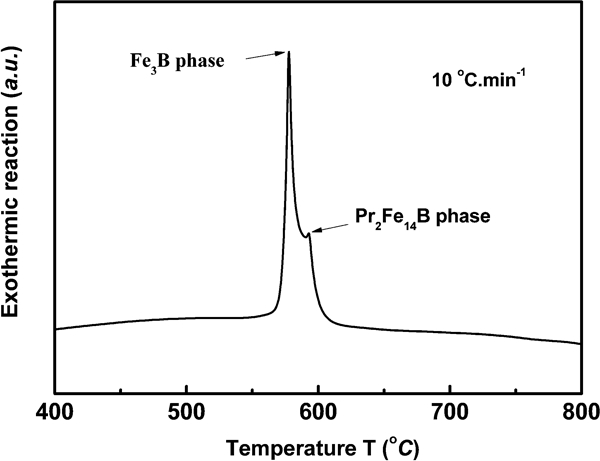
Differential thermal analysis curves of amorphous Pr4·5Fe77B18·5 sample at heating rate of 10°C min–1
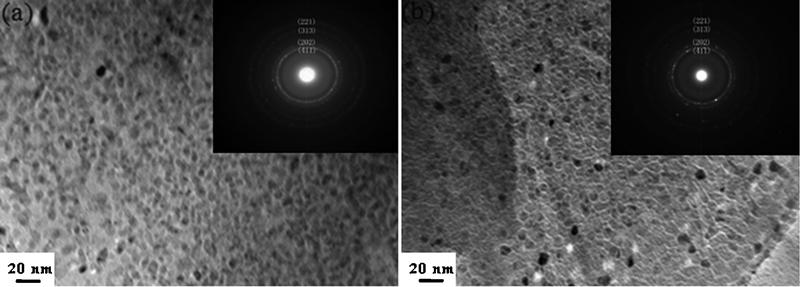
Images (TEM) and corresponding selected area electron diffraction patterns of Pr2Fe14B/Fe3B samples after annealing at a 625°C and b 800°C for 10 min respectively
Figure 4 plots the magnetic properties of the Pr2Fe14B/Fe3B nanocomposite alloys dependence of the annealing temperature. It can be seen that all of the magnetic parameters increase first as the annealing temperature increases, and then decrease. The optimal magnetic properties, Hc = 211·4 kA m−1, Mr = 1·18 T and (BH)max = 73·9 kJ m−3, have been obtained for the Pr4·5Fe77B18·5 alloys annealed at 625°C for 10 min. A more detailed analysis about the mechanism of the enhancement magnetic property in annealed Pr2Fe14B/Fe3B nanocomposite alloys is discussed as follows.
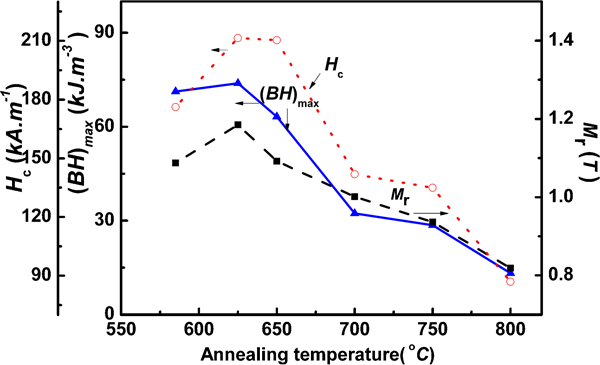
Intrinsic coercivity Hc, maximum energy product (BH)max and remanence Mr as function of annealing temperature for Pr2Fe14B/Fe3B samples
Figure 5 gives the recoil loops of demagnetisation curves for the Pr2Fe14B/Fe3B nanocomposite alloys annealed at a 625°C, b 700°C and c 800°C for 10 min respectively. The magnetisation M(H) and the dc demagnetisation remanence Md(H) curves as a function of the applied reversal field are plotted in the insets of Fig. 5 also. Here, Hc is the intrinsic coercivity defined by the condition for the magnetisation M(Hc) = 0, and Hr is the dc remanence coercivity defined by the condition Md(Hr) = 0.10 It can be seen that all recoil loops for three samples are relatively open, which is usually considered to be the criterion for the presence of the exchange spring mechanism.11 – 13 This result may be explained by the rotation of the magnetisation of exchange coupled soft phase for fields not large enough to reverse the magnetisation of the hard magnetic phase.11 – 13 The exchange coupled intensity can be seen very clearly from the plots of M(H) and Md(H) as a function of the applied reversal field in the insets of Fig. 5. As the annealing temperature increases from 625 up to 800°C, the ratio of Hr/Hc rises significantly from 1·75 up to 3·87. The smaller value Hr/Hc = 1·75, close to theoretical value predicted by Wohlfarth (Hr/Hc = 1·09),14 suggests that the Pr2Fe14B/Fe3B nanocomposite sample annealed at 625°C has a stronger exchange spring behaviour.
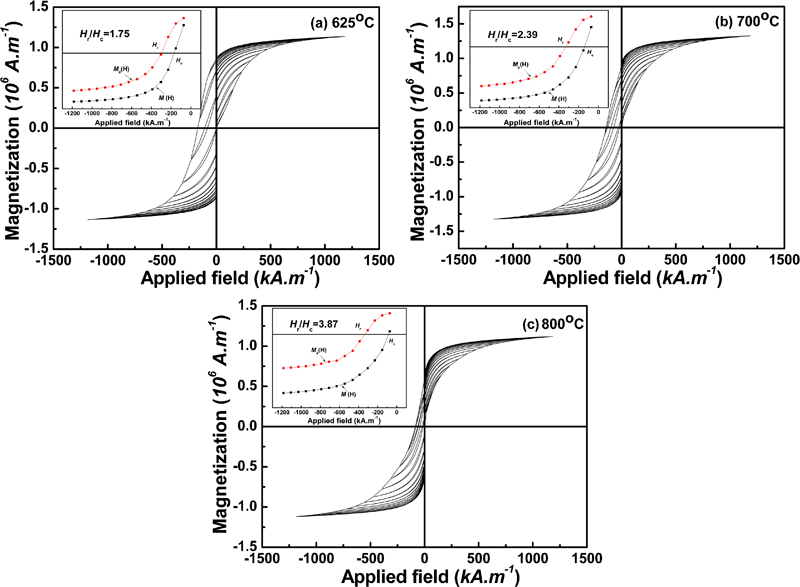
Recoil loops of demagnetisation curves for Pr2Fe14B/Fe3B samples after annealing at a 625°C, b 700°C and c 800°C for 10 min as function of applied reversal field: magnetisation M(H) and dc demagnetisation remanence Md(H) curves as function of applied reversal field are given in inset also
Additionally, an open recoil loop can be understood as a hysteresis loop, and the enclosed area of the recoil loop is equivalent to the energy loss after one cycle. Figure 6 shows the energy losses of the annealed Pr4·5Fe77B18·5 samples as a function of the applied reversal field Hreversal. With increasing annealing temperature, the maximum values of the normalised parameter are calculated to be 1·49×10−3, 2·97×10−3 and 17·23×10−3 for the samples annealed at 625, 700 and 800°C respectively. By the comparison of these three maximum values in Fig. 5, we find that the Pr4·5Fe77B18·5 alloy sample at the annealing temperature of 625°C should have the lowest energy loss as a reversal field is applied. It is very favourable for the future fabrication of low energy loss nanocomposite magnets used in electrical machines and generators.
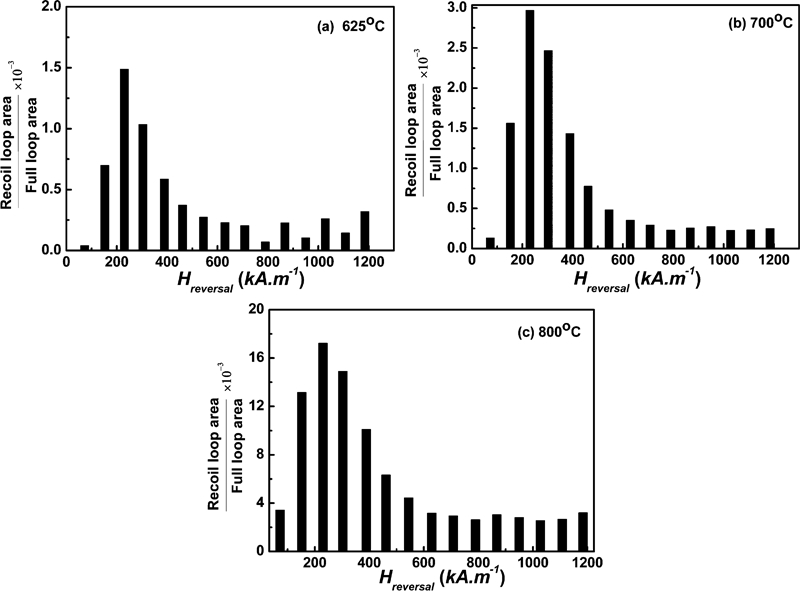
Integrated recoil loop area divided by full loop area Pr2Fe14B/Fe3B samples after annealing at a 625°C, b 700°C and c 800°C for 10 min as function of applied reversal field
As known, the refine and uniform microstructure in the nanocomposite magnets by controlling annealing temperature could be helpful for improving the magnetic exchange coupling between the soft and hard magnetic grains. In order to qualitatively determine the intensity of exchange coupling effect in Pr2Fe14B/Fe3B magnets, the maximum value of δM(H) was determined from the Henkel plots. The expression of the Henkel plot is as follows:15 δM(H) = [Md(H)−Mr+2Mr(H)]/Mr, where Mr(H) is reduced magnetisation remanence and Md(H) is reduced demagnetisation remanence. According to the Wohlfarth's analysis,14 positive values of δM(H) are due to the intergrain exchange coupling effect, while the negative values of δM(H) represent the dipolar interaction.16,17 As shown in Fig. 7, a large value of δM(H) = 0·30 is determined for the sample annealed at 625°C, whereas small δM(H) values are obtained for δM(H) = 0·15 and 0·12 for the ones at 700 and 800°C respectively. The larger δM(H) indicates directly a stronger exchange coupling effect between the soft and hard magnetic grains. As a result, a high maximum energy product (BH)max = 73·9 kJ m−3 is obtained in the Pr2Fe14B/Fe3B nanocomposite samples at 625°C.
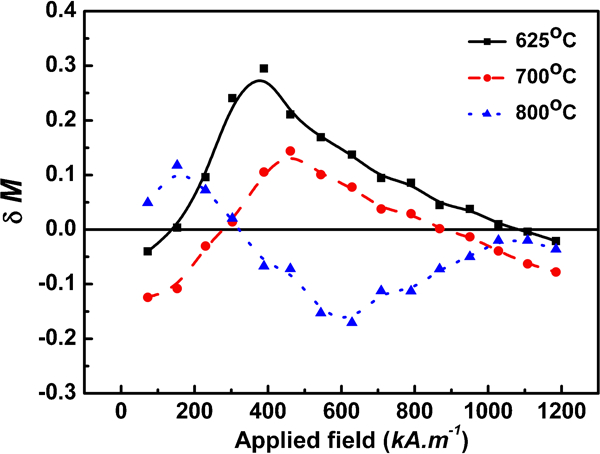
Henkel plot for Pr2Fe14B/Fe3B samples annealed at 625, 700 and 800°C for 10 min respectively
The present study has shown that the typical Pr2Fe14B/Fe3B magnet with optimum microstructures can be formed by a two-step method in which an amorphous precursor alloy is crystallised by treatment, although the direct method in which the two nanocrystal phases crystallise during the rapid solidification is the industrially desirable process because of its simplicity. It should be emphasised that the control of the nanocrystal microstructure in the amorphous alloys plays a significant role for the further improvement of the magnetic properties of Pr lean Fe3B/Pr2Fe14B nanocomposite magnet, providing us with the possibility of industrially applying the process to this type of magnet.
Conclusion
Pr lean Pr4·5Fe77B18·5 nanocomposite alloys were prepared by melt spinning method and subsequent thermal process. The effect of annealing temperature on the magnetic properties and the microstructure of the Pr2Fe14B/Fe3B alloys was investigated. The results show that at the annealing temperature of 625°C, the magnetic properties can reach maximum values: Hc = 211·4 kA m−1, Mr = 1·18 T and (BH)max = 73·9 kJ m−3. The larger Henkel plot δM(H) = 0·30 shows directly a stronger exchange coupling between the soft and hard magnetic grains.
Footnotes
Acknowledgements
This work was supported by the State Key Project of International Collaboration of Zhejiang Province (project no. 2006C14014), Major Science and Technology Project of Zhejiang Province (project no. 2009C21010), the Provincial Natural Science Foundation (grant nos. Z4090462 and Y6090542), the Public Projects for State inspection and quarantine administration (project no. 2012424107) and the Foundation for University Young Teachers from the Ministry of Education of Zhejiang province.