







Abstract
Infrared radiative properties of thermal barrier coatings have been investigated for developments of solar absorbing surface coatings. Various types of multilayer broadband optical filters were designed incorporating 7 wt-% yttria stabilised zirconia (7YSZ) and aluminium oxide (Al2O3). Electron beam physical vapour deposition method was employed to deposit 7YSZ thin films on quartz substrates to study their optical properties. The refractive index and thickness of 7YSZ films were estimated using spectroscopic ellipsometry technique, giving the index as 1·95 at 633 nm. Multilayer thermal barrier coating structures were fabricated by depositing alternate layers of 7YSZ and Al2O3 on quartz using electron beam physical vapour deposition. The spectral characteristics of multilayer 7YSZ–Al2O3 coatings were evaluated using a spectrometer in the visible and near infrared range. Preliminary results obtained from multilayer 7YSZ–Al2O3 coatings had exhibited 75% transmission over a wide band of 0·4–1·0 μm.
Introduction
In last three decades, extensive research has been undertaken to reduce the thermal conductivity of thermal barrier coating (TBC) materials to improve the efficiency, durability and overall performance of gas turbine engines.1 – 3 The combination of internal air cooling and lower thermal conductivity of the TBCs can provide a temperature drop of up to 150°C across the 200 μm thick ceramic coatings, thereby extending the lifetime of the underlying components.2 – 4 Currently, 7 wt-% (about 4–4·5 mol.-%) yttria stabilised zirconia (7YSZ) in its metastable tetragonal phase is the material of choice for industrial applications. The 7YSZ has one of the lowest thermal conductivities at elevated temperature due to its high concentration of point defects arising primarily from oxygen vacancies and substitutional solute atoms that promote scattering of heat conducting phonons. 5 5,6 It has a relatively high thermal expansion coefficient (∼11×10−6°C−1), allowing it to alleviate stress, and has a hardness of ∼14 GPa that gives it good resistance to erosion and foreign object damage.2 – 4,7,8 Electron beam physical vapour deposition (EBPVD) method is preferred in producing TBCs promoting columnar microstructures that offer high strain compliance, high phase stability and superior thermal cyclic life for ultrahigh temperature operation up to 1200°C.4 – 6,9 However, the EBPVD TBC system gives rise to a relatively high thermal conductivity (κ = 1·5–1·9 W m−1 K−1) due to its unique columnar microstructures compared with plasma sprayed TBCs (κ = 0·8–1·1 W m−1 K−1). 6 7 6,7,10 While there is continual search for new TBC materials having lower thermal conductivity, currently, two promising groups of candidates have been extensively studied in achieving low κ materials. 7 11 7,11,12 One of the low κ material groups is produced by codoping of YSZ with one or more of the rare earth (lanthanide) oxides, and the other one is the pyrochlore oxide (A2B2O7). 7 7,12 Although pyrochlore oxides are relatively new for TBC applications, research on zirconates of the larger lanthanides (M2Zr2O7 with M = Gd→La) gains momentum, recently offering phase stability up to 1500°C. 7 12 7,12,13
As the radiative heat transfer of zirconia ceramics is concerned, single crystal 7YSZ is semitransparent in the wavelength range of 0·3–8·0 μm, in particular showing very high transmission with low absorption below 5 μm.14 The radiative response of polycrystalline 7YSZ is slightly different in terms of photon transport because polycrystalline 7YSZ is subjected to scattering, depending on their microstructures, porosity and surface roughness and also on their interfaces in a multilayer architecture. 5 6 14 5,6,14,15 This implies that the radiative heat transfer through 7YSZ will be increased due to photon transport at elevated temperatures, in particular above 1200°C in a combustion environment. 6 6,15 Thermal radiation is, therefore, expected to play a significant role in determining the thermal conductivity of porous zirconia ceramics at elevated temperature. 15 15,16 Currently, there is a growing research interest to study photon transport through TBCs, and attention has been given to reduce the thermal radiation effects, in particular reradiation at longer wavelength, by modifying the optical properties of the constituent layers in a multilayer TBC system.14 – 17 One approach is to produce modulated microstructures with density variation periodically, thereby altering the refractive index across the thickness within monolithic material based coatings. 6 6,17 Another configuration is to create multilayer TBC structures incorporating two different thermally compatible ceramic materials having high and low refractive indices with large index contrast. 14 17 14,17,18 It is further envisaged that the multilayer translucent YSZ based structures will be suitable to develop solar absorbing surface coatings having potential for solar power collectors at high temperature environment. This paper will address the feasibility and future scope of the TBC based system for solar thermal power applications. The multilayer YSZ based structures can be engineered to produce reliable and durable solar surface coatings by manipulating their semitransparent spectral properties in the visible and near infrared (NIR) bands, offering high transmittance below 2 μm and exploiting their superior thermomechanical properties at high temperature operation. 6 16 6,16,19 There is a growing demand for a reliable coating technology in solar thermal applications that will be capable of sustaining the solar collector efficiency at elevated temperatures without mechanical and surface degradations and simultaneously maintaining spectral selectivity, e.g. high solar absorptance in the visible and NIR bands (0·3–2·0 μm) and low thermal emittance in mid and far infrared (IR) (2·0–20 μm). 20 20,21 In the present paper, the optical properties of 7YSZ have been investigated with an emphasis on optical filter designs and the spectral characteristics of multilayer 7YSZ based TBCs by depositing alternate layers of 7YSZ and Al2O3 thin films on quartz substrates using the EBPVD method. The surface morphology of the multilayer 7YSZ–Al2O3 coatings and their transmittance in the visible and NIR spectral range were also evaluated for solar thermal collector applications.
Design: Multilayer TBCs
Initially, a two material system having different refractive indices was considered in designing multilayer TBC structures to modify their optical properties. Various theoretical models for optical thin film filter designs were introduced, and the commercial FILMSTAR software was used as a tool to implement the design configurations and analyse their spectral performance. 18 18,22 As the first step, a simplified model was assumed with no absorption, and quarter wave (λ0/4) optical thickness (QWOT) at design wavelength λ0 was chosen for each layer of the constituent materials forming a stack. 14 14,18 The spectral reflectance of the design structure was evaluated at near normal incidence, assuming random polarisation mode for incident radiation. The 7YSZ and Al2O3 were chosen as alternate high and low refractive index materials respectively, forming the stacks on quartz substrates. The model proposed by Turner and Baumeister23 was employed to design broadband reflector mirrors consisting of 7YSZ and Al2O3 thin films having QWOT as layer thickness. Practical optical filter design assumes symmetrical periods, introducing the concept of an equivalent refractive index, known as Herpin index, for a given wavelength, and a wide spectral range is covered by stop bands of various periods combining stacks with overlapping reflectance bands at different design wavelengths. 24 24,25 One such design configuration comprised of 20(H/2 L H/2)12 type periodic structure with 20 stacks, and each stack was designed at λ0i to reflect a specific band Δλi. Here, H/L stands for high/low index material with QWOT layer. The (H/2 L H/2) period at a given wavelength λ0i was repeated 12 times within each stack, and λ0i for each stack followed an arithmetic progression to cover a broad spectral band.18 It should be noted that radiation with shorter wavelength scatters more than the longer wavelength, and so the stack reflecting the shortest Δλi(λ0i) band is preferred to be at top close to the air/incident radiation. 14 14,18 In this case, the final multilayer coatings were comprised of a total of 720 layers of 7YSZ–Al2O3 thin films, with their thicknesses varying from one stack to another. Figure 1 illustrates the reflectance spectrum of the multilayer 7YSZ–Al2O3 20(H/2 L H/2)12 design structure based on this model using FILMSTAR tool. The computed spectrum had shown 100% reflectance over a broadband in the range of 0·3 μm<λ<6 μm with a cutoff wavelength at ∼5·6 μm. It was observed that the few pronounced interference minima occurred below λ<1·3 μm. The interference minima can be further reduced by manipulating overlapping bands, period design, number of repetitions and individual layer thickness in a stack and thereby modification of the Herpin equivalent index.23,25 – 27 In addition, the theoretical design had predicted a very thin 7YSZ layer in a stack with minimum thickness as ∼18 nm, depending on the design wavelength. In this respect, EBPVD process conditions could impose practical limitations on depositing such very thin 7YSZ–Al2O3 layers to form a large number of stacks with interruption and subsequent growth, in particular fabricating a thicker coating, e.g. a 150 μm thick TBC widely used in gas turbine. The successful multilayer deposition ultimately depends on EBPVD process parameters, such as evaporation rate of the 7YSZ–Al2O3 ingots, gun power, furnace temperature, chamber pressure, rotational speed of the substrate holder and oxygen flow. 6 17 6,17,28 It is expected that there will be a compromise in achieving broadband spectral performance in terms of practical coating layer designs, material properties, EBPVD process and theoretical design specifications at process design and optimisation stages of the multilayer TBC based system for real time applications.
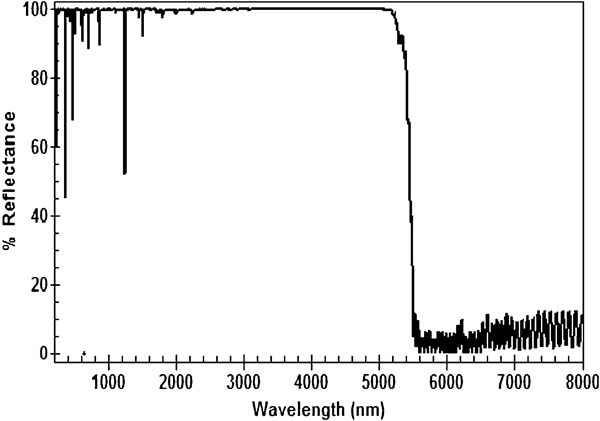
Computed reflectance spectrum of multilayer periodic 7YSZ–Al2O3 20 (H/2 L H/2)12 structure using FILMSTAR tool: structure had total of 20 stacks, and each stack was designed at given wavelength to reflect particular subband
Similarly, low pass TBC based filters were designed to realise a wide and high transmittance band in the visible and NIR range using FILMSTAR. This was based on a model proposed by Thelen25 and later refined by Ohmer. 26 26,27 According to Thelen, a wider transmittance band can be implemented by suppressing several successive low transmittance bands. A periodic multilayer (L/2 H L/2)12 structure was considered using a two material system, e.g. 7YSZ (H)/Al2O3 (L/2) at design wavelength of λ0 = 1·2 μm, and (L/2 H L/2) was repeated 12 times. The design wavelength λ0 was chosen to cover the visible spectral range with an emphasis on solar surface coating applications. Figure 2a depicts the computed transmittance plot of the periodic multilayer (L/2 H L/2)12 structure at λ0 = 1·2 μm. The model was extended to a three material system, in this case, a design configuration incorporating Al2O3 (L), 7YSZ (M) and TiO2 (H), where L, M and H correspond to the respective QWOT layer. In the three material system, the period was formulated with five elements having (LMHML)12 type structure at λ0 = 0·65 μm, where two successive low transmittance bands were suppressed. Ideally, the outer two pairs (LM and ML) should behave as two-layer antireflection coatings to provide unity transmittance at two specific wavelengths, depending on their optical thicknesses, e.g. ηL xL and ηM xM, where η and x stand for refractive index and physical thickness of the materials respectively.25 – 27 Figure 2b shows the computed transmittance spectrum of a multilayer periodic (LMHML)12 structure at λ0 = 0·65 μm.
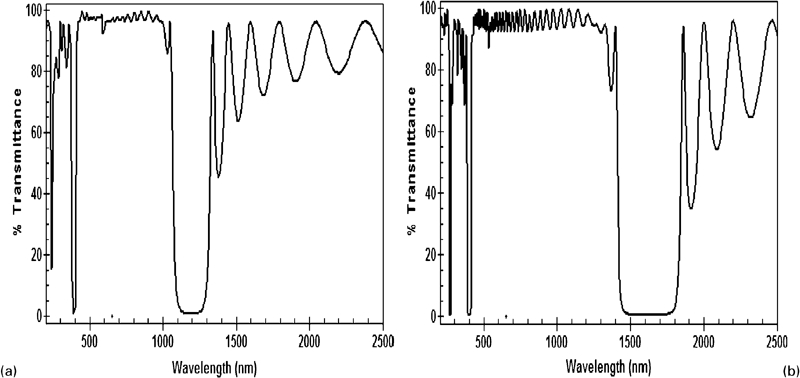
Computed transmittance spectra of multilayer periodic 7YSZ based low pass filters using FILMSTAR
As can be seen in Fig. 2, the low pass filter allows 100% transmission of the incident radiation over the spectral range of 0·4–1·1 and 0·4–1·4 μm for a two- and three material system respectively. It is evident from Fig. 2 that a three material system offers wider transmittance band in the visible and NIR range and larger rejection band (i.e. wider reflectance band) towards longer wavelength compared to a two material system. For solar thermal applications, the wavelength range of interest is 0·4–2·0 μm, which corresponds to a maximum solar energy flux of ∼99%. 20 20,29 In solar collector designs, the coatings are expected to reflect solar energy completely outside the desired band of 0·4 μm<λ<2·0 μm, enabling very low thermal emittance (<0·05) in the IR range.21 Otherwise, IR radiation will cause additional heat transfer through the coatings and raise the temperature, making the solar collectors inefficient at high temperature environment. Since the 7YSZ material is highly absorbing above λ⩾10 μm, 14 14,17 practical filter design for solar surface coatings is mostly confined to the 0·3–10 μm range with an emphasis on achieving wide and high reflectance band above λ⩾2 μm. Preliminary designs of the low pass filters incorporating a 7YSZ based periodic multilayer architecture had demonstrated wavelength selective radiative properties of the TBC system that need to be further refined and optimised in developing reliable and robust solar absorbing surface coatings for ultrahigh temperature applications, e.g. up to and above 1000°C.
Experimental
The EBPVD technique was used to deposit 7YSZ thin films on aluminide N75 coupons (a nickel–chromium based alloy) and quartz substrates to investigate their microstructures and the optical properties. The study was extended to include other ceramic materials, such as 20YSZ, the rare earth oxide doped (e.g. 4 mol.-%Nd2O3, Gd2O3 and Er2O3) YSZ and also Al2O3 as constituent layers for multilayer stacks. Single and multilayer YSZ based coatings were deposited in a von Ardenne EBE150 machine having a three ingot feeding system and equipped with a single linear electron beam gun. Trials were undertaken to evaporate 7YSZ and Al2O3 ingots successfully in depositing alternate 7YSZ–Al2O3 layers with interruption by controlling various process parameters, such as gun power, rotation of the substrate holder, deposition temperature and intraingot separation. A rotating substrate holder is mounted in a furnace within the evaporation chamber, and the substrate holder to ingot distance is 35 cm. Multilayer 7YSZ and Al2O3 were evaporated on N75 coupons and quartz substrates at ∼1000°C at a pressure of 6×10⁻³ mbar in the presence of oxygen gas at a flowrate of 400 sccm. The detail of the EBPVD process can be found in the literature. 6 9 28 6,9,28,30 Initial trials were conducted by depositing 0·5 μm thick 7YSZ films followed by two layers of 7YSZ–Al2O3 antireflection coating. The fabrication process of the EBPVD multilayer 7YSZ–Al2O3 structure was refined by depositing initially smaller number of alternate layers starting from 20 up to 100 layers before considering the final design structures, as discussed in the section on ‘Design: multilayer TBCs’. The phase and microstructures of the multilayer 7YSZ–Al2O3 coatings were evaluated using X-ray diffraction (XRD) and scanning electron microscopy (SEM) techniques respectively. The apparatus used for XRD was a Siemens D5005 diffractometer having Bragg–Brentano geometry with Cu Kα radiation, and an FEI XL30-SFEG model was used to capture the SEM images. The refractive index and film thickness were determined using spectroscopic ellipsometry technique, and an ellipsometer (model GES5E; Semilab-Sopra) was employed. The index measurements were performed at an angle of incidence of 60° that provided the optimum sensitive angle corresponding to the index of the quartz substrate. The experimental data (e.g. psi and delta, the amplitude ratio and phase shift respectively) were fitted to an appropriate model, modified Cauchy and Drude–Lorenz models in this case, giving a 99·7% fit to obtain the optical constants of the 7YSZ films. The transmittance of the multilayer 7YSZ–Al2O3 coatings was evaluated using UV–visible–NIR spectrometer (model V670; Jasco) and compared to analyse their spectral performance for various types of filter designs.
Results and discussion
Phase and microstructures
The XRD plots of single layer 7YSZ and two-layer 7YSZ–Al2O3 coatings are shown in Fig. 3a and b respectively. The XRD pattern of single layer 7YSZ had exhibited its polycrystalline nature with dominant tetragonal phase orientations. The tetragonal phases of 7YSZ films were identified, giving T(111), T(200) and T(400) with preferred orientations along the (200) direction that is desirable in achieving strain tolerance during thermal cycling. 31 31,32 The XRD analysis of a two-layer 7YSZ–Al2O3 had established the existence of both α-Al2O3 and T-YSZ phases. In this case, the α-Al2O3 (113) phase was weaker than α-Al2O3 (122). It was noticed that the tetragonal 7YSZ phases were still dominant in the two-layer 7YSZ–Al2O3 coatings with T(200) slightly weaker and orientation preferentially in the T-YSZ (111) direction. Figure 4 illustrates the surface morphology of multilayer 7YSZ–Al2O3 coatings having a total of 100 layers in stack. In this study, the SEM scan was performed at an acceleration voltage of 10 kV. Figure 4a exhibits the top view of the multilayer coatings, revealing a cauliflower-like surface topography that appeared to be dense, unlike the standard 7YSZ with faceted surface forming pyramidal tips. 33 33,34 Figure 4b shows the polished cross-section micrograph of 7YSZ–Al2O3, which had established clearly the formation of layered microstructures comprising of alternate 7YSZ and Al2O3 thin films, depicted as thick light and thin dark colour patches respectively. The cross-section SEM image had indicated the formation of vertical column-like structures with boundaries, but the boundaries were not distinct to distinguish a large number of parallel columns and their vertical interfaces. In addition, renucleation of the 7YSZ grains was observed following interruption of the 7YSZ evaporation and subsequent deposition of the Al2O3 interlayer to form a stack that seemed to inhibit the formation of columnar structures. In this case, the microstructures of multilayer 7YSZ–Al2O3 coatings resembled clustered and closely packed fibrous grains forming ultimately interlocked column-like layered structures but misaligned following renucleation and subsequent growth, unlike standard monolithic 7YSZ based coatings. A preliminary study of the multilayer 7YSZ–Al2O3 microstructures had exhibited the nature of their growth phase undergoing zone-T (transition) stage towards lower growth temperature mode rather than zone II observed typically in a standard 7YSZ that can be described by the Thornton phase diagram.6 – 9,34,35
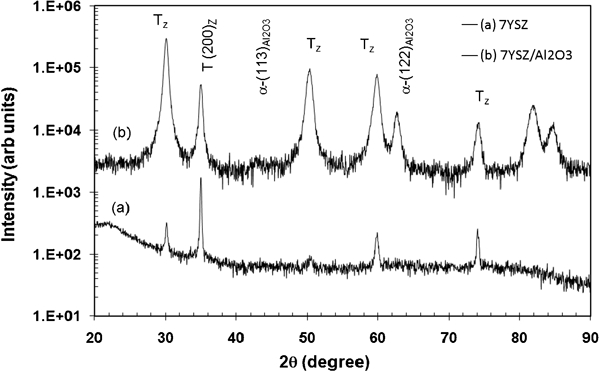
X-ray diffraction patterns of EBPVD deposited porous zirconia ceramic films on quartz substrates: a 0·5 μm thick 7YSZ; b two-layer 7YSZ–Al2O3 coatings
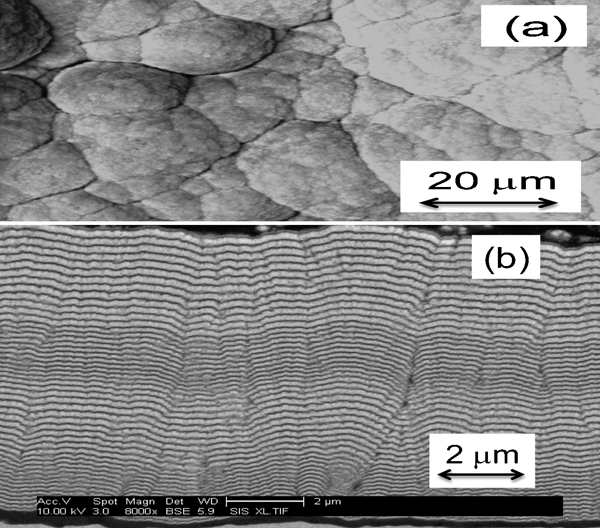
Images (SEM) of EBPVD multilayer 7YSZ–Al2O3 coatings showing surface morphology: a top view of coating surface and b polished cross-section of layered microstructure where light and dark colour patches correspond to 7YSZ and Al2O3 layers respectively
From the SEM analysis, the thickness of 7YSZ films was found to vary in the range of 145–190 nm across the stack, whereas the Al2O3 thickness varied only slightly at 40–50 nm. It was observed that 7YSZ and Al2O3 were almost uniform in thickness at the early stage of growth, and 7YSZ became thicker, showing a large thickness variation, in particular at the end phase near the top surface. The variation of 7YSZ thickness can be attributed to EBPVD process conditions that were not optimised to produce repeatable QWOT layers for 7YSZ–Al2O3 coatings in the initial trial run. The total thickness of the multilayer 7YSZ–Al2O3 coating was estimated as 11 μm, which implied the early phase of multiple nucleation and trend of subsequent growth of the interlocked column-like layered microstructures in this sample, as reported by others. 30 30,34 In addition, interfaces across 7YSZ–Al2O3 layers were smooth and crack free, which demonstrated their thermal compatibility in depositing a large number of 7YSZ–Al2O3 layers at higher deposition temperature of 1000°C. The porous nature of the coatings was observed from the surface topography, as shown in Fig. 4a, and both inter- and intracolumnar porosities can be seen on higher magnification scan. The pore size of a standard EBPVD 7YSZ varies typically between 10 and 100 nm, and nanosize pores occupy around 20–30% volume fraction relative to dense 7YSZ. 2 6 11 2,6,11,34 In these trials, the porosity of the coatings was not measured experimentally using conventional methods. However, it was anticipated that intracolumnar porosity will be reduced in multilayer 7YSZ–Al2O3 coatings due to the clustered and interlocked nature of the fibrous structures, as shown in Fig. 4. The root mean square value of surface roughness of the 11 μm thick coated sample was estimated as 62 nm following a scan over the 20 μm range using atomic force microscopy technique. In case of 150 μm EBPVD 7YSZ coatings having columns in 〈001〉 direction with pyramidal tips along one of the 〈011〉 directions, the variation of the peak to valley height/roughness could be in the range of 1–5 μm, depending on the base area of the pyramids. 2 6 2,6,33 Preliminary SEM analysis of the multilayer 7YSZ–Al2O3 coatings had revealed the fact that the nature of columnar microstructures as observed in standard 7YSZ was partially diminished by interruption of 7YSZ evaporation and subsequent deposition of Al2O3 interlayer while forming a thicker coating, as required for practical multilayer TBC system designs. 31 34 31,34,35 In addition, other factors such as thermal stress, gradient microstructures and microporosity will contribute to the texture and thermomechanical performance of fully grown multilayer TBCs having various types of ceramic materials in the device architecture, 9 28 31 9,28,31,35 which is beyond the scope of the paper presented here. These are critical issues in the developments of reliable EBPVD multilayer TBC based coatings that need further investigation, including in-depth knowledge on renucleation and temperature dependent complex growth phase of multilayer 7YSZ–Al2O3 and of similar thermally compatible ceramic materials.
Optical properties
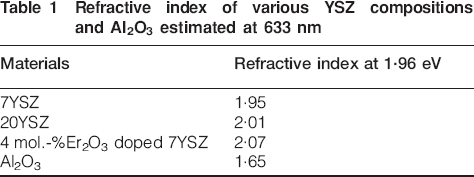
In order to measure the refractive index of 7YSZ employing spectroscopic ellipsometry technique, a single layer of 7YSZ film was deposited on quartz substrate, and the film thickness was chosen as ∼0·5 μm. Similarly, test samples were fabricated to measure the refractive indices of other types of materials, such as 20YSZ, 4 mol.-%Er2O3 doped 7YSZ and Al2O3. Figure 5 depicts the plots of the refractive index versus energy for 7YSZ, 20YSZ and 4 mol.-%Er2O3 doped 7YSZ, and Table 1 gives their estimated index values at a wavelength of 633 nm (1·96 eV) respectively. As discussed in the section on ‘Experimental’, modified Cauchy and Drude–Lorenz models were employed to fit the optical parameters, e.g. psi and delta, which gave close matching up to ∼99·7% between scan and fitted data. The refractive index and thickness of 7YSZ were estimated as 1·95 and 575 nm respectively at 633 nm. The extinction coefficient of the 7YSZ film was zero, as expected. All the samples exhibited wavelength dependence of the refractive index, as evident from Fig. 5. 18 18,36 In addition, the modified Cauchy model used to fit scan data had revealed the slight variation of the refractive index profile of 7YSZ across the layer thickness, e.g. varying from 1·95 to 2·03 at 633 nm, thereby establishing porosity in EBPVD 7YSZ films. 6 36 6,36,37 The refractive indices of 20YSZ and 4 mol.-%Er2O3 doped 7YSZ were obtained as 2·01 and 2·07 respectively at 633 nm. A comparison of the index values of various YSZ compositions given in Table 1 had demonstrated that the refractive index of YSZ films depends on their mole concentration and doping. 36 36,37 Preliminary results had established that the optical properties of YSZ based materials can be modified by doping and introducing porosity in their microstructures. This would be beneficial to select the constituent materials with an appropriate refractive index profile required in designing multilayer TBC based optical filters and coatings in the visible and NIR bands for high temperature optical system applications.
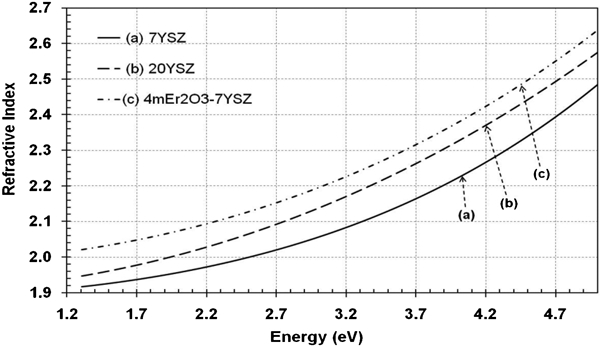
Comparison of refractive index of 7YSZ (solid line), 20YSZ (dash) and 4 mol.-%Er2O3 doped 7YSZ (dash dot) using spectroscopic ellipsometry technique
Refractive index of various YSZ compositions and Al2O3 estimated at 633 nm
As mentioned in the section on ‘Experimental’, the spectral characteristics of YSZ based coatings were evaluated using a UV–visible–NIR spectrometer. Initial characterisation was conducted on test samples with two types of design structures, including quartz as a reference. One sample had a total of 100 (50∶50) layers consisting of alternate 7YSZ–Al2O3 with thicknesses of 450 and 75 nm respectively that produced a ∼27 μm thick coating. The second sample was a periodic multilayer (L/2 H L/2)10 resembling a two material low pass filter configuration with 10 repetitions, as discussed in the section on ‘Design’. The thicknesses of 7YSZ and Al2O3 were 150 and 95 nm respectively, which gave rise to a ∼3·5 μm thick multilayer coating. Figure 6 exhibits the transmittance of the test structures to compare their spectral performance. It should be taken care of while comparing their transmission intensities that the thicknesses of the two test samples were not equal. The transmission intensity of the quartz substrate shown by the dashed line in Fig. 6a was measured, giving 93% and almost constant over a broadband of 0·4–2·5 μm that can be considered as the reference. The spectral response of 100 layers of alternate 7YSZ–Al2O3 coatings depicted in Fig. 6b was not flat and uniform, showing a large variation in intensity over a broadband; a similar spectral behaviour was also reported by others. 16 17 16,17,38 The average transmittance was obtained as 35% with large intensity fluctuation in the 0·4–1·0 μm range and was increased up to 70% in the subsequent band of 1·0–2·0 μm. Figure 6c illustrates the transmittance of periodic multilayer (L/2 H L/2)10 7YSZ–Al2O3 coatings. The spectral performance of the second test sample shown in Fig. 6c was improved compared to sample 1 in Fig. 6b, giving a maximum intensity of up to 75 and 85% in the 0·4–1·0 and 1·0–2·0 μm spectral range respectively. However, the spectral response of this periodic structure was not very flat, giving intensity fluctuation over a wide band that is undesirable in designing solar absorbing surface coatings.21 In addition, the upper cutoff wavelength of the spectrum was at 2·4 μm, with a smaller rejection band that had obviously less contribution to lower the thermal emittance in IR range.19 – 21,39 It was evident from the transmittance spectra of these unoptimised test structures that an ideal low pass filter response was not achieved to produce very high transmission (>90%) over wide visible and NIR bands. As solar surface coatings are concerned, the spectral performance needs to be further improved with a reduction in intensity fluctuation in the 0·4–2·0 μm band and a wide rejection band above the upper cutoff wavelength λ⩾2·0 μm, enabling negligible reradiation and heat transmission in the IR range. 15 21 15,21,39 However, it should be noted that the 7YSZ–Al2O3 multilayer structures under initial trials were not optimised in terms of both optical filter designs and EBPVD process conditions. As already discussed in the section on ‘Phase and microstructures’, the thickness of 7YSZ was not uniform to provide repeatable QWOT layer in multilayer stacks, thereby not satisfying strictly the design requirements for optical thin film filters.23 – 27
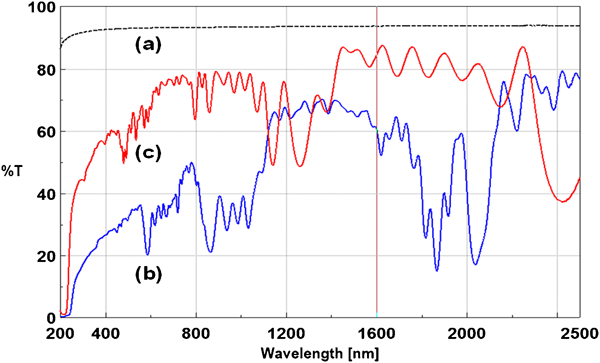
Transmittance spectra of EBPVD multilayer 7YSZ–Al2O3 coatings: a quartz substrate (dashed line); b 100 (50∶50) layers of alternate 7YSZ–Al2O3 stack (blue colour/dark colour); c periodic multilayer Al2O3(L/2)/7YSZ(H) in (L/2 H L/2)10 configuration (red colour/light colour)
Conclusion
Various types of multilayer 7YSZ–Al2O3 coatings were fabricated and characterised to investigate their microstructures and IR radiative properties for developments of solar absorbing surface coatings. High reflectance and transmittance multilayer coatings were designed in the visible and NIR bands using commercial FILMSTAR software. Low pass thin film filters that were designed to obtain high and wide band transmission, comprised of multilayer symmetrical periods with 7YSZ and Al2O3 as constituent materials in the device layer architecture. Initial designs of 7YSZ based multilayer filters had demonstrated their wavelength selective radiative properties and the suitability of the TBC based system in developing multilayer coatings for solar thermal collectors. Both single and multilayer 7YSZ–Al2O3 coatings were deposited on quartz substrates using the EBPVD method to investigate their optical properties, in particular the refractive index and the transmission spectra. The phase and microstructures of the multilayer 7YSZ–Al2O3 coatings were evaluated using XRD and SEM. X-ray diffraction analysis had identified the co-existence of dominant tetragonal phases of 7YSZ and α-Al2O3 phases in 7YSZ–Al2O3. The formation of clustered and interlocked fibrous layered microstructures comprising of alternate 7YSZ and Al2O3 thin films was established from the SEM analysis. Renucleation of the 7YSZ grains following interruption of 7YSZ evaporation and subsequent deposition of Al2O3 interlayer was also observed from a 11 μm thick multilayer 7YSZ–Al2O3 coating along with smooth and crack free interfaces. In addition, the variation in the thicknesses of 7YSZ and Al2O3 across the stack was noticed, implying that EBPVD process conditions need to be optimised to produce repeatable QWOT layers for constituent materials forming multilayer stacks. The refractive indices of 7YSZ and Al2O3 films were estimated using spectroscopic ellipsometry technique, giving index values as 1·95 and 1·65 at 633 nm respectively. The optical characterisation of various YSZ compositions had revealed that the refractive index of YSZ film depends on their mole concentration, doping and porosity. The transmittance of the multilayer periodic 7YSZ–Al2O3 coatings was measured using a UV–visible–NIR spectrometer. The maximum transmission intensity was obtained as 75 and 85% in the 0·4–1·0 and 1·0–2·0 μm spectral range respectively from these unoptimised periodic test structures. The spectral response of the test samples had exhibited fluctuation in transmission intensity over a wide band, indicating that the radiative performance of the multilayer periodic 7YSZ–Al2O3 structures needs to be further improved to achieve reliable solar surface coatings in terms of optical filter designs and EBPVD process parameters. Preliminary results had demonstrated the potential for the TBC based system in fabricating broadband optical filters in multilayer configurations, incorporating thermally compatible ceramic materials that are envisaged to provide technological route for realisation of highly efficient and robust solar absorbing surface coatings with intended applications at ultrahigh temperature environments.
Footnotes
Acknowledgements
The authors wish to acknowledge the Engineering and Physical Sciences Research Council (EPSRC), UK, and Ultra Precision and Structured Surfaces, Integrated Knowledge Centre (UPS -IKC) for financial support through award no. EP/EO23711/1. Mr M. Targa would like to acknowledge ‘Associazione Amici Museo del Patrimonio Industriale, Italy’ within the framework of the Leonardo Da Vinci project for providing support and assistance to carry out his research field training at Cranfield University.