







Abstract
In this research, substrate heating process has been used for the production of Ta–Mo high temperature protective coatings. The microstructures of the alloy coatings have been studied through X-ray diffraction and scanning electron microscopy. Mechanical and corrosion properties of different alloys have been investigated in both low and high temperature heating processes. Substrate heating processes (from 250 to 550°C) were expected to produce partially recrystallised and fully recrystallised microstructures. Higher heating temperature results in recrystallised microstructures, but adversely affects the density of atoms Vt and bond energy G. The behaviour of low and high temperature heating processes on corrosion and mechanical properties of Ta–Mo nanostructured coatings was studied.
Introduction
Nanostructured coatings based on Ta and Mo metals have attracted a great deal of attention in recent years because of its variety of applications.1, 2 It could be used for providing better high temperature oxidation protection to the superalloys as compared to the microcrystalline coatings.3 The intermetallic compound (metastable Ta–Mo phase) possesses many attractive properties such as low density, high hardness,4 high melting point (approximately 1873–2073 K), good oxidation resistance5, 6 and metal-like electrical and thermal conductivity.7
Hence, thin film materials based on Ta and Mo metals have been used for a wide variety of engineering applications such as under layers in magnetic recording media and high temperature protective coatings.8 For instance, Ta–Mo is the basis of a family of oxidation and corrosion resistant coatings that have been used on Ni based and Ta based superalloys.7 However, the high temperature oxidation behaviour of nanostructured Ta–Mo coatings on Ni based super alloy substrate is scarce in the literature.9
However, the mechanism of Ta–Mo phase in such materials is strongly dependent on the composition and surface energy, because of its complex components and low stability.10, 11 At the same time, the change in the grain size essentially affects their physical properties.12 In this case, the control of process is important for the industrial application of the Ta–Mo high temperature materials.13 In fact, presently there is a lack of information in the literature regarding the systematic investigation.
Here, a sputter deposited process can be developed as a cost effective approach for synthesis of Ta–Mo coatings. Sputter deposition is a novel technique for synthesis of advanced materials.14 In this technique, the coatings can be prepared on large area substrates and controlled over the composition.15 The structures and physical properties of coatings were highly influenced by the deposition parameters such as the sputtering temperatures.
The objective of the present work is to evaluate the possibility of strengthening mechanical and corrosion resistant properties by different sputtering parameters and substrate heating processes. The acquired results and related discussions would be feasible for their potential applications.
Experimental
Nanostructured Ta–Mo coatings were prepared through co-sputtering of Ta and Mo targets with a diameter of 7·62 cm using magnetron sputtering system (FJL560D2). Silicon (100) wafers with a diameter of 10 mm and a thickness of 0·5 mm were used as substrates. The substrates were ultrasonically rinsed in acetone before deposition. The deposition chamber's base pressure was 2·2×10−4 Pa, and during deposition the gas pressures were maintained constant at 1·0 Pa. The gas flowrate was set at 5·0×10−7 m3 s−1. The substrate to target distance was 140 mm. Deposition was performed at a substrate temperature of 150, 350, 450 and 550°C for 30 min. In this study, all samples of Ta–Mo coatings were prepared at Ta target power (73 W) and Mo target power (54 W) in argon atmosphere.
The surface morphologies and grain sizes of Ta–Mo coatings were examined by scanning electron microscopy (SEM-3400-N). The X-ray diffraction (XRD) with Cu target (Rigaku D/max2550) was used to determine the structure of Ta–Mo coatings at different sputtering temperatures. The electrochemical corrosion and mechanical properties were studied with electrochemical impedance spectroscopy using a Gamry PC4/300 system and hardness measurement of Nano-Press.
Results
Figure 1 shows the XRD pattern of Ta–Mo coatings deposited at different sputtering temperatures. The XRD results of the as deposited Ta–Mo coatings reveal only amorphous structure with a high level of atomic disorder, without any grains and grain boundaries. Substrate heating at 350°C, however, induces the formation of minor cubic phases such as Ta–Mo (111), (110) and (221) as well.16 It seems that the Ta–Mo phase was formed due to the reaction between Ta and Mo atomics in the ion bombardment at the process of substrate heating. Also, there is a little change in XRD spectra for polycrystalline Ta–Mo coatings deposited at 450°C, which indicates that the sputtering temperatures lower than 450°C produce partial recrystallinity of Ta–Mo microstructures. Similarly, there is no peak change in Ta–Mo (110) plane at the temperature up to 550°C but two tiny extra peaks from both planes of Ta–Mo (111) and (221). It reveals that the full recrystallinity of Ta–Mo microstructures at planes of Ta–Mo (111) and (221) occurred in the coatings deposited at 550°C. This is due to the fact that the increase in ion bombardment accelerates the surface moving and surface diffusion, and thus improves the grain quality of the Ta–Mo (111) and (221) metastable phases.17
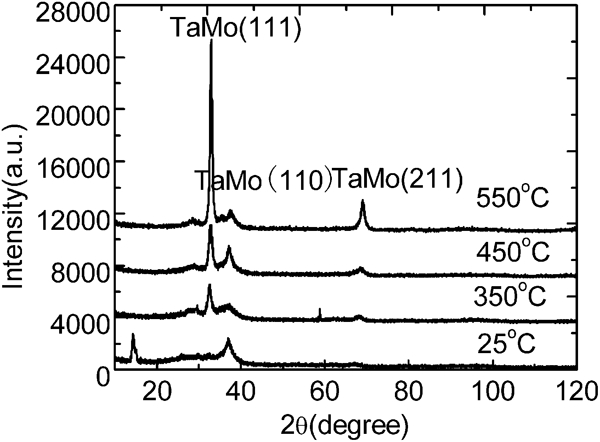
X-ray diffraction patterns of Ta–Mo coatings deposited at various sputtering temperatures
Figure 2 shows the surface morphologies of Ta–Mo coatings deposited at different sputtering temperatures. It can be seen in SEM images that little size grains with some holes spread in the coatings of room temperature. It is interesting to note that the coatings formed at 250°C seem to expose very compact morphologies with fewer pin holes and voids. Also the grains seem to be rather compact and dense as also found for the higher temperature 350°C. The change in grain sizes is associated to nucleation process followed by a diffusion mechanism at the higher energy.17 It is also reasonable to assume that increasing deposition temperatures accelerate the mobility of pin holes in the coatings through thermally activated nucleation and growth processes on the substrates.18
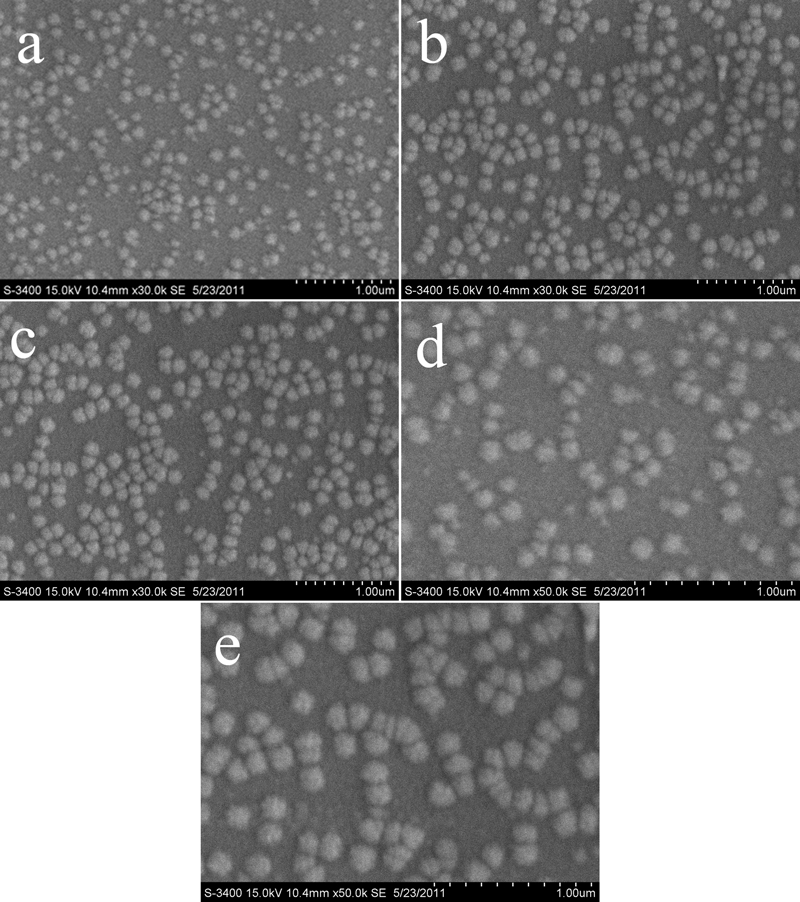
Images (SEM) of Ta–Mo coatings deposited at various sputtering temperatures: a 25°C; b 250°C; c 350°C; d 450°C; e 550°C
However, the change of density of holes is opposite at the higher deposition temperatures (450 and 550°C), which indicates that the density of holes was increased with increasing gain sizes at the higher deposition temperatures (450 and 550°C): the higher the temperature, the larger the density of the pits. The pits start to coarsen together into groves and separate the coating into small plateaus of different heights at such high sputtering temperatures.19 It was reported by Rahman et al.20 that a number of holes occurred in two element metal coatings may enhance the oxygen rate of grain particles.
Figure 3 is Tafel curves of Ta–Mo coatings at different sputtering temperatures. It can be seen in Fig. 3 that the polarisation potential of Ta–Mo coatings increased from −250 to −206, −186, −60 and 450 mV, while the corrosion current reduced from 8·7×10−9 to 4·5×10−9, 2·1×10−9, 1·8×10−9 and 1·1×10−9 A with the increase in sputtering temperatures from room temperature to 550°C. It shows that the substrate heating process increases the polarisation potential and decreases the corrosion current. The enhancement in the polarisation resistances by substrate heating process may be due to the difference in grain sizes or composition of the coatings present on the surface.
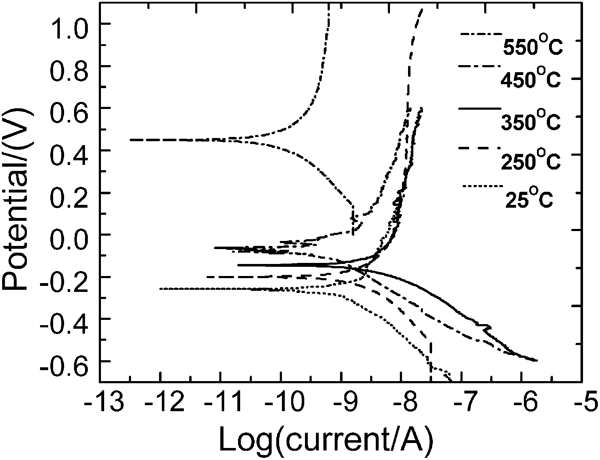
Tafel curves of Ta–Mo coatings deposited at various sputtering temperatures
The corrosion behaviour of Ta–Mo coatings depends on the microstructure, surface roughness and grain particles in the heating processes. The heating processes in used for coatings could improve the growth condition, as reconstruction or improvement of the crystal, which reduced the lattice mismatch impact and enhanced the lateral growth with increasing energy of sputtering particles. In addition, surface diffusion determined the nucleation and growth of the grain particles in the heating processes, which also had an important impact on the corrosion behaviour. The mechanism of corrosion behaviour determined on surface diffusion can be interpreted by the diffusion equation (Arrhenius equation) as follows
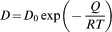
It can be known from equation (1) that the more intense atoms diffused at different directions in the higher heating processes, which led to the increase in grain sizes and hole density. It opened the possibility of a breakthrough in corrosion buffer and held down the surface flow of corrosion electric. In this result, the corrosion resistance was increased and corrosion rate was reduced.
Figure 4 shows the change of hardness H and the elastic modulus E as a function of sputtering temperatures. Before substrate heating, the as deposited Ta–Mo coating had far lower mechanical properties than the coatings heated. This could be due to the existence of amorphous phase. An amorphous phase is known to contribute negatively to the mechanical properties because of its weak localisation effect to nanoparticles. With the temperatures increased to 250 and 350°C, the Ta–Mo particles began to form, making the average hardness shift towards the positive side. However, with the temperatures further increased to 450 and 550°C, the number of lattice imperfections (holes, dislocations, point defects, etc.) was increased, which resulted in the decrease in hardness.21
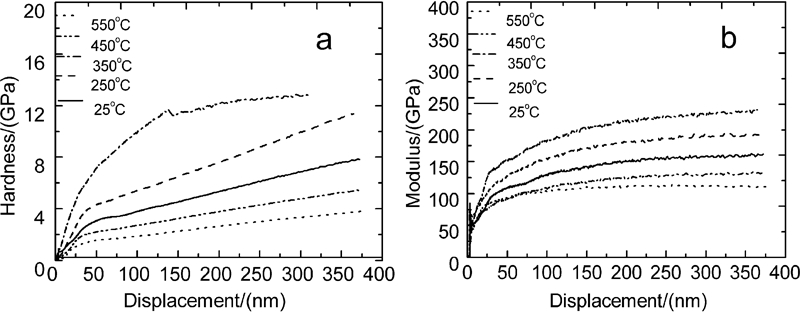
Variation of curves of Ta–Mo coatings deposited at various sputtering temperatures: a H–h curve; b E–h curve
Makishima and Mackenzie22 gives the formula calculated the hardness H and the elastic modulus E as follows


It can be observed in equations (2) and (3) that there was a great relationship between the internal resistance properties (H and E), density of atoms Vt and bond energy G in the coatings. Apparently, the temperatures (250 and 350°C) used for heating the coatings may be high enough to cause the significant increase in the density of atoms Vt and bond energy G. It led to the increased sputtering rate produced by the increase in the adhesion coefficient of the gas atoms or molecules on the surface of coatings, which could make the structure relaxed and the hardness increased. Therefore, substrate heating process may change the film hardness H and the elastic modulus E at the suitable temperatures.
In contrast, the growth surface, which was deposited at the 450 and 550°C heated processes, exhibited much lower density of atoms Vt and bond energy G. In this result, the density of Ta and Mo atoms had reached the saturated condition and the release of stress and adjustment of structure occurred in the coatings, which led to the decrease in mechanical properties.22 It also implied that the hardness values had reached a turn point at 350°C.
Conclusions
The main results can be summarised as follows.
The phase transformation from amorphous phase to cubic phase during low temperature annealing was influenced by the sputtering temperatures. Substrate heating processes were expected to produce partially recrystallised and fully recrystallised microstructures.
The low temperature heating process was found to be the key parameter on the grain growth and improvement of the crystalline. In addition, density of holes was increased with increasing gain sizes at the higher deposition temperatures.
Surface diffusion determined the nucleation and growth of the grain particles in the heating processes, which also had an important impact on the corrosion behaviour.
Low temperature heating may increase the density of atoms and bond energy which increase mechanical properties. However, that had reached the saturated condition in the high temperature heating process, which led to the decrease in mechanical properties.
Footnotes
Acknowledgements
This work is supported by the Shanghai Specialized Fund for the Outstanding Young Teachers in High Education Institutions (grant no. gjd11033) and the Academic Program of Shanghai Municipal Education Commission (grant nos 11XK11 and 2011X34).