







Abstract
Cadmium–zinc alloy coatings were successfully electrodeposited on copper electrodes from a choline chloride–ethylene glycol deep eutectic solvent containing CdCl2 and ZnCl2. The electrochemical behaviour of the electrolyte system was investigated via linear sweep voltammetry, and the result revealed that the CdZn alloy was codeposited when the deposition potential was prolonged to the potential range, leading to the insufficient zinc deposition on the copper electrode. The scanning electron microscopy results demonstrated that the morphologies of codeposits were cauliflower-like. The codeposition mechanism was also investigated, and the dependencies of the Cd content in the CdZn codeposit on the deposition potential, Cd(II) molar ratio and temperature were discussed.
Introduction
Cadmium and zinc elements are usually used in a wide variety of applications, such as plating process materials and surface corrosion protective coatings.1 – 6 As alloying elements, Cd and Zn significantly affect many semiconductor and memory alloy properties.7 – 11 CdZn alloys are often used in soldering and brazing processes, with large to small amounts of Cd, and exhibit some interesting properties. Therefore, this kind of alloy plays a significant role in technological applications and experimental studies because of its low melting point and regular lamellar structure.12, 13
Numerous electrochemical examinations of Cd and Cd alloys in aqueous solutions are available in the literature.14 – 16 However, water suffers from drawbacks such as relatively narrow potential windows, difficulty in handling gas evolution process, difficulties caused by metal passivation and the necessity for complexing agents.17
Ionic liquids have attracted much attention as solvents because of their several unique features, such as wide potential windows, high solubility of metal salts, avoidance of water, high conductivity compared with non-aqueous electrolytes or liquids and non-toxic solvents compared with poisonous plating baths. These fascinating properties make ionic liquids green solvents for the cathodic electrodeposition of metals.18, 19 Ionic liquids have three generations: AlCl3 based ionic liquids, BF4 based ionic liquids and task specific ionic liquids.20 – 22 The first generation is difficult to handle because of its high reactivity to air and water, whereas the latter two are problematic because of their high costs.23, 24 Al, Ti, Ta, Nb, Mo and W are used as electrodeposits with a number of Al and Zn based alloys.17 Unlike traditional ionic liquids, deep eutectic solvents (DESs) can be easily prepared at low cost with high purity. Therefore, as promising solvents, DESs have been used to electrodeposit numerous metals or alloys at high current efficiency.25, 26 However, little information on CdZn alloy electrodeposition has been presented in previous references.
In this study, the electrochemical behaviour of the electrolyte system was studied via linear sweep voltammetry (LSV) in a choline chloride–ethylene glycol (ChCl–EG) DES containing 0·25–0·25 mol L−1 of CdCl2–ZnCl2. The crystalline phase of a CdZn electrodeposit was studied by X-ray diffraction (XRD). The dependence of codeposit morphologies on proper voltage was also discussed using scanning electron microscopy. The tendencies of the Cd content in the CdZn codeposition composition on the deposition potential, Cd(II) molar ratio and temperature were investigated.
Experimental
The CdCl2–ZnCl2–ChCl–EG eutectic mixtures were prepared by mixing proper amounts of anhydrous CdCl2 (AR, Kelong), ZnCl2 (AR, Kelong) and DES in a glass at 75°C for 12 h. The mixture was then kept at room temperature under vacuum conditions for another 12 h in a laboratory vacuum furnace to remove water.
All electrochemical experiments were conducted in a three-electrode electrochemical cell and an electrochemical workstation (CHI 660D). The electrolyte (∼20 mL) was kept under flowing nitrogen (99·9% purity) atmosphere within the cell for 10 min to remove oxygen. Copper foil, with an exposed area of 1 cm2, was used as the working electrode. Before electrodeposition, the copper foil was immersed in an acidic solution containing 27 vol.-% of nitric acid, 55 vol.-% of phosphate acid and 18 vol.-% of glacial acetic acid for 30 s to remove oxides from the surface. Then, it was rinsed with deionised water and, subsequently, ethanol. It was dried under vacuum conditions and immediately immersed into the electrolytes to prevent the reformation of oxides on the surface. A platinum wire was used as the counter electrode. A silver wire, immersed in 10 mm of AgNO3 ChCl–EG DES contained in a separate fritted glass tube, was used as the reference electrode. Cathodic LSV was performed within the range of −0·40 to −1·80 V with a scan rate of 0·01 V s−1. The constant potential electrodepositions were conducted at the potentials in the range from −1·3 to −1·7 V for 6 C cm−2. An oil bath was used to maintain the electrolyte temperature from 50 to 90°C. The surface morphology and elemental compositions of the electrodeposits were analysed using a scanning electrode microscope (Inspect F Co.) with an energy dispersive X-ray spectrometer (EDAX Co.) working at 15 kV. The crystalline phase of the sample was studied using an X-ray diffractometer (Philips X'Pert) with a Cu target (λ = 0·15406 nm) and operated at 40 kV and 40 mA.
Results and discussion
Voltammetric behaviour
A typical LSV curve for the ChCl–EG DES containing 0·25–0·25 mol L−1 of CdCl2–ZnCl2 on copper electrodes with a scan rate of 0·01 V s−1 at 90°C is shown in Fig. 1. The LSV results showed three kinds of reduction peaks: C1, C2 and C3. Compared with that of Saravanan and Mohan,27 C1 indicates that the electrodeposits consist of Cd, C3 shows the reduction of Zn(II) to the bulk Zn electrodeposit and C2 is attributed to the underpotential deposition of Zn to prepare the CdZn codeposition. The electrodeposition potentials of C1, C2 and C3 were approximately −0·85, −1·25 and −1·45 V respectively.
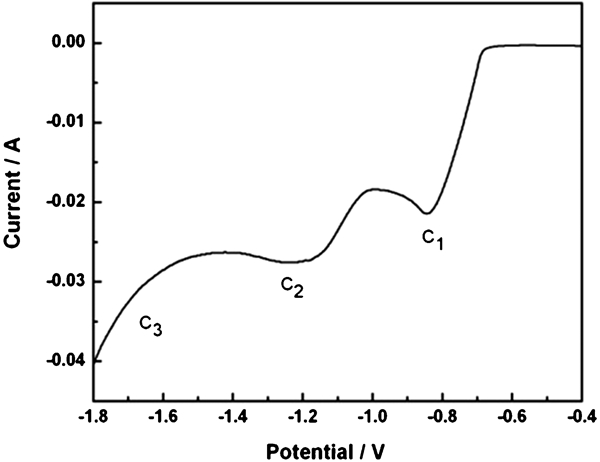
Linear sweep voltammetry curve of ChCl–EG DES containing 0·25–0·25 mol L−1 of CdCl2–ZnCl2 at 0·01 V s−1 on copper substrate at 90°C (black)
XRD analysis
The XRD pattern of the CdZn electrodeposit in the ChCl–EG DES containing 0·25–0·25 mol L−1 of CdCl2–ZnCl2 at −1·10 V in copper substrate at 90°C is shown in Fig. 2. The reflections at 2θ (31·866°), (34·768°), (38·391°), (47·874°), (61·160°), (62·328°) and (71·718°) characteristics for (022), (100), (101), (102), (103), (110) and (112) respectively represent Cd. The reflection at 2θ (43·221°) characteristic for (101) represents Zn. The three main reflections at 2θ (43·297°), (50·443°) and (74·130°) characteristics for (111), (200) and (220) respectively represented the copper substrate. The Cu (111) reflection is strong enough to cover Zn (101). According to the phase diagram, CdZn is a simple eutectic system that does not form any intermetallic compound at room temperature.28 Therefore, the CdZn electrodeposit would consist of a two-phase mixture of Cd and Zn.
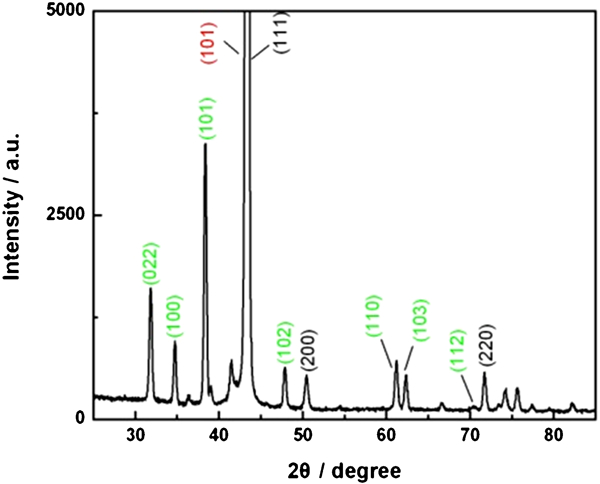
X-ray diffraction pattern obtained from CdZn electrodeposit, which was electrodeposited in ChCl–EG DES containing 0·25–0·25 mol L−1 of CdCl2–ZnCl2 at −1·10 V on copper substrate at 90°C cadmium (green), zinc (red) and copper (black)
Surface morphologies of CdZn alloy coatings
The surface morphologies of the CdZn codeposits obtained from 0·25 to 0·25 mol L−1 of CdCl2–ZnCl2 at 90°C in the ChCl–EG DES are shown in Fig. 3. All electrodeposits adhered well to the copper substrates. As the potential became negative, the electrodeposit lost its surface appearance and became a sintered structure (Fig. 3b). The morphologies of the cauliflower-like surface had different sizes, and these differences were attributed to the increased deposition rate.29
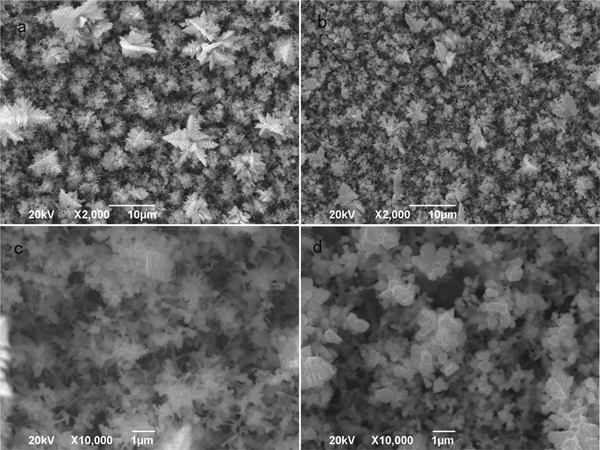
Magnification (×2000 and ×10 000) of surface morphologies of CdZn electrodeposits obtained from ChCl–EG DES containing 0·25–0·25 mol L−1 of CdCl2–ZnCl2 on copper substrate at 90°C:
With a higher magnitude, scanning electron microscopy revealed that the cauliflower-like morphologies were composed of a large number of non-uniform small dendrites (Fig. 3c). The typical surface included plane, edge, node, dislocation and so on. The branches developed at the edges of crystals and were diffused to achieve mass transfer and support further growth. The deposition occurred easily on the vertical angle of the cube. The dendritic structures were formed by repeating this process. At lower potentials, small crystals, which were formed on the surface, served as seed sites of the dendritic structures. The branches of the crystals grew to form dendrite structures. At more negative potentials, the deposited metal grew into dendrite structures. 30 30,31
Chemical compositions of CdZn codeposits
The typical energy dispersive X-ray spectrometry analysis of CdZn codeposits is given in Fig. 4. The corresponding sample was derived from the ChCl–EG DES containing 0·25–0·25 mol L−1 of CdCl2–ZnCl2 at −1·30 V on copper substrate. The codeposit was composed of 83·18 at-%Cd and16·82 at-%Zn. The Cd contents were investigated using the same analysis.
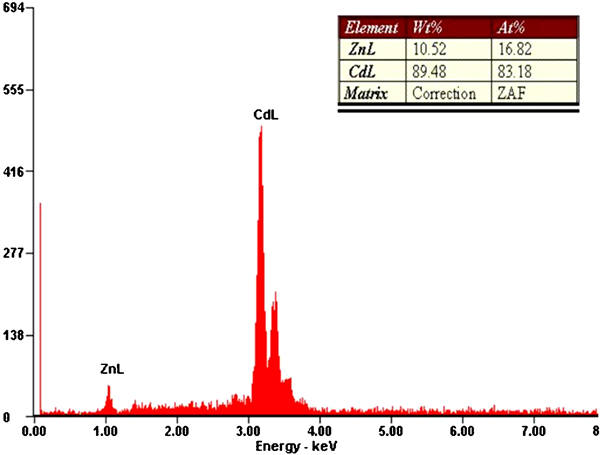
Energy dispersive spectroscopy analysis excepted copper substrate: CdZn codeposition was obtained from ChCl–EG DES containing 0·25–0·25 mol L−1 of CdCl2–ZnCl2 at −1·30 V on copper substrates at 90°C
The deposition potential could affect the Cd content in CdZn alloy coatings. The relation between the potential and the Cd content is shown in Fig. 5, whereas electrodeposition occurred in the ChCl–EG DES containing 0·25–0·25 mol L−1 of CdCl2–ZnCl2 at 90°C. The Cd content of the codeposits decreased from 83 to 66 at-% as the potential became more negative. The Zn content increased because of the reduction of Zn(II) to the bulk Zn electrodeposit when the potential became negative. This finding is consistent with the LSV result. Interestingly, 83–66 at-%Cd can be electrodeposited by varying the potential from −1·30 to 1·70 V.
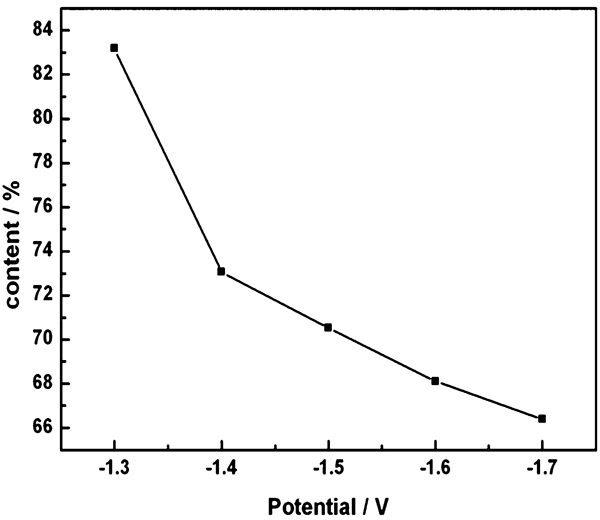
Plot of Cd content versus deposition potential in CdZn codeposits, which were obtained from ChCl–EG DES containing 0·25–0·25 mol L−1 of CdCl2–ZnCl2 on copper substrates at 90°C
The plot of Cd content versus temperature is shown in Fig. 6. The coatings were electrodeposited in the ChCl–EG DES containing 0·25–0·25 mol L−1 of CdCl2–ZnCl2 at −1·30 V. The Cd content increased from 45 to 83 at-% when the temperature increased during the codeposition because a temperature increase not only decreases the electrodeposition overpotential but also increases the mass transport rates of metal ions and the content of the more noble metal in the deposit.26 These results demonstrate that 45–83 at-%Cd can be electrodeposited by increasing the temperature from 50 to 90°C.
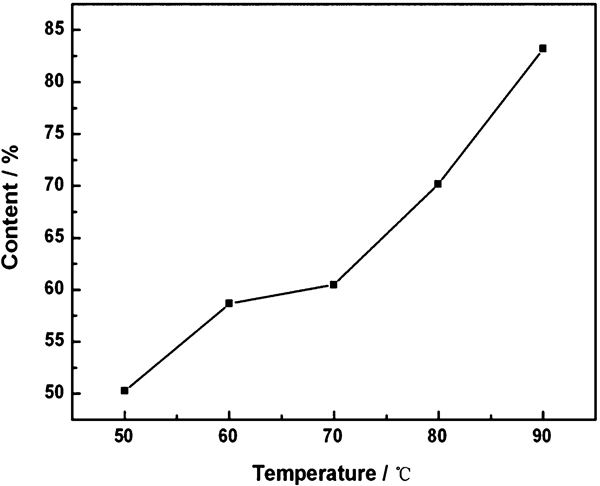
Plot of Cd content versus deposition temperature in CdZn codeposits, which were obtained from ChCl–EG DES containing 0·25–0·25 mol L−1 of CdCl2–ZnCl2 at −1·30 V on copper substrates
The dependence of Cd content on the molar ratio of ZnCl2–CdCl2 in the ChCl–EG DES is shown in Fig. 7. The Cd content decreased from 83 to 45 at-% as the molar ratio of ZnCl2/CdCl2 increased from 1 to 5. A high concentration of Zn2+ in the electrolyte solution could decrease the electrodeposition overpotential of Zn according to the Nernst equation. Hence, the controllable Cd content can be varied from 45 to 83 at-% in CdZn alloy coatings by adjusting the ZnCl2/CdCl2 ratio.
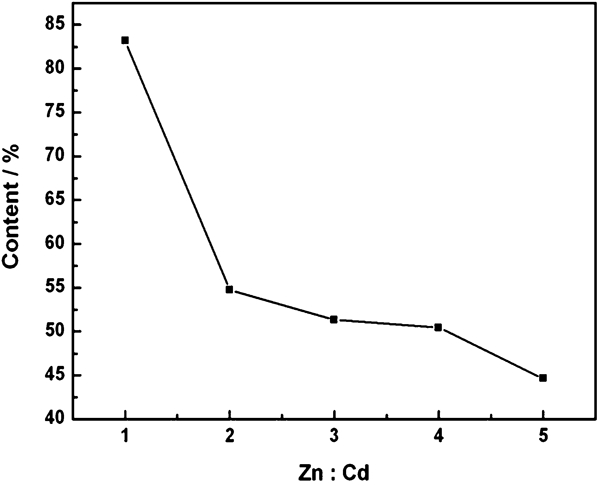
Plot of Cd content versus deposition molar ratio in CdZn codeposits, which were obtained from ChCl–EG DES at −1·30 V on copper substrates at 90°C
Conclusion
The electrochemical behaviour of the electrolyte system was studied via LSV. The electrochemical study showed that CdZn codeposition occurred when the deposition potential was prolonged to the potential range, leading to the underpotential deposition of Zn on the Cu electrode. The XRD showed that CdZn is a simple eutectic system that does not form any intermetallic compound at room temperature. The cauliflower-like electrodeposits appeared at low applied voltage. However, the morphologies of the codeposits changed at high applied voltage. The content of Cd in the codeposits, which varied from 45 to 83 at-%, depended on the deposition potential, Cd(II) molar ratio and temperature.