






Abstract
Corrosion behaviour of Co–W coatings deposited on copper substrates was studied in 3·5 wt-% NaCl aqueous solution using polarisation technique. The physicochemical characterisation of the alloy coatings was studied by scanning electron microscopy and energy dispersive X-ray analysis techniques. The study revealed the extent of shift in corrosion potential towards the noble direction and the decrease in corrosion current density for Co–W coatings. Among the various Co–W coatings studied here, the Co78·5W21·5 coating presented the best corrosion behaviour and superior corrosion potential compared to pure cobalt coating. In addition, their catalytic activity towards methanol electro-oxidation in alkaline medium was assessed by cyclic voltammetry technique. In cyclic voltammetry studies, Co–21·5 wt-%W electrode shows a significantly higher response for methanol oxidation than pure cobalt electrode.
Introduction
Cobalt–tungsten alloys are of interest due to their exceptional hardness (670 kgf mm−2) and high corrosion resistance in acidic and alkaline media. Therefore, they can be used in valves, dies, cutting tools, gas turbines and jet engines.1, 2 In the electronic industry, Co–W alloys are used as barrier layers to prevent diffusion of copper into gold.3 Replacement of hard chromium coatings deposited from hexavalent chromium (these baths are toxic and carcinogenic) is another goal to produce Co–W coatings.4, 5 Although pure tungsten can be electrodeposited from its florid melt,6 it cannot be deposited from organic and/or aqueous solutions.6 – 8 This refers to its low deposition potential.8 To overcome this problem, iron group metals can be added to aqueous solutions.6 According to Podlaha and Landolt,9 the addition of iron group metals to aqueous solutions containing molybdenum and/or tungsten would cause co-deposition of both elements. This mechanism is called ‘induced codeposition’.9 Tungsten containing alloy coatings can be produced with widely different compositions and microstructures, depending on the composition of the plating bath and the deposition parameters. Amorphous, crystalline and nanocrystalline forms of Co–W and Ni–W electrodeposits have been reported in the literature.10 – 12 The development of Co–W and Ni–W alloys with amorphous or nanocrystalline structures is expected to be of particular future interest since materials with such microstructures often possess better corrosion resistance and tribological properties when compared to their crystalline counterparts.
Considerable efforts have been directed towards the study of methanol electro-oxidation at high pH. The use of alkaline solutions in a fuel cell has many advantages, such as increasing its efficiency,13, 14 higher efficiency of both anodic and cathodic processes, almost no sensitivity to the surface structure15 and negligible poisoning effects.16 Intensive researches have been devoted to develop an active electrocatalyst for oxidation of methanol mainly with the aim of developing high performance methanol fuel cells.17, 18 Most of the works reported in the literature deal with Pt and Pt based alloys in acid medium.17, 18 Pt based alloys have been considered most active for this reaction. However, the cost price and limited supply of Pt constitute a major barrier to the development of direct methanol fuel cells.19 In addition, Pt based electrodes generally become deactivated due to surface poisoning20 by the reaction intermediates, particularly CO molecule. It is therefore of interest to investigate low cost non-noble metals and their alloys as well as oxides for electrocatalysis of the methanol oxidation reaction in alkaline medium.
Generally, intensive research has been directed towards the development of electrocatalysts aiming at lowering the normally large overpotential encountered in the electro-oxidation of materials and, in particular, the fuels in the emerging fuel cell systems.21, 22 However, the research of the electrocatalytic properties of Co–W alloys for the oxidation of methanol was seldom reported.
The aim of this work is to study the electrodeposition of Co–W coatings from environmentally friendly citrate–ammonia solutions containing high amounts of ammonia. Furthermore, in this work, a comparative study is made of the corrosion and electrocatalytic properties of electrodeposited pure Co and Co–W coatings.
Experimental
Solutions were prepared from analytical grade chemicals, dissolved in water purified by a Millipore Milli-Q system. Alloyed tungsten coatings were electrodeposited on mechanically polished copper. Just before electrodeposition, the substrates were degreased and activated in 10% sulphuric acid. Then, alloy coatings were electrodeposited from citrate–ammonia baths containing 0·071 mol L−1 cobalt sulphate (CoSO4.7H2O), sodium tungstate (Na2WO4.2H2O) variable (0–0·196 mol L−1), 0·066 mol L−1 ammonia sulphate [(NH4)2SO4], 0·412mol L−1 sodium citrate (Na3C6H5O7.2H2O) and a surfactant such as 0·00001 mol L−1 sodium dodecyl benzene sulphonate [CH3(CH2)10CH2OSO3Na]. The bath was maintained at pH of 9·2, temperature of 60°C and current density of 30 mA cm−2, and the plating time was 30 min during which the bath was agitated. A platinum sheet was used as anode.2, 23, 24
The surface morphology of the Co–W electrodeposits was analysed using a Philips XL30 scanning electron microscope (SEM). The coating compositions were analysed by an energy dispersive X-ray apparatus attached to the SEM. Each sample was measured at different locations to confirm uniformity.
The electrochemical studies were carried out in a conventional electrochemical cell. A standard three-electrode cell arrangement was used in all experiments. A platinum sheet of geometric area of ∼20 cm2 was used as counter electrode, while all potentials were measured with respect to a commercial saturated calomel electrode. The catalytic activity of the electrodes towards the methanol electro-oxidation in 1M NaOH solution was tested by cyclic voltammetry. However, all the electrochemical corrosion tests involved at least triplicate samples and were conducted at room temperature in an aerated 3·5 wt-% NaCl aqueous solution by using linear Tafel polarisation. Polarisation curves were recorded in a potential range of E = corrosion potential Ecorr±200 mV with a scan rate of 0·2 mV s−1. Electrochemical experiments were carried out using a Princeton Applied Research, EG&G PARSTAT 2263 advanced electrochemical system run by PowerSuite software.
Results and discussion
Effect of concentration of tungstate
The effect of the concentration of Na2WO4 at constant concentration of other compounds and at 60°C, pH 9·2 and current density of 30 mA cm−2 on the tungsten weight per cent in the deposits is shown in Fig. 1. It is observed that the tungsten weight per cent in the deposit increases significantly as the concentration of Na2WO4 increases and eventually reaches a maximum of ∼0·106 mol L−1. With a further increase in the Na2WO4 concentration, the weight per cent of tungsten in the deposits decreases. The advantages of using a low concentrated solution of Na2WO4 are high cathodic current efficiencies and high conductivity. An increase in concentration under given conditions decreases the efficiency and cathodic polarisation and thereby decreases the deposition rate and the tungsten weight per cent in the deposit. Generally, Fig. 1 supports the idea induced effect of cobalt in tungsten codeposition successfully.
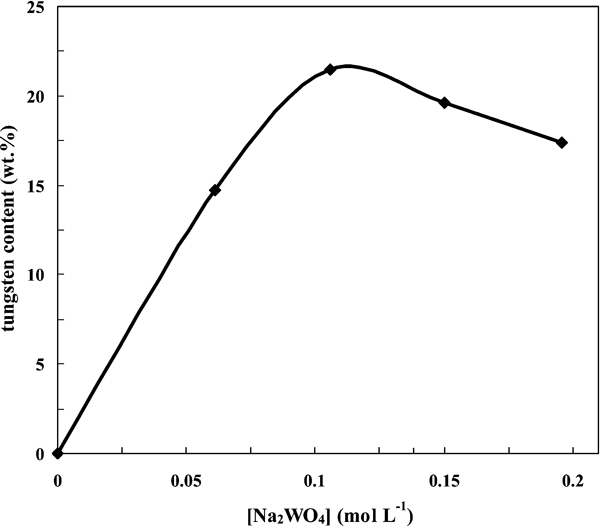
Effect of sodium tungstate concentration in electrolyte on tungsten content of coatings
Morphology and composition of coatings
Figure 2 shows how the surface morphology changes with the increase in tungsten content in the deposit. The Co–W alloy deposit morphology was compared with the morphology of a pure cobalt deposit. The crystal structure of pure cobalt is nodular (Fig. 2a). The addition of tungsten to cobalt deposit led to refining the structure and strong change in coating appearance. When the tungsten per cent was 21·5 wt-%, the coating layer was bright with fine grained structure, where grain size was between 5 and 10 μm (Fig. 2b).
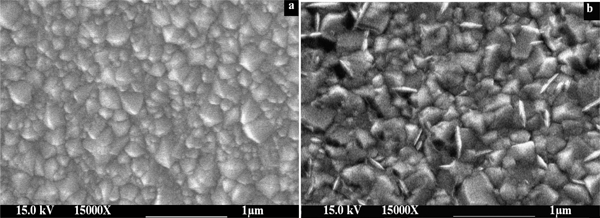
Surface morphology (SEM) of pure cobalt electroplating and Co–21·5W alloy coating deposited from plating baths containing various concentrations of Na2WO4:
Corrosion behaviour
The corrosion potential Ecorr and the corrosion current density icorr were calculated from the intersection of the cathodic and anodic Tafel curves and the extrapolated cathodic and anodic polarisation curves. Figure 3 shows the polarisation curves of the Co and Co–W coatings after 60 min immersion in 3·5 wt-% NaCl solution at room temperature. The Ecorr difference among Co–W deposits is due to the alloy phase difference and the difference in chemical composition. The corrosion potential of the cobalt coating is more negative than that of the coated copper with Co–W. Between the coating materials, Co–21·5W alloy coating shows nobler corrosion potential (−0·267 V) than other coatings. Therefore, it can be said that the Co–21·5W coating has nobler Ecorr, the lowest icorr and thus potentially better corrosion resistance in the active region. The dissolution of cobalt species is due to the Cl− attack (e.g. CoO+H2O→Co2++2OH−). In addition, during the corrosion process, tungsten preferentially migrates towards the surface and forms oxides.
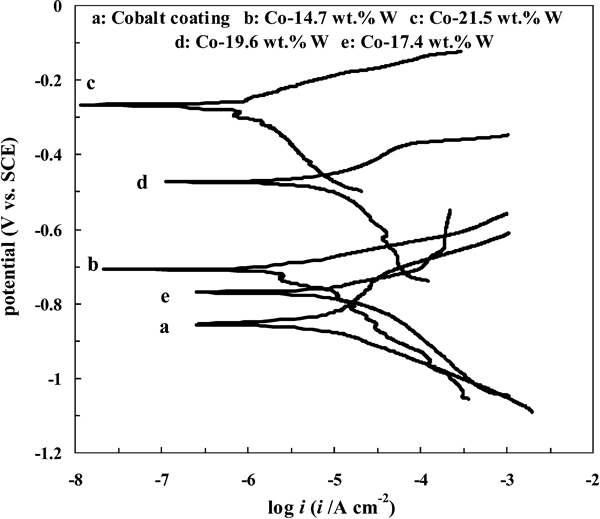
Polarisation curves of pure cobalt and Co–W alloy coatings in 3·5 wt-% NaCl solution at scan rate of 0·2 mV s−1
Cyclic voltammetry
In order to compare Co–W electrodes with pure Co electrode, the method of cyclic voltammetry was applied. Figure 4 presents cyclic voltammograms of Co and Co–W electrodes in 1M NaOH solution recorded at a scan rate of 50 mV s−1. It is evident from Fig. 4 that both anodic and cathodic peak current densities on Co–W electrodes are higher than that of the pure Co electrode. Among these electrodes, Co–21·5W has the best electrocatalytic properties in alkaline medium. Figure 5 shows cyclic voltammograms of pure Co and Co–21·5W electrodes in 1M NaOH+0·1M methanol solution at a scan rate of 30 mV s−1. An increment in the anodic peak current for peak I followed by the appearance of a new peak (II) at more positive potential are the main effects observed upon the addition of 0·1M methanol to the electrolyte. According to the literature related to methanol electro-oxidation at nickel electrodes,16,
22,
25,
26 peak I is referred to the α-Co(OH)2/CoOOH redox couple, and another peak II was assigned to the methanol electro-oxidation. The appearance of the new anodic peak II shows that methanol oxidation takes place after the oxidation of Co(OH)2 to CoOOH.25,
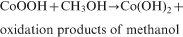
26 This phenomenon is similar to the pure cobalt electrode. The Co2+/Co3+ redox couple acts as a catalyst for the oxidation of methanol in basic solutions. The current density for methanol oxidation on Co–21·5W electrode is greater than that observed for pure Co electrode. This result may also be attributed to the larger surface roughness of the Co–21·5W electrode. The influence of the scan rate on the cyclic voltammetry behaviour of Co–21·5W electrode in 1M NaOH/0·1M methanol is shown in Fig. 6a. As the scan rate increases, the anodic peak potential shifts to more positive, and the cathodic peak potential is converted to a slightly negative direction. The plot of cyclic voltammetric peak currents Ipa against the square root of the scan rate ν1/2 gives a reasonable linear relationship (R2 = 0·997) (Fig. 6b), suggesting that the electrocatalytic oxidation of methanol on Co–21·5W electrode is a diffusion controlled process. In the case of alkaline electrolyte, the active ionic species is OH−, and the electrochemical M(II)→M(III) oxide transformation process at cobalt electrodes can be represented by27


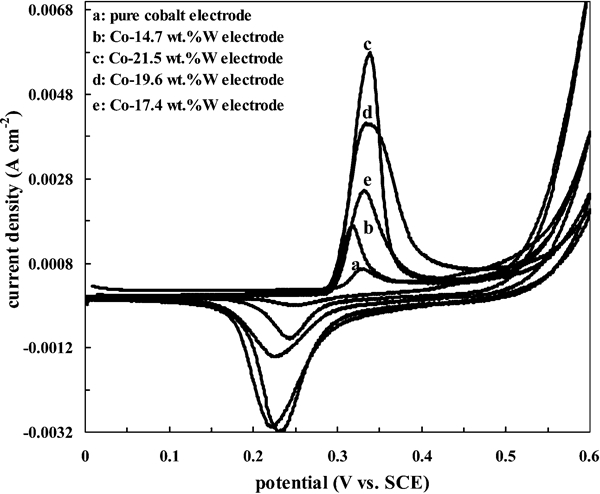
Cyclic voltammograms for different electrodes in 1M NaOH solution at 20°C with scan rate of 50 mV s−1
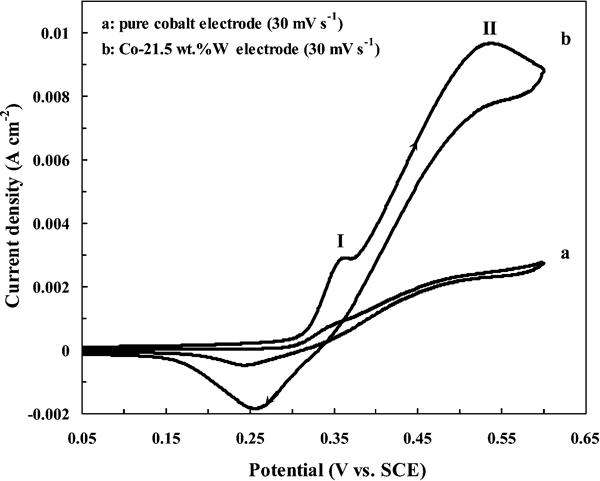
Cyclic voltammograms of a pure cobalt electrode and b Co–21·5W electrode in 1M NaOH+0·1M methanol with scan rate of 30 mV s−1
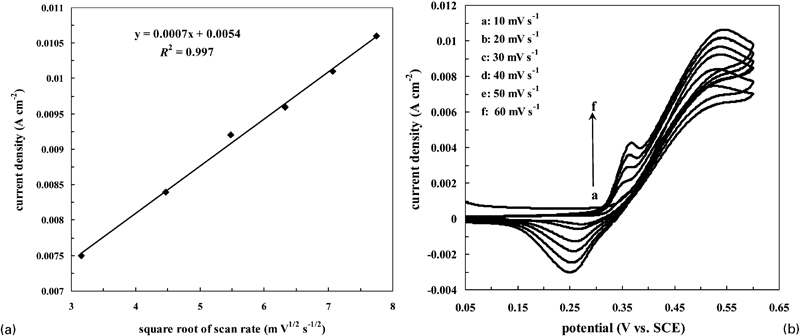
a cyclic voltammograms obtained in 1M NaOH+0·1M methanol for Co–21·5W electrode in various scan rates and b plot of variation of anodic current density with ν1/2
Conclusion
The surface morphology of Co–W coatings is different compared with pure cobalt coating. Polarisation measurements indicated that the incorporation of tungsten in the Co matrix led to a decrease in corrosion current density and increase in potential corrosion so that the Co–21·5W coating deposited at a solution with 0·106 mol L−1 sodium tungstate concentration is concluded to be the best corrosion resistant coating compared to other coatings. The cyclic voltammetry results exhibited that during the anodic potential sweep, the electro-oxidation of methanol follows the formation of CoOOH on the electrode surface and is then catalysed by CoOOH. In addition, the cyclic voltammetry studies showed that the Co–21·5W electrode behaves as an efficient catalyst for the electro-oxidation of methanol in basic media, and its electrocatalytic activity towards methanol oxidation is higher than that of the pure cobalt electrode.
Footnotes
Acknowledgements
This research was supported by the Islamic Azad University, Toyserkan Branch, Toyserkan, Iran.