







Abstract
A potent catalyst, platinum nanoparticles (Pt-NPs) supported on titanium substrate (Pt-NPs/Ti), was prepared. The morphology and surface analysis of Pt-NPs/Ti electrodes were investigated using scanning electron microscopy and energy dispersive X-ray spectroscopy respectively. The results indicate that Pt-NPs are homogeneously deposited on the surface of titanium plates. Electrochemical characteristics of formic acid oxidation on Pt-NPs/Ti electrodes were investigated via cyclic voltammetric in mixed 0·1M formic acid and 0·1M H2SO4 solutions. The results were compared to those at a polycrystalline smooth platinum electrode. It was found that the electrocatalytic oxidation of formic acid on the Pt-NPs/Ti electrode increases the rate of formic acid electro-oxidation several times larger than a smooth platinum electrode and confirmed the better electrocatalytic activity and stability of Pt-NPs/Ti electrodes.
Introduction
Direct formic acid fuel cell (DFAFC) has attracted great attention as a power source for portable electronic devices because of its advantages over direct methanol fuel cell.1 – 3 Although methanol has higher theoretical energy density than formic acid, it has some disadvantages, such as inherent toxicity, slow electrocatalytic oxidation kinetics, having a high crossover through the polymer membrane and a complicated reaction process.4, 5 In contrast, formic acid is non-toxic and has low crossover, which makes it possible for DFAFC to work at high concentrations.6 – 8 Platinum has been extensively used for the electrocatalytic oxidation of formic acid. However, it has been conclusively shown that platinum could affect the anode activity by greatly poisoning carbon monoxide. Many efforts have been devoted to reduce the poisoning effect by modifying the platinum surface. In order to reduce the amount of noble metal loading and also for enhancement of electrocatalytic activity of electrodes, there have been considerable efforts to increase the dispersion of metal particles on different supports. Titanium is corrosion resistant and has high mechanical strength, reasonable cost, wide electrochemical potential windows and good stability. Because of its excellent properties, titanium has been applied as a substrate in order to prepare novel and stable electrocatalysts, including the well known dimensionally stable anodes (DSA) electrode.9 – 11 The titanium supported catalysts present significant electrocatalytic activity towards methanol oxidation.12, 13 Compared with the conventional structure of the anode, the titanium anode has many advantages,14 such as simplicity, easily produced on a mass scale, low cost and allowing flexibility in terms of shape. Titanium anodes prepared by the deposition of platinum directly on titanium have been used in direct alcohol fuel cells and show higher performance than platinum supported on carbon black.15 – 18 The DFAFCs were investigated thoroughly, and different authors have used different nanoparticles as electrocatalyst for electro-oxidation of formic acid.19 – 28 To the best of our knowledge, the electro-oxidation of formic acid on titanium coated with noble metals is not reported in the literature. In the present work, for the first time, we prepared a high activity electrocatalyst based on the deposition of platinum nanoparticle (Pt-NP) on titanium plate and studied their electrochemical activity for formic acid electro-oxidation using cyclic voltammetry.
Experimental
Solutions, chemicals and electrochemical measurement
All chemicals used were of analytical grade. All electrochemical experiments were carried out at room temperature. Distilled water was used throughout. The electrochemical experiments were performed in a three-electrode cell arrangement. A platinum sheet was used as counter electrode, while all potentials were measured with respect to a commercial saturated calomel reference electrode. Electrochemical experiments were carried out using a Princeton Applied Research, EG&G PARSTAT 2263 Advanced Electrochemical system run by Powersuite software.
Preparation of Pt-NPs/Ti electrodes
Titanium discs were cut from titanium plates and mounted using polyester resin. The titanium electrodes was first mechanically polished and then chemically etched by immersing in a mixture of HF/HNO3 1∶3 solution for 1 min. Before electrodeposition, titanium samples were degreased by sonicating in acetone and ethanol followed by rinsing with distilled water. The Pt-NPs were electrochemically deposited at the surface of titanium substrate (Pt-NPs/Ti) from 1 mM H2PtCl6 in aqueous 0·1M H2SO4 solution as the supporting electrolyte. The deposition conditions were a current density of 10 mA cm−2 for 5 min, and the temperature is maintained at 45°C.
Surface morphology of electrodes
For characterising the morphology of Pt-NPs deposited on titanium substrates, a scanning electron microscope (Model XL30, Philips, The Netherlands) was employed with an accelerating voltage 15 kV. To identify the element composition, an energy dispersive X-ray was employed with an accelerating voltage 16 kV.
Results and discussion
Morphology of Pt-NPs/Ti electrodes
Figure 1a illustrates the SEM images of Pt-NPs deposited on the titanium plate. It can be seen that Pt-NPs with diameters of ∼20–40 nm are distributed in an almost homogeneous manner at the surface of the titanium plate. Figure 1b shows the EDX spectrum of Pt-NPs/Ti electrodes, and the result confirms the presence of Pt-NPs on the titanium palates.
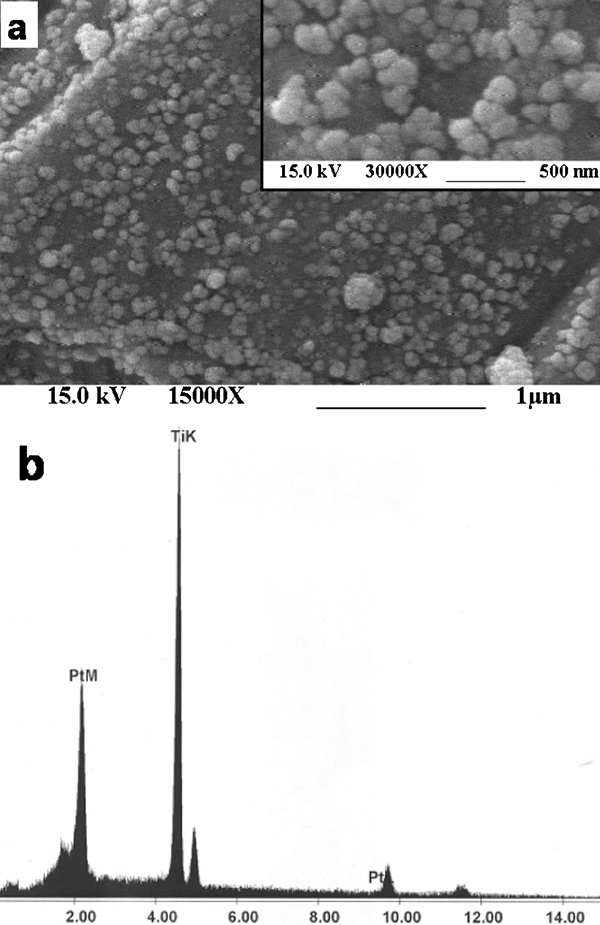
a surface morphology of Pt-NPs deposited on titanium plate and b EDX of Pt-NPs/Ti electrodes
Characterisation of Pt-NPs/Ti electrode surface
To determine whether the electrodeposition procedure had resulted in the removal of the oxide layer, thereby ensuring good electrical contact between the platinum deposit and the underlying substrates, the Pt-NPs/Ti were tested as electrodes using a one-electron redox couple. Figure 2 shows the voltammetric curves for the reduction in K3Fe(CN)6 on smooth platinum, Pt-NPs/Ti and titanium electrodes. The voltammogram for the Pt-NPs/Ti electrodes shows the expected reversible behaviour for the reduction on a bulk platinum electrode. In comparison, the voltammogram obtained with one titanium electrode shows increased peak separation and peak widths. This is probably attributable to a passivating surface film, most likely the oxide layer present on the surface of the titanium electrode. The presence of such a passivating layer would shift the position of the peaks for the redox reaction of the ferri/ferrocyanide to greater overpotentials, increasing the peak separation and reducing the peak heights, as observed. The lack of such resistances and overpotentials observed on repeated redox cycling of Pt-NPs/Ti electrodes indicates that there is no significant resistive film between the underlying titanium and the deposited platinum film. It suggests that the adhesion and electrical contact property of the deposited platinum film with titanium is quite satisfactory, and because of the high surface area of Pt-NPs/Ti electrode, the current density is much more than the smooth platinum electrode.
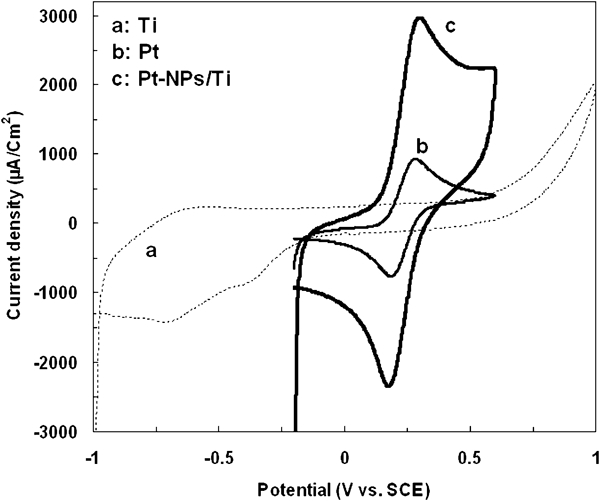
Cyclic voltammograms for Pt-NPs/Ti (1×1 cm), smooth platinum (1×1 cm) and bare titanium (1×1 cm) electrodes recorded solution containing 10 mM K3[Fe(CN)6]+1M KCl at 25°C with scan rate of 100 mV s−1
Electrocatalytic activity of Pt-NPs/Ti and smooth platinum electrodes for formic acid electro-oxidation
In order to compare the Pt-NPs/Ti electrode with the smooth platinum electrode, the cyclic voltammetry method was used to estimate the electrocatalytic behaviour of the electrodes. Figure 3 shows the comparison of oxidation of formic acid on the smooth platinum electrode and the Pt-NPs/Ti electrode. It can be seen from Fig. 3 that the cyclic voltammogram of Pt-NPs/Ti electrode (curve b) shows the usual characteristics of smooth Pt electrode (curve a) except that for both forward and reverse scan directions the oxidation currents of formic acid on the Pt-NPs/Ti electrode are significantly higher than on the smooth Pt electrode, indicating that the surface area of the Pt-NPs/Ti electrode was enlarged by the dispersion Pt-NPs on titanium plates. Figure 3, inset A, shows the cyclic voltammograms of 1 cm2 smooth platinum electrode in 0·1M H2SO4 aqueous solution at a scan rate of 100 mV s−1 without formic acid (dash line) and at present 0·1M formic acid (solid line). Cyclic voltammetry data were recorded for 1 cm2 Pt-NPs/Ti electrode in 0·1M H2SO4 aqueous solution at a scan rate of 100 mV s−1 without formic acid (dash line) and at present 0·1M formic acid (solid line), as shown in Fig. 3 (inset B). It can be seen from the cyclic voltammetry of formic acid oxidation on the Pt-NPs/Ti electrode that the reaction commences in the hydrogen region and proceeds slowly in the positive direction, and then reaches a plateau at about −0·20 V. At potentials with more than ∼0·00 V, the reaction becomes accelerated, and the maximum rate at ∼0·78 V occurs. Another increase in current at potentials more than ∼1·10 V is assigned to the reaction intermediates and poisonous adsorbed species to CO2 and oxygen evolution reaction. Upon reversing the potential sweep, a very steep increase in the reaction rate at ∼0·48 V develops, and a maximum current is observed at ∼0·42 V. After that, the current gradually decreases, but the reaction rate is still faster than in the forward scan. This large anodic peak in the reverse scan is attributed to the removal of the incompletely oxidised carbonaceous species formed in the forward scan.28
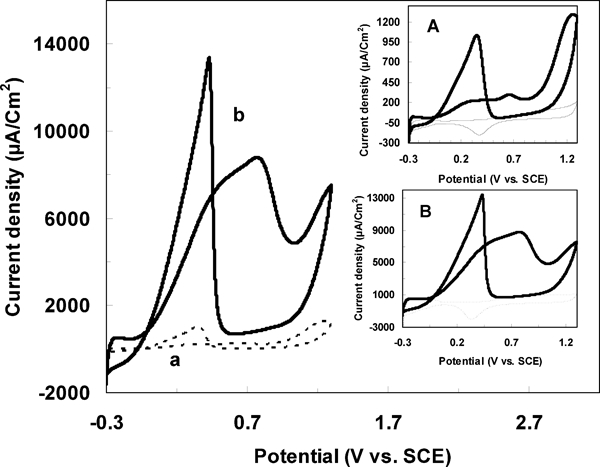
Cyclic voltammograms for (a) Pt-NPs/Ti and (b) smooth Pt electrodes in 0·1M H2SO4+0·1M formic acid aqueous solution at 25°C with scan rate of 100 mV s−1: (A) cyclic voltammogram for smooth platinum and (B) cyclic voltammograms for Pt-NPs/Ti in 0·1M H2SO4 without (dash line) and with (solid line) 0·1M formic acid
It has been widely accepted in the literature that formic acid in the forward scan is oxidised to CO2 via a dual pathway mechanism, i.e. direct and indirect oxidation processes involving dehydrogenation and dehydration. In the direct pathway mechanism, i.e. dehydrogenation pathway, the HCOOH adsorbed on Pt sites is converted to CO2 without the formation of poisonous COads species




Cyclic voltammetric data under different scan rates were recorded on the Pt-NPs/Ti electrodes in a solution containing 0·1M formic acid–0·1M H2SO4, as shown in Fig. 4. It is seen from Fig. 4 that with the increase in the scanning rates, anodic currents increase, and a linear relationship of the anodic peak currents against the square root of scan rate ν1/2 (inset) ensures that the reaction is a diffusion controlled process.
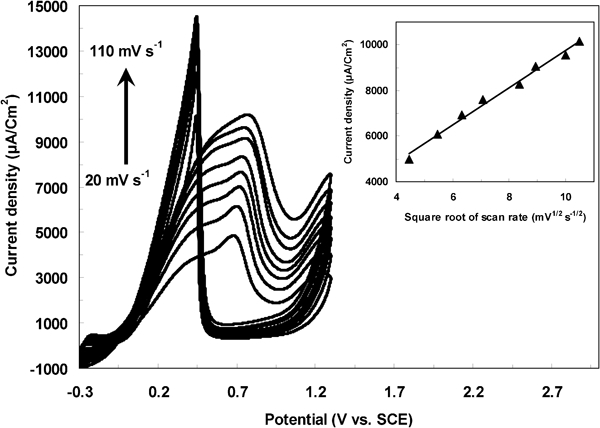
Cyclic voltammograms of formic acid oxidation on Pt-NPs/Ti electrode in 0·1M H2SO4+0·1M formic acid aqueous solution at different scan rates: (inset) dependence of formic acid oxidation peak current on square root of scan rates
The long term stability of Pt-NP/Ti was examined in 0·1M H2SO4 aqueous solution containing 0·1M formic acid (Fig. 5). It can be observed that the anodic current remains constant with an increase in the scan number at the initial stage and then starts to decrease after 50 scans. The peak current of the 200th scan is ∼96% than that of the first scan. After the long term cyclic voltammetry (CV) experiments, the Pt-NP/Ti was stored in water for a week; then, formic acid oxidation was carried out again by CV, and excellent catalytic activity towards formic acid oxidation was still observed. This indicates that the Pt-NP/Ti electrodes prepared in our experiment have good long term stability and storage properties.
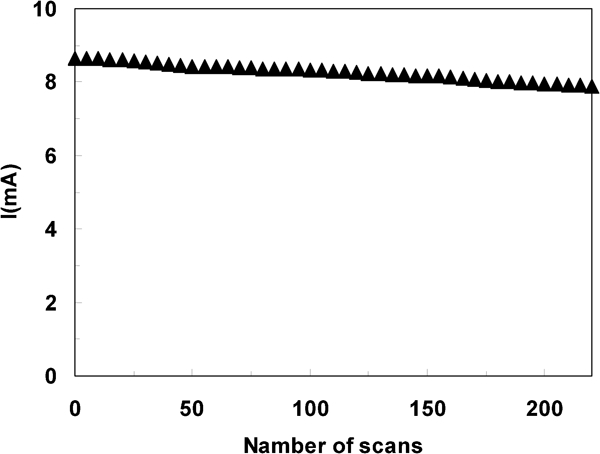
Plot of anodic peak current in electro-oxidation of 0·1M formic acid as function of scan number in cyclic voltammetric method at scan rate of 100 mV s−1 (long term stability of Pt-NP/Ti electrode)
Conclusion
The Pt-NPs/Ti electrode with good electrocatalytic property has been successfully fabricated by electroplating of platinum on titanium plates. The electrocatalytic activity of the Pt-NPs/Ti electrode for formic acid oxidation was evaluated by electrochemical methods. The Pt-NPs/Ti electrode showed much higher currents of formic acid oxidation and better stability than the smooth platinum electrode. Compared to modified carbon electrodes requiring tedious preparations and pretreatment procedures, Pt-NPs/Ti electrodes can easily be prepared without any further need for modification; thus, from a practical point of view, these new electrodes show great prospect in the applications of alcohol fuel cells.
Footnotes
Acknowledgements
This research was supported by the Islamic Azad University, Toyserkan Branch, Toyserkan, Iran. The authors would like to acknowledge the financial support of the Iranian Nanotechnology Society.