







Abstract
We present results of our efforts to develop thin films that may prove to be appropriate solid electrolytes for lower operating temperature solid oxide fuel cells. The electron beam evaporation technique has been used to deposit yttrium stabilised zirconia (YSZ: ZrO2 stabilised with 8 wt-%Y2O3) thin films on a variety of porous and non-porous substrates. Thin films have been grown on conducting films on glass, monocrystalline silicon wafers and highly porous NiO/YSZ substrates. Some of the porous substrates have been polished in order to be able to support thinner films. Films ranging from 0·2 to 2 μm in thickness have been manufactured. Submicrometre thin films have successfully been deposited on NiO/YSZ polished substrates. Operating technical parameters that influence the film properties were studied and the influence of substrate structure and deposition rate has been investigated. The film thickness has been measured in situ via a quartz crystal monitor and ex situ by a stylus profilometer. The morphology of the films has been studied by scanning electron microscopy. Samples have also been investigated in terms of chemical composition via X-ray photoelectron spectroscopy. Using the Scotch tape test, it has been found that the films exhibited good adhesive qualities; however, in some occasions, when annealed, cracks appeared. Using a polished – hence smoother – substrate has reduced the occurrence of cracks and other abnormalities. The electron gun power – and subsequently the rate of deposition – played an important role in film morphology. The latter presented an interesting crystallite structure in the nanometre range.
Introduction
Oxide ion conductivity was first observed in ZrO2 1 in the 1890s and even though, a wide range of materials, some with superior properties, have been introduced since zirconium oxides remain popular, due to their low electronic conductivity, low cost and ease of production and process. Yttrium stabilised zirconia (YSZ) is ZrO2 stabilised by 8 wt-%Y2O3 and is part of the fluorite structure family, along with CeO2–Ln2O3 electrolytes. A large number of techniques are used to fabricate YSZ films,2 such as press heating,3 tape casting,4 chemical vapour deposition,5 sputtering and e-beam deposition.6 – 8 Vapour deposition by the electron beam evaporation method allows good control of the film's thickness, porosity and stoichiometry. By varying the growth rate during the deposition, differing film properties can be achieved. This is important for achieving film quality that has the characteristics required for the application as very thin solid electrolyte. Another important parameter is the mode of the beam scan of the crucible that allows for minor differences in stoichiometry and deposition rate. The resulting film is homogenous and adheres well on the substrate, as can be easily seen by using the Scotch tape test. Using that technique, thin electrolyte films with a thickness in the range of 0·2–2 μm have been fabricated, in order to achieve high oxygen ion conductivity in a solid oxide fuel cell (SOFC) device.
Solid oxide fuel cells are all solid state devices designed to operate at high temperatures (700–1000°C). The attractiveness of SOFC technology stands with its efficient generation of electrical power from a variety of fuels for a wide range of fuel applications.9 – 12 Therefore, during the past years, the SOFC has received much attention and development effort,13 – 16 all converging in the ultimate development of an efficient and stable system.
Efforts to develop SOFCs operating at intermediate temperatures (600–800°C) aim at extending the lifetime of the devices and reducing the material costs for commercial applications. Accordingly, researchers worldwide work on developing a technically viable processing tool that can yield a thin and impervious electrolyte film, so that the operating temperature of the SOFC can be reduced to a level at which several years of stable system operation can be secured.
The performance of the cell depends critically on the resistance of the electrolyte. In addition to high ionic conductivity, the electrolyte must be stable in both reducing and oxidising environments and must also possess good mechanical and thermal properties. Another important aspect is the cell's operating temperature. Lowering the SOFC's working temperature will increase its lifetime and introduce less expensive and exotic materials in its configuration. However, lowering the operating temperature carries the drawback of reducing the ionic conductivity of the electrolyte. In order to enhance the oxide ion conductivity within the cell, it is crucial to reduce the thickness of the solid electrolyte. Thus, it will be possible to achieve satisfactory ion conductivity at lower working temperatures (∼700°C). In order to achieve this objective, substrates that have been subjected to a polishing procedure have been used, which led to a reduction in the porosity of the substrate surface. Therefore, films of smaller thickness can be successfully deposited on actual anode substrates.
Experimental
As mentioned above, vacuum techniques have been used for the preparation of the thin films examined in this study. The vacuum chamber that is used to manufacture the specimens consists of a glass cylinder cover, 45 cm tall and 30 cm in diameter that allows optical control during the deposition process. For the film deposition, an electron beam gun was used. This device consists of a W wire that is being subjected to high voltage (∼7 kV) and emits electrons of high kinetic energy. The resulting electron beam is guided by a combined electromagnetic field to a copper crucible containing the material to be deposited (YSZ), as shown in Fig. 1.
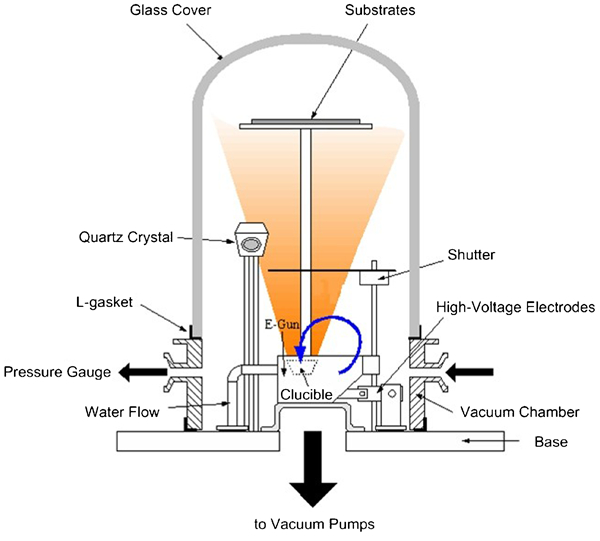
Vacuum chamber
The vacuum chamber is connected to a turbomolecular and a mechanical pump in series. Pirani and Penning gauges are used to measure the pressure before and during the deposition process. The thickness of the film is controlled during the deposition by the quartz crystal sensor and verified ex situ by use of a stylus profilometer.
Other techniques used to characterise the specimens morphologically and quantitatively are scanning electron microscopy (Zeiss SUPRA 35VP) coupled with energy dispersive spectrometry (EDS) apparatus. Moreover, the film's internal structure was analysed by X-ray diffraction (Bruker D8 Advance) using Cu Kα radiation and with the 2θ angle in the 10–80° range. Finally, the elemental composition of the specimens has been investigated by means of X-ray photoelectron spectroscopy (SPECS LHS-10UHV).
Yttrium stabilised zirconia films (0·2–2 μm thick) were deposited on different substrates: glass covered with a thin transparent conducting coating based on SnO2:F, float glass, microscope glass slides, YSZ and NiO/YSZ. Different types of substrates were chosen in order to study the influence of the substrate material and structure on the film growth process. For the anode supported SOFCs, an important factor in the determination of the maximum thickness of sufficiently dense electrolyte film is the pore structure of the anode substrate. Thus, the NiO/YSZ substrates that have been used had pores <1 μm in size. The samples were thoroughly cleaned in ultrasonic bath and heated at about 350–400°C before the YSZ film deposition.
For the NiO/YSZ substrate manufacture, NiO (Sigma Aldrich) with initial particle size of 325 mesh and stabilised zirconia (ZrO2 with 8 mol.-%Y2O3) from Stanford Materials have been used. A mixture of the two materials (56 wt-%NiO and 44 wt-%YSZ) was subjected to liquid grinding/homogenisation for 48 h. The final mixture composes of particles 90% smaller than 2·5 μm and 50% of them under 0·99 μm. Grain size analysis measurements were conducted with the laser technique in a laser particle analysis system (Masterizer 2000; Malvern). Consequently, the mixture has been dried, a binder has been added (phenolic resin from Borden) and it was formatted with monoaxial compression in pellets 2 mm thick and 13 mm in diameter. The samples were then heated up to their sintering temperature with a rate of 5°C min−1. Their respective porosity has been measured with the Archimedes method and has been found to vary from 25 to 35%, depending on the annealing temperature.
Some of the samples have been subjected to superficial polishing with a Buehler Ecomet 4 polishing system. Liquid polishing has also been conducted with the use of Microcut and Carbimet polishing papers. The latter technique has been applied in order to achieve smaller porosity values in the substrate surface and to be able to further reduce the thickness of the deposited electrolyte.
Results and discussion
Scanning electron microscopy/EDS characterisation
The chamber pressure during deposition was 2×10⁻⁵ mbar and the temperature was the ambient temperature. The growth rate for our purposes ranged from 5 to 40 Å s−1. Films deposited at lower rates presented better uniformity, while films created at higher rates exhibited abnormalities. The presence of these is evident by comparing Fig. 2a with b.
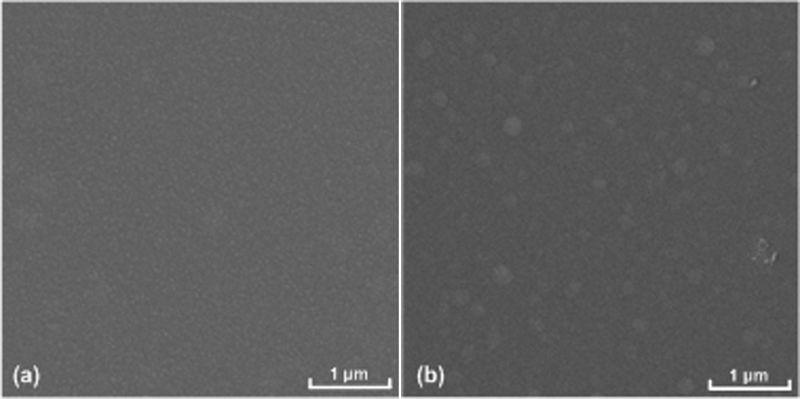
As deposited YSZ films deposited at a 5 Å s−1 and b 20 Å s−1
The deposited films were dense and very transparent and thus only the colour of the substrate was visible through the transparent electrolyte layer. The substrates were of both smooth (Fig. 3a and b) and porous nature (Fig. 4a and b). In Fig. 4 (scanning electron microscopy images), it can be seen that the films that are deposited on smooth substrates are uniform, as stated earlier. Only when we examine the film in the nanoscale region do we observe some texture, which consists of granules at the size of ∼50 nm. While observing the film structure in depth (Figs. 3b and 4b), we note that the cross-section of the film has the typical columnar structure of grains normal to the substrate plane that has also been observed by other investigators.16 – 18 Regarding porous substrates, it is observed that the deposited film covers the uneven surface of the substrate in a uniform way and follows its geometry (Figs. 3 and 4).
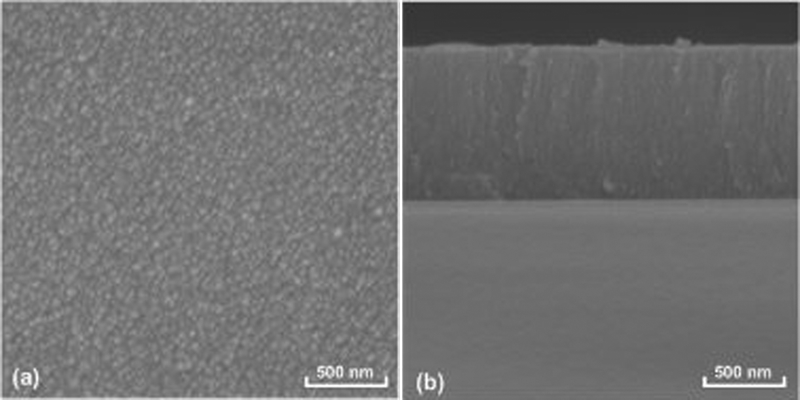
a top view and b cross-section of YSZ film deposited on smooth substrate (K glass)
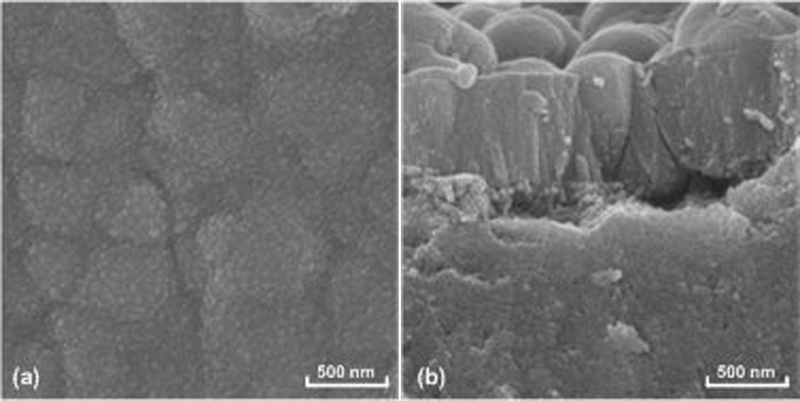
a top view and b cross-section of YSZ film on porous substrate (NiO/YSZ)
At the interface with the substrate – both the smooth and porous – the YSZ layer exhibits good adhesion, as all samples have passed the Scotch tape test (Figs. 3b and 4b). This test is frequently used as a general qualitative method of estimation of the adhesion of prepared films on various substrates. This test is used in order to characterise the adhesion of the film to the substrate. For this purpose, we apply a pressure sensitive tape on the deposited films and remove it. If the film does not come off with the tape, then the test is passed. Moreover, strong chemical and mechanical bonding is expected, especially, since the electron beam method is an atomic scale deposition method, in which the deposited materials are almost free of imperfections. Therefore, regarding the as deposited films, neither cracks nor any other sort of defect can be observed, not even at the film/substrate interface. This lack of imperfections results in excellent structural and diffusive properties (the latter regarding the O− diffusion in the electrolyte lattice, the electrolyte/anode interface and at the grain boundaries of the electrolyte).
In Figs. 5 and 6, the effect of the polishing process in both the substrate and the deposited film can be seen, which is obviously smoother and yields a more even film surface (Fig. 6). The difference in the morphology of the substrate in Fig. 6a to the typical NiO/YSZ morphology, which is depicted in Fig. 5a, is due to the polishing process in which the substrate has been subjected to. Some of the deposited films were annealed in air at 500 and 900°C in order to investigate the influence of high temperature – close to the working temperatures of the fuel cell – to the morphology and the stability of the deposited film. It has been observed that thermal treatment increases the crystallite size while binding the film better with the substrate and rendering it stiffer, in agreement with previous findings.19, 20
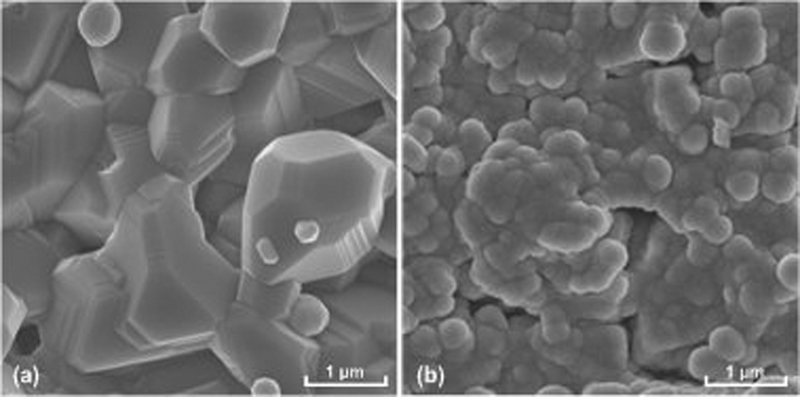
Top view of as prepared NiO/YSZ anode substrate a before and b after deposition of 1 μm thick YSZ film
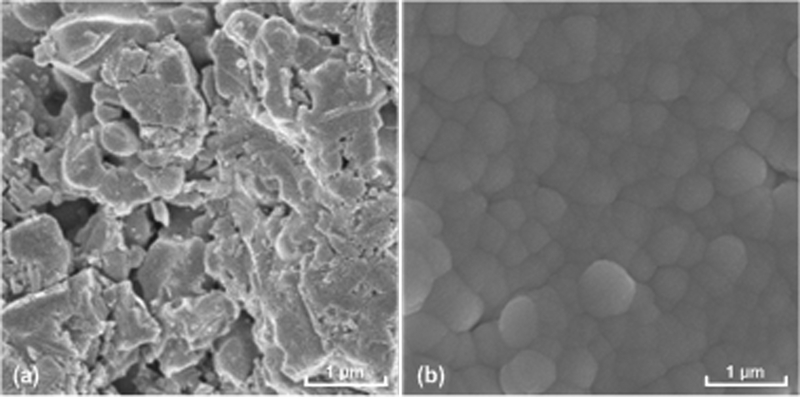
Top view of polished NiO/YSZ anode substrate a before and b after deposition of 1 μm thick YSZ film
The EDS results (Figs. 7 and 8) show that the ZrO2/Y2O3 ratio is not changed by the deposition process, which is explained by the similar evaporation temperatures of the two oxides. Therefore, the elemental stoichiometry of the film is the same as that of the chosen evaporated material in its initial form, regardless of deposition rate or the substrate type. The Ni traces present in the film spectrum (Fig. 8) may be explained by the diffusion of Ni atoms from the substrate, which contains a significant amount of Ni, as it is shown in the substrate spectrum (Fig. 7).
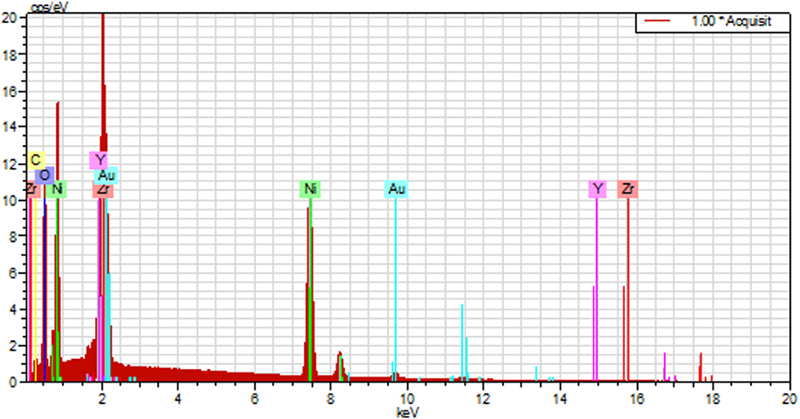
Energy dispersive spectrum of NiO/YSZ substrate
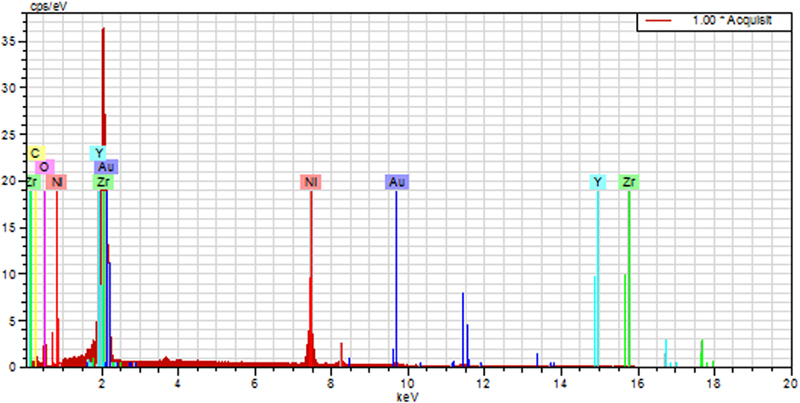
Energy dispersive spectrum of deposited YSZ film
X-ray diffraction
Zirconia exhibits three polymorphs. It has monoclinic structure at room temperature, changing to tetragonal above 1170°C and to the cubic fluorite structure above 2370°C. The addition of a doping material, such as yttria, stabilises the fluorite and tetragonal phases down to room temperature, leading to an increase in the oxide vacancy concentration. As mentioned elsewhere,21 the best ionic conductivity is registered when the crystalline orientation of the YSZ electrolyte is cubic (111). The film's crystallographic peaks are: (111), (200), (220), (311), (400), (331) and (420), indicating a multicrystalline nature in the film (Fig. 9). However, the prevailing orientation in the deposited films is the desired (111). The sharpness of the (111) peak is another indicator of the film homogeneity. The diffraction intensity of the (111) plane increases even more after sintering (Fig. 9). During the e-beam deposition process, the vapour stream consists of small clusters, depending on powder type. These clusters could be the initial growing stages influencing the entire film's structure, as the crystal structure of the deposited material is repeated on the deposited film. The crystal orientation of the film did not evidently depend on the substrate material and structure.
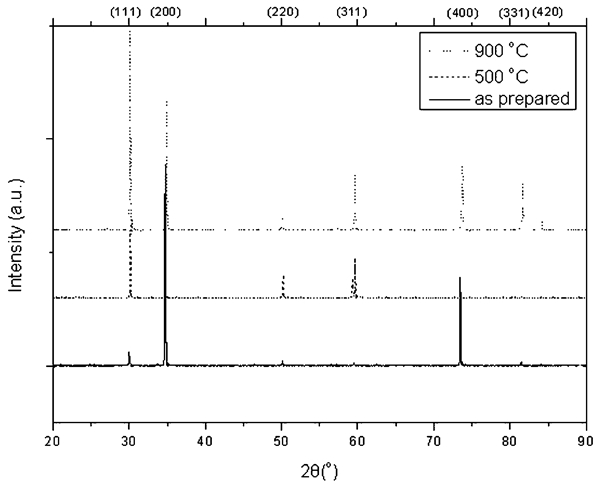
X-ray diffraction of deposited film before and after sintering at 500 and 900°C
X-ray photoelectron spectroscopy
X-ray photoelectron spectroscopy data are referred to the C 1s line at 284·6 eV (Fig. 10). The spectrum that refers to the O 1s peak was studied in order to acquire more information on the absorbed oxygen species on the electrolyte surface. The O 1s peak is analysed in two components at 531·6 and 533·1 eV. The lower energy peak has also been observed in other transition metals22 and is attributed to absorbed oxygen, while the higher energy peak corresponds to absorbed OH− species. In the Zr 3d peak, the spin-orbit splitting effect is observed, which gives two distinct peaks at 183·7 and 186·1 eV, in agreement with the peaks observed in fully oxidised ZrO2.23 The Zr 3d doublet is analysed using two Gaussian shaped peaks with full widths at half-maximum of 2·0 eV and a spin-orbit splitting of 2·35 eV. The intensity ratio of the two peaks is 1·26. The same splitting effect is present in the Y 3d spectrum (two peaks at 159·3 and 161·4 eV), also in accordance with literature.24 – 26 The Y/Zr ratio, determined by the Y 3d and Zr 3d peaks and corrected for sensitivity factors is 0·21. This corresponds to the Y/Zr bulk ratio of the YSZ target material used.
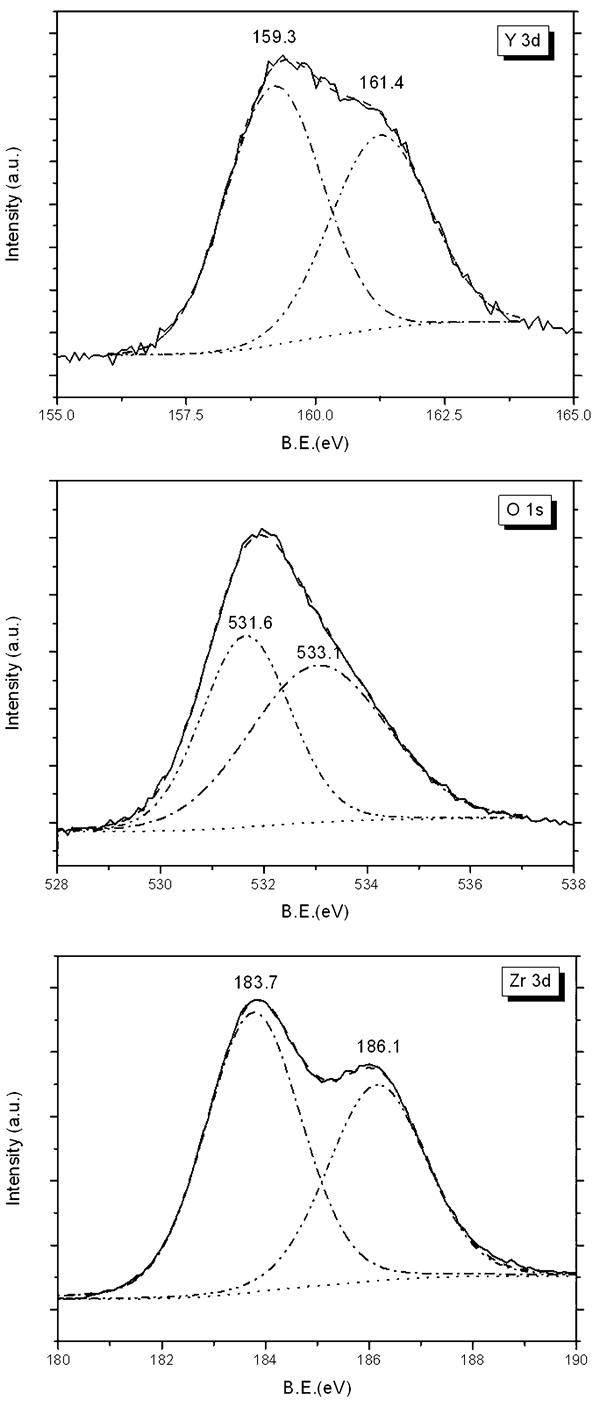
X-ray photoelectron spectra of Zr 3d, Y 3d and O 1s regions (measurements were corrected using C 1s peak at 284·6 eV as reference)
Conclusions
Lowering the SOFC's working temperature increases its lifetime and introduces less expensive and exotic materials in its configuration. However, lowering the operating temperature has the drawback of reducing the ionic conductivity of the electrolyte. In order to enhance the oxide ion conductivity within the cell, it is crucial to reduce the thickness of the solid electrolyte to the submicrometre level. In this way, it is possible to achieve satisfactory ion conductivity at lower working temperatures (∼700°C). This objective is achieved by using polished substrates, which presented lower porosity on substrate surface. Therefore, films of submicrometre thickness can be successfully deposited on actual anode substrates.
It can be concluded from our work on depositing YSZ films on various substrates that the electron beam gun vacuum deposition method is suitable for preparing thin YSZ films on a variety of substrates. The deposition rates using this technique are sufficiently high and the control of the film morphology is satisfactory. The adhesion of the film on the substrate and the homogeneity of the films are satisfactory, after acquiring some experience with the particular instruments that were used. The main conclusion on this point after many depositions is that the uniformity of the film depends crucially on the pore structure of the substrate. To this end, NiO/YSZ substrates with pores that were <1 μm in size have been used, which was achieved by polishing the substrate. It can be concluded that with this vapour deposition technique, the film's thickness, porosity, stoichiometry and growth rate can be strictly controlled during the deposition. The resulting film apart from being homogeneous also adheres well on the substrate. In particular, the films deposited on porous substrates with a smaller porosity exhibit even better qualities in terms of stability, and absence of impurities.
Footnotes
Acknowledgements
This paper is part of the 03ED375 research project, implemented within the framework of the ‘Reinforcement program of human research manpower’ (PENED) and cofinanced by National and Community Funds (20% from the Greek Ministry of Development – General Secretariat of Research and Technology and 80% from EU – European Social Fund). The authors also wish to acknowledge the preparation of substrates of varying porosity by Dr Vassilis Stathopoulos, Assistant Professor, Technical Educational Institute of Chalkida, Greece.