







Abstract
The Mycenaean necklace found in a tomb in the Limenaria cemetery at Mochlos, Crete, consists of a row of faience beads and a central gold bead, and it is dated to the LM IIIA period (about 1400–1300 BC). Studies on faience have shown that different production technologies were used in this period: efflorescence, cementation and direct application methods. The efflorescence method was used in Egypt. The manufacture of the faience from Mochlos indicates an Egyptian origin, but the shape and the style are Aegean. The gold bead shows a deliberately applied rose patination on one side and a normal golden colour on the other. The analyses showed that the composition of the pink film is very similar to that on Tutankhamun's sequins. The technique of colouring gold is known from objects found in royal tombs in Egypt. This piece of jewelry shows, like the faience, a strong Egyptian technological influence.
Keywords
Introduction
Among many other finds, the excavation carried out by the team of the Mochlos Excavation Project brought to light one object that appears to be of particular importance both for the study of surface treatments in antiquity and for its significance for the trade connections of the time. This find consists of a large number of light blue faience beads shaped like hearts or ivy leaves and a wheel shaped gold bead. Sixteen of the faience beads are complete and could be used for a reconstruction with the central decorated rosette (Fig. 1). At least 32 more beads in the group of faience fragments can be reconstructed, so that we can calculate that their original number must have been around 50. All together, they would form a long string, which could be worn as a necklace. The jewel was found in a double grave, i.e. Tomb 10, in the Limenaria cemetery at Mochlos, Crete. The tomb contained the bodies of a male and a female, presumably a husband and a wife. Both had a number of burial offerings placed with them in the grave or in the painted sarcophagus. Among the woman's grave gifts was a bronze bowl, with a mirror without a handle used as a cover. Inside the bowl, there were a broken necklace, a spindle hook, a fragmentary bronze pin and a gold plated copper ring.1 As we will see, the necklace is particularly important for the history of technology in eastern Mediterranean of the mid second millennium BC, and also for the reconstruction of cultural connections and trade patterns, because it indicates technological contacts between Crete and Egypt. In this special case, the connections are not limited to the import of wares or to the imitation of the shape and the style of imported objects, but are witnessed in the composition of the material and the production technology of the objects, i.e. they reflect a technological transfer between the two countries. The shape and style of the faience beads and those of the central rosette bead belong to the Aegean world; however, analyses of the materials of the necklace demonstrate a strong Egyptian influence in their production technology.2
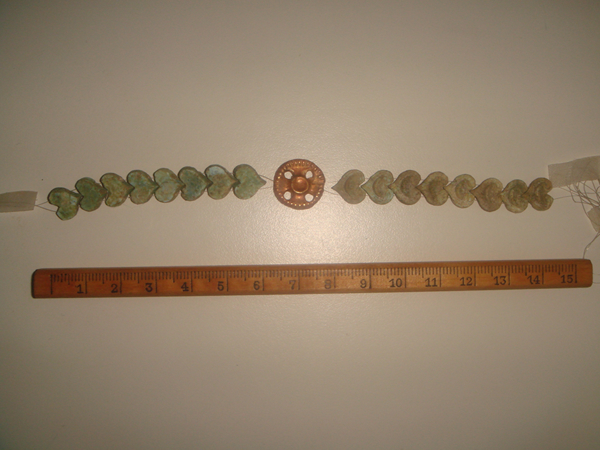
Faience and gold necklace found in Tomb 10 of the Limenaria cemetery at Mochlos, Crete (photograph A. Giumlia-Mair)
Excavation and site
The Mochlos Excavation Project is a joint Greek–American excavation under the direction of Jeffrey Soles, University of North Carolina at Greensboro, and Costis Davaras, University of Athens, under the auspices of the American School of Classical Studies in Athens and in cooperation with the Greek Archaeological Service. The excavations brought to light parts of the prepalatial settlement, dating to the third millennium BC; extensive remains of the Late Minoan IB settlement, dating to the sixteenth and fifteenth century BC; remains of the LM III reoccupation in the Mycenaean era, dating from 1400 to 1250 BC; and remains of a late Hellenistic fort and an early Byzantine settlement as well as 31 LM III chamber tombs located on a hill at Limenaria. The location and excellent harbour made it a major port on an overseas trading route that stretched through Cyprus, the near East and all the way to Egypt.
The necklace comes from Tomb 10 of the Mycenaean Limenaria cemetery.3 The graves are typical chamber tombs, mostly with a dromos (the entrance corridor) and an irregular chamber measuring 1·3–3 m across and 1–2 m high. They normally held one or two burials. Only one of them had been plundered, and most graves still had their original grave gifts. As a large number of the skeletons are fairly complete, it has been possible to identify age, sex and physical abnormalities of many of the people buried in the cemetery. In many of the tombs, male–female couples have been identified. As was the case with Tomb 10, the tombs containing two bodies were reopened to introduce the second person, and the earlier burial was relocated. In some cases, the couples were buried in adjacent tombs, and in one of these, Tomb 15, a tunnel was cut between the chambers. Most tombs contain at least two to four vessels placed around the burial, for example kraters for holding liquids, pitchers for pouring, conical cups and semiglobular bowls used as drinking cups, and stirrup jars for holding oil. The bodies were buried in decorated terracotta sarcophagi or in clay pithoi (large vessels).
The tomb in which the women who owned the necklace and the other jewels was found is a medium sized, rock cut chamber tomb.3 The latest pottery in the tomb can be dated to the LM IIIA2 period, most probably sometime early in that period, i.e. around 1370 BC. This is contemporary with the period of reign of Amenhotep III in Egypt.4 Both bodies had been placed in a tub shaped, decorated sarcophagus, which was set at the rear of the tomb (Fig. 2). The earlier burial was certainly that of the male, a mature individual in his early 40s at the time of death; the later burial was that of the female who died in prime adulthood in her early 30s. With all probability, they were husband and wife. When the female was buried, various offerings were placed in front of her sarcophagus. Among them were a bronze hemispherical bowl and a mirror, which are likely to have belonged to her during her life. The bowl was used as a jewelry box, and a fragmentary pin, ring, spindle hook and necklace were placed inside, while the mirror was then used as a lid to seal the bowl (Fig. 3). The spindle hook was used for weaving textiles, and this was clearly one of the woman's activities while she lived. From the analyses carried out on contemporary weaving hooks, for example from Gournia,5 it is evident that these items had a special meaning in the society of the time because the alloys employed are the same used for jewelry or in general for decorative objects of personal use, such as for example decorative pins. Possibly small personal tools were made of more expensive metal to also be used as decorative ornaments; multiple uses certainly should not be excluded. Furthermore, there also are parallel examples of similar objects made of Au and Ag.
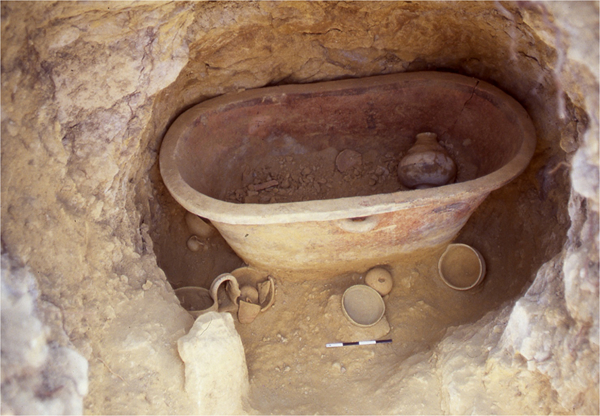
Tub-shaped sarcophagus in Tomb 10, used for the burial of a male-female couple (photograph J. Soles)
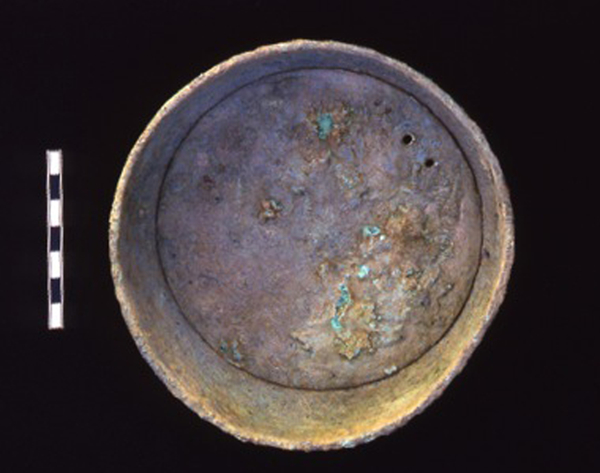
Hemispherical bronze bowl used as jewelry-box in Tomb 10. A fragmentary pin, ring, spindle hook and necklace were placed inside, while the mirror was used as a lid to seal the bowl (photograph J. Soles)
There was no evidence for the activities of the male, but apparently, he had some knowledge of Egypt or some kind of connection with it. On the inside of his sarcophagus, he had a scene painted which appears to have depicted an ordinary mortal on one side and a god of the underworld on the other side. The god is an animal headed figure with a long snout and two upright ears, perhaps a kind of dog or a jackal, who very much resembles the Egyptian underworld god Anubis (Fig. 4). The theriomorph god has been interpreted as a Mycenaean psychopompos (a god who accompanies the souls of the dead), who greets the deceased at the start of his journey to the afterworld.6 It is now impossible to ascertain how the deceased male became acquainted with Anubis, but it is worth noting once again the strategic role that Mochlos played in overseas trading network and that its trading network stretched all the way to Egypt. It was quite possible for anyone living at Mochlos to travel along this trading route. It is particularly significant therefore that the female's jewelry collection included faience produced with Egyptian technology and a gold bead showing strong Egyptian influence.
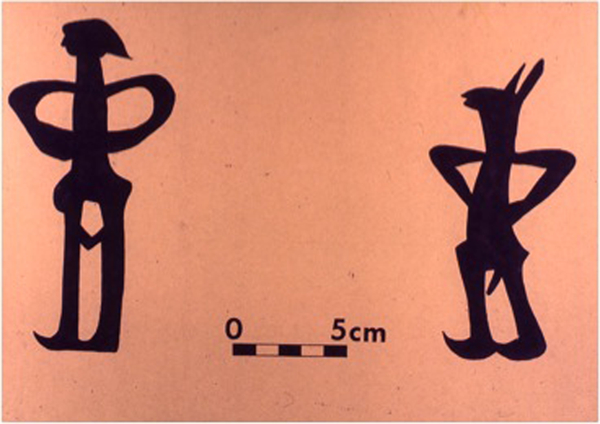
Painted on the inside of the sarcophagus there are the figure of a animal-headed god with a long snout, two upright ears and possibly a tail, resembling the Egyptian underworld god Anubis, and a human figure with a short skirt and arms akimbo on his hips (frawing D. Faulmann, INSTAP, Crete)
Method
The objects have been examined under a microscope to check the conservation of each piece and to identify the best spots for the measurements. As it was necessary to use a completely non-destructive method, a transportable X-ray fluorescence (XRF) analyser, especially developed for the analysis of cultural heritage objects and consisting of an X-ray source, a transformer, a transportable support with incorporated devices ensuring its stability and proper position and a laptop computer with dedicated programme for the analysis of ancient metals, was brought to the Institute for Aegean Prehistory (INSTAP) Study Center in Pacheia Ammos, Crete. The XRF measurements are performed by illuminating with X-rays, emitted by a miniaturised X-ray tube, a small area on the surface of the object for a short time (typically 10–15 min). This particular equipment, with its specially developed software, is much more flexible and versatile than the common XRF versions available on the market and developed for the needs of modern industry. The analytical device has useful features that improve the quality of the results. The size of the irradiated area has a diameter of around 1·5–2 mm, but the analysed spot can be smaller or larger, as required by the size of the object, the detail to be analysed and the surface texture. The measurements are accomplished at a fixed angle and a fixed distance from the sample. A laser pointer indicates the exact spot of the measurement on the object, and the equipment gives an acoustic signal when the distance from the metal surface that has to be measured is correct. The comparison with a number of suitable standards, expressly produced by AGM Archeoanalisi for the study of ancient metal objects, and similar in composition to the most common ancient objects, is a great help and allows us to obtain reliable data. The most important diagnostic elements of ancient alloys are simultaneously quantified with precision if the standards and some cautions are used. 7 7,8 As shown by past experience, the obtained measurements compare well with the reference samples. The comparison of previous analyses, carried out by AAS and XRF on the same samples, demonstrated that >90% of the XRF results were well within ±10% of the corresponding AAS results.
Results
The glaze appearance and structure of the faience were examined by optical microscopy and analysed by XRF. The aim was that of determining the elements present in the material and identifying the colouring agents employed to achieve the blue colour of the faience. A number of damaged beads were selected for the examination of the internal material. The internal structure and the surface glaze give important information on the production technology. As what the microscopy examination showed, the light blue ivy shaped beads do not have a clay core. The internal material is a porous and rather crystalline looking mass, consisting almost entirely of interstitial glass (Fig. 5). The glaze on the outer surface of the beads looks irregular and is rather thick. The XRF analysis identified considerable amounts of Cu, Fe, Ca and traces of Mn, Co, Ni and Zn. No K could be detected. The presence of K in faience is typical for similar objects made of faience of bluish turquoise colour from east Mediterranean in the second half of the second millennium BC,9 – 11 and it indicates the use of ash plants rich in soda, Ca and K. In the case of the blue faience beads from Mochlos, the stabilisers of the glaze were with all probability calcium oxides or phosphates and calcium carbonates.
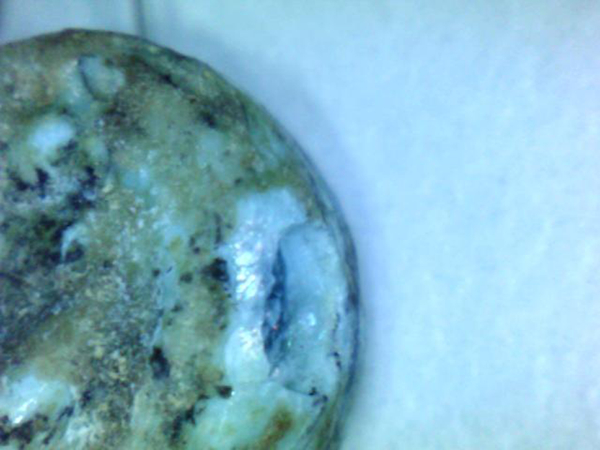
The glaze of the faience beads is irregular and rather thick, with an interstitial glass interface. The presence of Co as coloring agent indicates Egyptian technology (photograph A. Giumlia-Mair)
The gold bead belonging to the necklace was analysed by XRF. One side of the wheel shaped bead looks pink purplish, while the other side has the usual golden colour. The analysis of the ‘clean’ side with a golden colour identified an Au alloy containing 8%Ag, 3%Cu and very low traces of Fe and As. The gold alloy on the other side is the same, but the XRF analyses carried out on the rosy purple surface patina detected measurable Fe (∼1%), up to 0·8%As, and traces of Sb.
Discussion
As mentioned above, the most significant data for the identification of the production technology of faience are the colouring agents and the stabilisers. The different techniques used in the various regions to obtain a glaze can, therefore, be diagnostic for the identification of the different technologies. This allows the determination of the tradition to which the production technique belongs and therefore the establishment of the origin of the objects. The different technologies in use in eastern Mediterranean of the second half of the second millennium BC will therefore be briefly described and discussed below for a better understanding of the analysis results. The problems involved in the different production technologies of faience will be discussed in summary.
Rose pink gold jewelry has been found in Egyptian royal graves, but no example of this particular surface treatment was previously known outside of Egypt. The production technology of ancient rose gold, the history of the material and some of the characteristics of similar finds will also be discussed below, in the dedicated section. To prevent confusion, it should be noted that modern ‘rose gold’ is a gold alloy with a high copper content, while the ancient rose gold discussed here is the result of a surface treatment of gold.
Faience
In the past, many studies on the technology of faience have been carried out.9, 11, 12 Several studies have shown that different production technologies were used in different regions of the ancient world. The identification of the production technology is important for the reconstruction of the metallurgical tradition. The three main methods employed in antiquity were the efflorescence, the cementation and the direct application method. The production of faience objects involved two different phases: the production of the body (or core) and the process employed for covering it with glassy material. The body could be made either by modelling the mixture by hand or by pressing it into an open mould. In the efflorescence technique quartz, soda and copper oxides were ground and mixed with water. The mixture was left to dry slowly, so that the water soluble alkali salts could migrate to the surface, where they created a whitish layer. The firing temperature of this material reaches around 950°C. The glaze obtained by this method is a thick glassy layer, with a relatively thick and irregular, interstitial glass interface, similar to that identified in the beads from the Limenaria cemetery in Mochlos. The finishing stages, e.g. polishing, carving and drilling, could be carried out with different tools.
In the case of the direct application method, a clay core was covered with a mixture of quartz, calcium carbonate and powdered malachite, i.e. copper carbonate. The latter was the actual colouring agent. The pieces were fired at temperatures between 850 and 980°C. The results could be improved using a previously prepared fritte. To do this, the mixture, heated to ∼800°C, turned to glassy material and was then ground to a fine powder. The fritte powder was mixed with water and tragacanth gum and applied on the surface. The objects were fired at a temperature of around 850°C. The obtained glaze was thin, regular and shiny and can be easily recognised because it is well differentiated from the core in which, at the interface, only a small amount of interstitial glass can be distinguished. The direct method often shows flow lines and drips.
In the cementation technique, the clay core was covered by a mixture of plant ash, quartz powder, copper oxide and charcoal and then heated to a temperature ∼980°C. The microstructure of the faience glaze produced by cementation is irregular and quite thin. Near the interface, a layer of interstitial glass is recognisable, but it is totally missing inside the core. The core visible on breaks looks relatively homogeneous, and no interstitial glass can be seen.
Egyptian faience was made by the efflorescence method by using a glazed silica mixture without clay, while from the mid second millennium BC onward, in the near East and Cyprus, a cored faience with a bluish turquoise glaze was produced. The colouring agent employed in the near East was copper. Al, Mg, Mn, Ni, Zn and especially Co are the typical trace elements found in Egyptian faience because Egyptian artisans used alum from Kharga and Dakhla in combination with copper as colouring agents.9 – 13 It is important to note that to obtain the deep blue colour, typical for the Egyptian faience, only 0·5%Co was needed. The production of glass and faience is widely testified in Egypt during the fourteenth century BC. Here, fritte and molten remains of glass and faience with cobalt as colouring agent have been found. In the ‘Amarna letters,’ materials such as mekku and exlipakku are mentioned as very precious export goods. They were even accepted as a means of payment instead of gold or silver. The two names are sometimes used as equivalent terms for faience, and apparently, they were also imported to Egypt from Palestine. The word mekku is also mentioned in the texts on glass making at the time of King Assurbanipal in Nineveh (669–627 BC) as the raw material used by craftsmen to produce glass vases and necklace beads.
The examined fragments of faience beads from Mochlos show on the fractures a thick and rather irregular interstitial glass interface without any visible clay (Fig. 6), i.e. they were produced by the efflorescence method. As mentioned above, no traces of K could be detected in the beads. In eastern Mediterranean, Syria and Mesopotamia, ash of plants rich in soda, K and Ca were the alkali sources in the production of faience, while the sources of alkaline substances employed for glass and faience in Egypt were Na carbonates and sulphates found in Wadi Natron in lower Egypt. The products from Wadi Natron were later exported from Egypt all over the Mediterranean. The characteristics of the material of the beads, their production technology and the analyses results, in particular the Co traces, all indicate that the faience beads from Mochlos belong to the Egyptian tradition; however, the shapes and the style of the beads belong to the Aegean tradition.
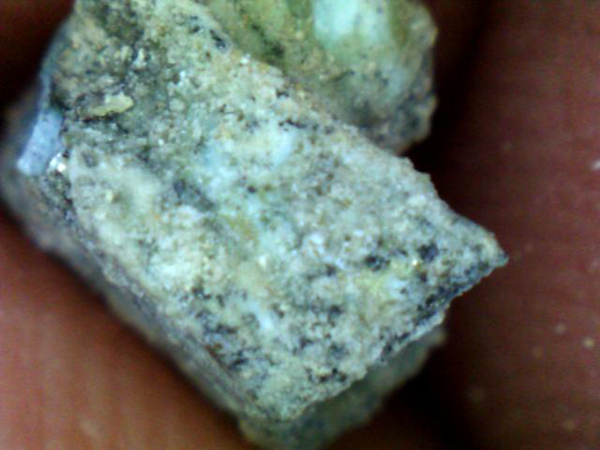
The internal material of the faience beads consists almost completely of interstitial glass. No clay core is visible. This is typical for the efflorescence method, used in Egypt (photograph A. Giumlia-Mair)
Rose gold
The wheel shaped gold bead in the centre of the necklace (diameter 15 mm) is cast with a single hole for suspension and shows a central circle in relief, a beaded rim and four rather irregular holes between the wheel ‘spokes’ (Fig. 7). The casting had originally a core that had been partly removed through the openings inside the holes.2 Two of the openings are still to be seen in two of the decorative holes, while, after removing the material of the core, the openings in the two further holes were closed by bending the metal over the fissure (Fig. 8). Around the hole, several dark spots are visible (Fig. 9). Apparently, before bending the metal into place to close the gaps, the goldsmith annealed the gold to make it less fragile. The annealing process involves the careful heating of the gold to induce the recrystallisation of the metallographic structure. In this case, annealing was necessary because the metal had been bent to remove the core. Bending it back without annealing would have probably produced a fracture. When gold is heated in air, the copper and the traces of iron in the alloy migrate to the surface and build the dark, mixed Cu–Fe oxides that are now visible around the holes of the bead.
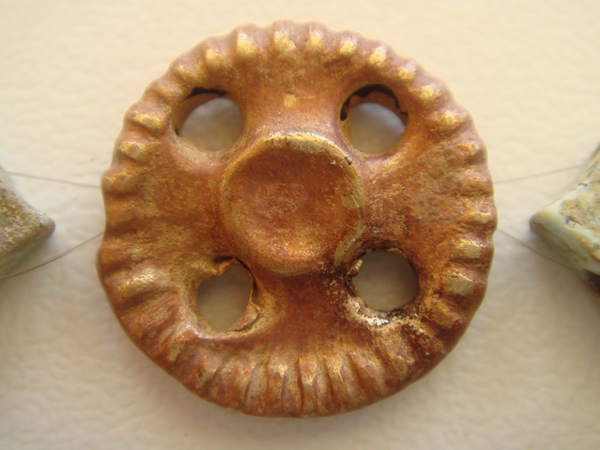
Wheel-shaped Au bead with suspension holes, beaded rim and 4 irregular decorative holes. Au contains 8%Ag and 3% Cu. On this side of the bead a rosy-purple patination is visible. The opposite side is not patinated (photograph A. Giumlia-Mair)
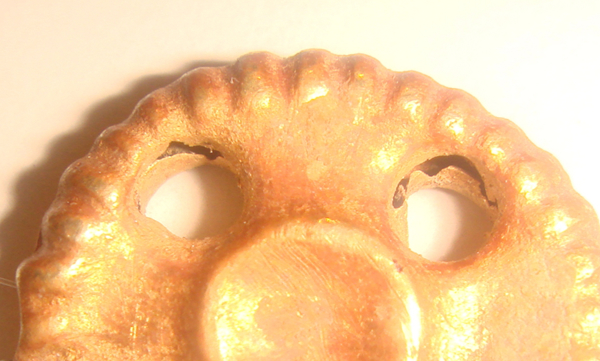
Detail of the wheel-shaped Au bead. The bead was cast with a core that was partly removed through the openings. Two of them are still open (photograph A. Giumlia-Mair)
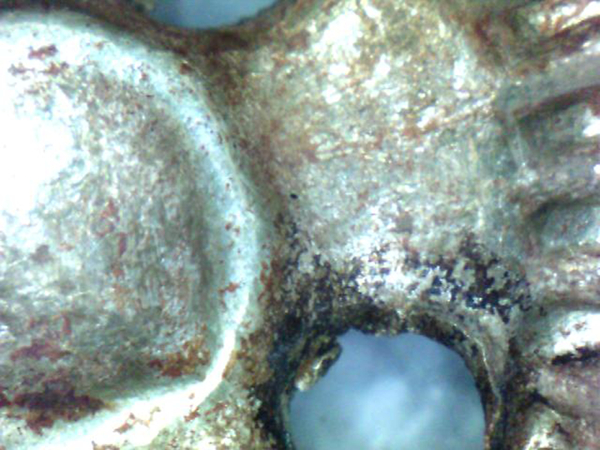
Detail of the non-patinated side of the Au bead with traces of annealing (photograph A. Giumlia-Mair)
The XRF analyses showed that the jewel is made of a good gold alloy containing only 8%Ag and 3%Cu. In this period, this kind of composition is typical for good quality jewelry. On one of the two sides of the bead, a regular and evenly distributed rosy purple patination is visible, while the other side shows a normal golden colour. This rosy patination has never been found up to now in any Mycenaean context. The fact that the evenly distributed rose pink patination is found on one side only leaves no doubt that the colouring was deliberately applied. The rosy patina is different from the kind of natural patination due to the oxidation of impurities, such as for example Ag, Cu and Fe, present in the gold. The colour would in this case be reddish brown and obviously not so regular and limited to one side. It can also be excluded that the pink colouring might be due to the rather common brownish staining that develops during burial in contact with organic matter. The red alteration of gold sometimes found on ancient Au objects, due to the presence of silver sulphides, is also different. Various specimens of the so called Egyptian ‘red gold’ from the collection in the Metropolitan Museum in New York have been studied by Frantz and Schorsch.16 As already mentioned, this is a totally different kind of colouring, found mainly on gold leaf, and it represents a phenomenon of natural origin. The red colour shows an uneven colouration, has noticeable hue variations on the same areas and contains silver/gold sulphides as principal compounds.
The rosy purple coloured patina is remarkably clear and even and can be compared to that found on some examples of jewels from Egyptian royal tombs dated to the New Kingdom, i.e. the time of the eighteenth, nineteenth and twentieth dynasties (sixteenth to eleventh centuries BC). This very special surface treatment on gold jewelry has had various names since its discovery in the last century: the most common names given to this material are rose gold, purple gold and rose pink gold.14, 15
The first person who studied this kind of pink patination was Professor R. W. Wood, a physicist from John Hopkins University in Baltimore. He had noticed it on a trip to Egypt in 1931 on the ornaments from the tomb of Tutankhamun. His attention was drawn to the colour of small purple gold rosettes sewn in alternation with yellow gold bars on the king's slippers, where they created a colour pattern. The colouring was similar to the one he had achieved during his experiments on the optical properties of finely divided metallic granules, and he felt sure that it was a deliberately produced effect. At the time, he received for study some of the sequins from the clothing of the king.14 His intention was to ascertain whether the colour was a simple ‘interference’ effect on thin films (soap bubble colours) or if it was due to some ‘resonance’ action of minute particles covering the surface. Interference requires two streams of light reflected from opposed surfaces of a thin film, so he tried to stop the reflection from the outer surface by covering it with a transparent varnish. The colour was not destroyed by the application of varnish, and after it had become dry, he found that it could be peeled off, carrying the film with it and leaving bright yellow the underlying gold. The film showed no colour, either by transmitted or reflected light; however, when he deposited metallic gold on the back of the film by cathodic sputtering, he succeeded in restoring the purple pink reflection. The film was magnetic, and further analyses showed that the coloured patina contained iron and arsenic. The microscopic examination revealed that the colouring process involved the heating of the gold during the treatment.14 He reproduced in his laboratory the exact appearance of the rose pink gold patina by mixing small quantities of iron oxide (1% hematite) and orpiment (arsenic trisulphide As2S3) with the gold and heating the surface with an acetylene torch. His replicas, on display in the Cairo Museum, cannot be distinguished from the originals. Later analyses by Lucas showed that iron is present on all specimens, and he hypothesised that the most probable process was the dipping of the gold pieces in a solution of iron salts before heating them.15 According to Lucas’ studies, the thickness of the rose pink patina is <100 000th of an inch. He also noted: ‘The rose colour can be proved by chemical analysis not to be due to any colloidal modification of the gold, nor to any sort of organic lacquer or varnish, and the gold can be made red hot without the colour being removed or diminished, but in some instances rather enhanced’.
The XRF analyses carried out on the rose purple patination of the necklace bead from Mochlos determined 1%Fe and 0·8%As on the gold. The microscopic examination seems to indicate that the two elements have been spread on the surface, most probably as a mixture of powdered Fe and As salts in a liquid or pasty medium, before heating the gold to achieve the formation of the coloured film. The composition of the thin rose pink coloured film on one side of the bead is therefore very similar to that identified for the first time by Wood on Tutankhamun's sequins, and later by Lucas on more Egyptian objects.14, 15
This technique of colouring gold is known from objects found in royal tombs in Egypt, for example a gold ‘marguerite’ from the Tomb of Queen Tiy (eighteenth dynasty), the diadem from the tomb of Queen Tewosret (nineteenth dynasty), the ornaments from Tutankhamun's tomb, for instance sequins (Fig. 10) of different shape and size and large plaques, two light pink and very wide gold bracelets (inv. n. AO 2a-1) on display with another bracelet decorated with the cartouche of Thutmose III in the Dutch National Museum of Antiquities (Rijksmuseum van Oudheden) in Leiden, and the earring from Abydos (Fig. 11), dated to the reign of Ramses XI (twentieth dynasty, ca. 1099–1070 BC, Cairo Museum CG 52323).
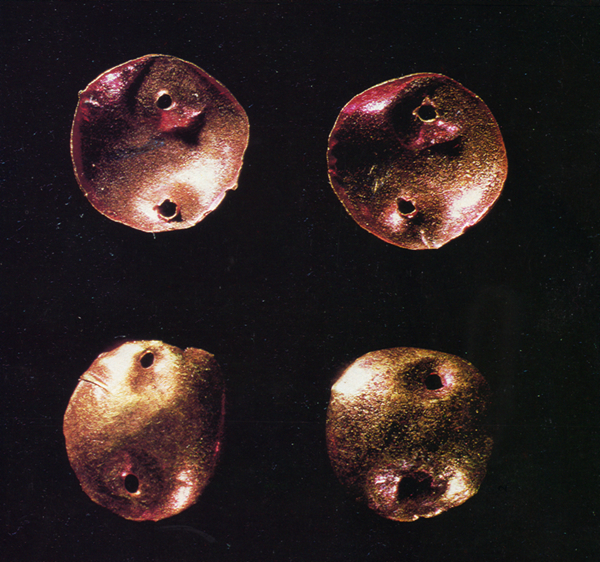
Rose gold ornaments from Tutankhamon's tomb (photograph J. Ogden 1983)
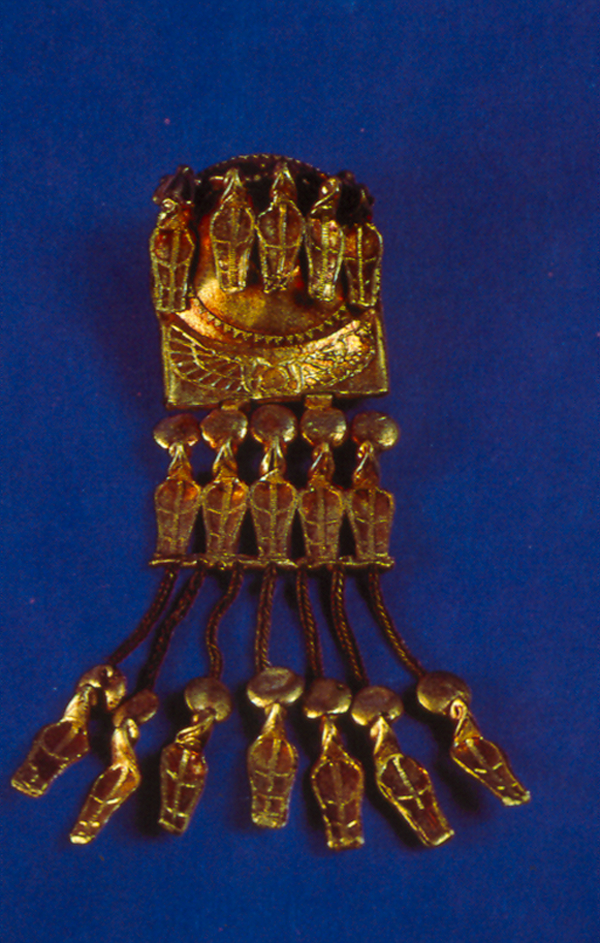
Rose gold earring from Abydos, dated to the reign of Ramses XI, ca. 1099–1070 BC, Cairo Museum inv.n. CG 52323 (photograph S. Curto and A. Roccati, 1984, Exhib. Milan)
This patination technique is supposed to originate from western Asia because of a passage in the Amarna letters. Pharaoh Amenhotep III (eighteenth dynasty, ca. 1386–1349 BC) received gifts from the king of Mitanni in northwestern Mesopotamia, and some of the jewels were made of ‘gold through which blood shines’.17 Ogden also refers to Mesopotamian texts in which the addition of hematite to gold is mentioned, but he does not give any indications on where the text can be found. Regrettably, no research has been carried out yet on the period of time in which this technique was in use. It is however quite clear that rose gold, found in Egypt only in royal burials, was considered a very special and precious material.
This decorative surface technique on gold has never been identified before outside of Egypt and was completely unexpected in a Mycenaean cemetery in Crete. The discovery of the presence of rose gold in a Mycenaean context is of great importance because it indicates technological connections between Egypt and Greece, but most especially because it makes us aware of the possible existence of other artefacts of this kind outside of the area in which this material is considered autochthonous.
Conclusion
The technology and the materials employed for the faience and gold necklace from the Limenaria cemetery at Mochlos show strong Egyptian influence.
In Cyprus and in the near East, a cored faience was employed from the second millennium BC, while in Egypt, the efflorescence method was in use. The manufacturing process and the trace elements in the faience from Mochlos seem to indicate an Egyptian origin, but the shape and the style of the beads are Aegean and have several comparisons in the Aegean production.
The surface treatment discovered on the gold bead of the necklace is also characterised by Egyptian technology, while its shape is less easily attributed to a particular context because it is more common and widely used.
Some kind of Egyptian connection is also testified in the tomb of the Limenaria cemetery in Mochlos, in which this object was found. In Tomb 10, on the inside of the sarcophagus of the deceased male, a theriomorphic figure, which very closely resembles the Egyptian god Anubis with the jackal head, long ears and possible tail, is painted on the internal sarcophagus wall, and it faces a stylised human figure, painted on the opposite wall, with long hair and the pointed shoes worn in this period by Mycenaeans.5
Egyptian objects are no rarity in Crete;18 however, this particular piece may not be an imported jewel. The style and shape of the faience beads suggest that they might have been produced by an Egyptian artisan, but in the local style and taste, or by an Aegean artisan who learned his skills from highly specialised Egyptian goldsmiths. The latter hypothesis seems however to be the less credible because it is well known that workshop secrets were jealously kept in very narrow circles, and it is difficult to imagine that a Mycenaean artisan would be trained in sophisticated techniques in an Egyptian workshop. Nevertheless, we also know of the presence of Mycenaeans in Egypt around 1300 BC, for example from a painted Egyptian papyrus found in the storerooms of the British Museum. It represents mercenary warriors fighting for the Egyptians against the Lybians. They wear boar's tusk helmets and an ox hide tunic. Mycenaean pottery has also been found in Egypt, so no hypothesis can be excluded.19
The discovery of rose purple gold in Mochlos is significant and of great importance. For the moment, it seems to be a unique find outside Egypt. Its presence in an important trading port like Mochlos demonstrates that ideas and technologies were widely circulating in this part of the Mediterranean.20
Possibly other examples exist in Greek, Egyptian or other museum cases. It is also likely that, especially in the past, their coloured films were removed through cleaning by overzealous conservation experts. It is therefore extremely important to make museum curators aware of the existence of this decorative technique outside of Egypt on early gold objects.
Footnotes
Acknowledgements
All conservation specialists of the INSTAP Study Center at Pacheia Ammos have been extremely helpful, in particular S. Chlouveraki, Head of the W.D.E. Coulson Conservation Laboratory, and K. Hall, Senior Conservator at the Study Center. Whenever necessary, they mechanically removed the layer of dirt from the objects and made analyses possible. We gratefully acknowledge funding provided by the INSTAP, Philadelphia, PA, USA.
This paper is part of a special issue on Arts and Surfaces