







Abstract
The present work was aimed at characterising the materials and assessing the state of conservation of the ‘Adorazione dei Magi’, a wooden panel painted by Bartolo di Fredi in the second half of fourteenth century. To this goal, innovative non-destructive investigation techniques such as portable Raman spectroscopy, visible reflectance spectroscopy and unilateral nuclear magnetic resonance, were used in situ in order to achieve surface and bulk compositional data. The former allowed the identification of the artist's palette including cinnabar, red ochre, minium, carbon black, lead white, ultramarine blue, malachite and phthalocyanine green, while the latter provided information on the stratigraphic structure and state of conservation of the wooden panel.
Introduction
The study and conservation of artworks usually involve the use of several analytical techniques in order to achieve compositional and microstructural information, which is of fundamental importance for characterising the materials used, interpreting the execution processes and assessing the state of conservation of the artefacts. These are fundamental features in order to increase the knowledge on the art techniques of the past and optimising the conservation treatments, needed for implementing long term preservation strategies.
The large variety of materials and crafting techniques, along with the different deterioration mechanisms usually involved in knowledge and safeguard of cultural heritage, makes the archaeometrical approach very complex. The analytical techniques must be chosen according to the specific characterisation problems and exploited through suitable elaboration and interpretation of the data collected.
Furthermore, the present application field imposes strict limitations on material sampling. In cases of unique masterpieces, the latter must be minimised to micrometric sizes or prevented at all. This requirement is representing a significant stimulus for developing non-destructive and microanalytical techniques.
Atomic (elemental) spectroscopy is commonly used for the study of works of art. The classification of some pigments used in paintings, for instance, can be based on the identification of the elemental constituents of the organic and inorganic salts. Techniques not requiring material removal and sample preparation such as XRF1 and PIXE2 (both based on X-ray induced emissions), as well as LIPS3, 4 (laser induced plasma spectroscopy), represent the best solution for non-invasive elemental characterisation of paintings. However, elemental analysis has some limitations for discriminating minerals with similar chemical composition (i.e. azurite and malachite), as well as complex mixtures and organic pigments.
Among molecular techniques, Raman and visible reflectance spectroscopy are non-destructive techniques commonly used in archaeometrical investigations in order to identify the molecular components of inorganic pigments,5 colourants6 and organic media.7 In particular, Raman spectroscopy, based on laser excitation of molecular bonds, allows to identifying inorganic and organic materials according to the vibrational frequency of chemical bonds such as OH–,
 ,
,
 and
and
 molecular groups, as regards, for example, the study of inorganic minerals, and CH, CC, C = C, N = N, OO, SS, C = O groups for organic materials.
Optical spectral reflectance employs a light source with a broadband emission spectrum. This technique represents an objective way to parameterise the chromatic appearance of the surface under examination, as well as a useful support to the identification and discrimination of different pigments.8
In the present work, the combination of portable Raman and visible reflectance spectroscopy allowed the identification of most of the pigments used in the panel painting ‘Adorazione dei Magi’ by Bartolo di Fredi and the discrimination between modern and ancient pigment, as well as the detection of overpaintings. Measurements were carried out in situ without moving the painting from the Pinacoteca Nazionale di Siena where it is exhibited (Inv. no. 104).
Unilateral nuclear magnetic resonance (NMR), a relatively new technique in the historical paintings research, allows to perform measurements in situ and in a fully non-destructive way.9, 10
In the present study, unilateral NMR was applied to assess the state of conservation of the painting by Bartolo di Fredi, to characterise the stratigraphic sequence of the painting layers and to understand the artist's painting technique. NMR analyses were carried out in selected areas of the painting, and based on the presence of different hydrogen containing layers, it was possible to obtain NMR depth profiles which can be related to the pictorial technique.
Painting
Historical documents attest that the painting ‘Adorazione dei Magi’ (Fig. 1) by Bartolo di Fredi, a Senese painter of the fourteenth century, was part of an altarpiece dismounted before 1816 from the Church of San Domenico (Siena, Italy).11 The parts of the altarpiece that are still preserved in different museums are as follows: the predella showing the crucifixion of Christ (Lindenau Museum, Altenburg, Germany), the lateral panel ‘Seven Saints in Adoration’ (University of Virginia's Art Museum Charlottesville, USA) and the wooden panel discussed here, which is exhibited at the Pinacoteca Nazionale di Siena (Siena, Italy). The pictorial theme of the ‘Adorazione dei Magi’ was inspired by the triumphal entry in Siena of the King of Cyprus in June 1368. According to Neri di Donato's description,12 he was accompanied by 300 knights.

Bartolo di Fredi, ‘Adorazione dei Magi’ (about 1375–1385), 195×163 cm. Pinacoteca Nazionale di Siena, Siena, Italy
Experimental
Raman measurements were performed using a portable device equipped with a diode laser emitting at 785 nm. Measuring points were selected by focusing the laser beam on a small area (∼500 μm) in order to achieve a complete mapping of colours with a sufficient spatial resolution.
Visible reflectance measurements were carried out by using a portable spectroradiometer connected to a personal computer. The spectral range of the measurements was 380–780 nm.
NMR measurements were performed with a unilateral NMR instrument from Bruker Biospin interfaced with a single sided sensor by RWTH Aachen University, Aachen, Germany.13 This sensor generates a magnetic field with an extremely uniform gradient to resolve the near surface structure of arbitrarily large samples. Measurements were carried out at 13·55 MHz. Profiles were measured by repositioning the sensor in steps of 50 μm in order to scan the desired spatial range from the surface up to 0·5 cm in depth with a nominal resolution of 57 μm and an echo time of 0·056 ms. Depth profiles were obtained as the addition of the first of our echoes acquired with a CPMG sequence.
Results and discussion
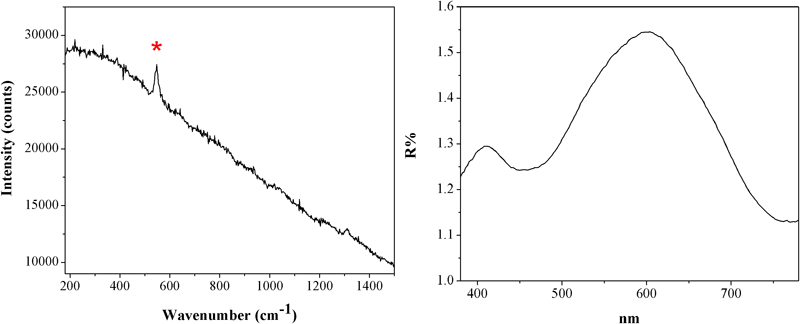
Visible reflectance and Raman spectroscopy measurements were carried out on the painting ‘Adorazione dei Magi’ by Bartolo di Fredi in order to identify the pigments used by the artist and discriminate between ancient and modern colours due to later restoration works. The combined use of Raman and visible reflectance spectroscopy allowed achieving the complete palette of the artist and recognising later overpaintings. In particular, 21 visible reflectance and 32 Raman measurements were performed. Pigments identified are shown in Table 1. The Raman analysis allowed identifying blue, red, white and black pigments. Unfortunately, laser emission at 785 nm was not able to excite an appreciable inelastic scattering from green and yellow pigments. However, a Raman spectrum of the phthalocyanine green pigment was acquired with a quite good signal/noise ratio (Fig. 2, left). Phthalocyanine green is a modern synthetic pigment probably used in a recent restoration work in order to integrate colour losses. Visible reflectance measurements performed in other green areas indicated the presence of a band at 520 nm (Fig. 2, right) characteristic of malachite, a pigment which could not be identified by using 785 nm Raman excitation wavelength.
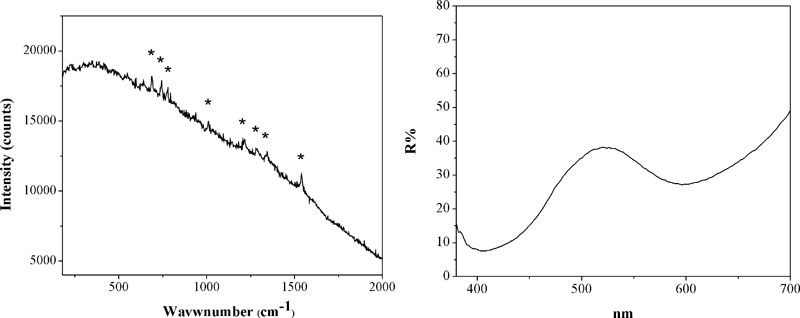
Raman spectrum of phthalocyanine green (left side) and visible reflectance spectrum of malachite pigment (right side)
Pigments identified by Raman and visible reflectance spectroscopy
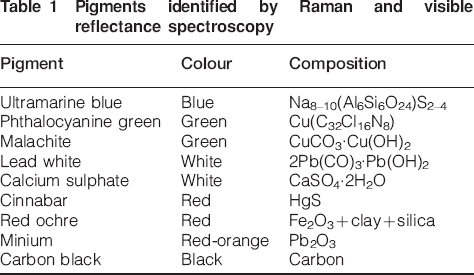
Figure 3 shows three examples of Raman spectra acquired on reddish areas of the painting. Red and orange pigments were identified as cinnabar (Fig. 3a) and minium respectively. In some parts of the painting, they were also mixed together (Fig. 3b). In other zones, red ochre was also recognised (Fig. 3c). High spectral resolution is a peculiar feature of Raman technique, which allows analysing even complex pigment mixtures including several pigments. Figure 4 shows visible reflectance spectra of reddish pigments found in the painting. In this case, the first derivative provides an alternative way to improve the discrimination between cinnabar and minium.14
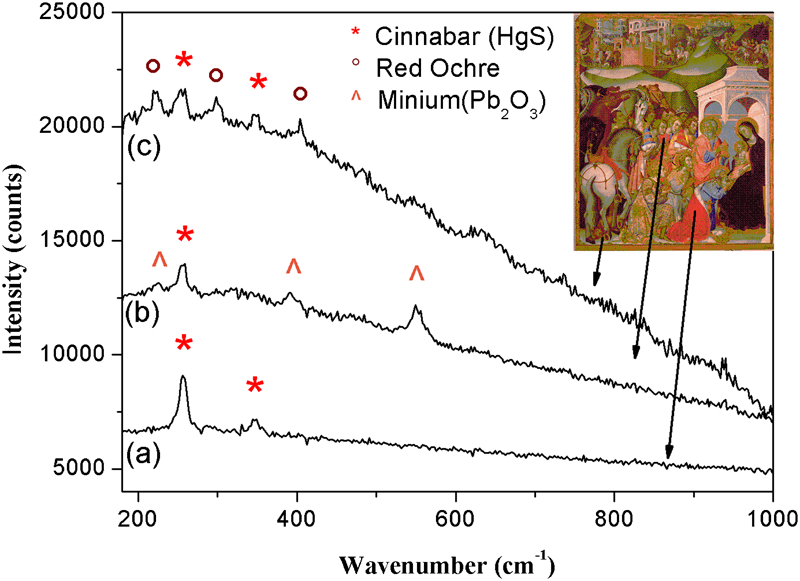
Raman spectra of reddish pigments
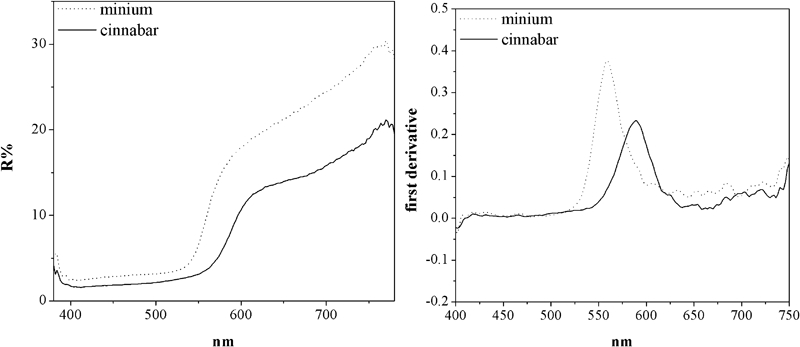
Visible reflectance spectra of minium (dashed line) and cinnabar (solid line) pigments (left side) and first derivative spectra of minium (dashed line) and cinnabar (solid line) pigments (right side)
Figure 5 (left) shows the Raman spectrum of ultramarine blue pigment largely used by Bartolo di Fredi to paint the Magi's clothes and the blue architectural background. Unfortunately, the reduced sensitivity of portable Raman instrumentations with respect to bench devices could not discriminate between natural lapis lazuli and synthetic ultramarine. Visible reflectance spectroscopy can, on the contrary, give more information on this issue. Figure 5 (right) shows the visible reflectance spectrum of the ultramarine blue pigment: the characteristic absorption band that peaked at 400 nm is clearly observable. According to the literature,15 this band can be ascribable only to the Afghan natural lapis lazuli, while synthetic ultramarine shows only a shoulder in the same spectral range (350–450 nm). All visible reflectance ultramarine spectra acquired in the painting have shown the band at 400 nm, confirming the natural origin of this blue pigment.
Raman (left side) and visible reflectance spectrum (right side) of blue ultramarine pigment
For the sake of completeness, Figs. 6 and 7 show Raman spectra of white and black pigments respectively; in particular, white pigments were easily identified by both Raman and visible reflectance spectroscopy as lead white [PbCO3·Pb(OH)2] and calcium sulphate (CaSO4·2H2O), whereas black painting areas were identified as carbon black.
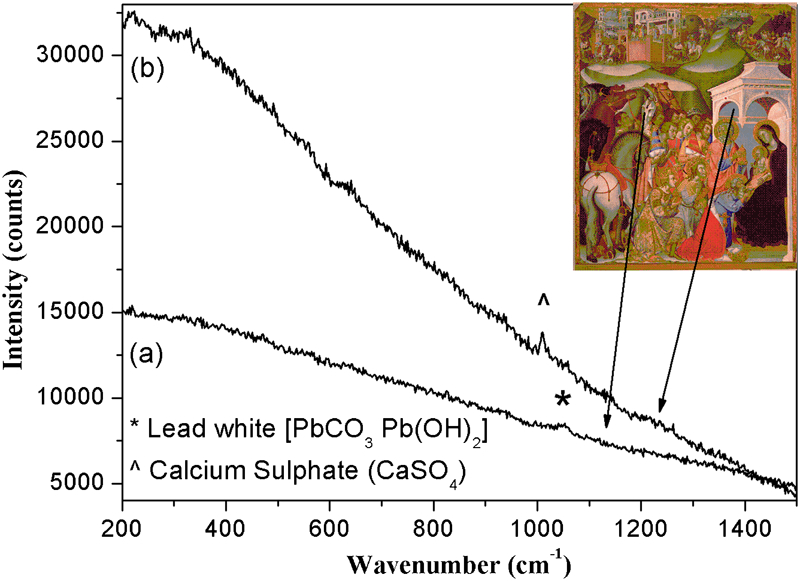
Raman spectra of white pigments
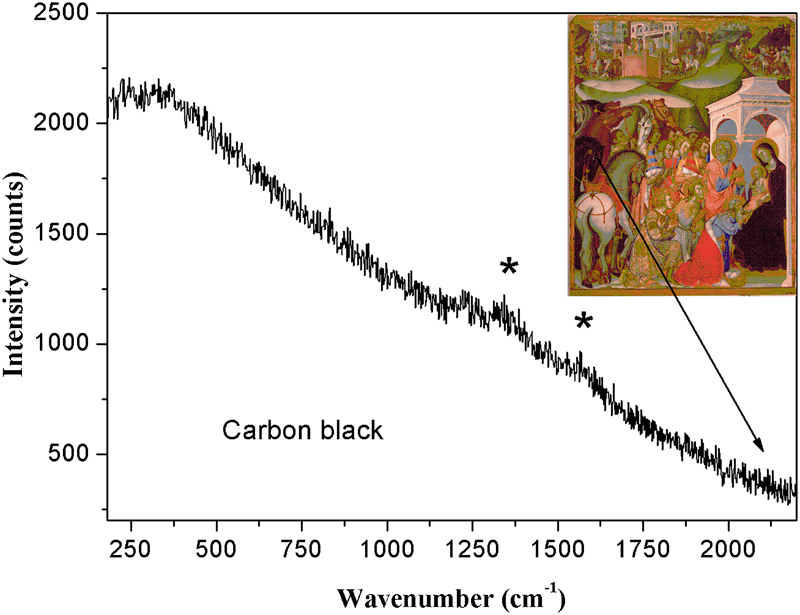
Raman spectrum of carbon black
NMR preliminary analyses were carried out in different areas of the painting. Here, we report an NMR depth profile of the Magus pink mantle, obtained by scanning the painting from the surface up to 5 mm of depth (Fig. 8). In Fig. 8, it is possible to observe the presence of three different layers: the first, collected on the 1 mm thick outermost surface, made of pigment and binder; the second, an 0·8 mm thick preparatory layer, detected between 0·8 and 1·6 mm of depth; the deepest one, detected from 1·7 to 5 mm of depth, due to the wooden panel. NMR depth profiles, collected on different regions of the painting, showed the same intensities for pigment, binder and preparatory layers, whereas the wooden region was characterised by different NMR signal intensities, probably due to the deterioration of the wood, a material easily degradable by physical, chemical and biological agents (i.e. xylophagous insects such as woodworms or Anobium punctatum).
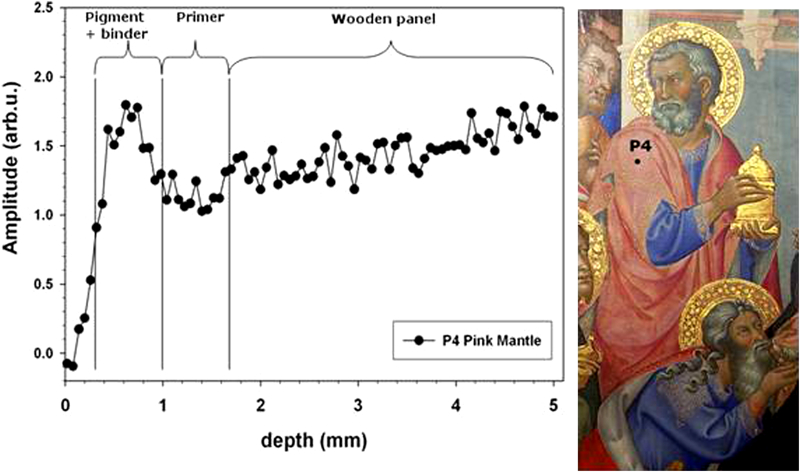
NMR depth profile of Magus’ pink mantle
Conclusion
A campaign of measurements was performed on the painting ‘Adorazione dei Magi’, dated back at the second half of XIV century, using non-invasive techniques, i.e. unilateral NMR, Raman spectroscopy and visible reflectance spectroscopy. The Raman and visible reflectance spectroscopy permitted to identify the pigments used by the artist, i.e. cinnabar, red ochre, red lead, carbon black, white lead, ultramarine blue, malachite and phthalocyanine green. The latter is the only identified modern pigment, and its presence is due to recent restoration.
Visible reflectance spectroscopy gave more information about the nature of ultramarine blue pigment. In the visible reflectance spectrum, the characteristic absorption band at 400 nm was attributed to the use of natural lapis lazuli as ultramarine blue pigment. Obviously, we cannot exclude the presence of artificial ultramarine in areas of the painting that we did not analyse.
Unilateral NMR is a new method used in the painting studies, and we applied it for mapping in situ the stratigraphic profiles of the painting ‘Adorazione dei Magi’ in order to characterise the pictorial technique of Bartolo di Fredi. By means of the NMR depth profiles, we identified three different layers: an upper layer composed of pigment and binder, a preparatory layer and the wooden layer of the table. This study is still in progress, and we are now analysing some specimens prepared according to the ancient recipes reported by Cennino Cennini.16 The profiles obtained by measuring the specimens may help to better understand the NMR depth profiles measured in situ on the painting and to investigate the painting techniques used in the work of art ‘Adorazione dei Magi’ by Bartolo di Fredi. Future investigations will focus, also, on surface sensitive microinvasive measurements, by using the time of flight secondary ion mass spectrometry technique, in order to characterise the inorganic and organic components, as well as their spatial distribution, in the painting cross-sections.
Footnotes
Acknowledgements
This study is part of a larger project entitled ‘Sviluppo di Indagini Chimiche Applicate al Mantenimento delle Opere e al Restauro (SICAMOR)’, financed by the Tuscany Region (P.A.R.FAS REGIONE TOSCANA, linea di azione 1·1.a.3, 2011–2013). Raman and visible reflectance measurements were performed in the framework of TEMART project, supported by the Tuscany Region (grant no. POR-Creo/FESR 2007-2013).
This paper is part of a special issue on Arts and Surfaces