







Abstract
Titanium dioxide (TiO2) thin films were prepared using a sol–gel process and applying between two and five coating layers onto the surface of borosilicate glass slides and 304 stainless steel sheets. The physical properties of the multilayer TiO2 thin films on both of the substrates under the same fabrication process were systematically compared. Our results indicate that the crystalline phase structure of the prepared TiO2 thin film was entirely composed of anatase with an optical band gap of 3·27 eV. The grain sizes of the TiO2 crystals in the films on the glass slides and the stainless steel sheets were in the ranges of 15–100 nm and 20–250 nm respectively. The results suggested that at least three layers of coating were required to produce the TiO2 thin film with the desired range of properties.
Introduction
Titanium dioxide (TiO2) is a photocatalyst that has been extensively used due to its good photocatalytic activity, relatively low toxicity and low production cost. The applications of TiO2 can be found in various practices including the sterilisation and disinfection of micro-organism s (especially bacteria and viruses), as well as the treatment and purification of water and air.1 – 5 One of the most widely used methods to fabricate TiO2 nanoparticles is the sol–gel technique.5 – 8 This coating technique has been applied to various materials, such as metal, plastic, silicon and polymer.9 – 11 In this research, we fabricated TiO2 thin films using a simplified sol–gel technique modified from Eshaghi et al.5 This was achieved by hydrolysing the sol solution at room temperature, using different solvents for the sol–gel preparation, modifying the calcination temperature scheme for the multilayer coating and reducing the stirring time and dip coating speed. A wide range of the thin films’ physical properties were also systematically compared and reported for the different amounts of coating layers. The main objective of this article is to provide information for selecting the optimum number of layers of TiO2 thin film for a photocatalytic process based on their physical properties.
Experimental
Preparation of TiO2 thin films
Two different substrates were used in this study: borosilicate glass slides (25·4×76·2×1·2 mm) and stainless steel sheets (40·0×85·0×0·3 mm). The TiO2 thin films were prepared with an acid catalysed sol–gel dip coating process using titanium tetraisopropoxide {Ti[OCH(CH3)2]4 (TTIP)} as a precursor. In this study, the sol solution was prepared by the hydrolysis of TTIP under acidic conditions at room temperature. The TTIP was mixed with isopropanol at a volume ratio of 1∶15. The pH of the solutions was adjusted to 2–3 using concentrated hydrochloric acid. The solutions were stirred at room temperature in a closed chamber with a constant flush of N2 gas for 1 h and then left at room temperature in a closed vessel for 24 h to transform the sol to gel before being ready to use.
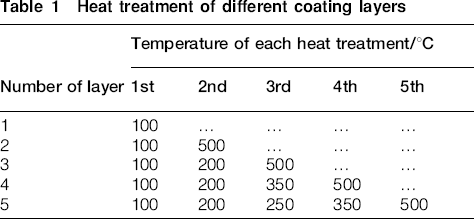
The thin films were developed on the surfaces by dip coating the sol–gel solutions at a speed of 9 mm min−1 in a closed chamber flushed with N2 gas (Fig. 1) to minimise contact with air. The first coating layer was heated to 100°C to prepare the surface for coating the next layer. After coating the first layer, the same dip coating processes were carried out repeatedly for the subsequent layers. However, each of the subsequent layers was heated in the oven at different temperatures ranging from 200 to 500°C for 1 h. The heat treatments for the different coating layers are shown in Table 1. After heat treatment, the coated substrates were gradually cooled down in the oven for 1 h before being taken out and left to cool at room temperature. All of the glass slides and stainless steel sheets were weighed before and after the coating of each layer.
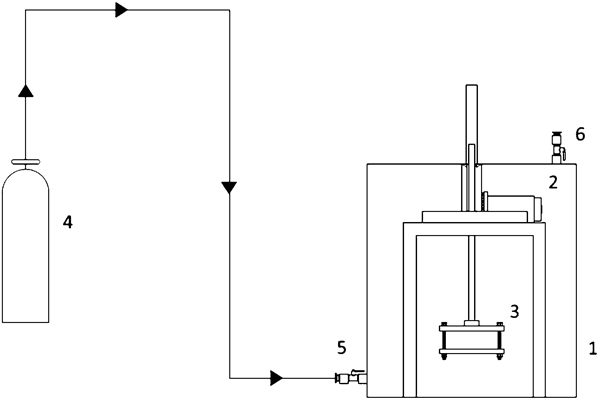
Schematic representation of coating chamber (1: coating chamber; 2: motor; 3: glass/stainless steel holder; 4: N2 gas; 5. gas inlet valve; 6: gas outlet valve)
Heat treatment of different coating layers
Characterisation of TiO2 thin films
The nanostructure and optical band gap of the thin films were determined using X-ray diffraction (X-ray diffractometer model D8 Advance; Bruker) and a UV-Vis spectrometer in the wavelength range of 290–800 nm (Lambda 650; Perkin Elmer) respectively. The surface morphology of the thin films was investigated using the atomic force microscopy (AFM) technique (MFP-3D-BIO; Asylum Research). The grain size was measured directly from cross-sectional AFM images at the base of each grain. The apparent surface areas of the thin films were determined with Gwyddion software version 2.22 (http://gwyddion.net). The TiO2 powder for Brunauer–Emmett–Teller (BET) surface area analyses were prepared by heating the sol–gel solutions at 100°C for 1 h and then heating at 500°C for 1 h. The BET surface area was determined using a sorption analyser (BELSORP-max; Bel Japan Inc.). The cross-hatch adhesion between the thin films and the substrates was examined using the ASTM method D3359B-08.12 The corrosion resistance of the thin films was tested using a method modified from Shankar et al.,13 which involves dipping the coated substrates in nitric acid and sodium hydroxide at concentrations of 1, 5 and 10 mol-% respectively for 5 min.
Results and discussion
The result of the X-ray diffraction pattern showed prominent peaks occurring at 2θ = 25·2° (Fig. 2). The strong peaks confirm the presence of an anatase phase only in the TiO2 thin films.14 This result is similar to the TiO2 thin films prepared using the sol–gel dip coating technique that was annealed at temperatures from 400 to 600°C.15
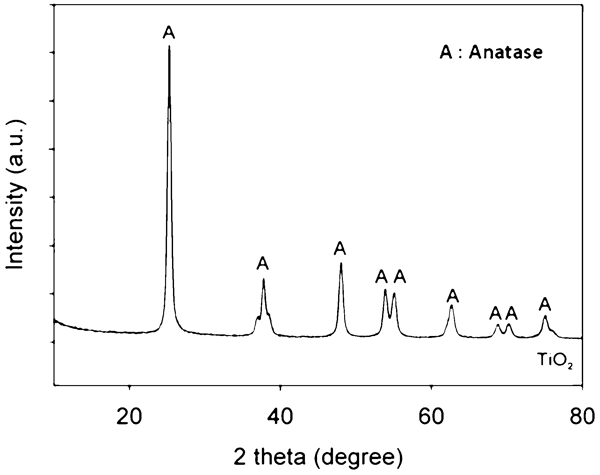
X-ray diffraction pattern of TiO2 crystalline
The band gap Eg was obtained from a linear regression of (αhν)1/2 against hν with extrapolation to zero (equation (1), often called a Tauc plot)1,
16
–
19

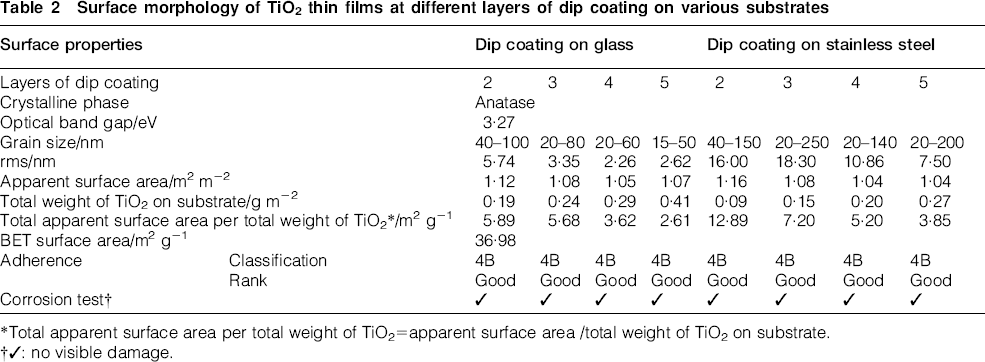
The AFM images for the different number of coating layers are shown in Figs. 3 and 4. The grain sizes of TiO2 thin films for all sample surfaces were between 15–100 nm and 20–250 nm for glass slides and stainless steel sheets respectively. The results indicated that the TiO2 particles in the thin film coating on the glass slides were more uniform and more evenly distributed. The root mean square (rms) average roughnesses of the TiO2 thin films on the glass slides were lower than those on stainless steel sheets. The results showed that the surface of TiO2 thin films on both substrates was smoother when the number of coating layers increased. The data for surface morphology are summarised in Table 2. The apparent surface area tended to decrease when the number of layers of coatings increased, similar to the results reported by Prochazka et al.20 Since the addition of further coating layers fills up the crevices on the surface, the surface became smoother and the overall apparent surface area decreased. However, the total apparent surface area of the thin film did not change significantly after more than three layers of coating.
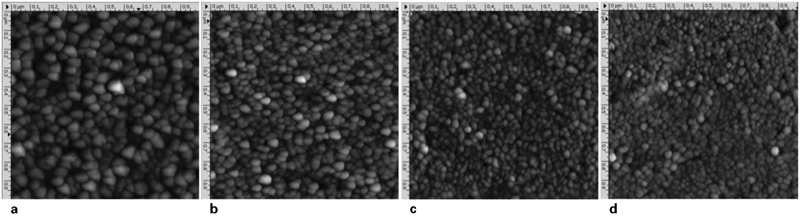
Images (AFM) in two dimension of TiO2 thin films on glass slides substrate:
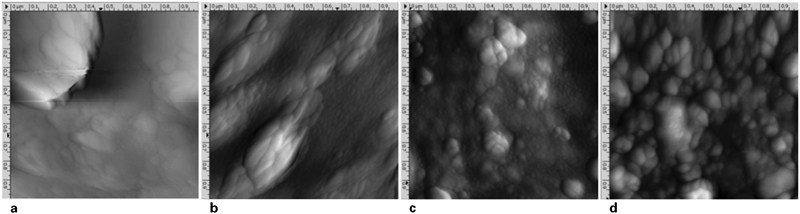
Images (AFM) in two dimension of TiO2 thin films on stainless steel substrate:
Surface morphology of TiO2 thin films at different layers of dip coating on various substrates
Total apparent surface area per total weight of TiO2 = apparent surface area /total weight of TiO2 on substrate.
†✓: no visible damage.
Both surfaces showed a similar pattern in terms of the total apparent surface area per total weight of TiO2 coated on each layer (Table 2). These results indicate that additional amounts of TiO2 in the additional layer did not contribute to a further increase in the total apparent surface area. Nonetheless, the extra coating layer did contribute to the development of finer grains and a smoother surface. The coating process in this study achieved a particle size range of 30 nm after three layers of coating on both surfaces, which is a suggested optimum size for light absorption and scattering efficiencies.21 Therefore, a coating of at least three layers on both surfaces is recommended.
The adhesion of the films on both surfaces was classified as class 4B (good adhesion).12 The results implied that the calcination temperature used in this study (at 500°C) was high enough to create good adhesion of TiO2 films on both surfaces.22 The corrosion–resistance test indicated that the TiO2 thin films could resist corrosion without any visible damage (Table 2).
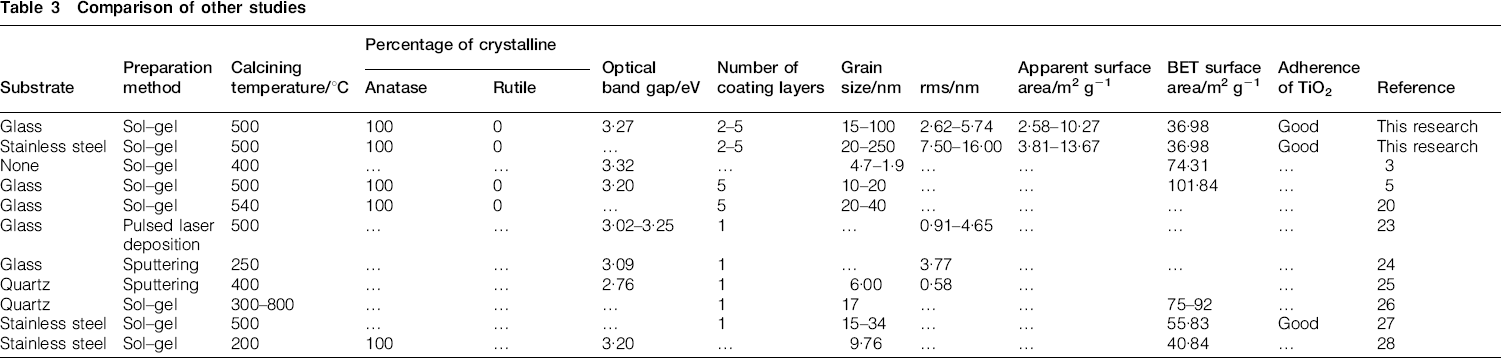
All test results from this study have been compared to those of previous studies with similar coating techniques and substrates, and are summarised in Table 3. In general, the physical properties of the TiO2 thin film prepared in this study were not much different from those reported previously. The results of the physical properties indicated that this process can produce a thin film with desirable properties. In addition to that, the thin film can be applied to various surfaces and does not require an additional separation process of TiO2 powder from the environmental media; therefore, the thin film is suitable and adaptable to many environmental applications, such as air purification, water and wastewater treatments.
Comparison of other studies
Conclusion
The overall results showed that the prepared TiO2 thin films prepared from the processes described were achieving desirable properties, such as having a nanosized anatase crystalline structure, narrow band gap, good mechanical stability and good corrosion resistance. The desired properties could be achieved with a minimum of three layers of coating. Additional coating did not significantly contribute to the improvement of the surface physical properties in terms of grain size and physical stability, which are the key properties for most applications.
Footnotes
Acknowledgements
The authors gratefully acknowledge the research scholarship support from the Center of Advanced Studies in Industrial Technology, Faculty of Engineering, Kasetsart University, Thailand.