







Abstract
A low cost, large scale fabrication method of easily achieving superhydrophobic surfaces with very low contact angle hysteresis was reported in this paper. Microstructures were fabricated by the aggregation of the copolymer of styrene and methyl methacrylate using the phase separation method. Nanostructures were also achieved by the introduction of silica nanoparticles with hexamethyldisilazane modified surfaces into the copolymer. The presence of the nanoparticles significantly reduced the contact angle hysteresis of the superhydrophobic surface. The as prepared superhydrophobic surface had a large water contact angle of 162·3° and very low contact angle hysteresis of 1·7°. Hence, the method can enable the large scale fabrication of superhydrophobic surfaces with very low contact angle hysteresis on different substrates for practical applications.
Introduction
Solid surfaces with wetting behaviour are gaining interest because of their potential applications,1 – 4 such as in self-cleaning windows, smart microfluidic devices, antibioadhesion, antifreezing and oil–water separation. A superhydrophobic surface is characterised as having a large water contact angle (WCA) of >150° and a low contact angle hysteresis (CAH) of <10°.5 Numerous studies on superhydrophobic surfaces have rapidly emerged since Li and Shen6 found that the ‘lotus effect’ is related to its hierarchical structure. These studies are inspired by many natural organisms, including lotus leaves, rose petals and water strider legs.7 – 9 Traditionally, superhydrophobic surfaces are fabricated by two main strategies that involve modifying a rough surface with low surface energy compounds and roughening the surface of hydrophobic materials.10 Specifically, electrochemical reaction and deposition, plasma etching and lithography, hydrothermal reaction, layer by layer, phase separation, self-assembly, sol–gel, organic/inorganic hybrid method as well as chemical vapour deposition are adopted to initiate the fabrication process.11 – 20 However, some methods can only be applied on a small scale (e.g. plasma etching, chemical vapour deposition and hydrothermal reaction) or on limited types of substrates (e.g. electrochemical deposition). Accordingly, our main research has focused on establishing a cost efficient and simple method of fabricating superhydrophobic coatings suitable for a broad range of substrates and large scale applications.
Contact angle hysteresis, defined as the difference between advancing and receding contact angles (CAH = θadv–θrec), is an important factor affecting the characterisation of liquid motion on the surface and self-cleaning property of the surface.21 A low CAH of a superhydrophobic surface generally implies weak adhesion force between the water drop and surface,22 which indicates good self-cleaning ability. In this study, the as prepared superhydrophobic surface has a large WCA of 162·3° and very low CAH of 1·7°. Compared with a previous work in which superhydrophobic films are prepared by the phase separation method (WCA<162° and CAH>7°),23 the introduction of silica nanoparticles into the copolymer created a finer nano/microroughness structure with a very low CAH. Hsieh et al.24 investigated superhydrophobic surfaces from carbon fabrics coated with silica nanoparticles and found that the WCA increased from 152·9 to 162·5° and the CAH decreased from 10·4 to 6·6°. Zhang and Lamb5 also reported a superhydrophobic surface with a WCA of ∼166° and a sliding angle of ∼6°. Han et al.25 fabricated a superhydrophobic surface with a WCA of 166°, sliding angle of 2·6° and CAH of 10° by the water vapour impingement method. Pham et al.26 prepared hydrophobic polymeric nanolines with a maximum WCA of 132·6° by the capillary force lithography technique. Wang and Tzai10 fabricated a hydrophobic antireflection film with a maximum WCA of 122°. Compared with these previous reports, the WCA was large and the CAH was very low in the present study. These findings increase the practical value of industrial superhydrophobic coatings, such as those used for outdoor buildings or textile self-cleaning.
This study designed a simple method of fabricating superhydrophobic surfaces using the phase separation method to create microrough structures. Nanorough structures were also constructed by the self-assembly of silica nanoparticles to decrease the surface energy further. No fluorine containing chemicals (expensive chemical reagents) were used in the coating fabrication, making it a low cost technique for the large scale realisation of superhydrophobic surfaces with a very low CAH.
Experimental
PVA-1788 (0·01 g) was dissolved in distilled water (80 g). Styrene (5 g), methyl methacrylate (5 g) and azobisisobutyronitrile (0·1 g) were fully mixed and then transferred to the above solution. Transparent, uniform, small polymeric beads were obtained by filtration after reaction at 70°C for 10 h and washed with distilled water five times. The copolymer was then purified by dissolving it in tetrahydrofuran (THF) and precipitating in methanol.
Silica sol (xylene) was prepared by the modified Stöber method with hexamethyldisilazane.6 After solvent exchanged with xylene and subsequent concentration, a silica sol (30 wt-%) with a particle size of ∼20 nm was obtained.
The copolymer (0·40 g) was dissolved in a mixed solution of THF (10 mL) and ethanol (10 mL). A certain amount of silica sol was added to the solution. After stirring the mixture at the refluxing temperature for 30 min and cooling to room temperature, a few droplets of the mixed solution were dropped onto a cleaned glass substrate. The composite films with various roughness surfaces were obtained after 12 h drying the coating at ambient temperature.
Results and discussion
Water contact angle and CAH had been performed to investigate the hydrophobic of the films. Figure 1 indicates the variations in WCA and CAH with the mass percentage of SiO2/copolymer. Although the WCA of the copolymer film without silica sol was 151°, the addition of silica sol effectively increased the WCA and decreased the CAH of the superhydrophobic films. This finding indicated that the WCA increased and the CAH decreased with increased mass percentage of SiO2/copolymer. The largest WCA of 162·3° and the lowest CAH of 1·7° were observed at 30 wt-%SiO2/copolymer. Figure 2 shows the profiles of 5 μL distilled water droplets on the superhydrophobic films. The materials shed from the composite film (40 wt-%SiO2/copolymer) cannot be ignored because they indicate bad adhesion between the composite film and glass substrate. Therefore, 30% was the optimal mass percentage of SiO2/copolymer for fabricating superhydrophobic films. The process of CAH measurement (30 wt-%SiO2/copolymer) is shown in Fig. 2f. A composite film without any residual water drop was found when the water drop was sucked back into the injection needle, which indicated extremely low adhesion between the composite films and water. Thus, good self-cleaning ability of the composite film can be predicted.
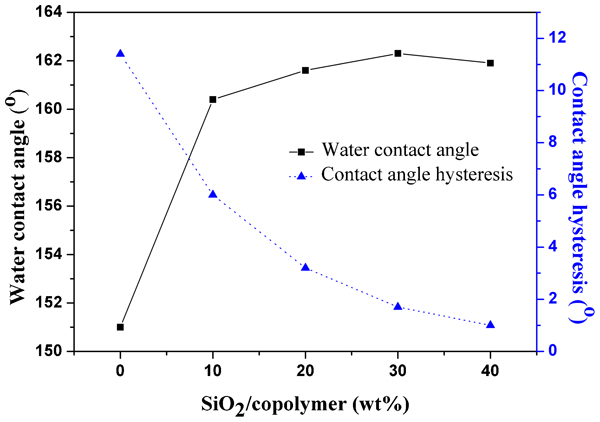
Variations in WCA and CAH with mass percentage of SiO2/copolymer
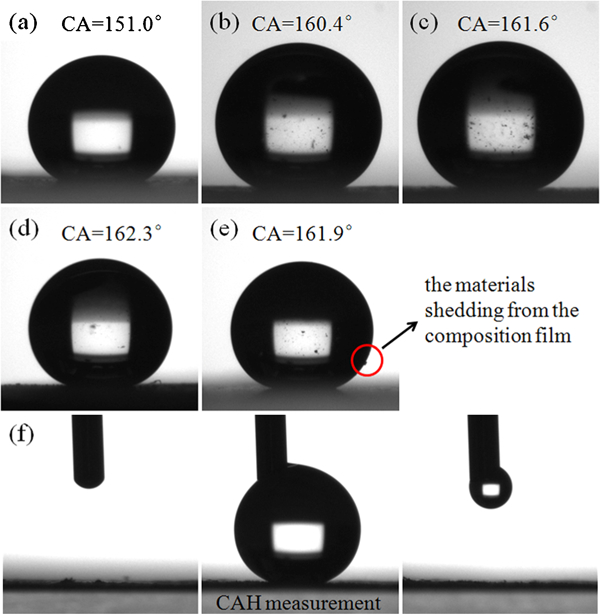
Profiles of 5 μL distilled water droplets on superhydrophobic films; mass percentage of SiO2/copolymer: a 0%, b 10%, c 20%, d 30% and e 40%; f process of CAH measurement (30 wt-%SiO2/copolymer)
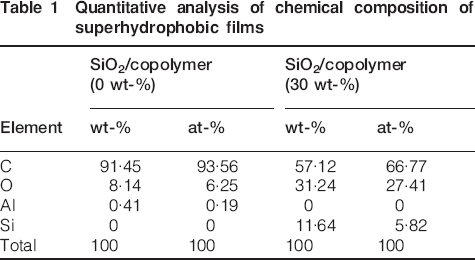
The surface morphologies of the films were examined by SEM. Figure 3 shows the SEM images of the superhydrophobic films at different SiO2/copolymer mass percentages: 0, 10 and 30%. Both formal spheres with smooth surfaces and particles ∼3 μm in diameter were uniformly distributed on the surface of the copolymer film (Fig. 3a and d). This result can be ascribed to the thermodynamic film formation (a typical process during phase separation). Initially, the linear copolymer chains freely stretched in the copolymer solution. However, with the evaporation of THF and ethanol, the linear copolymer chains spontaneously gathered to form a spherical coil that minimised the surface energy after coating. Consequently, the copolymer finally exhibited spherical structures, which increased the surface roughness of the coating. Spheres with irregular surfaces and non-uniform particle sizes can be seen in Fig. 3b, c, e and f. The surfaces of these large spheres seem to have a large number of particles with small sizes, and these small particles have contributed to the nanoscale roughness structures on the surfaces. To increase the conductivity of the films in the EDX test, aluminium slides were used as the coating substrates. The Al peak in the EDX spectrum (0 wt-%SiO2/copolymer) was attributed to the aluminium substrate, which minimally affected the component analysis because of the small amount of Al element (0·41 wt-%) present. Thus, the small particles in the SEM images can be further confirmed as silica (Table 1) by EDX spectrum analysis. Combined with the microspherical structures of the copolymer and the nanospherical structures of silica, multiscale nano/microstructures were fabricated on the surfaces of the composite films.
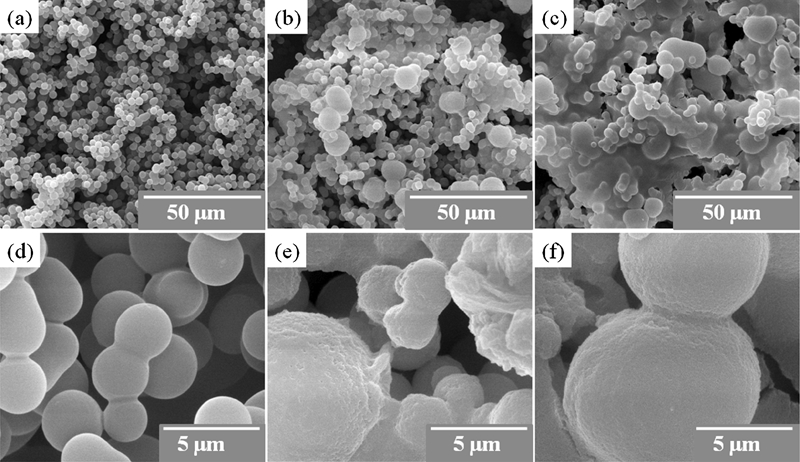
Images (SEM) of as prepared superhydrophobic films at different SiO2/copolymer mass percentages: a 0%, b 10% and c 30%; d–f high magnification images of a–c respectively
Quantitative analysis of chemical composition of superhydrophobic films
Conclusion
In summary, this communication presented a simple phase separation method of fabricating microstructures using the copolymer of styrene and methyl methacrylate. The addition of silica nanoparticles with hexamethyldisilazane modified surfaces to the above copolymer system introduced nanostructures into the copolymer surface. As a result, multiscale nano/microroughness structures were fabricated on the surface of the composite coating. The addition of the hydrophobic silica nanoparticles not only increased the WCA but also significantly decreased the CAH of the as prepared superhydrophobic surfaces. Compared with previous reports, the CAH of the as prepared superhydrophobic surface was very low. Therefore, these superhydrophobic surfaces have excellent self-cleaning properties for practical industrial applications, such as in self-cleaning coatings for outdoor buildings and textiles.
Footnotes
Acknowledgements
This work was supported by the National Science and Technology Support Program of China (grant no. 2009BAA23B04).