







Abstract
An alternating current field (ACF) was employed in pack boriding at 800°C to produce a thick Fe2B coating on an AISI 1045 steel. The effect of ACF on the growth of the boride coating was studied, and the coating's structure and phases were characterised. The results showed that an ACF could greatly enhance pack boriding and lead to the formation of a single Fe2B phase coating, which is much thicker than a coating by corresponding conventional pack boriding (CPB). The ACF's enhancing effect increased almost proportionally with increasing ACF currents from 1 to 9 A. The growth rate of the coating versus boriding time showed the same parabolic character as CPB. The mechanism of the ACF's effect on the formation of the single phase Fe2B coating was associated with enhanced chemical reactions in the boriding media and enhanced diffusion both in the media and in the treated sample.
Introduction
Boride coatings by pack boriding can greatly enhance ferrous and many non-ferrous metallic materials’ hardness, wear and corrosion resistance.1 – 4 The coatings on steels are generally composed of either a single phase Fe2B layer or a dual phase layer with an outer FeB zone and an inner Fe2B zone. The type of coating depends on the boron potential at the steel surface, the boriding temperature and the composition of the substrate.5 – 7 A single phase Fe2B coating is generally preferred in industrial applications for its lower brittleness under thermal or mechanical shock than the dual phase coating.6,8 Single Fe2B phase coatings can be produced by lowering the boron potential of the boriding media,9,10 but the boriding speed is decreased. A dual phase FeB–Fe2B coating can be changed to a single Fe2B phase coating by a vacuum or salt bath treatment for several hours above 800°C after normal boriding.11 However, production cost will be increased because of the prolonged heat treating time. Kartal et al.12 introduced a method ‘phase homogenisation in electrochemical boriding’ for forming a single phase Fe2B coating on steel substrates. FeB formed by electrochemical boriding was transformed to Fe2B by a subsequent homogenisation treatment in the same electrolyte for an additional time. Employing direct current field can greatly accelerate pack boriding as well as alumunising with energy saving,13 – 16 but the boride coating is a dual phase one. However, no report has been found that produces a single phase Fe2B coating directly by pack boriding in a quick and economic way.
The aim of the present work was an attempt to use an alternating current field (ACF) during pack boriding to enhance diffusion in the treated samples to obtain a thick Fe2B coating at a moderate temperature and within a shorter time. The goal was to create a new engineering process that is both economic and efficient. A mechanism to the enhancing effect of the ACF was proposed.
Experimental
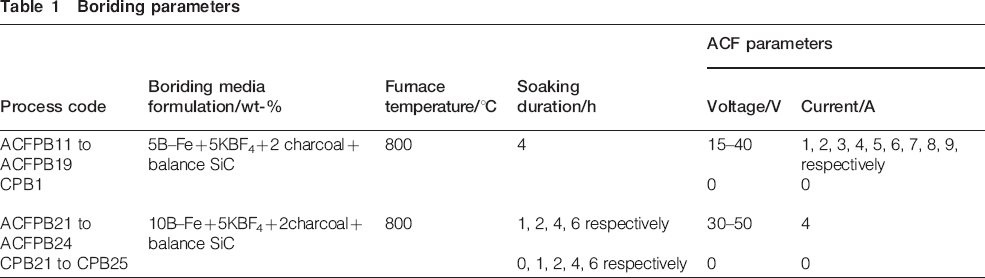
The experimental ACF enhanced pack boriding (ACFPB) apparatus is schematically shown in Fig. 1. All parts of the apparatus were heated in a chamber furnace during the treatment except for the adjustable ac supplier (part 6) and some of the conducting lines (part 7). Conventional pack boriding (CPB) for comparison was carried out in a separate container heated in the same furnace used for ACFPB. Samples subjected to boriding were made of normalised AISI 1045 steel with dimensions of 10×10×5 mm. The samples were ground and cleaned to remove surface contamination before boriding. Alternating current field enhanced pack boriding was realised by applying a 50 Hz ACF with a designated current to the electrodes once the soaking temperature (800°C) was reached. Detailed parameters for the treating are given in Table 1. After cooling in the furnace to the room temperature, the samples were removed from the container for further study.
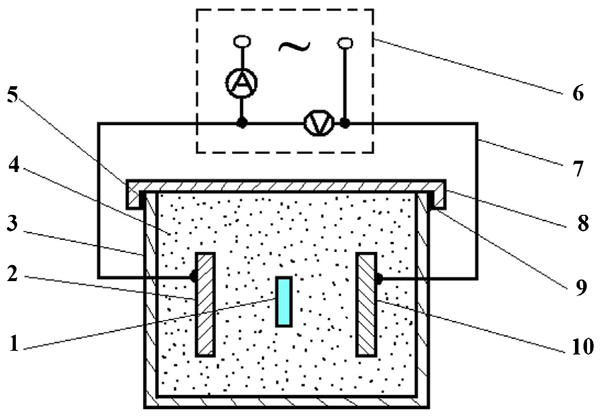
1: sample; 2, 10: electrodes; 3: container; 4: powder boriding medium; 5, 9: clay sealing; 6: adjustable ac supplier; 7: conducting wire; 8: lid
Boriding parameters
Microstructures of the treated samples were evaluated in cross-sections by optical microscopy (OM). Coating phases were investigated by both OM and X-ray diffraction (XRD, Cu Kα radiation, 100 mA and 40 kV). The boride coating thickness, as seen in the OM, was obtained by averaging the distance from the surface to the tip of the finger shaped boride. Borides measured were always at the centre of the sample.
Results
Coating thickness
Figure 2 gives the change of boride coating thickness with boriding time for CPB and ACFPB at an ACF current of 4 A. The boride coating thickness versus boriding time shows a parabolic character, which proves that diffusion is the main controlling factor in the growth of the coating for both ACFPB and CPB. In this case, the ACFPB coating is about twice as thick as the CPB coating as a function of different boriding times.
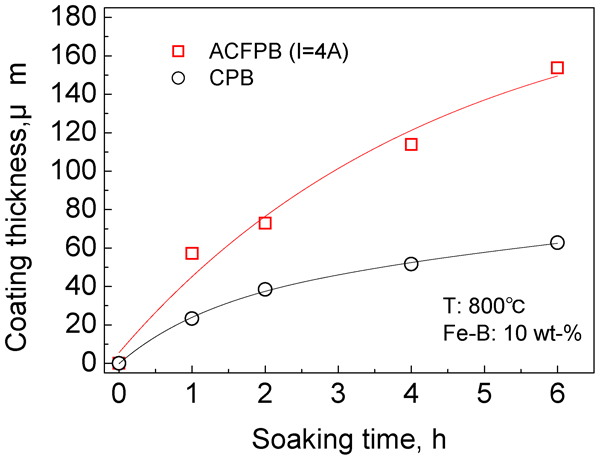
Boride coating thickness versus boriding time
The influence of current on the ACFPB boride coating thickness after 4 h boriding is shown in Fig. 3. As the current increased to 9 A, the coating thickness increased in a linear manner to more than 2·5 times the thickness of the CPB coating. As an example, a Fe2B coating more than 140 μm thick was produced by 4 h ACFPB treatment with an ACF current of 8 A, but the boride coating thickness of the corresponding CPB sample was only ∼60 μm.
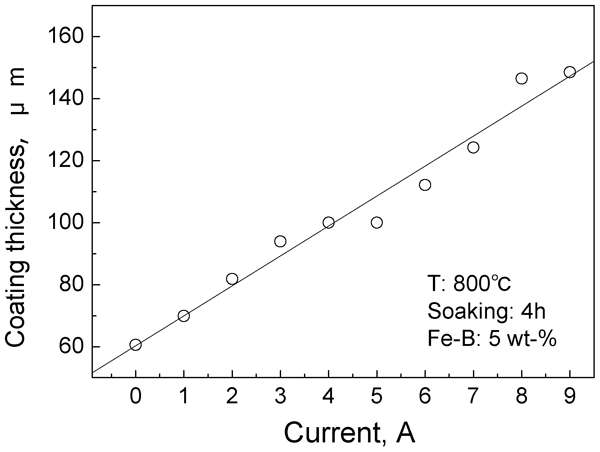
Boride coating thickness versus ACF current
Microstructures
Investigation through OM found no FeB in the boride coatings of all ACF samples. Single Fe2B phase coatings comprised the coating of samples borided at 800°C not only with the pack media containing 5 wt-% masteralloy of FeB, but also with the one containing 10 wt-%FeB masteralloy. However, dual phase coating was clearly revealed for all CPB samples, even with the lower boron potential of the boriding media containing 5 wt-%FeB masteralloy. Figure 4 shows microstructures in cross-sections of some typical CPB and ACFPB samples. FeB phase appeared in the 0 h soaking sample (process CPB21) indicated that FeB phase had formed in the surface before the designated boriding temperature (800°C) was reached.
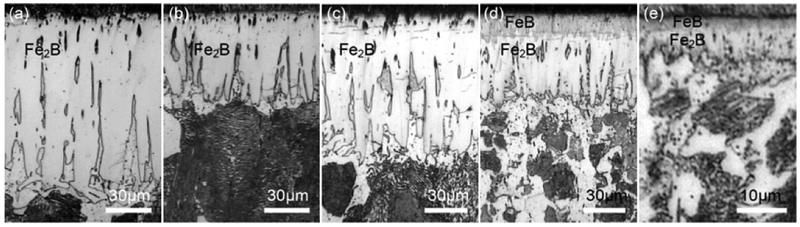
Microstructures in cross-sections of borided samples: a process ACFPB23; b process ACFPB21; c process ACFPB14; d process CPB1; e process CPB21
Phases
Surface XRD patterns on typical CPB and ACFPB samples are given in Fig. 5. Only FeB was detected for the 4 h CPB sample. Although 100 mA X-ray was used during XRD, the inner Fe2B phase could not be detected for the CPB sample because of the outer thick FeB layer. Both FeB and Fe2B were identified for the 0 h soaking sample CPB21. Only Fe2B was detected for all ACFPB samples, which indicates that no FeB phase exists in the heat treated samples. The XRD analysis further verified the types and amounts of boride phases observed through OM.
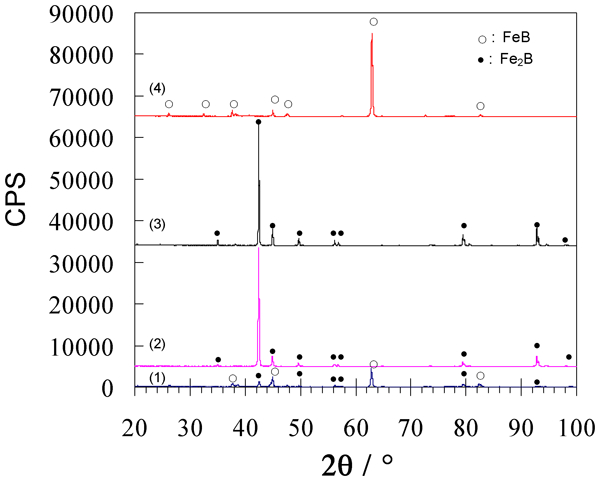
1: process CPB21; 2: process ACFPB23; 3: process ACFPB14; 4: process CPB1
Discussions
During pack boriding, Fe2B forms first by a reaction of active boron atoms with iron atoms in the sample surface.14,17 When the concentration of boron at the exterior of the Fe2B reaches ∼16%, FeB forms and grows on top of the Fe2B layer by a reaction of boron with the Fe2B. A two-phase boride coating is thus produced.18 Once the compact boride coating has formed on the surface, its further growth takes place at the common interface of the FeB zone with the Fe2B zone. The FeB zone grows by the reaction of the inner Fe2B with boron atoms diffusing from the surface across the outer FeB zone, while the Fe2B zone grows by the reaction of the outer FeB zone with iron atoms diffusing from the substrate across the inner Fe2B zone.17 When the formation rate of the new Fe2B is faster than that of the new FeB and the boriding time is long enough, a single phase Fe2B coating is produced. As the iron atom is larger than boron atom, the iron atom's diffusion depends a lot on vacancies in the matrix and is relatively slow in CPB.
It was reported that a direct current increases vacancy concentrations and their mobility in some metallic materials.19,20 Therefore, it is reasonable to believe that alternating current flowing through the steel sample will also increase vacancy concentrations. The vacancies will greatly promote the diffusion of iron atoms for the formation of the new Fe2B. The treated sample was positioned between the electrodes (see Fig. 1). Alternating current field induced an alternating current in the treated sample. The induced alternating current distributed itself within the sample with the current density being largest near the sample's surface, decreasing from the surface at greater depths. This is called skin effect. The concentration of vacancy produced by the alternating current should thus be highest near the sample's surface. Increasing ACF current correspondingly increased vacancy concentration. With the high concentration vacancies, much more iron atoms than those in CPB diffused from the substrate across the inner Fe2B layer to react with the outer FeB. The formation rate of the new Fe2B was therefore faster than that of the new FeB, and a thick single phase Fe2B coating would be obtained. Increasing ACF current increased alternating current induced in the treated sample. Correspondingly, the vacancy concentration was increased in the near surface region of the treated sample, and the coating thickness was therefore increased (see Fig. 3).
Alternating current field should also intensify chemical reactions and diffusions in the boriding media with the energy from the ACF and the ACF's electromagnetic stirring effect. Therefore, more active boron containing species moved to the sample's surface to promote the formation of borides.
Conclusion
Employing a proper ACF greatly enhanced pack boriding at 800°C with a soaking time varied from 1 to 6 h. Single Fe2B phase coatings were produced, which were much thicker than those by corresponding CPB.
The ACF's enhancing effect on the growth of the single phase Fe2B coating increased almost proportionally as the ACF current increased from 1 to 9 A. The growth rate of the coating versus boriding time showed a parabolic character.
It was proposed that the enhancing effect of ACF on the formation of the thick Fe2B coating was realised by promoting chemical reactions in the boriding media and promoting diffusion both in the media and in the treated sample.
Footnotes
Acknowledgements
Financial support from the National Science Foundation of China (grant no. 51171032) is acknowledged.