







Abstract
The radio frequency (RF) discharge in an oxygen atmosphere was used to produce metal oxide films. The high efficiency of the RF discharge technique for metal oxidation at room temperature was demonstrated for gold, silver and copper foils. Oxide films up to 10 nm in thickness were obtained. The produced oxide films were studied by X-ray photoelectron spectroscopy (XPS). The XPS data showed the formation of oxidised species: Cu2+, Ag1+ and Au3+. Analysis of the oxygen species was performed using O1s spectra. For copper and silver foils, the formation of additional oxygen species apart from oxygen in the structure of oxides was shown. The reaction probability toward oxidation of carbon monoxide (CO) was estimated for all oxidised layers. It was established that gold and silver oxide films interacted with CO at room temperature, while cupric oxide showed high activity at temperature >353 K.
Introduction
Oxide films have numerous applications, such as solar cells, flat panel displays, sensors, optoelectronics, etc. [1–3] One of them is the preparation of model catalyst systems for the investigation of catalytic properties of oxidised metal species. This information is very important for understanding the nature of active centres of the catalysts and for establishing the mechanisms of catalytic reaction. Noble metals, such as Pt, Pd, Ag, Au, etc., are widely applied in catalytic processes [4–6], and therefore, analysis of their oxidised surface layers is of high importance. There are a lot of techniques to produce oxidised surfaces. One of the easiest methods is heating of samples in an atmosphere of molecular oxygen. However, this oxidation technique can be successfully applied only to a limited number of metals. Materials such as precious metals are inert towards dioxygen treatment [7]; moreover, a sample heating can lead to the decomposition of weekly bound oxygen species. The oxidised films can also be formed by irradiation of physisorbed O2 layers with low energy electrons or ultraviolet photons [8] or by exposure of atomic oxygen [9–11] or O3 [12,13]. However, these techniques only result in very thin oxidised films.
The thermal and magnetron sputtering [14,15] or laser ablation [16,17] results in the formation of oxidised films, and the thickness of the film depends on the sputtering time. In these methods, the growth of the oxide film is through the sputtering of the target material and not due to the oxidation of the metallic surface under study. In which case, the surface impurities remain in the interface layer between the support and the deposited layers. The presence of impurities can play a crucial role during the analysis of the properties of thin oxidised film (<5 nm in thickness) by physicochemical methods.
Deep oxidation of metal surfaces can be achieved by oxidation in an electrochemical cell [18]. However, this technique requires performing experiments with solutions that are hardly compatible with high vacuum experiments. Moreover, the application of different oxidation agents like acids can lead to the formation of impurities like S, N, etc.
The application of oxygen activated by means of microwave [19,20] or radio frequency (RF) discharge [21,22] to create oxidised layers seems to be one of the most convenient oxidation techniques capable of producing fully oxidised surfaces of bulk samples at room temperature. This method allows avoiding impurities and can be easily applied in model surface science experiments for studying the catalyst properties.
In the present work, we applied RF discharge in O2 to produce highly oxidised layers of gold, silver and copper on the surfaces of bulk samples. The electronic structure of the obtained oxide layers was investigated by X-ray photoelectron spectroscopy (XPS). Possible application of the oxidised systems for analysis of the catalytic properties of metals was demonstrated.
Experimental
The experiments were carried out using a ‘‘VG ESCALAB HP’’ (VG Scienta, UK) spectrometer equipped with an analysis chamber and a chamber for preliminary treatments. The samples were polycrystalline gold, silver and copper foils (Ezocm, Verhnjaja Pyshma city, Russia) of 99·99% purity and 50 μm thickness. The metal surfaces were cleaned in the preparation chamber of the spectrometer by the successive cycles of Ar+ ion bombardment followed by annealing at 600–800°C. The oxidation of the clean metal surfaces was performed in the preparation chamber by RF discharge in an oxygen atmosphere (O2 pressure ∼25 Pa, time of RF discharge 1–5 min). The RF discharge was generated at 300 W by a homemade RF source (frequency ∼12·6 MHz) [23,24]. An aluminium wire (Goodfellow, UK, 99·999% purity, 2 mm thick) was used as an electrode for RF discharge generation. Sputtering of the electrode material was not detected for any of the experiments. For each of the analysed metals, at least 10 cycles of plasma oxidation followed by XPS experiments were performed. The obtained results were characterised by a very high reproducibility.
An AlKa X-ray source (photon energy hv = 1486·6 eV) operated at 180 W was applied to collect the X-ray photoelectron spectra. The spectral regions O1s, Au4f, Ag3d, Cu2p, C1s, AgMNN and CuLMM were used to study the charge state of Ib group metals and the oxygen species in the obtained layers. The level of surface contamination was monitored using survey spectra with high sensitivities.
The thickness d of a homogeneous oxide layer was estimated on the basis of the dependence of the metal's signal on the covering layer thickness [25]

where Imet is the intensity of the bulk metal covered by an oxide layer with d thickness, Imet∞ is the intensity of the pure bulk metal, λ is the inelastic mean free paths of the photoelectrons and θ is an electron takeoff angle.
Analyses of the obtained data, including Shirley background subtraction and curve fitting procedure with Gaussian–Lorentzian or Doniach–Sunjic functions, were carried out using the ‘‘XPS-Calc’’ programme tested on a number of systems [26–28].
Results and discussion
In case of copper foil oxidation, the formation of copper oxide film was observed after 3 min of plasma treatment. The Cu2p spectrum (Figure 1(a)) of the oxidised copper surface consisted of a doublet with Eb(Cu2p3/2) = 933·3 eV and shake-up satellites at ∼940–945 eV. Such spectrum structure was similar to one of the reference cupric oxide spectra [28]. The O1s spectrum analysis showed the presence of several oxygen electronic states (Figure 1(b)). The peak with Eb(O1s) = 529·4 eV corresponded to the oxygen of the CuO crystal lattice [29]. However, a noticeable shoulder at higher binding energy was observed. It consisted of three peaks, with binding energies 530·9, 531·8 and 533·3 eV, which can be attributed to the ‘non-lattice’ oxygen state inside of the cupric oxide structure, carbonate groups (in good agreement with C1s data) and small impurities of adsorbed water [30] respectively.
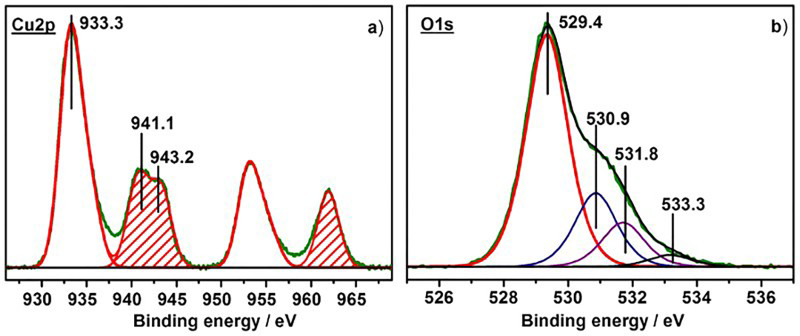
(a) Cu2p and (b) O1s spectra of copper (II) oxide film produced by 3 min RF discharge in oxygen.
Oxygen plasma treatment of the silver foil led to surface oxidation with the formation of silver oxidised state at Eb(Ag3d5/2) = 367·7 eV (Figure 2(a)). Such value of binding energy was close to the known Eb of silver oxide Ag2O. [31–33] The kinetic energy of Auger electrons Ekin(AgM4N4,5N4,5) (Auger spectra are not shown in this article) and the calculated value of the Auger parameter α were 356·4 and 724·1 eV respectively, also indicating the formation of Ag2O species [32]. The O1s spectrum of oxygen for this oxidised system (Figure 2(b)) showed two maxima ∼529 and 532 eV. By curve fitting of the O1s spectrum, four individual components were determined. The main peak with Eb(O1s) = 529·2 eV was assigned to the oxygen species in the Ag2O structure [31,32,34]. The components with binding energy value higher than 530 eV could be interpreted as weakly charged oxygen of carbonate species, hydroxyl groups or molecular oxygen species: peroxides, superoxides and ozonides [31,35–37]. The obtained Ag3d, O1s and AgMNN spectra pointed to the complete oxidation of silver surface, within the area of XPS analysis, to Ag2O oxide.
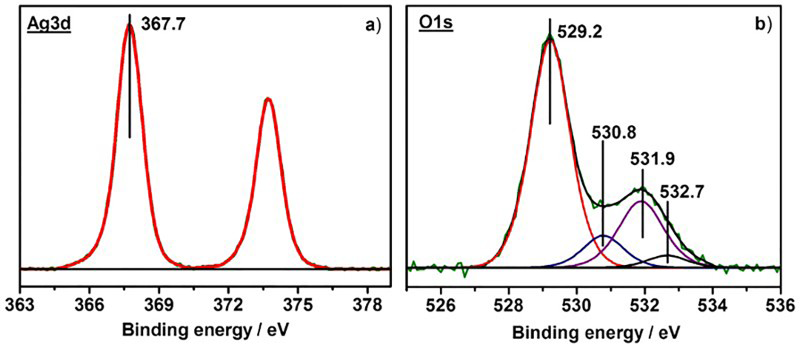
(a) Ag3d and (b) O1s spectra of silver oxide film produced by 3 min RF discharge in oxygen.
The oxidation rate of the gold surface was lower than that for silver and copper. The Au4f spectrum showed two doublets with Eb(Au4f7/2) ∼84 and 86 eV typical for metal gold and Au3+ species [16,18] (Figure 3(a)). The increase in treatment time did not lead to the complete disappearance of metal gold component in the XPS spectra. Based on the Eb(Au4f7/2) shift of the metal component to 83·7 eV (0·3 eV lower than the Eb typical for bulk metal gold), we can propose the formation of a metal cluster covered by the gold oxide film surface.
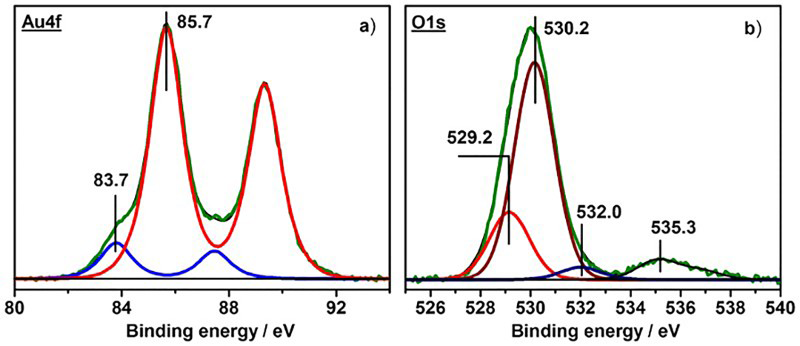
(a) Au4f and (b) O1s spectra of gold oxide film produced by 6 min RF discharge in oxygen.
The O1s spectrum analysis showed the presence of several oxygen electronic states (Figure 3(b)). Two of them with Eb(O1s) at 529·2 and 530·2 eV were assigned to the oxygen in Au2O3 oxide. Most probably, these oxygen species originated from surface and bulk gold oxides. However, the presence of two non-equivalent oxygen types in the structure of bulk gold oxide was previously shown [38]. For unambiguous interpretation of these oxygen states, further experiments should be performed. The low intensity peak at 532·0 eV could be interpreted as surface hydroxyl groups [19]. The oxygen form with Eb(O1s) = 535·3 eV was observed only after a prolonged plasma treatment of the gold surface. The binding energy of this species (535·3 eV) is anomalously high for a thermostable oxygen form, since only weakly adsorbed or physisorbed oxygen species have such high binding energies Eb(O1s) [39]. Thus, it could be interpreted as molecular oxygen occluded by intergrain voids of the oxide film or stabilised by the metal–oxide interface layer.
The reaction probability of all Ib metal oxide films was tested in a model carbon monoxide (CO) oxidation reaction by step by step CO exposure. The reaction probability was estimated as a ratio of the number of reactions between CO molecules and oxidised metal species to the total number of CO impingements on the oxide surface [28]. It was established that gold and silver oxide films showed activity even at room temperature, while copper oxide film interacted with CO at temperature higher than 353 K. In case of gold oxide film, the inductive period was observed, followed by reactivity up to χ = 5×10⁻⁴. For silver oxide film, reactivity was found to be χ = ∼10−3 for oxygen in Ag2O structures and χ = ∼10−4 for molecular oxygen forms (Eb(O1s) = 530–533 eV). The initial reactivity of copper oxide film measured at 353 K was χ = 5×10⁻⁵; however, further decrease in reaction probability up to 5×10⁻⁹ occurred. The ‘non-lattice’ oxygen form with Eb(O1s) = 530·9 eV was shown to be responsible for the initial high reactivity. The drop of the reaction probability to 5×10⁻⁹ occurred after the complete removal of this oxygen species from the surface.
The obtained results showed that apart from the oxygen in the composition of oxides, oxides with different electronic and catalytic properties were formed on the surfaces of the analysed metals. The copper oxidation by the RF discharge gave an additional oxide with Eb ∼530·9 eV that could not be ascribed to such species like carbonates or hydroxides. The distortion of CuO lattice could lead to the stabilisation of this oxide [40]. The molecular oxygen species were observed following the RF discharge exposure on the surface of silver foil. The formation of this type of oxygen was likely a result of a defect structure of the oxidised layer [37]. The oxidised gold surface mostly included gold oxide with a small contribution of oxygen species that originated from the surface carbonate or hydroxide species. The formation of specific oxygen type in case of each metal should depend on many factors like the difference in metal nature, the crystallographic structure of their oxides, etc.
Experiments showed that oxidised gold and silver layers reacted with CO at room temperature, while the oxidised copper surface was active at temperatures higher than 353 K. The nature of Me–O bond and specific of CO interaction with oxidised surfaces have a strong influence on the metal's activity. Although copper does not show low temperature activity, it can be considered as a good substitute of precious metals for reaction in temperature diapason high 350 K.
The technique of RF discharge in an oxygen atmosphere could be successfully applied for the production of oxidised films even in case of relatively inert metals like silver and gold. The thickness of the obtained films could be estimated from the XPS data. The increase in the RF discharge time led to the complete oxidation of copper and silver surfaces as no metallic components could be observed in the XPS spectra within the depth of the XPS analysis (about 8–10 nm) [28]. The RF discharge treatment of gold foil resulted in the formation of gold oxide film with thickness of about 5–7 nm. Although we could not control the thickness of the oxidised film exceeding the depth of XPS analysis, we can propose that with further oxidation of the foils the depth of the oxidation should increase, but certain limitations like oxygen diffusion through the oxidised layers would influence the oxidation rate. Obviously, methods of oxide film production like laser ablation, reactive magnetron sputtering, etc. allow to obtain films with the thickness limited only by a deposition time. Nevertheless, the RF discharge in an oxygen atmosphere can be more convenient for the direct oxidation of substrates of different compositions.
Conclusion
In present work, the application of RF discharge in an oxygen atmosphere for oxidation of metal surface was demonstrated. For all analysed metals, complete oxidation of surface layers was observed. The thickness of the oxidised films was estimated by XPS as 5–10 nm. The presence of several oxygen species was detected in the produced oxide films. Additional oxygen states could be partly attributed to the impurities but also to the specific oxygen forms stabilised by the oxide layer structures. Study of the oxidised species exposed to CO gave information about the reaction probability of nanostructured gold, silver and copper oxides.
It is clear that oxidation by RF discharge could be an efficient method for passivation and functionalisation of surfaces for numerous engineering and scientific applications.
Footnotes
Acknowledgment
This work was supported by the Ministry of Education and Science of the Russian Federation.