







Abstract
The superiority of sharkskin is the consequence of nature selection and self-evolution. The nano/microhierarchical structure covering over sharkskin can match its living surroundings perfectly, whereas the best drag reducing effect cannot be implemented at all circumstances. Therefore, it is necessary to adjust the size and shape of sharkskin morphology to accommodate more potential flowing conditions. In this paper, the stretching deformed fabrication process of sharkskin surface is explored and investigated, and the super-hydrophobic and hydrodynamic drag reduction effect is inspected. The experimental results in the water tunnel indicate that the stretched sharkskin can expand the speed scope of applications with satisfactory drag reduction effect. Additionally, the drag reduction mechanism is explained and derived comprehensively, which has important significance to apprehend sharkskin effect.
Introduction
Selected by nature, only the fittest creatures survive. Through millions of years of struggle for existence, excellent species have shaped their special functional surfaces, and the hierarchical structures on the biological skin can enable them to hold the anti-wear/self-cleaning/anti-fouling/drag reduction/anti-sticking effect. For example, lotus leaf has the self-cleaning/super-hydrophobic function to protect it from pollution in the mud, 1 morphology on dung beetle head possesses the anti-sticking function to make it move smoothly in the soil, 2 and scales on pangolin own the anti-wear function. 3 Nature has long become the important source of inspiration for human to explore artificial ways to mimic the remarkable properties of biological systems. 4 Sharkskin is covered by the microgrooved scales, which contribute to improving its speed,5–8 and dolphin has the soft and flexible skin that can save energy during acceleration. 9 In 1980s, Walsh in NASA Langley Research Center found that the bioinspired sharkskin ribbed surface could effectively reduce the viscous friction on turbulent conditions compared with the smooth skin. 10 Since then, many researchers have explored the drag reduction mechanism and extended its applications in different fields. Bechert manufactured the microgrooved surfaces with different sizes and shapes by the optimisation method, and then conducted the experiments in water tunnel, and the results told us that the maximum of drag reducing efficiency was ∼10%.11,12 Luo et al. machined the continuous biomimetic drag reducing surface in a large area and imported the technology into application on natural gas pipelining, and a drag reducing efficiency of >8% was acquired.13–16 Lauder studied the self-propelled swimming speed of sharkskin, and the average drag reducing efficiency of 12·3% was received.17,18 The reports of Lang told us that shark scales were pliable and might erect passively, which was beneficial to maintain the high drag reducing effect.19,20 Therefore, due to the priorities and advantages of sharkskin, it is very necessary to explore the new methods to fabricate drag reducing surfaces with the real/biological sharkskin morphology.
As consequence of the pertinent natural selection and self-evolution, sharks have gradually developed the micro/nanohierarchical morphology on the skins for survival in their living environment, 21 which implies that the real sharkskin morphology has the best drag reduction effect in the special range of velocity. Based on the basic theories of fluid mechanics that the best drag reducing efficiency of microgrooved surface depends on the optimum spacing s+ and h+, which is relevant to the width and depth of microgrooves, 10 deformation of sharkskin morphology is one important and feasible way to ensure the optimal drag reduction function of shark skin in different fluid surroundings. It is a valuable issue to expand the practical applications by adjusting the sizes and shapes of sharkskin morphology. In this paper, the adjustable deformations of biomorphology on sharkskin are carried out, and the results show that the super-hydrophobic and hydrodynamic drag reduction effects are improved on some extent, which will inevitably expand the bioinspired sharkskin technology into more applications.
Experimental
Materials and methods
In this paper, the Carcharhinus brachyurus shark is selected as the research object. Sharkskin is covered by many diamond arranged small scales. The extension direction of scale is approximately parallel to its swimming direction, and the groove tips of scale can protrude from the viscous sublayer, which can effectively inhibit the occurrence of turbulence and has the function of reducing wall resistance. It is deemed as ‘sharkskin effect’. The two-dimensional SEM image of sharkskin and three-dimensional morphology of sharkskin scale are illustrated in Figs. 1 and 2. It can be acquired that microgrooves sit on it. The size of scales is basically 0.1 mm × 0·1 mm, and the depth and width of microgroove are ∼2 × 10− 5 m and 5 × 10− 5 m respectively.
SEM image of biological sharkskin Three-dimensional morphology of sharkskin scale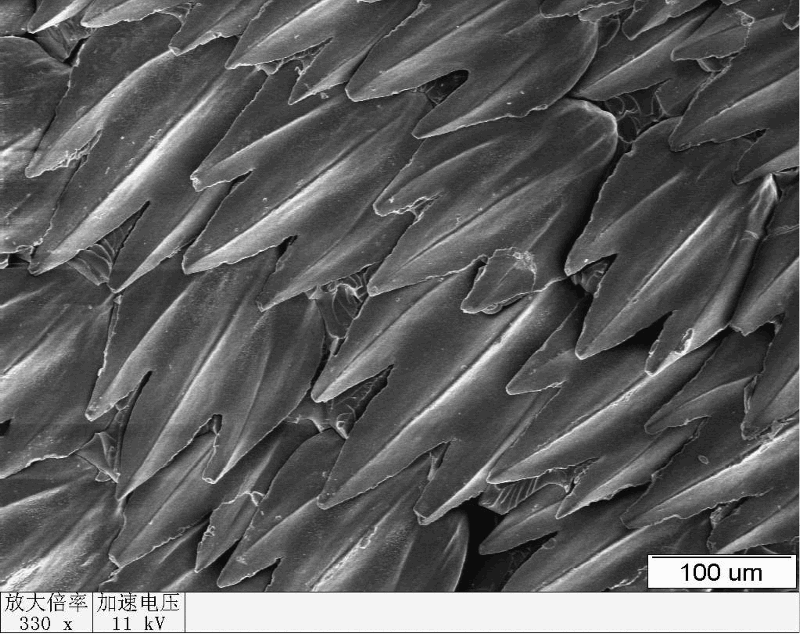
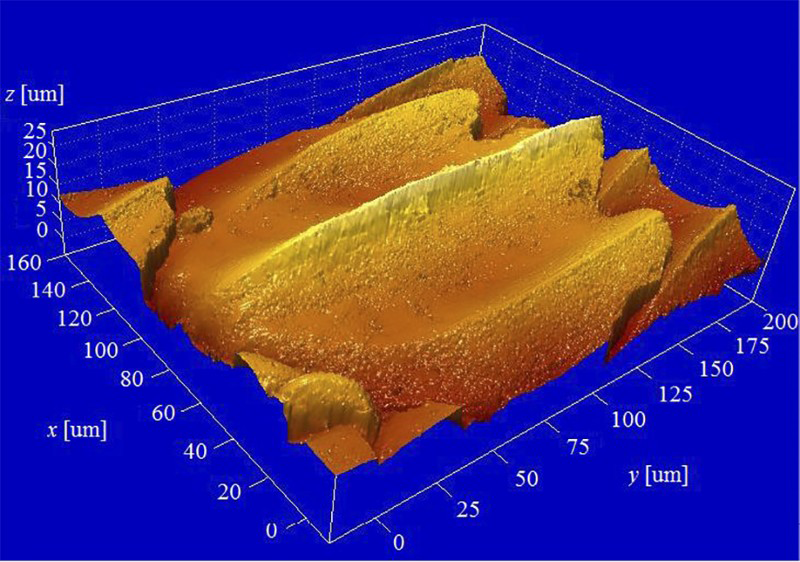
Treatments of biological sharkskin
For the purpose of maintaining the integrity and mechanical strength of biological sharkskin, it should experience the following treatments, as indicated in Fig. 3.
Treatments of biological sharkskin template
The details of treatments are as follows: (i) cleaning the sharkskin samples with clear water for three to five times, and then washing the samples with deionised water for two or three times, the purpose of which is to get rid of the mucus, dirt and blood on the surface. (ii) Glutaraldehyde (C5H8O2) fixation is put into application. After cleaning, the biological sharkskin is fully immersed into the 2·5% glutaraldehyde solution and then placed in a constant temperature environment over 6 h at 4°C. The sharkskin can be fixed completely. (iii) After fixing the sharkskin, the biological sample should be rinsed with phosphate buffer solution and then rinsed with deionised water for three to five times, the purpose of which is to flush out the residual glutaraldehyde attached to the biological sharkskin. (iv) In order to avoid the shrinkage and deformation of sharkskin in the subsequent heating process, it should experience the dehydration step. The commonly used dehydrating agents include alcohol (C2H6O) and acetone (C3H6O).22,23 Because the abrupt dehydration can lead to the adverse shrinkage and deformation, the biological sharkskin should be gradually dehydrated before heating. In addition, the excessive dehydration can enable the biological sharkskin to become crisp, so the dehydration should be medium well. In this paper, the alcohol with mass ratios of 50%, 75%, 90% and 95% is adopted in dehydration. (v) After the dehydration, in order to remove the moisture in the biological sharkskin to the greatest extent, the purpose of which is to keep the biological sharkskin without deterioration/deformation at the room temperature, it should be placed into the oven ∼60°C for ∼5–6 h.
Deformed fabrication of sharkskin surface
The steps of fabricating drag reducing surface with deformed sharkskin morphology for the purpose of expanding its application in a larger speed range are illustrated in Fig. 4, and the main steps are as follows: (i) treatments of biological sharkskin; (ii) filling the silicone rubber RTV-II 5230 with curing agent (produced by Shandong Hero Chemical Materials Corporation); the mass ratio of silicone rubber and curing agent is set as 100:1; (iii) flexibility demounding after the silicone rubber is cured completely; (iv) stretching and fixing the negative template for some time; (v) filling the resin polymer [composed of water based epoxy resin emulsion (AB-EP-44) and waterborne epoxy curing agent (AB-HGF), produced by Beijing Jingyi Chemical Corporation] into the stretched negative sharkskin template; (vi) flexibility demounding of resin polymer after being cured completely, and the drag reducing surface with deformed sharkskin morphology can be obtained.
Fabrication of drag reducing surface with deformed sharkskin morphology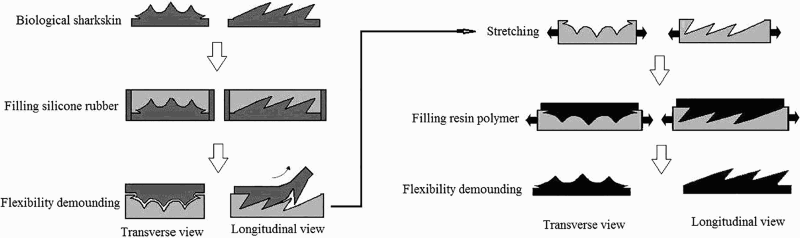
Results and discussion
Morphology of deformed sharkskin surface
In order to inspect the morphology on different sharkskin surfaces, they are observed by a scanning electron microscope (KYKY1000, manufactured by Beijing Jingyi Precise Equipment Corporation). The SEM images of different morphologies are illustrated in Fig. 5, in which Fig. 5a shows the original morphology of sharkskin, Fig. 5b shows the morphology of sharkskin stretched 50% on the transverse direction, and Fig. 5c shows the morphology of sharkskin stretched 50% on the longitudinal direction.
SEM images of different sharkskin surfaces: a sharkskin surface with original size; b sharkskin surface stretching on longitudinal direction; c sharkskin surface stretching on transverse direction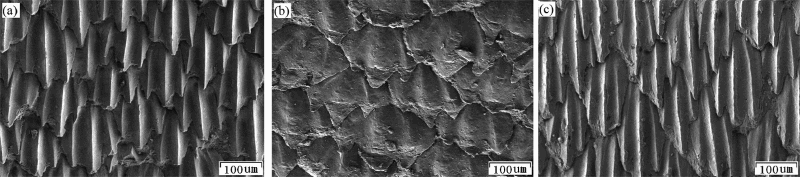
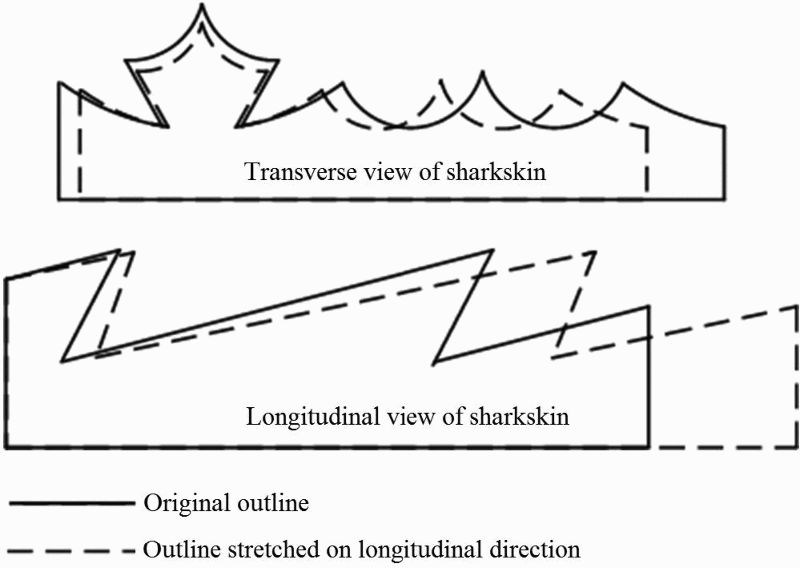
The schematics of sharkskin stretching on transverse and longitudinal direction are shown in Figs. 6 and 7. After the stretching on the transverse direction, the width of microgroove is becoming larger and the height of the microgroove is becoming smaller; therefore, the ratio of height (h) and width (s) is lessening. For the stretching on the longitudinal direction, the width and height of microgroove are both becoming smaller, and the ratio of height (h) and width (s) is approximately constant. The changed sizes and shapes of microgrooves on sharkskin scale can generate the potential influence on super-hydrophobic and hydrodynamic drag reduction effect.
Schematic of sharkskin stretching on width direction Schematic of sharkskin stretching on longitudinal direction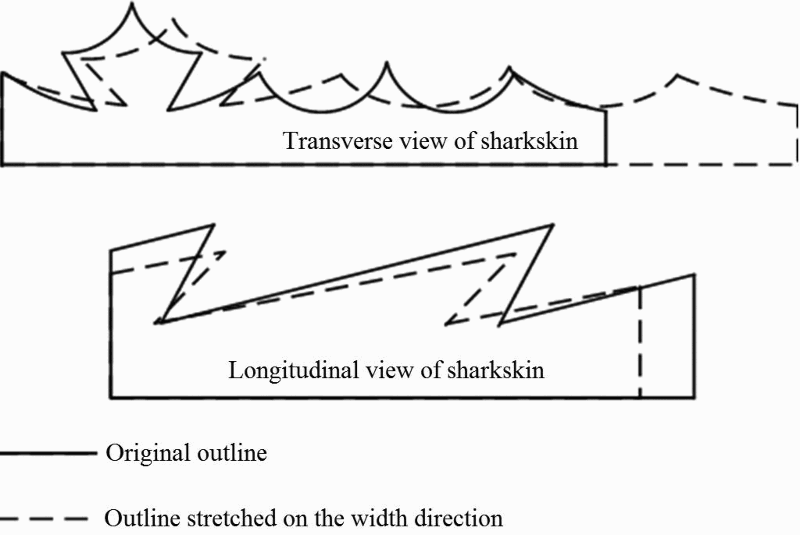
Wetting property on deformed sharkskin surface
It is known that lotus leaf has the hierarchical nano/microstructure possessing the self-cleaning/super-hydrophobic effect, and some facts have validated that bioinspired sharkskin surface has the anti-wearing and self-cleaning effect.24,25 In order to validate the super-hydrophobic effect on different surfaces, the contact angles are measured by the dataphysics OCA50 automatic contact angle measuring instrument.
The contact angles on different sharkskin surfaces are 120°, 95° and 152°, as illustrated in Fig. 8, which indicates that the deformed sharkskin surface has developed into the super-hydrophobic surface. For the sharkskin stretched on the transverse direction, the contact angle is becoming less, and for the sharkskin stretched on the longitudinal direction, because the morphology has become finer, the contact angle is becoming larger, and it has developed into the super-hydrophobic surface.
Contact angles on different surfaces: a contact angle on sharkskin surface with original size; b contact angle on sharkskin surface stretching on transverse direction; c contact angle on sharkskin surface stretching on longitudinal direction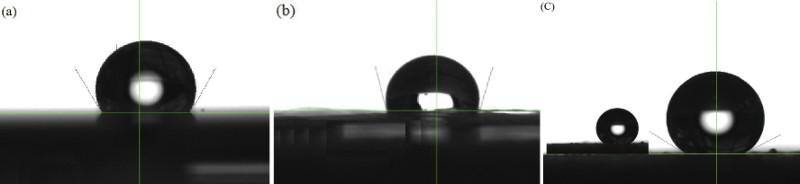
Hydrodynamic drag reduction effect
To confirm the drag reducing efficiency of the stretched sharkskin with deformed morphology, the hydrodynamic experiment is conducted in a water tunnel. The schematic drawing and field image of water tunnel system are illustrated in Fig. 9a and b.
Water tunnel system: a schematic drawing; b field image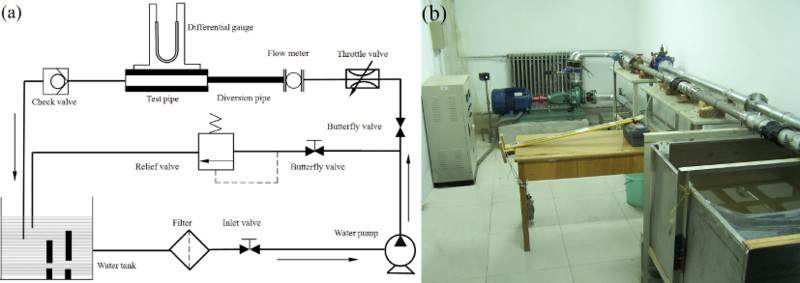
The tunnel system consists of water pump, water tank, pressure differential gauge, pipe section, relief valve, throttle valve, butterfly valve, check valve and so on. The drag resistance of different skins can be calculated by testing the pressure difference between two measurement points, and the buffer pipe section is set as longer than 50 mm, the purpose of which is to stabilise water flow in front of the test pipe section. The inner wall of the test pipe section is covered by the prepared different drag reduction skins under test. In the process of testing drag reduction effect, smoothness is the principal requirement for covering process to avoid adverse effect of surface wrinkling and other defects on drag reduction. The inner diameters of the diversion pipe and test pipe are 49 and 52 mm respectively. The thickness of all the test skins is kept as 1·5 mm to ensure smooth transition at connection after bonding the skins on the inner surface of the test pipe. The testing results are summarised in the supporting materials.
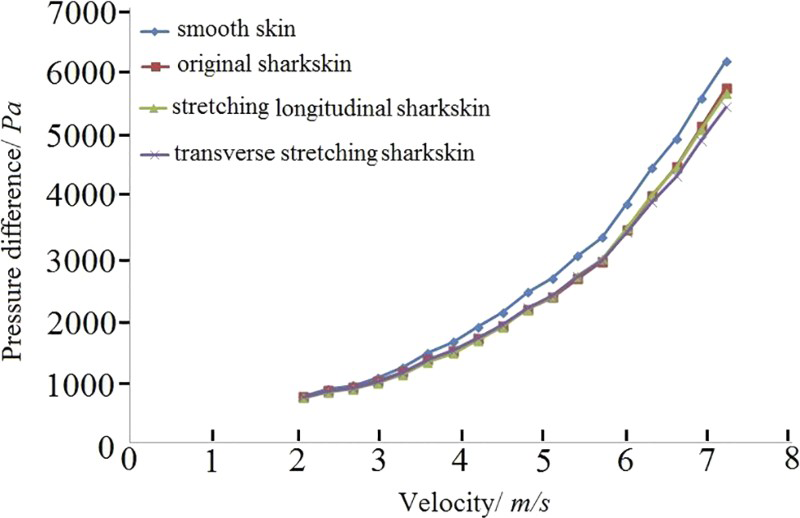
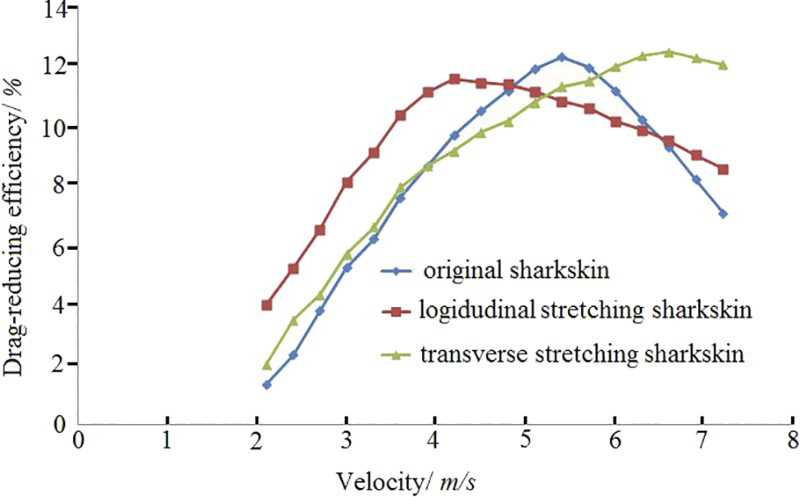
The pressure difference on different skins is shown in Fig. 10, and in this paper, the drag reducing efficiency can be calculated as
Pressure difference on different skins Drag reducing efficiency of different skins . The drag reducing efficiency of different skins is plotted in Fig. 11. It can be seen that when the velocity is larger than 4 m s− 1, the difference between different skins is becoming larger. Sharkskin stretched on the longitudinal direction has the best drag reduction effect, and the common conclusion can be obtained that with the increasing of flowing velocity, the drag reducing efficiency is going up gradully, and when it reaches the maximum, it will go down. In addition, the maximum of different sharkksin surfaces is >12%.
Influence of deformed sharkskin morphology on microflow field
In order to explain and understand the influence of deformed sharkskin morphology on drag reduction effect, the numerical simulation of microflow field is carried out. Figure 12 shows the process flow sheets of analysing the microflow field on the real sharkskin surface.
Schematic of microflow field analysis over sharkskin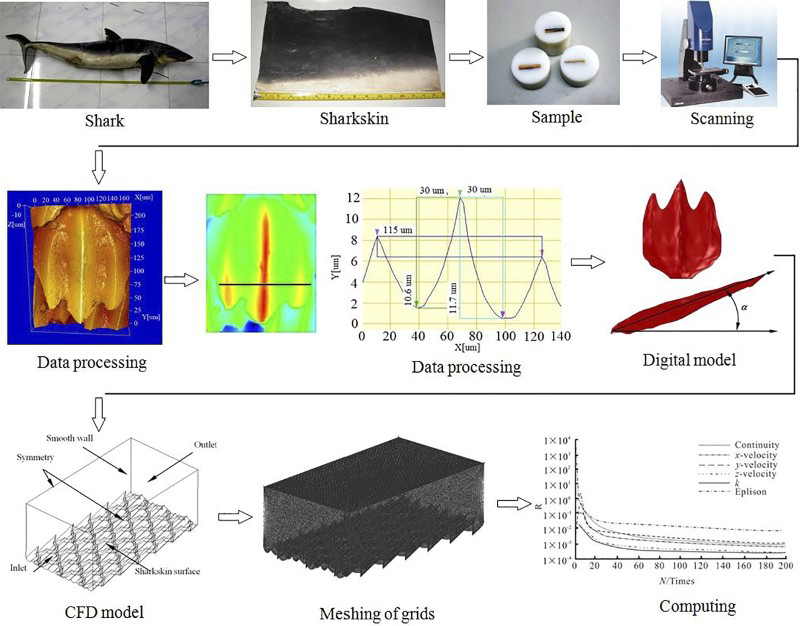
The main steps are as follows26–28: (i) acquire the biological sharkskin sample from the fresh shark; (ii) pretreat the biological sharkskin and obtain the clean and flat surface for scanning, which mainly includes cleaning, chemical fixation, recleaning, dehydration and desiccation; (iii) sputter the surface of biological sharkskin for good optical reflection and electric conduction; the subtle particles of Au should be uniformly distributed on the sharkskin surface, and the depth of Au layer is < 20 μm with the purpose of protecting the original morphology; (iv) scan the morphology on sharkskin surface with the highly accurate electrical equipment and get the sufficient and precise data; (v) process the data in a reasonable way to eliminate the redundant points; (vi) introduce the information into the software and built the digital model; (vii) construct the continuous and no overlap surface in a large area; (viii) build the CFD (computational fluid dynamics) model and carry out the meshing of grids; (ix) perform the interactive computation, and the microflow field over the sharkskin surface can be received, including the wall resistance and turbulence intensity.
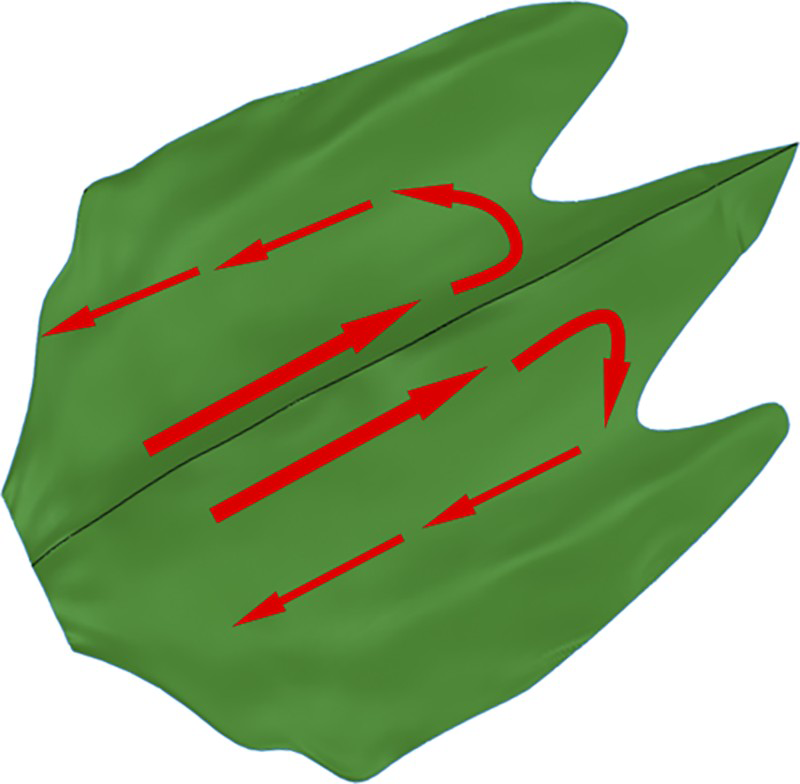
When the average velocity in the whole fluid zone is set as 6 m s− 1, the velocity distribution on the longitudinal section of sharkskin is shown in Fig. 13. It can be seen that the apparent ‘back flowing’ phenomenon exists on the surface of scale. It is another important factor to generate the higher drag reducing efficiency than simplified microgrooved surface without attack angles, and the schematic drawing of back flowing phenomenon is illustrated in Fig. 14.
Numerical simulation of attack angles on scale's back Schematic drawing of back flowing phenomenon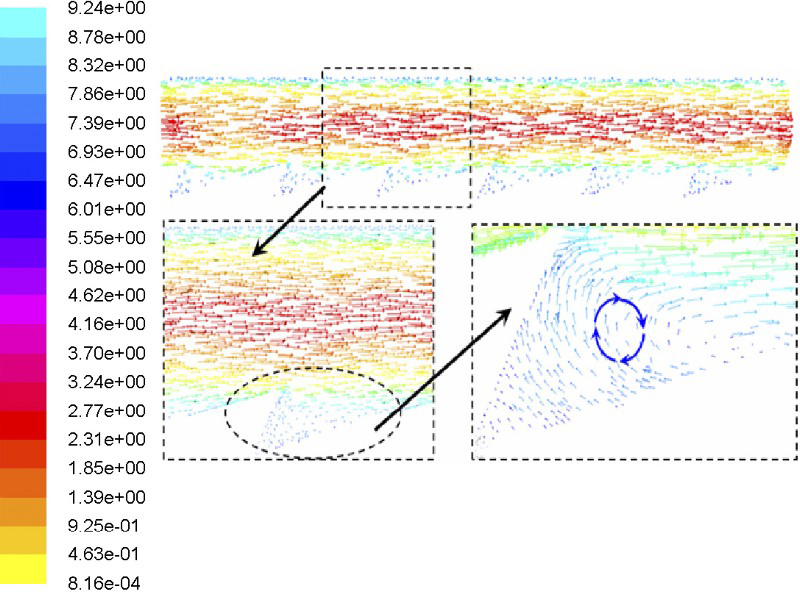
For the stretching on the width direction, the width and height of microgrooves are becoming smaller; therefore, the second vortex generated by the interaction between microgrooves and the main flowing vortex is weakened, as illustrated in Fig. 15. The capacity of inhibiting the turbulent intensity is also running down, and therefore, the drag force is increased to some extent.
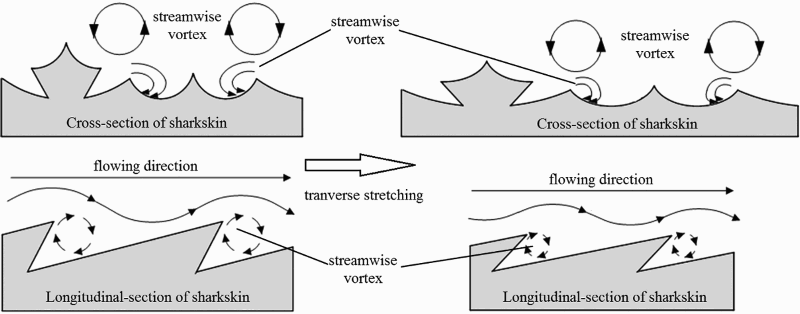
Influence of stretched sharkskin on transverse direction
For the sharkskin stretching on the longitudinal direction, although the width and height of microgroove are simultaneously becoming smaller, the ratio of width and height of microgroove is approximately constant, the result of which is that the developing space of second vortex is reduced, as shown in Fig. 16, and therefore, the speed scope in response to the best drag reduction effect is shifted.
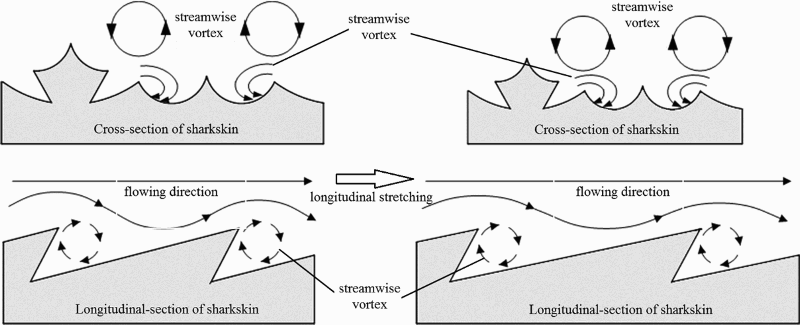
Influence of stretched sharkskin on longitudinal direction
Conclusions
In this paper, the stretching deformed fabrication process of sharkskin surface is explored and investigated for the first time, and the super-hydrophobic and hydrodynamic drag reduction effect is inspected by different methods. In addition, the drag reduction mechanism of real sharkskin morphology is discussed according to the numerical simulation, and the following conclusions can be obtained. (i) The deformed sharkskin morphology can adjust the speed scope in response to the best drag reduction effect, which can expand the applications. (ii) The super-hydrophobic effect has some influence on drag reduction rate. (iii) The drag reduction efficiency can surpass 12%, which is greater than that of simplified/straight microgrooved surface.