







Abstract
Zn–Ni–TiO2 nanocomposites with various amounts of TiO2 were successfully prepared by electroplating method on copper substrates using an acidic solution with TiO2 nanoparticles in suspension. The composition and morphology of the composite coatings were characterised respectively using of scanning electron microscope (SEM), energy dispersive spectrometer and elemental mapping analysis system. The microhardness of the nanocomposite coatings was investigated. The antibacterial activity of Zn–Ni–TiO2 nanocomposites films was studied against Gram positive (Staphylococcus aureus) and Gram negative (Escherichia coli) bacteria. Antimicrobial property increased upon the increase in the TiO2 concentration. In addition, the antimicrobial property was more pronounced with the positive bacteria than the negative one. These results demonstrated the microbiocidal property of TiO2, so Zn–Ni–TiO2 coatings have great potential applications in reducing biofouling formation in devices that suffer from biofouling problems.
Introduction
Although pure zinc coatings continue to be used widely for the protection of steel from corrosion, considerable efforts are being made to improve their corrosion resistance for use in harsher environment. 1 One of the ways to increase the corrosion resistance of zinc coatings consists in alloying with Fe, Co and Ni. It was reported that Zn–Ni coatings provide cathodic protection to steel, exhibiting significantly higher corrosion resistance than pure zinc.2,3 An alternate process for enhancing the corrosion resistance of zinc coatings on steel consists in zinc composite coating on its surface by electrolysis of plating solutions, in which submicrometre or nanosize particles are suspended. 4 Their incorporation in the coating Ni–Zn refines the crystal size and enhances corrosion resistance, microhardness and wear resistance property. 4 . Composite materials have various properties such as dispersion hardening, self-lubricity, high temperature oxidation resistance, excellent wear and corrosion resistance. Because of their importance in many fields, the newer composite materials are synthesised through different methods. Among these methods, the electrodeposition is considered to be one of the most important techniques for producing composites, owing to precisely controlled near room temperature operation, rapid deposition rates and low cost. A number of the literatures appear in scientific journals connected to the codeposition of SiC, ZrO2, Al2O3, TiO2 and PTFE with single metal and alloy electrodeposition.5–12 In 1985, microbiocidal effect of TiO2 photocatalytic reactions was the first time reported by Matsunaga et al. 13 The microbiocidal mechanisms of TiO2 photocatalysts have been investigated in detail.14,15 Kikuchi and coworkers showed that TiO2 films coated on different substrates such as glass, tiles and stainless steel possessed antibacterial functions under weak ultraviolet light in living areas, and the viable number of Escherichia coli significantly decreased on the illuminated TiO2 film. 16 Li and Logan reported that bacterial adhesion on TiO2 coated surfaces reduced significantly after exposed UV light. 17 Yu and coworkers prepared the TiO2 films on stainless steel and found that the films had excellent antibacterial effect with Bacillus pumilus. 18 Marciano incorporated TiO2 into diamond-like carbon coatings and found that the antibacterial activity of DLC–TiO2 coating with UV treatment increased with increasing TiO2 contents in the coating. 19 However, no research has been reported on antibacterial property of Zn–Ni–TiO2 nanocomposites coatings. Biofouling on the surfaces of heat exchangers, ships’ hulls, pipelines, etc., causes serious problems. 20 A thin layer of bacterial biofilm on the surfaces of heat exchangers significantly reduces heat transfer performance. In this paper, Zn–Ni–TiO2 nanocomposite coatings with different TiO2 contents were prepared on copper substrates by applying direct current electrodeposition technique. The electrolyte was aqueous solution containing zinc and nickel salts with uniformly dispersed TiO2 nanoparticles. The produced coatings were characterised by scanning electron microscope (SEM), energy dispersive spectrometer (EDS) and elemental mapping analysis system. Mechanical properties of the coatings such as microhardness were evaluated by a FUTHER-TECH CORP (FM700 series, Japan) microhardness tester applying the load of 0·05 kgf. Many studies reported that the incorporation of nanosized particles TiO2 into different matrix greatly improved their anticorrosion. However, no studies have been reported on their antibacterial property. The antibacterial performance of the coatings towards Gram positive (Staphylococcus aureus PTCC1431) and Gram negative (E. coli PTCC1394) bacteria were investigated.
Experimental
Sample preparation
Plating and subsequent studies were carried out on copper panels (99·99% purity, thickness of 1 mm) with plated area of 1 cm2 (10 mm × 10 mm × 1 mm). Initially, the copper samples were mechanically polished with successively finer grades of emery paper (with final roughness of 0·3 mm). They were then washed in deionised water. This procedure was repeated until a clear and smooth surface was obtained. Before each experiment, copper samples (cathodes) were cleaned in ethanol, NaOH (30%) and activated in composition H2SO4 (10%) and H2O2 (10%) for 5 min, washed in distilled water and then immersed immediately in the plating bath to allow the electrodeposition of nanocomposite coatings.
Preparation of Zn–Ni–TiO2 coatings
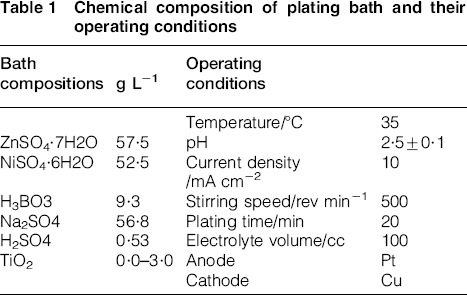
A range of Zn–Ni–TiO2 coatings with different TiO2 contents were produced on copper plates by electrodeposition. TiO2 nanoparticles (99·5%, 20 nm, Degussa) were added into the plating bath in order to obtain Zn–Ni–TiO2 coating. Zn–Ni–TiO2 nanocomposite deposition was carried using an acid bath with a pH of 2·5. The composition of the bath and plating parameters are presented in Table 1. The surface morphologies of coatings were observed by scanning electron microscopy (Phenom pro X, Netherlands). X-ray energy dispersion spectroscopy (EDS) and elemental mapping analysis system attached to the SEM were utilised to determine the weight percentage of TiO2 nanoparticles and distribution of materials in the Zn–Ni–TiO2 coatings. Hardness (Vickers) measurements of both Zn–Ni coatings and Zn–Ni–TiO2 coatings were performed with a FUTHER-TECH CORP (FM700 series, Japan) microhardness tester at a load of 50 g and duration of 5 s with three tests per sample.
Chemical composition of plating bath and their operating conditions
Antibacterial testing
In this research, two kinds of bacteria – Gram negative (E. coli PTCC1394) and Gram positive (S. aureus PTCC1431) – were used to study the antibacterial activity of Zn–Ni–TiO2 coatings by an inhibition zone method. Both strains were transferred into flasks containing nutrient broth, and the bacteria were cultured at 37°C in aerated condition until reaching an optical density of 0·3. The agar diffusion test was especially used to determine the antibacterial activity Zn–Ni–TiO2 coatings samples. The inoculums of E. coli and S. aureus were spread on the surface of nutrient agar respectively. Each Zn–Ni–TiO2 coatings sample was placed on surface inoculated nutrient agar and incubated at 37°C for 24 h. Inhibition zone around Zn–Ni–TiO2 coatings sample was used to indicate antibacterial activity of each film sample.
Results and discussion
Characterisation of nanocomposite coatings
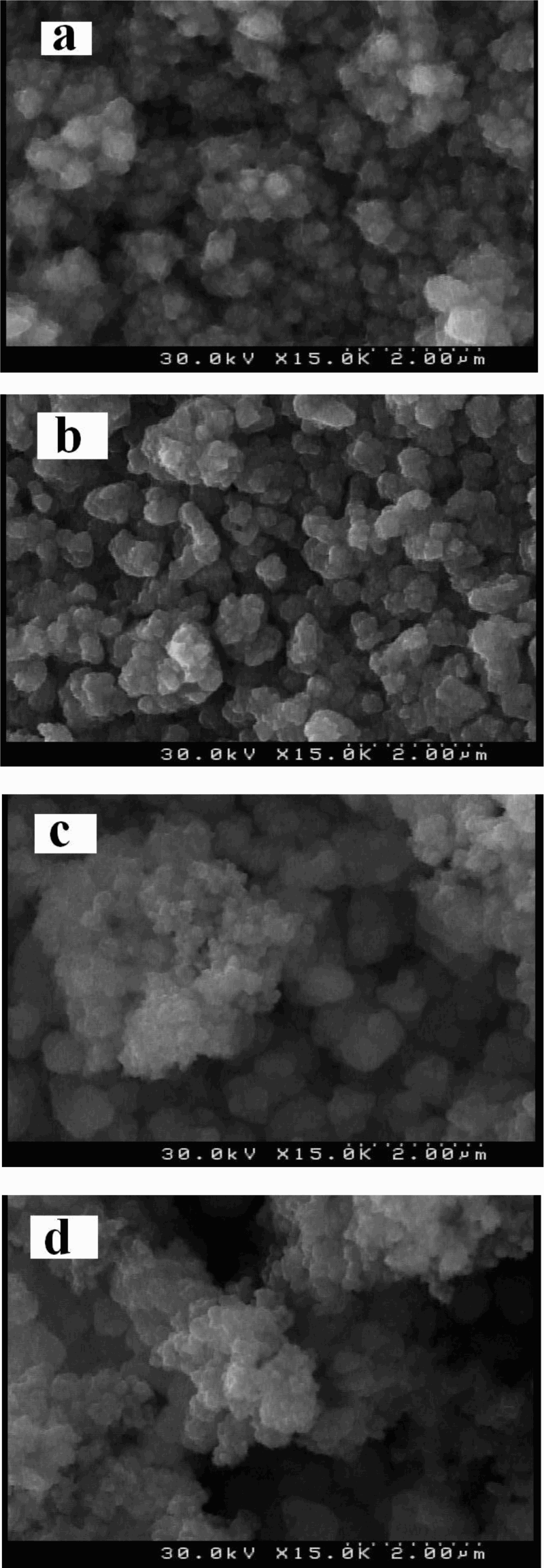
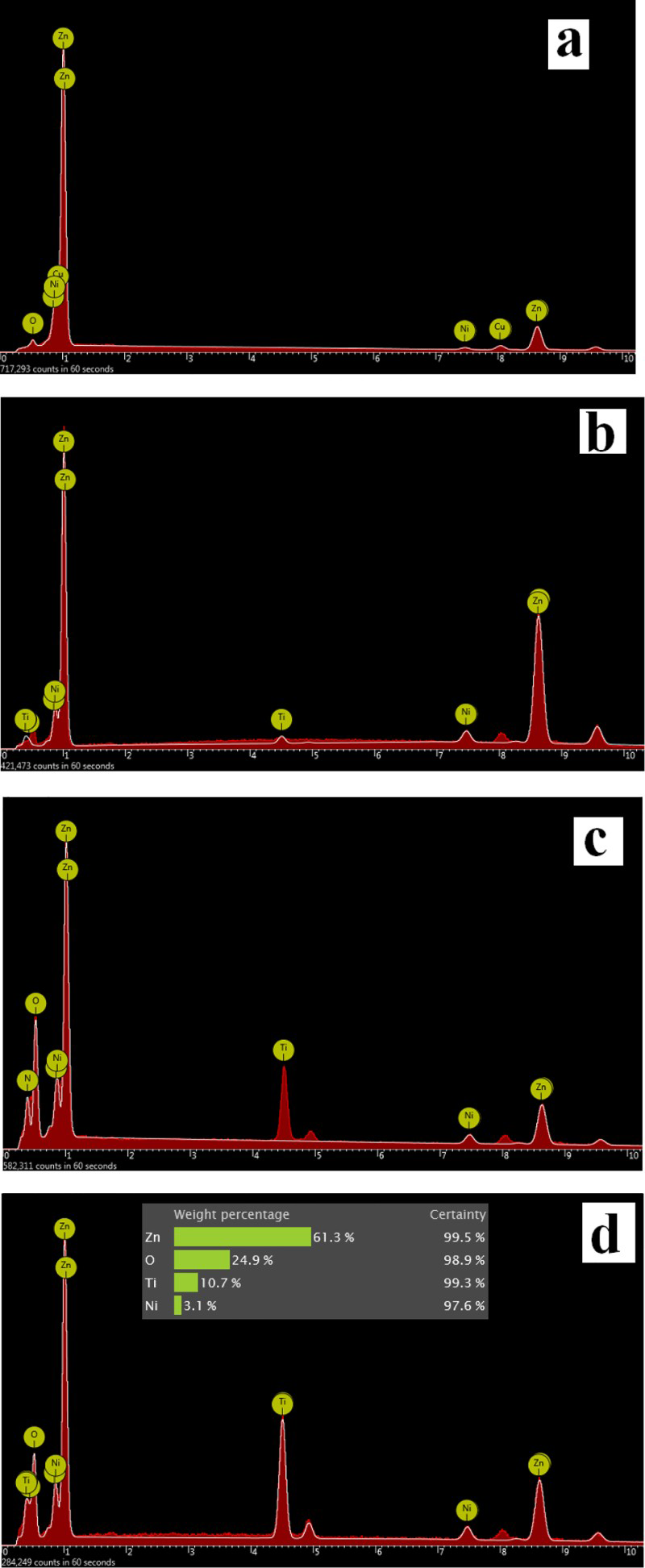
Figure 1 shows the surface morphologies of Zn–Ni–TiO2 nanocomposite coatings with different values of TiO2 nanoparticles. All the composite coatings have no regular surface at different values of TiO2 nanoparticles. It can be seen that the surfaces of the substrate were fully covered with the coatings, and the composite coatings were composed of compact fine nodules uniform in size. Figure 2 shows the EDS spectra of electrodeposited Zn–Ni–TiO2 nanocomposite coatings at different values of TiO2 nanoparticles, which confirms the presence of Ni, Zn, Ti and O elementals in the composites. The amounts of Ti were increased by increasing the TiO2 nanoparticles content. According to elemental mapping analysis shown in Fig. 3, Ni, Zn, Ti and O distributed on the surfaces of the composite coatings, indicating that the TiO2 nanoparticles uniformly distributed on the surfaces of the Zn–Ni–TiO2 nanocomposite.
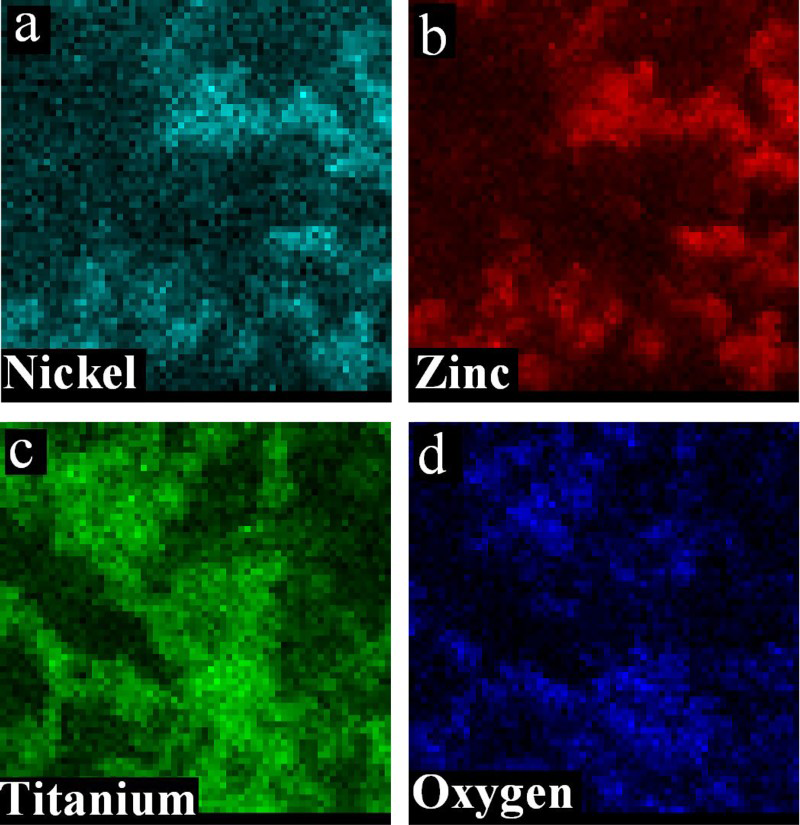
Elemental mapping spectra of Zn–Ni–TiO2 nanocomposite plated from bath with 3.0 g L − 1 of TiO2 nanoparticles
Effect of TiO2 nanoparticles content in bath on microhardness of coatings
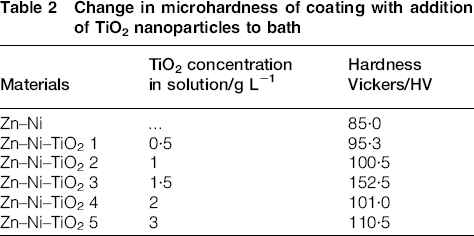
Table 2 indicates that the microhardness of all Zn–Ni–TiO2 nanocomposite coatings is considerably higher than the Zn–Ni alloy coatings. Hardness of composite coatings containing TiO2 nanoparticles has been attributed to the hindrance of dislocation movement by TiO2 particles. 21 High hardness of the Zn–Ni–TiO2 nanocomposite coating will provide wear resistance. 22 Table 2 shows that at a constant stirring rate of 500 rev min − 1 and current density of 10 mA cm− 2, the microhardness of the deposit increases with increasing TiO2 nanoparticle content up to 1·5 g L − 1 in the electrolyte. Microhardness of the coating decreases with TiO2 content higher than 1·5 g L − 1 . This might be attributed to agglomeration of the TiO2 nanoparticles in the electrolyte due to their higher concentration and poor wettability. The results shown in Table 2 can be explained by the Guglielmi two-step adsorption model, 23 where a higher particle concentration in the electrolyte increases the adsorption, thus resulting in higher weight per cent of TiO2 nanoparticles in the composite coatings and consequently higher microhardness.
Change in microhardness of coating with addition of TiO2 nanoparticles to bath
Antibacterial studies
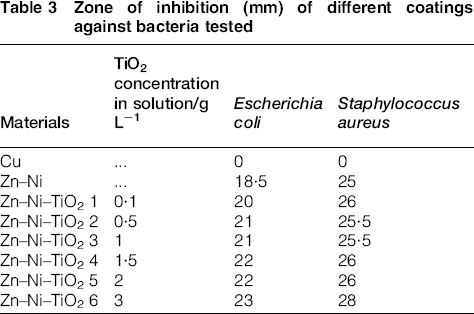
In this study, the antibacterial activities of the coatings against both Gram positive (S. aureus) and Gram negative (E. coli) bacteria were investigated, and results are presented in Table 3. The extent of inhibition of bacterial growth observed in this study was found to be variable and nanosized TiO2 concentration dependant. According to the obtained results, the inhibition zones increased instantly at once in relation with the percent content of nanosized TiO2 for all samples.
Zone of inhibition (mm) of different coatings against bacteria tested
Conclusion
TiO2 nanoparticles were dispersed in zinc–nickel sulphate electrolyte, and thin film of Zn–Ni–TiO2 composite was generated by electrodeposition on copper plates. The morphology, hardness and antibacterial activity of the Zn–Ni coatings codeposited with nanosized TiO2 particles were investigated. The films surface is rough (with roughness of 0·5 mm), and the TiO2 nanoparticles are distributed on the Zn–Ni–TiO2 nanocomposite matrix. The incorporation of TiO2 in the coating was confirmed by EDX and elemental mapping analysis system. The presence of the TiO2 nanoparticles in the deposit increased the microhardness and surface roughness of the deposit. It seems that microhardness reached its maximum values by the addition of TiO2 to the bath. The antimicrobial property of the Zn–Ni–TiO2 nanocomposite coatings increased upon the increase in the TiO2 concentration against two bacteria. Therefore, Zn–Ni–TiO2 coatings have great potential applications in reducing biofouling formation in heat exchangers, pipelines, ship hulls and many other devices that suffer from biofouling problems.