







Abstract
The WCN films with different C contents were deposited under different substrate bias by a sputtering system. The composition, structure and mechanical properties were characterised by X-ray photoelectron spectroscopy, X-ray diffraction, high resolution transmission electron microscopy, scanning electron microscopy, atomic force microscopy and nanoindentation. Results showed that the WCN films consisted of WCN, W2N, amorphous C and CNx phases. With the incorporation of C content, the growth pattern changed from continuous columnar to discontinuous columnar due to grain refinement. By applying substrate bias to the films, the growth pattern changed from discontinuous columnar to fine grained structure because the bias could enhance the mobility of impinging ions or atoms leading to film densification. As increasing the C content, the hardness first increased and then decreased due to the effect of solid solution strengthening and grain refinement. However, the substrate bias had little influence on the hardness because of the co-action of the dense structure and residual stress induced by bias.
Introduction
In the last decades, transition metal nitrides and transition metal carbides have been extensively investigated for their scientific and technological significance.1-4 Among these transition metal based films, tungsten based films, such as tungsten (W), tungsten nitride (WNx) and tungsten carbide (WCx), are potential candidates for various future applications, such as Cu diffusion barriers,5,6 protective films and electrodes for metal– insulator–metal structures, 7 due to their high melting point and hardness, coupled with good corrosion resistance. However, many researchers 8 have reported that binary tungsten based compounds, such as WNx and WCx, usually failed under thermal stress due to the recrystallisation of the film. One effective way to increase the recrystallisation temperature is through fabrication of ternary tungsten based compounds by adding a third element. 9 On this basis, WCN has been proposed and studied for use as diffusion barriers or protective films in recent years.10-12 As reported, WCN films exhibit thermal stability after annealing up to 700°C, 13 low electrical resistivity and good adhesion to many different substrates. 11 Most studies reported in the past years, with specific regard to the production of WCN films, have used CVD techniques14,15 since Gesheva et al. 16 prepared WCN films by CVD. For example, Ajmera17,18 prepared WCN films as a diffusion barrier by varying the deposition temperature. The other grown method used is the physical vapour deposition (PVD) technique. The PVD techniques that were reported include atomic layer deposition and sputtering.19,20 The atomic layer deposition technique has been used to prepare WCN films by many authors.21-23 Nevertheless, little attention has been paid to the sputtering techniques. Su et al. 24 have prepared WCN films by reactive magnetron sputtering using a target of tungsten and a mixture reactive gases of CH4/N2/Ar and investigated the influence of bias voltage and annealing process on the film structure. They found that two different phases, α-WCN (hexagonal) and β-WCN (fcc), appeared depending on the different conditions. Recently, Ospina et al.20,25 prepared WCN with pulsed vacuum arc PVD using a WC target with nitrogen gas to study the phase evolution and analyse the chemical state of the WCxNy layers. They found that the phase transformation and the polycrystallinity depended on the number of pulses, N ˭ C ˭ N, C‒C, C ˭ C, C‒N and C ˭ N bonds existed in films and obtained a low hardness (lower than 15 GPa). However, these authors mentioned above just focused on the research of sputtering condition of WCN films; they failed to investigate the effect of C content on the structure and mechanical properties systematically. In addition, previous researches on nanocomposite films have shown that the substrate bias also had great effects on the film structure and mechanical properties.26,27
In this paper, a series of WCN films with different C contents have been deposited by reactive magnetron sputtering. The effects of C content and substrate bias on the microstructure and mechanical properties were explored.
Experimental
The WCN films with a thickness of ∼2 μm were deposited on Si (100) wafers by a reactive magnetron sputtering system. The substrates were cleaned with successive rinses in ultrasonic baths of deionised water, alcohol and acetone and blown dry with dry air. Water cooled 75 mm diameter W (99·9%) and C (99·99%) targets were positioned at 78 mm from the substrate. The base pressure was 6·0 × 10−4 Pa before deposition. Just prior to initiating deposition, the targets were sputter cleaned for 10°min. The CrN film was deposited by fixing the power of Cr target at 100°W and Ar/N2 ratio of 10:3 for 15 min to increase the adhesion. Then, WCN films with different C contents were sputtered by fixing the powers of W target at 200 W and adjusting the power of C target from 0 to 150 W using no bias voltage, no substrate temperature and a constant working pressure (0·3 Pa) with the same ratio of Ar and N2 flow rates (10:10). Then, the WCN films were achieved under different substrate bias of 0, −40, −80, −120, −160 and −200 V at room temperature by fixing the powers of W target at 200 W and C target at 120 W. The total working pressure and Ar/N2 ratio were 0·3 Pa and 10:10 respectively.
The crystalline structure of the films was explored by X-ray diffraction (XRD) with a Cu Kα source, operated at 40 kV and 35 mA. The elemental composition and chemical bonds of the films were characterised by X-ray photoelectron spectroscopy (XPS) with Al Kα irradiation at a pass energy of 160 eV after removing the surface contaminants on the films by sputtering with Ar+ ion beam at a primary energy of 3°keV for 3 min. The spectra were calibrated by the C1s line with a binding energy of 284·5 eV and then corrected for the linear emission background and decomposed into peaks with Gaussian– Lorentzian line shapes by a non-linear least square fitting method. The microstructure was analysed by a high resolution transmission electron microscopy (HRTEM, field emission JEOL 2010F) operated at 200 kV. Scanning electron microscopy (SEM) was used to investigate the cross-sectional microscopy of the films. The surface morphology was determined by atomic force microscopy (AFM) using a Pisco-2500 microscope with a silicon nitride supertip. The AFM was operated in contact mode, and the scan range was 1×1 μm.
The hardness measurements were conducted using nanoindentation CSM, which was equipped with a diamond Berkovich indenter tip (three-side pyramid). An automatic indentation mode was programmed to place indentations in a 3×3 array. The maximum penetration depth of 100 nm was always less than 10% of the film thickness (2·0 μm) to ensure the hardness was not influenced by the substrate.
Results and discussion
Structural analysis
The influence of C target powers and substrate bias on the chemical compositions of WCN films is summarised in Fig. 1. It is found that the C content increases gradually from 0 to 19·2°at-% with increasing the C target power, whereas the W content decreases from 48·0 to 38·0°at-% and the N content decreases from 50·0 to 40·7°at-% respectively. The C content keeps basically constant at ∼11°at-% with increasing substrate bias. This result is in agreement with the report of Su et al.
24
that the C content showed no variation at increasing substrate bias. The reason is attributed to the rather low ionisation of magnetron sputtering.
26
All the films contain a certain amount of O, which might be induced by contamination of the targets and residual oxygen in the chamber atmosphere.
26
Chemical compositions of WCN films deposited a by adjusting C target power and b under different substrate bias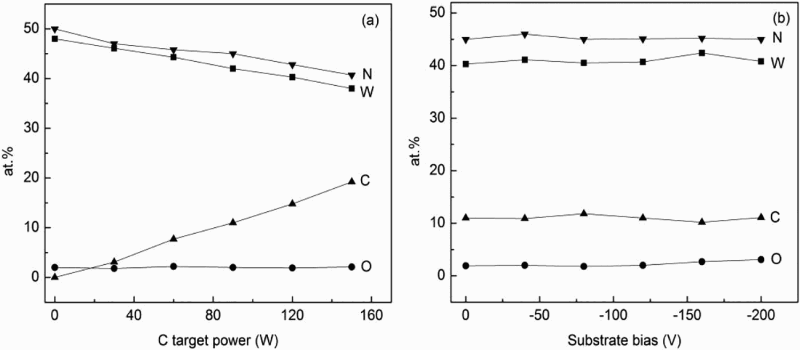
The XRD patterns of WCN films deposited with different C contents and under different substrate bias are presented in Fig. 2. According to Fig. 2
a, the pattern of the W2N film presents multiple orientations of (111) and (200) crystal planes of face centered cubic (fcc) β-W2N structure (PDF card 25-1257). The WCN films exhibit a cubic structure with slight (111) preferential orientation, originated by a cubic lattice whose positions lie intermediate between those for the bulk W2C and W2N phases. According to Refs. 20 and 24, these peaks correspond to a β-WCN phase. No XRD peaks corresponding to a carbon compound, such as W2C, C and CNx, can be observed. From Fig. 2
b, it can be seen that only the β-WCN phase occurs as the bias is lower than or equal to −40 V. However, as the bias exceeds −40 V, a mixture of β-WCN and α-WCN phases appears. In addition, with increasing bias from 0 to −200°V, the intensity of (111) orientation decreases, and the intensity of (200) orientation increases. Similar phenomena were also found by Tan et al.
26
This may be caused by the increase of bombardment of N ion. Furthermore, a contribution to the peak shift due to the compressive residual stress and the change of film composition can be also possible.
X-ray diffraction patterns of WCN films deposited a with different C content and b under different substrate bias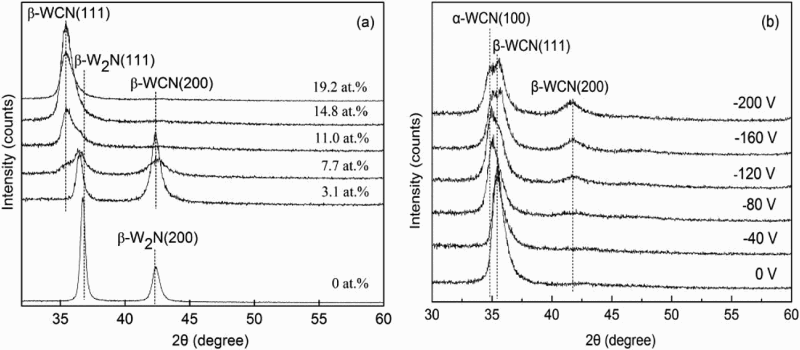
In order to obtain further information about these carbon containing phases, XPS analysis was carried out on the C1s and N1s photoelectron spectra of WCN films. Figure 3 shows the XPS analysis results of WCN films with different C contents, where the C1s peak of adventitious hydrogen carbon (binding energy, 284·5 eV) is taken as a reference to calculate the binding energy. As shown in Fig. 3
a, the peaks of C1s correspond to C ˭ C (284·5 eV)
28
and W‒C‒N (282·4 eV).
20
The intensities of C ˭ C and W‒C‒N increase gradually with the increase of carbon content. These suggest that the C and WCN phases coexist in the films and the content increases with increasing C content. In the N1s spectra of Fig. 3
b, three contributions are found at 396·9, 398·1 and 399 eV ascribed to W‒N, W‒C‒N and N ˭ C bonds respectively.
20
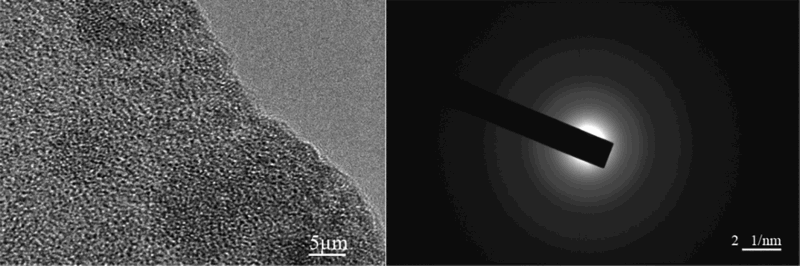
The intensity of W‒N decreases gradually, while the intensities of W‒C‒N and N ˭ C increase (in agreement with the results for C1s spectra). These suggest that W2N, CNx and WCN phases coexist in the films, and the content of WCN and CNx increases with decreasing W2N content. However, no peaks of C or CNx are found in any of the XRD patterns, which suggests that C or CNx may be present in an amorphous form. Thus, further details of the microstructure of the film as the C content is 14·8 at-% is revealed by the HRTEM image, as shown in Fig. 4. In the bright field image (Fig. 4
a), the grains are found to be surrounded by amorphous matrix, which is in agreement with the results of Fig. 4
b, where a diffuse halo ring corresponds to an amorphous phase that coexists with sharp diffraction rings corresponding to crystalline phases.
26
X-ray photoelectron spectra of WCN films with different C content (a C1s; b N1s) a bright field TEM image and b SEAD pattern of WCN film as C content is 14·8°at-%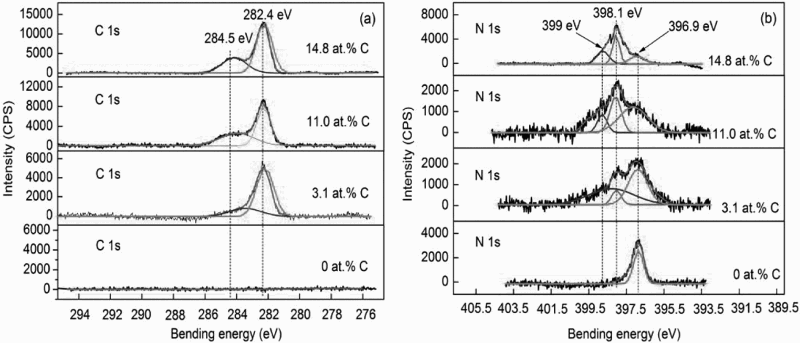
According to previous reports,20,24 XRD, XPS analysis and HRTEM observation of WCN films, the films consist of a mixture of WCN, W2N, amorphous C and CNx phases.
The cross-sectional SEM micrographs of WCN films with different C contents are shown in Fig. 5. For W2N film (containing no C), there exhibits a fibrous and columnar structure. With increasing the C content, the growth pattern changes from continuous columnar to discontinuous columnar. For example, the WCN film demonstrates a discontinuous columnar and fine grained structure as the C content is 19·2 at-%.
Cross-sectional SEM micrographs of WCN films with different C contents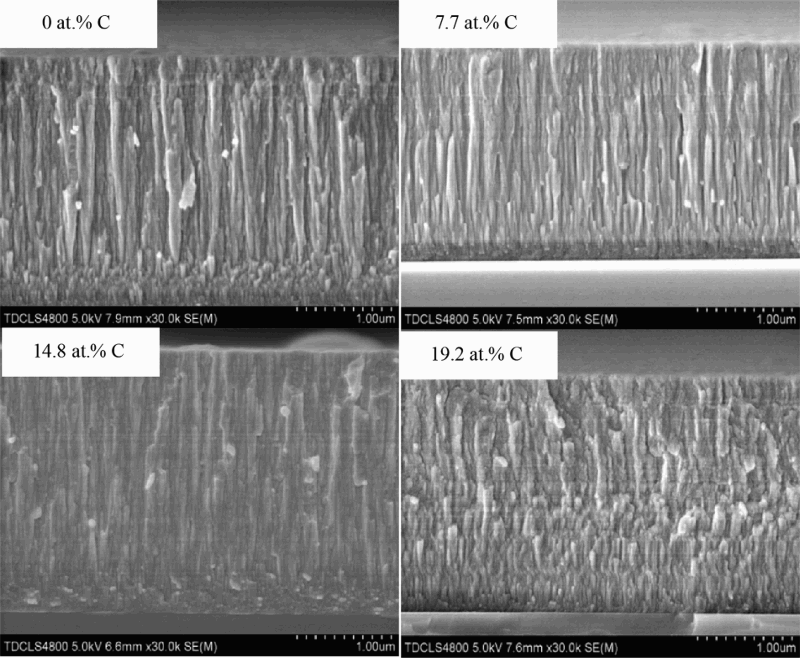
The cross-sectional SEM micrographs of WCN film as the C content is 14·8 at-% under different substrate bias are present in Fig. 6. With increasing substrate bias, the growth pattern changes from discontinuous columnar to fine grained structure. For example, the grain boundary becomes vague resulting in difficult to distinguish grains and the structure becomes more dense for the film deposited under −200°V. This may be due to that the increase of substrate bias could enhance the mobility of impinging ions or atoms by improving their energies, leading to film densification. Similar results were also obtained by Tan et al.
27
Cross-sectional SEM micrographs of WCN film as C content is 14.8 at-% under different substrate bias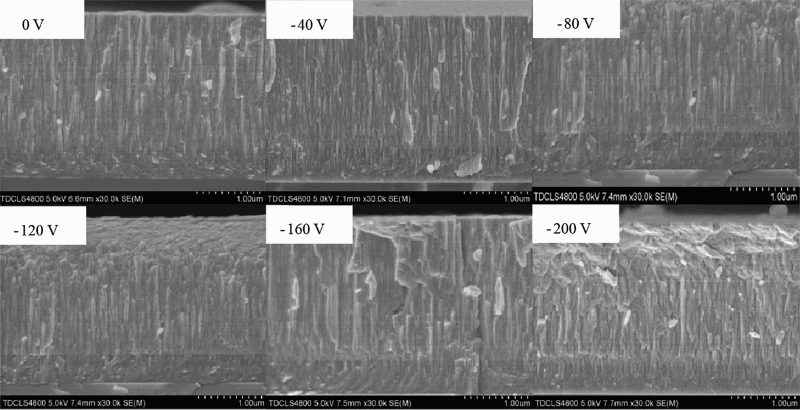
The AFM images of the WCN film surfaces with different C contents are given in Fig. 7. All the film surfaces are of the island growth type. With increasing the C content, the average roughness Ra value decreases gradually, which is in agreement with the change of cross-sectional observations from Fig. 5. The Ra value is 4·3 nm for W2N film (Fig. 7
a). As the C content is 19·2 at-%, the Ra value decreases to 1·1°nm (Fig. 7
d). This is probably because the addition of C to W2N promotes the continuous nucleation process, leading to grain refinement and then a decrease of Ra.
Atomic force microscopy images of WCN films surfaces with different C contents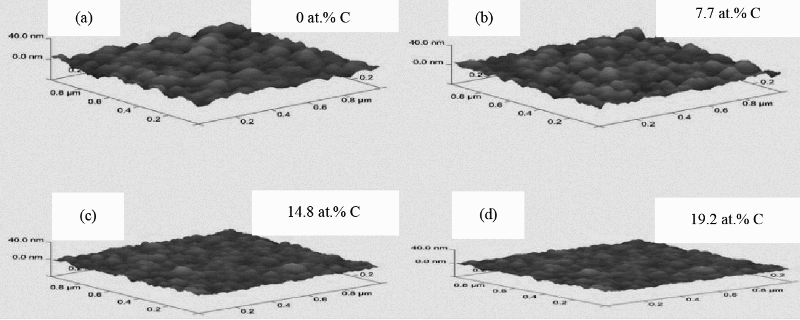
The AFM images of WCN film as the C content is 14·8 at-% under different substrate bias are given in Fig. 8. With increasing the substrate bias, the Ra value decreases gradually. The Ra value decreases to 0·4 nm as the bias is −200°V. This corresponds to the variation of cross-sectional observations from Fig. 6.
Atomic force microscopy images of WCN film as C content is 14·8 at-% under different substrate bias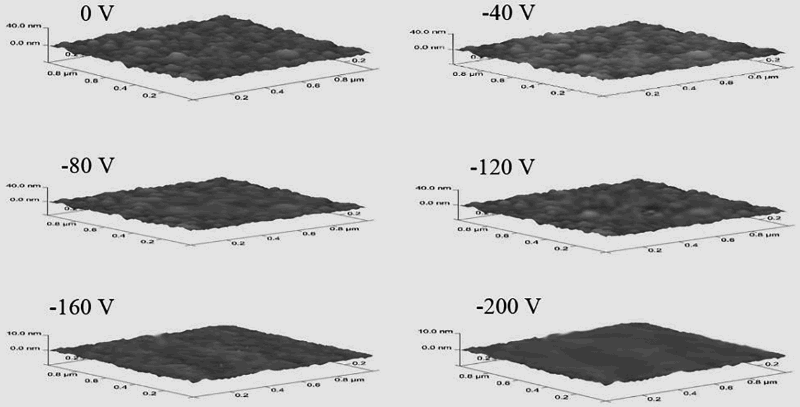
Mechanical properties
The hardness of WCN films deposited with different C contents and under different substrate bias is presented in Fig. 9. It can be seen that the hardness of WCN is higher than W2N as the C content ranges from 0 to 19·2 at-% (Fig. 9
a). As the C content increases, the hardness first increases then decreases, and a maximum value of 36·7°GPa is obtained as the C content is 14·8 at-%. As the C content increases from 0 to 14·8 at-%, the increase of hardness is mainly attributed to the effect of solid solution strengthening and the grain refinement.
29
In addition, the residual stresses that existed in the films may also contribute to the part of hardness improvement.
26
Further increasing the C content to 19·2 at-%, the hardness decreases to 32·4 GPa due to the increase of amorphous C and CNx content according to Fig. 3. For the film containing 14·8 at-% C deposited under different substrate bias (Fig. 9
b), the hardness first increases from 36·7 to 38·8 GPa with increasing the substrate bias from 0 to −120°V and then decreases to 37·7 GPa with further increasing the substrate bias to −200°V. This change trend is mainly attributed to the dense structure and residual stress induced by bias.
26
Hardness of WCN films deposited a with different C content and b under different substrate bias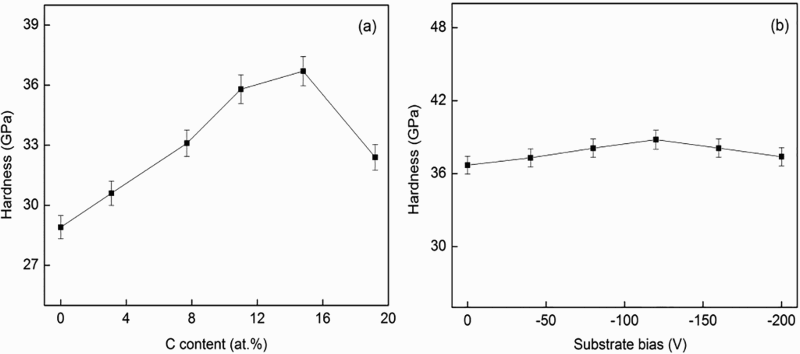
Conclusions
The WCN films were deposited by a multitarget magnetron sputtering system. The structure and mechanical properties of WCN films have been investigated. The following conclusions can be drawn.
The WCN films consist of a mixture of WCN, W2N, amorphous C and CNx phases. The WCN films exhibit a cubic structure with slight (111) preferred orientation, the intensity of (111) orientation decreases and the intensity of (200) orientation increases with increasing bias from 0 to −200°V. This may be caused by the increase of bombardment of N ion and the compressive residual stress. As the C content increases, the growth pattern changes from continuous columnar to discontinuous columnar due to grain refinement. As the substrate bias increases, the growth pattern changes from discontinuous columnar to fine grained structure because the bias could enhance the mobility of impinging ions or atoms leading to film densification. The hardness of WCN is higher than W2N, and it first increases to a maximum value of 36·7 GPa as the C content is 14·8 at-% and then decreases as further increasing the C content due to the effect of solid solution strengthening and grain refinement. The substrate bias had little influence on the hardness because of the coactions of the dense structure and residual stress induced by bias.
Footnotes
Acknowledgements
This work was supported by the National Natural Science Foundation of China (grant no.°51074080) and the Research Innovation Program for College Graduates of Jiangsu Province (grant no.°CXZZ13_0718).