







Abstract
A novel rapid salt bath nitriding technology based on normal salt bath nitriding was primarily developed by additionally applying a direct current field (DCF) of 7·5 V between the treated samples, and the corresponding kinetics was investigated. The results showed that DCF could significantly enhance the nitriding efficiency, shorten the holding duration and decrease the treatment temperature. Meanwhile, the diffusion coefficient of nitrogen was increased about two times, and the activation energy was decreased from 184 to 159 kJ mol− 1. The main enhancement mechanism was discussed as well.
Abbreviations
direct current field
salt bath nitriding assisted by DCF
normal salt bath nitriding
Introduction
Quench–polish–quench (QPQ) treatment is one of the widely used surface modification technologies for steels to obtain the required properties; a protective coating can be formed on the surface of the components by the QPQ process, which can significantly improve their wear resistance, especially the corrosion resistance.1–3 Therefore, it is gradually used to replace plasma nitriding, soft nitriding and hard chromium plating in many applications.
The essence of the QPQ salt bath technology is low temperature salt bath nitriding plus short time salt bath oxidation;4–8 the former step is crucial and time consuming. 9 Generally, several hours are needed to obtain the required depth of the compound layer in a normal salt bath nitriding (NSN) process; it will be quite valuable to improve the efficiency of this process and thus shorten the treatment duration.
Based on the enhancement effect of direct current field (DCF) on powder pack thermochemical treatment,10,11 a novel rapid salt bath nitriding technology enhanced by DCF was developed. This technology was carried out by applying DCF between the two electrodes in the nitriding salt bath. The sample to be nitrided was used as a cathode paralleled to an anode made of stainless steel. The growth of the compound layer was analysed by measuring the thickness of the compound layer based on different nitriding times within a temperature range of 803–848 K. The goal of this study is to investigate the kinetics in DCF enhanced salt bath nitriding. The results showed that dc electric field could significantly accelerate the salt bath nitriding and thus shorten the holding duration and decrease the treatment temperature. Besides, the main enhancement mechanism was discussed as well.
Experimental
The material used in this study was 35 steel with the following chemical compositions: Fe–0·36C–0·3Si–0·72Mn–0·23Cr–0·21Ni–0·24Cu–0·022S–0·023P (wt-%). The specimens were machined into a size of 10 × 10 × 10 mm, followed by quenching at 1113 K and tempering at 853 K to obtain a substrate with a uniform microstructure. Then, the mechanically polished specimens were further polished with emery papers of different granulometry to achieve a fine finish. Finally, the specimens were ultrasonically cleaned in anhydrous ethanol and dried before salt bath nitriding treatment.
A schematic diagram of the main parts of the experimental apparatus is shown in Fig. 1a. In this apparatus, two electrodes with a distance of 10 mm are placed in the salt bath in a crucible and heated in a vertical pit furnace, and the specimen is used as a cathode. The pit furnace temperature is then raised to a determined temperature (803–848 K), applying a DCF of 7·5 V between the two electrodes, and was held for the designed duration (60–120 min).
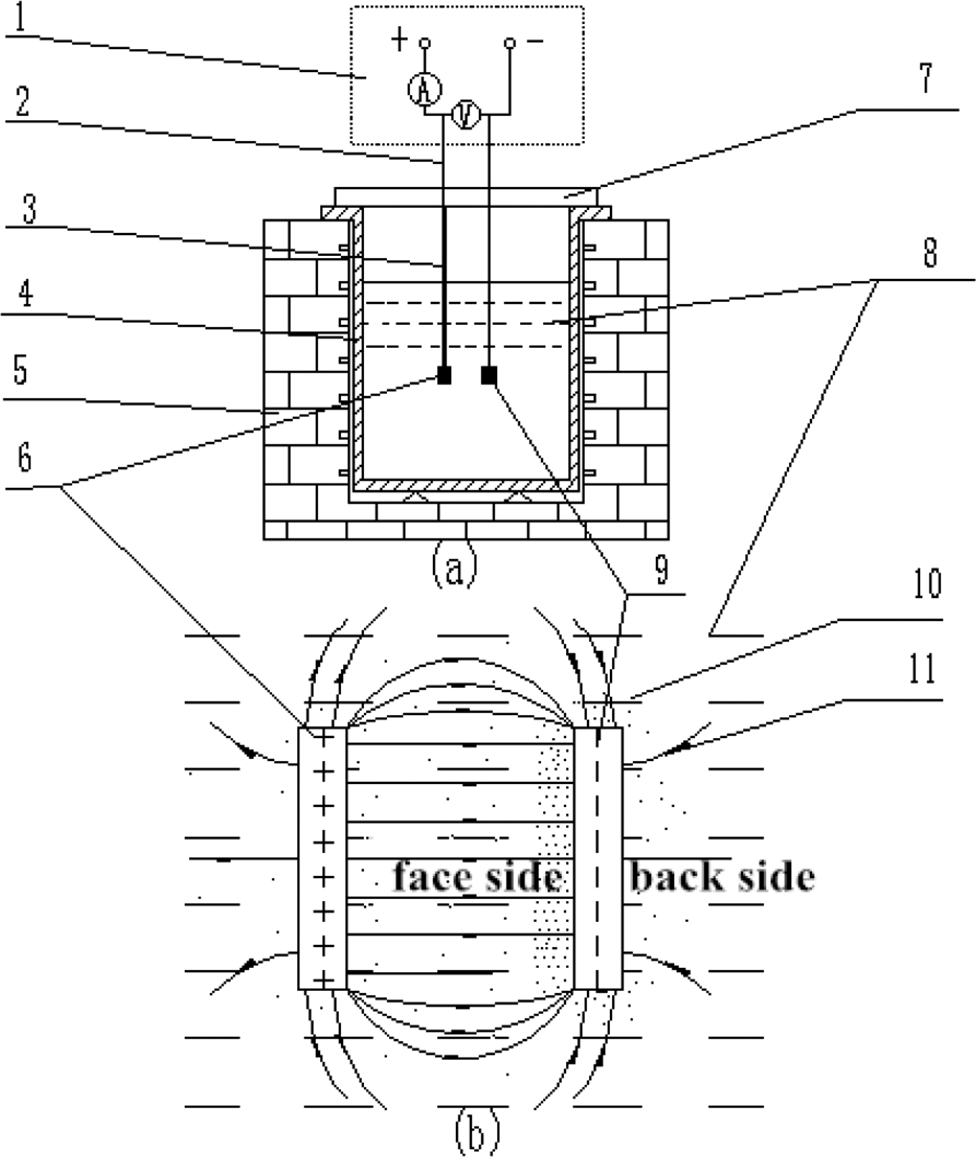
Schematic diagram of experimental apparatus and enhancement mechanism assisted by DCF in salt bath nitriding technology (1: voltage controller; 2: conducting line; 3: ceramic pipes; 4: crucible; 5: pit furnace; 6: lid; 7: salt bath; 8: anode; 9: specimen as cathode; 10: active nitrogen atoms; 11: electric field lines): a experimental apparatus; b enhancement mechanism
After salt bath nitriding, the cross-sectional microstructure was observed by optical microscopy. The phases detected under different status were determined by X-ray diffraction analysis with Cu Kα (λ = 1·54 Å) radiation.
Results and discussion
Cross-sectional microstructure and depth analysis
Figure 2 shows the typical cross-sectional microstructures and the thickness of the compound layer versus duration at different temperatures of 35 steel after salt bath nitriding. From the outmost surface to the core, compound layer, a diffusion layer is formed. The compound layer, also called the white layer, is obviously observed. The compound layer is an important part of the treated samples and plays an important role in improving the wear resistance and corrosion resistance. The diffusion layer between the compound layer and the radical centre is hard to be clearly distinguished by optical microscopy, as shown in Fig. 2. Comparing Fig. 2a–c and g with d–f and h respectively, it can be clearly seen that at each temperature, the depth of the compound layer enhanced by DCF is thicker than that in NSN. Meanwhile, the compound layer thickness of the cathode sample in the face side is thicker than that in the back side as shown in Fig. 2g and i, which can back up the proposed mechanism as shown in Fig. 1. Therefore, it can be concluded that DCF could significantly enhance the efficiency of salt bath nitriding and thus effectively shorten the holding duration or decrease the heating temperature to obtain the required thickness of the compound layer.
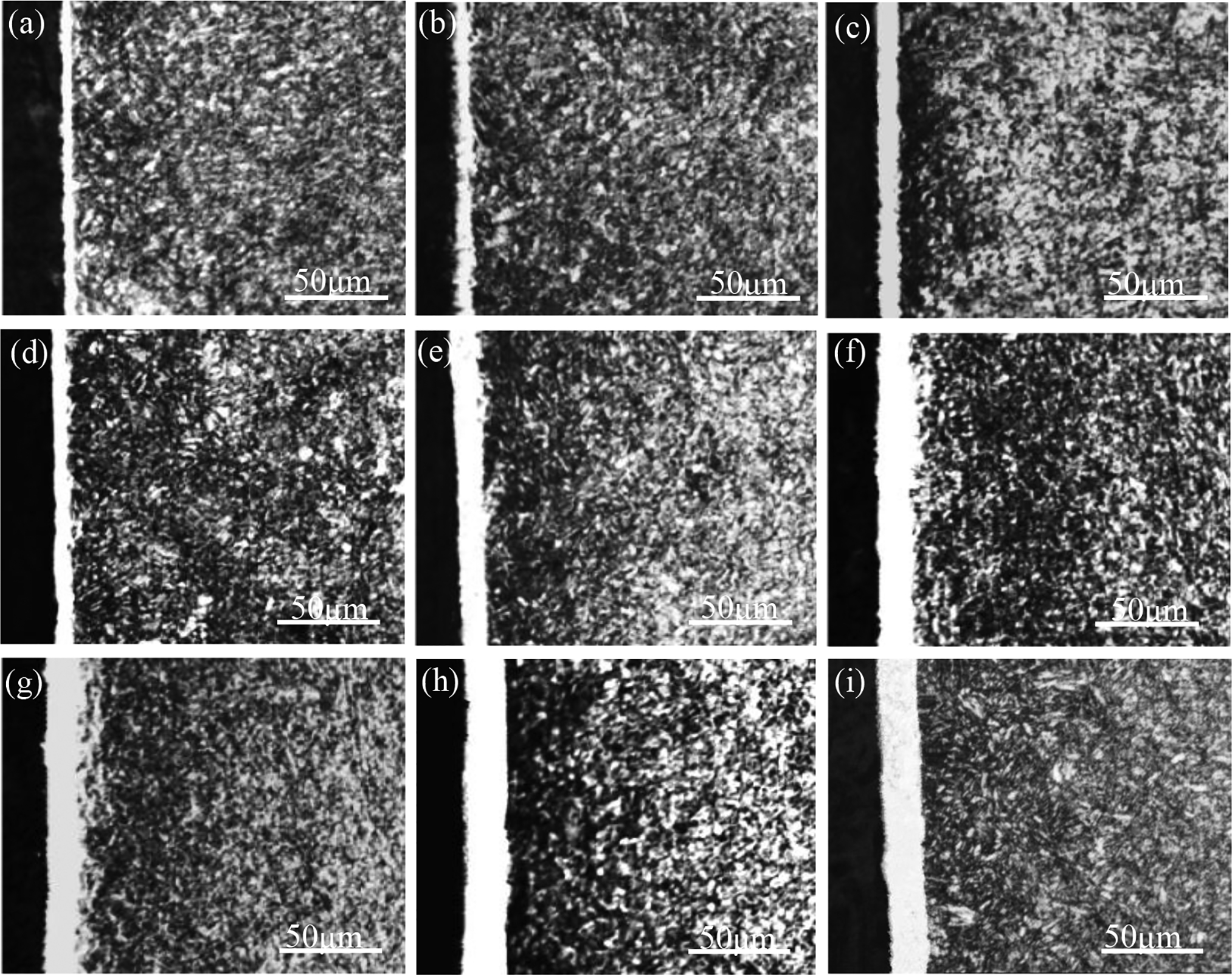
Cross-sectional microstructures of 35 steel after nitriding at different temperatures for 60 min (B: back side of cathode sample): a NSN, 803 K; b NSN, 818 K; c NSN, 833 K; d DCFSN, 803 K, 7·5 V; e DCFSN, 818 K, 7·5 V; f DCFSN, 833 K, 7·5 V; g NSN, 848 K; h DCFSN, 848 K, 7·5 V; i DCFSNB, 848 K, 7·5 V
X-ray diffraction analysis
Figure 3 presents X-ray diffraction patterns of 35 steel samples untreated and nitrided under the same conditions of 833 K and 60 min with and without the application of DCF. It clearly shows that the same typical characteristic peaks corresponding to ϵ-Fe3N and a small amount of γ′-Fe4N are observed under all salt bath conditions. The difference is that the diffraction intensities of the DCF treated samples are stronger and there are no α-Fe characteristic peaks, owing to the thicker compound layer, 12 as shown in Fig. 3c. The results can also confirm that the depth of the compound layer formed in salt bath nitriding assisted by DCF (DCFSN) is much thicker than that formed in NSN, which is in good agreement with the data shown in Fig. 2c and g.
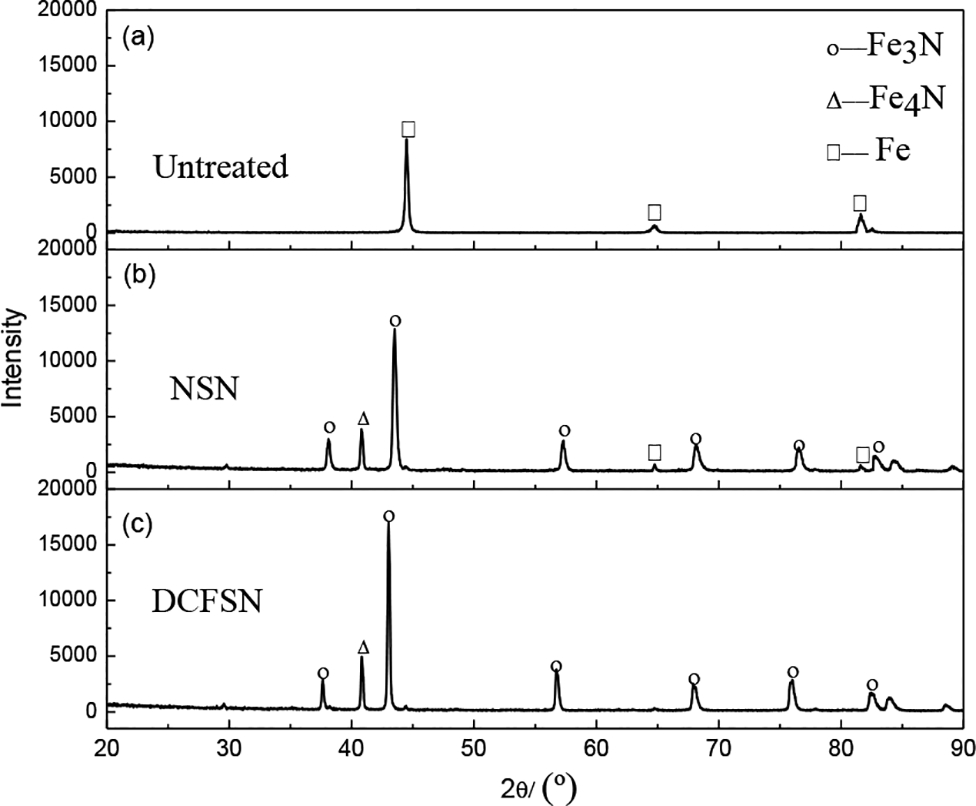
X-ray diffraction patterns of samples unnitrided and nitrided at 833 K for 60 min: a untreated; b NSN; c DCFSN, 7·5 V
Kinetic analysis
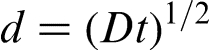
From the data on compound layer thickness, the growth rate constant of nitrogen is calculated for each temperature using equation (1)
13


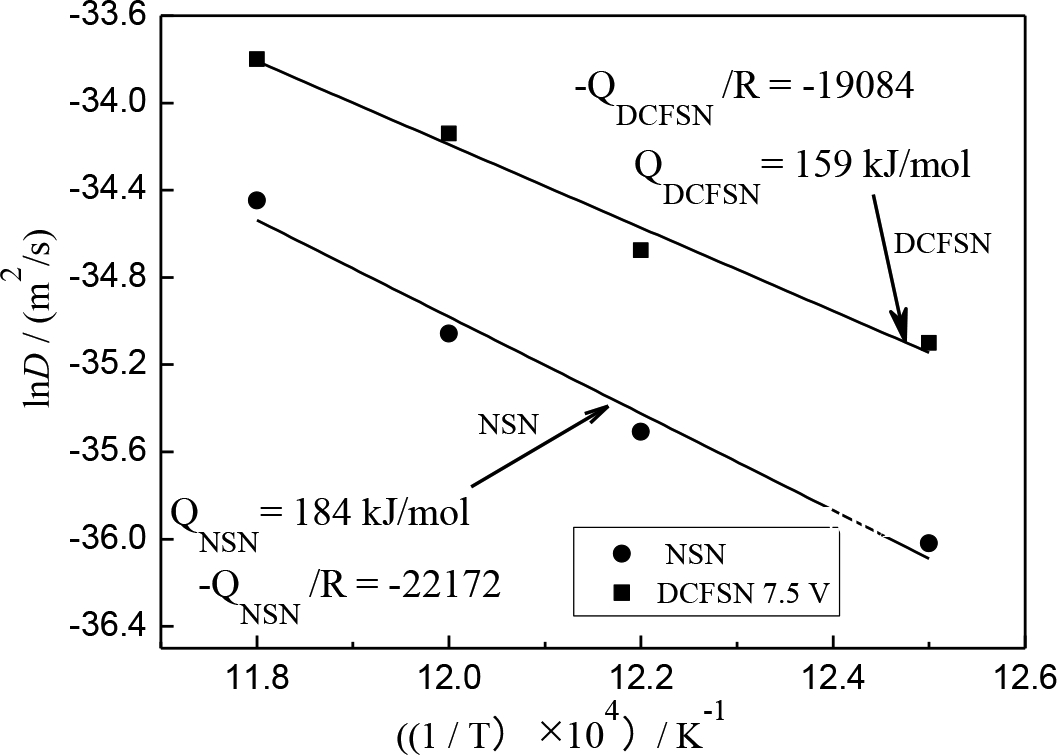
ln D versus 1/T during salt bath nitriding with and without DCF and Q value calculation for 35 steel
Diffusion coefficient D, pre-exponential constant D0 and activation energy Q of nitrogen elements*

NSN: normal salt bath nitriding; DCFSN: salt bath nitriding assisted by DCF.
Mechanism of DCF's effects on salt bath nitriding
The thickness of the compound layer in DCFSN is much thicker than that in NSN under the same treatment conditions as shown in Fig. 2, which clearly illustrates that DCF has a significant enhancement effect on the efficiency of salt bath nitriding. The schematic DCF enhancement mechanism in salt bath nitriding is shown in Fig. 1b. First, active nitrogen/nitrogen-containing species in NSN is produced only by chemical reactions in the salt bath media. The reaction intensity is mainly determined by temperature when the composition of the media is set. While in DCFSN, DCF could promote the following chemical reactions and thus increase the concentration of active nitrogen atoms in the salt bath


Conclusion
A rapid salt bath nitriding technology was developed with DCF enhancement for 35 steel, the diffusion coefficient of active elements is increased around two times, and the activation energy Q for diffusion was decreased. The enhancement mechanism indicates that DCF can promote chemical reactions and produce more active atoms in the salt bath, positively charge the active atoms and force them to diffuse directionally towards the surface of the treated specimen, and thus significantly increase the concentration of the active atoms around the surface of the treated specimen and improve the efficiency of the active atoms in the salt bath.
Acknowledgements
This research was supported by the Priority Academic Program Development of Jiangsu Higher Education Institutions, Jiangsu Province Graduate Student Innovation Fund (SCZ100431322) and Jiangsu Government Scholarship for Overseas Studies under grant no. JS-2012-173.