







Abstract
Scandia, yttria and erbia are thermodynamically stable oxides and could be used as a structural material for crucibles, in order to avoid contamination of the melt. These oxides have similar wetting behaviour in contact with aluminium containing melts, but different interaction characteristics and different interfacial products. When yttria and erbia substrates are exposed to Al containing melts, the substrate decomposes, large amounts of Y or Er are released into the melt and a thick interaction layer consisting of a new YAlO3 or ErAlO3 phase is formed beneath the drop. These results were not obtained in the Sc2O3/Al system where only a slight amount of Sc was dissolved in the melt and a thin interfacial layer consisting of Al2O3 was formed. The differences in the mechanism and in the nature of the reaction products of the studied systems are attributed to the thermodynamic properties of the ternary Al–Me–O systems. These properties dictate the sequence of dissolution–precipitation reactions during the wetting experiment and the final equilibrium state for each system.
Introduction
Chemical interaction in metal–ceramic systems is of significant interest, especially for fabrication of metal–ceramic composites, ceramic joining and evaluation of crucible performance. Thermodynamic stability of oxides is generally related to their standard Gibbs formation energies (Fig. 1). According to the presented thermodynamic data, scandia, yttria and erbia have the largest negative values of the standard Gibbs formation energies and may be considered as the most stable oxides. Therefore, attempts were made to use yttria as a structural material for Ti–Al melts, which are highly reactive and display relatively high melting temperatures.1
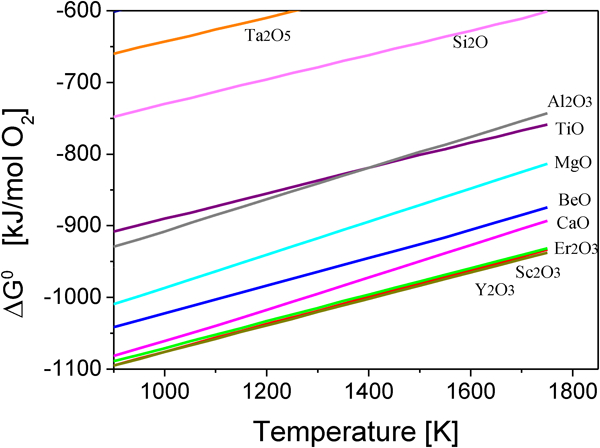
Standard Gibbs formation energy for various oxides: thermodynamic data were extracted from Ref. 2 and was normalised to 1 mol of O2
The reported results of the experimental investigations on the interface interaction between yttria and erbia with liquid metals are limited3–12 and usually contain only macroscopic measurements of the contact angle. The chemical interaction between yttria, erbia and scandia and aluminium containing melts was investigated.10–12 In the present study, a comparison of the experimental results is presented. The observed differences are explained by a thermodynamic analysis accompanied with new experimental results.
Experimental observations and thermodynamic consideration10–12
In this paragraph, the experimental observations along with the thermodynamic consideration, which takes into account the thermodynamic properties of the oxides and metallic solutions, are briefly presented and will be discussed in the next part of the manuscript. According to Refs.10–12, the wetting behaviours of Al containing melt in contact with Sc2O3, Y2O3 and Er2O3 substrates are rather similar and Al additions to liquid Cu improved wetting until the apparent contact angle reached gradually its final value (Fig. 2). Despite the similar wetting behaviours, the reaction products and the depth of the interaction zones beneath the drops were different. When yttria and erbia substrates were exposed to Al containing melt, relatively large amounts of Y or Er were dissolved in the liquid solution (Fig. 3b and c). The dissolution was followed by the formation of a relatively large crater, which consists of new phase (YAlO3 or ErAlO3, Fig. 3b, c and e).10,12 Different reaction products and different reaction region depths were observed for the Sc2O3/Al system. In this case, a small amount of Sc was released into the melt (Fig. 3a) and a relatively thin reaction layer, based on alumina, was formed (Fig. 3a and d).11
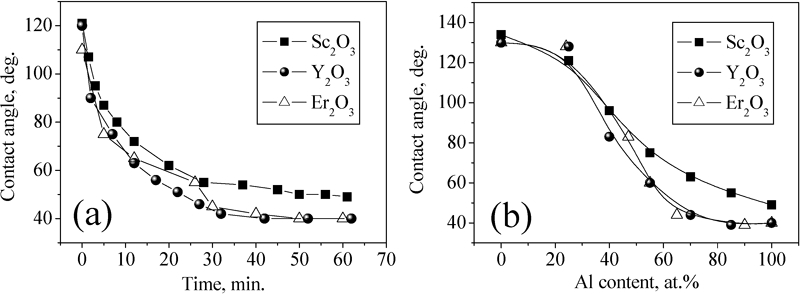
a Wetting kinetic for Sc2O3/Al, Y2O3/Al and Er2O3/Al systems at 1423 K and b apparent contact angles of Cu–Al drops on these oxides after 60 min: error bar for each measurement is ±3°
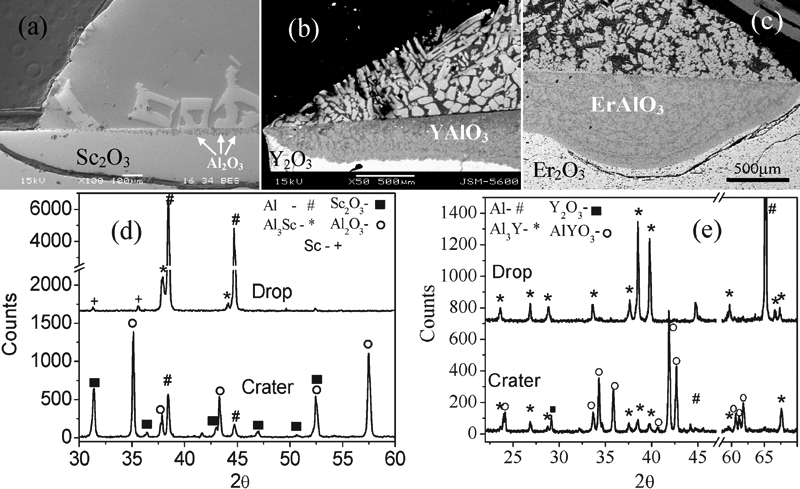
Interface characterisation in a Sc2O3/Al, b Y2O3/Al and c Er2O3/Al systems: reaction region beneath drops consists of Al2O3, YAlO3 and ErAlO3 respectively and composition of precipitates within drop, which are formed during solidification and cooling, corresponds to Al3Me (Me = Sc, Y or Er) phase; XRD patterns for solidified drops and for reaction regions in Sc2O3/Al and Y2O3/Al systems are presented in d and e
These differences were well accounted for by a thermodynamic analysis of the interaction in the oxides/Al systems.10–12 For instance, the calculated values of the equilibrium (Sc or Y) content for each system as a function of the Al–Cu composition are shown in Fig. 4. For the Sc2O3/(Cu–Al) and Y2O3/(Cu–Al) systems, the equilibrium content of Sc or Y in the melt decreases with increasing Cu alloying of the melt. The highest equilibrium dissolution values of Sc or Y correspond to the interaction with pure Al. The values, calculated for Sc2O3/(Cu–Al), are significantly lower than that for Y2O3/(Cu–Al).
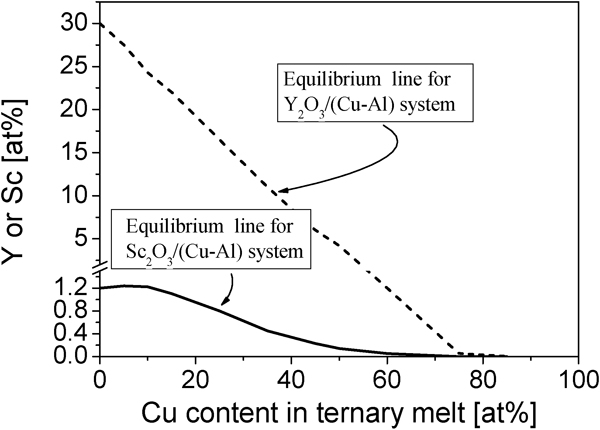
Equilibrium Sc and Y contents as function of Cu concentration for Sc2O3/(Cu–Al) and Y2O3/(Cu–Al) systems
For the Y2O3/Al system, the equilibrium content of Y in the melt is ∼30 at‐% and it is much higher than the equilibrium content of Sc (∼1 at‐%) calculated for Sc2O3/Al system.
Even though the level of the chemical interaction in these systems was explained, the reasons for the formation of different reaction products, namely, the formation of alumina in the Sc2O3/(Cu–Al) system and the interaction mechanism, were still not clear.
Discussion
As mentioned above, the new YAlO3 or ErAlO3 phases were formed at the Y2O3/Al or Er2O3/Al interfaces, while Al2O3 was formed in the Sc2O3/Al system. Owing to the absence of reliable thermodynamic data for ErAlO3 in the present communication, only the Sc2O3/(Cu–Al) and Y2O3/(Cu–Al) systems are discussed.
It is suggested that these differences are related to the differences in the thermodynamic properties of the ternary Y–Al–O (or Er–Al–O) and Sc–Al–O systems. The analysis was conducted using published data for the quasibinary Sc2O3–Al2O3 and Y2O3–Al2O3 systems,13–15 and the authors’ experimental findings.
Y–Al–O system
The quasibinary Y2O3–Al2O3 phase diagram, above 1800 K (Fig. 5a) was published in Ref. 15. At high temperatures, Y3Al5O12 (YAG), YAlO3 (YAP) and Y4Al2O9 (YAM) phases are stable in the system. It was noted15 that at lower temperatures (namely, at 1385 K), the YAM phase becomes unstable and decomposes to a mixture of YAP and yttria. Based on this information, a schematic isothermal section of a ternary Y–Al–O phase diagram was constructed and presented in Fig. 5b. Region 1 in Fig. 5b corresponds to a liquid Y–Al–O solution, and is shown out of scale due to extremely low oxygen content in the melt. In this isothermal section, each oxide phase is in equilibrium with Y–O–Al liquid solution, within a certain compositional range. For instance, liquid solutions corresponding to Y contents within a–b range are in equilibrium with Al2O3, while b–c and c–d ranges are related to the equilibrium with YAG and YAP respectively. The compositions of b, c and d in the liquid solutions, are in equilibrium with two oxides phases, namely, alumina and YAG, YAG and YAP, and YAP and yttria respectively. In the isothermal section, the regions, where liquid solutions are in equilibrium with one oxide phase, are denoted by 2, 4, 6 and 8. The regions 3, 5 and 7 correspond to three phase regions (melt and two oxides).
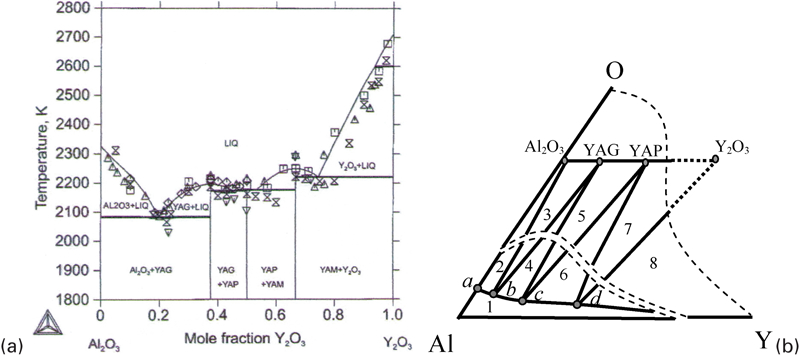
a quasibinary phase diagram of Y2O3–Al2O3 system14 for temperature range above 1800 K and b schematic isothermal section of Y–Al–O phase diagram at 1423 K: numbers within ternary diagram represent following phases: 1, single phase region (liquid solution, LS); 2, two phase region (LS+Al2O3); 3, three phase region (YAG+Al2O3+LS); 4, two phase region (LS+YAG); 5, three phase region (LS+YAG+YAP); 6, two phase region (LS+YAP); 7, three phase region (LS+YAP+Y2O3); 8, two phase region (LS+Y2O3)
The authors suggest that the evolution of the interface in the Y2O3/Al system involves the substrate dissolution in the melt and a new phase precipitation from the liquid solution. At an initial stage of contact, the substrate starts to decompose and small amount of Y dissolves in the melt. At this stage of interaction, the composition of the liquid solution corresponds to the equilibrium conditions with alumina, which has to precipitate. As a result of alumina precipitation, a local equilibrium between the melt and oxide phases is achieved. The substrate continues to decompose, Y content increases, alumina becomes non‐stable phase and has to be transformed to YAG. Finally, when the Y content in the liquid solution achieves the point d, the liquid solution and the substrate (yttria) will be in equilibrium with YAP.
In order to confirm the suggested mechanism of the metal/oxide interaction, further experiments were made according to the experimental procedure described in Ref. 10. Y2O3 substrates were exposed to liquid Al at 1423 K for short duration (1 and 5 min). The formation of alumina at the interface was expected. However, according to Fig. 6, the composition of the craters beneath each drop corresponds to the YAG phase (EDS analysis) and the solidified drop of ∼1 at‐%Y was observed after 1 min of contact and ∼7 at‐% after 5 min of contact (Fig. 6a and b). The ‘1 min’ experiment indicates that region 2 in the Y–Al–O system is relatively small, and Y concentration that is in equilibrium with Al2O3 (point b) is lower than 1 at‐%. The second experiment indicates that region 4 is larger and the Y concentration that is in equilibrium with YAG (point c) is at least 7 at‐%. As was demonstrated in Ref. 10, when Y2O3 substrates were exposed to liquid Al for longer duration (60 min) at 1423 K, the Y concentration in the solidified drop was much higher and the crater beneath the drop corresponds to the YAP phase (Fig. 3b and e).
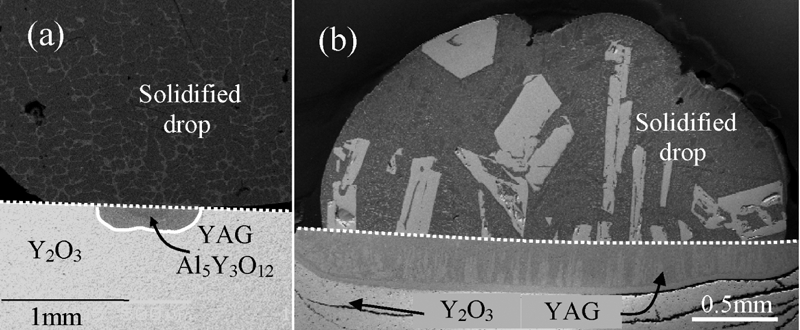
Images (SEM) of Y2O3/Al interface a after 1 min and b after 5 min in contact at 1423 K: doted line corresponds to position of initial interface
Sc–Al–O system
The quasibinary Al2O3–Sc2O3 phase diagram is presented in Fig. 7a.13 As can be seen, the ScAlO3 phase, which is equivalent to the YAP in the Al2O3–Y2O3, is stable only in the 2003–2143 K range. It has to be noted that ScAlO3 was not detected in the authors’ experiments too. According to the quasibinary Al2O3–Sc2O3 phase diagram, for temperature range above 1873 K, the RSS phase, which may be treated as a solid solution of Al2O3 and Sc2O3 with a wide compositional domain, is stable. Unfortunately, data for the temperature range corresponding to the authors’ experimental conditions are not available. As mentioned above, in the authors’ wetting experiments at 1423 K (Fig. 3a and d), the RSS phase was not detected. Moreover, this phase was not found in the additional experiments, which were performed using Al2O3–Sc2O3 powder mixture. This mixture was uniaxially pressed under 150 MPa and annealed in an air furnace at 1423 K for 100 h. The results of the XRD analysis are presented in Fig. 8. As can be seen, the initial phases did not change and no traces of the RSS phase were detected. Probably, the RSS phase is not stable at this temperature or there are strong kinetic constrains, which prevent its formation by sintering. In order to eliminate the probability of the kinetic constrains that may be associated in powder metallurgy, additional wetting experiment was preformed for Sc2O3/(Al–2 at‐%Sc) system using the same experimental procedure described in Ref. 11. In this new system, the initial Sc concentration is higher than the equilibrium concentration calculated in the authors’ previous study (Fig. 4). Thus, the precipitation of Al2O3 should be avoided, and similar to the Y–Al–O system (discussed above), the next oxide phase, which is in equilibrium with higher Sc concentration in the melt, should precipitate under the drop. The results of this experiment (Fig. 9) indicate that both Al2O3 and RSS phases are not formed beneath the drop, and the only solid existing phase is Sc2O3.
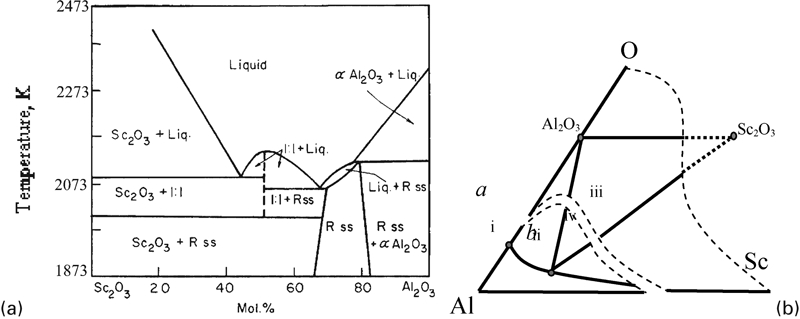
a quasibinary phase diagram of Sc2O3–Al2O3 system12 for temperature range above 1873 K and b schematic isothermal section of Sc–Al–O phase diagram at 1423 K: numbers within ternary diagram represent following phases: i, single phase region (liquid solution, LS); ii, two phase region (LS+Al2O3); iii, three phase region (LS+Sc2O3+Al2O3); iv, two phase region (LS+Sc2O3)
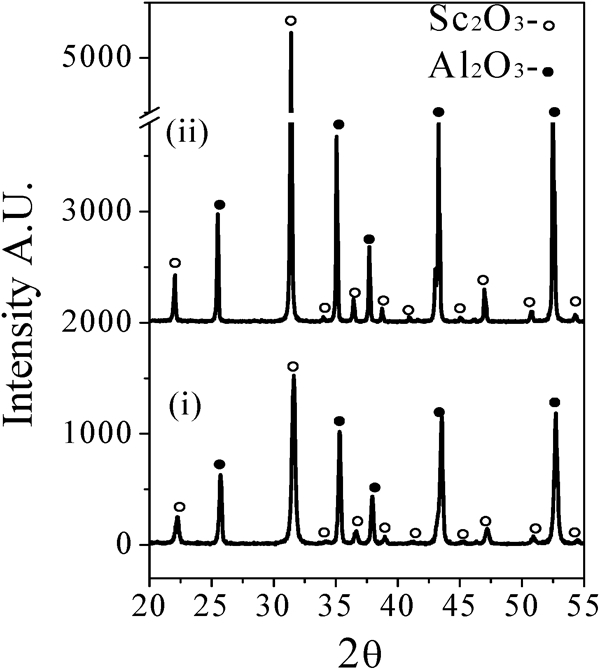
Analysis (XRD) for powder mixture of Sc2O3 and Al2O3 in ratio fit to RSS phase, before (i) and after (ii) annealing at 1423 K for 100 h
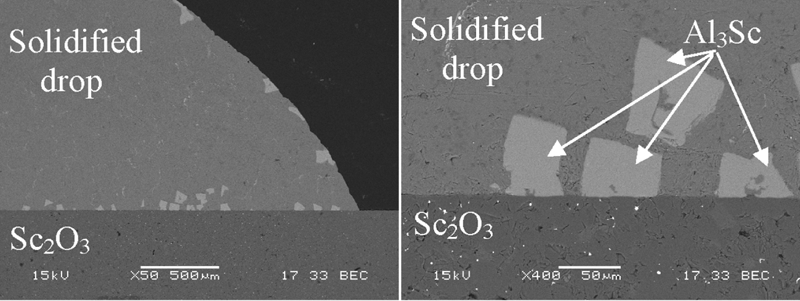
Images (SEM) of Sc2O3/(Al–2 at‐%Sc) interface after 60 min in contact at 1423 K: Al3Sc was precipitate during cooling
Based on the above considerations, a schematic isothermal section of the ternary Sc–Al–O phase diagram is presented in Fig. 7b. In this schematic view, the region corresponding to liquid Sc–Al–O solutions (region i), as for the previous system, is out of scale. According to this isothermal section, liquid solutions corresponding to Sc contents within a–b range are in equilibrium with Al2O3 (region ii). Liquid solutions containing Sc, which corresponds to point b, is in equilibrium with Al2O3 and Sc2O3 (region iii), and liquid solutions with higher Sc contents, are in equilibrium with Sc2O3 (region iv). It is suggested that for the Sc2O3/Al system, the final contact angle is established when Sc2O3, Al2O3 and the liquid solution are in thermodynamic equilibrium (region ii, Fig. 7b).
Conclusions
The wetting of the thermodynamically stable oxides (Sc2O3, Y2O3 and Er2O3) by Al containing melt at 1423 K involves chemical interaction between the Al and the substrates, even though the Al2O3 is significantly less stable compound. Thus, the stability expressed by Gibbs free energy is not enough to predict satisfying compatibility between the oxide melt and substrates oxides. When Y2O3 and Er2O3 are exposed to Al containing melts, large amounts of Y or Er are released into the melt and a thick interfacial layer consisting of the YAlO3 or ErAlO3 phases is formed beneath the drops. However, when Sc2O3 was exposed to Al containing melt, only a small amount of Sc dissolved into the melt and a thin reaction layer based on Al2O3 was formed. The differences in the degree of the interaction and in the nature of the reaction products are attributed to the thermodynamic properties of the ternary Al–Y–O and Al–Sc–O systems, which dictate the sequence of dissolution–precipitation reactions and the equilibrium states of the systems. For the Y2O3/Al system as well as for the Er2O3/Al system, the reaction layer phases beneath the drops are continually changing during the experiment according to the local equilibrium between the Y or Er concentrations which were released into the melt. The final contact angle is reached when the liquid drop, the reaction layer phase and the substrate reach thermodynamic equilibrium. For the Y2O3/Al system, it corresponds to Y2O3–YAlO3–(Al–Y) liquid solution. For the Sc2O3/Al system, the first phase that precipitates due to the Sc dissolution is already in equilibrium with the substrate, and therefore remains stable for long durations of contact. For this system, the final equilibrium corresponds to Sc2O3–Al2O3–(Al–Sc) liquid solution.
Footnotes
Acknowledgements
The authors wish to thank Mr M. Shohat and Ms H. Nagar for their expert technical assistance. This work was supported by the grant no. 138‐05 from the Israeli Council of High Education and the Israeli Atomic Energy Commission.