







Abstract
Materials with A2B2O7 (pyrochlore) structure have received significant attention for their applications as new protonic conductors and materials used in electronic devices. One of the unique synthesis routes for La2Zr2O7 (pyrochlore) powders is the glycine–nitrate combustion method, which shows superior properties of the synthesised powder using glycine as a complexing agent. The Sr doped La2Zr2O7 powders in pure pyrochlore structure were produced using this approach. Selected characteristics of the synthesised powders, such as crystal structure, lattice parameters, crystallite size, the vibrational properties, the morphology of the particles, along with the specific surface area and particle size, have been investigated. The dependence of some properties on annealing temperatures of the powders has been studied.
Introduction
Oxides with A2B2O7 (pyrochlore) structures have received significant attention as materials for use in power generation, heating elements, oxygen electrodes, solid electrolytes for solid oxide fuel cells (SOFCs), thermal barrier coating and for multiple electronic applications.1–6 In SOFC applications, the lanthanum zirconate pyrochlore structure, La2Zr2O7 (LZO), draws attention due to its ability to form an intermediate layer between Lay–xSryMnO3 porous cathode and Y2O3 stabilised ZrO2 dense electrolyte in SOFCs during operation.7 The formation of the LZO layer, which can occur during high cell fabrication temperatures (about >1400°C) or operation (about 1000°C), is reported to be responsible for the degraded performance of SOFCs. Despite this possible phase formation, the LZO structure still receives interest in fuel cell applications because of its reported protonic conductivity in Ca2+ or Sr2+ doped LZO.8–11 The doped LZO materials can be used in a number of ways as to exploit its chemical properties. One of the possibilities includes using LZO as an electrode during the synthesis of ammonia. Hence, with proper control of its localised structure formation, pyrochlore phases can offer improved performance of fuel cell systems. Finally, another application of the LZO structure includes using LZO as a solid electrolyte in proton conducting membranes of SOFCs.
Different techniques, such as solid state synthesis,8,9 sol–gel12 and combustion,13,14 have been employed for producing LZO (pyrochlore) powders. One of the unique synthesis routes for powders is the glycine–nitrate combustion method,15 which reports superior properties of the synthesised powder using glycine as a complexing agent. The advantages of glycine–nitrate synthesis include fast, self‐sustained reactions at high temperatures, where a homogenous liquid rapidly transforms into a crystalline ceramic powder. The resulting powders have high specific surface area and are compositionally homogeneous with low levels of residual carbon. In the present paper, the authors report an application of the glycine–nitrate combustion method for the synthesis of Sr doped LZO (pyrochlore) powders and selected characteristics.
Experimental
To prepare a solution of cations in appropriate molar ratios, 29·99 g La(NO3)3.6H2O, 0·22 g Sr(NO3)2, 18·72 g ZrO(NO3)2.xH2O nitrates and 14·54 g glycine (C2H5NO2), all in analytical grade and produced by Alfa Aesar (Ward Hill, MA, USA), were used by dissolving the metal nitrates in deionised water (the ratio of fuel/oxidiser is about 1∶1). The nitrate and glycine solutions were placed in an ultrasonic bath to help put the metals into the solution. The solution was then mixed in a 2 L beaker with the intention of synthesising a stoichiometry of La1·97Sr0·03Zr2O7 (LSZ) powders. The beaker was set up on a Fisher hot plate at 75°C, with a stir bar at a constant revolution per minute in order to evaporate the deionised water. The target goal of the synthesis was to produce 20 g of LSZ. After letting the solution heat and stirring for about 3–4 h, the solution becomes viscous and gel‐like. When this point was achieved, the temperature was increased from 75 to 400°C, which is the ignition temperature for glycine. Once ignition temperature is reached, a fast, self‐sustaining combustion produced a white pyrochlore product, as shown in the movie (http://research.cecs.ucf.edu/CHEA/Movie 1.wmv). Some small amounts of carbon residue are left on the side of the beaker and can be detected by visual inspection. The synthesised powder was calcined at 800, 1100, 1250 and 1350°C for 2 h to obtain different particle sizes.
An X'Pert PRO X‐ray diffraction (XRD) system (PANalytical, Almelo, The Netherlands) was used to characterise the crystal structure of the synthesised powder. The Scherrer equation was applied for the calculation of the crystallite sizes of the powders. Thermogravimetric analysis was performed using a Q‐50 thermogravimetric analyser (TA Instruments Inc., New Castle, DE, USA), coupled with a Thermostar mass spectrometer (Pfeiffer, Inc., Pembroke Pines, FL, USA) and an Ultra‐55 scanning electron microscope (SEM; Carl Zeiss SMT Inc., Oberkochen, Germany), which were used for morphology and particle size characterisation. A small amount of as obtained or each calcined powders was dispersed in acetone (99+%) via ultrasonic vibration, and then, the nanoparticles of the powders were observed by a JEM‐1011 transmission electron microscope (TEM, JEOL Ltd, Tokyo, Japan), with an acceleration voltage of 100 kV. Raman spectroscopy (inVia Raman spectrometer with 532 nm Si solid laser, Reinshaw, UK) was used to characterise the vibration properties of the powder. Specific surface area (SSA) has been measured with an Autosorb‐1C chemisorption–physisorption analyser (Quantachrome, Boynton Beach, FL, USA).
Results and discussion
The selected characteristics of LSZ powders both after combustion (as obtained) and after calcination at different temperatures are presented in Table 1. As expected, the temperature during combustion could be as high as 1400–1500°C,15 which is high enough to produce a pure pyrochlore powder of a given composition after synthesis. The combustion process of the LSZ powder is provided in the recorded movie. The synthesised powder is white; however, a small quantity of the organic residue could be observed along the walls of the beaker, where the temperature of combustion is expected to be much lower because of the temperature gradient close to the wall of the beaker. The ‘as obtained’ powder collected from the central part of the beaker, where no organic residue was present, shows a pure pyrochlore structure after synthesis, as verified by XRD. A small amount of La2O3 secondary phase was also detected, the intensity of which might suggest a slight off‐stoichiometry of the pyrochlore product (Fig. 1a). The thermogravimetric analysis also indicated a high purity product as almost no weight loss was measured upon heating and dwelling at 1000°C for more than 2 h of the heating experiments (Fig. 1b). As a result of the combustion, minimal residual carbon content and small particle sizes of LSZ were observed. The morphology of the ‘as obtained’ powder shows the existence of small particles (0·1 μm), which assembled into larger agglomerates (1·1 μm) (Fig. 2a). The TEM image of the ‘as obtained’ powder shows one of the agglomerates consisting of numerous crystallites with a size of 17±3 nm (Fig. 2f). The SSA of the ‘as obtained’ powder is reported to be 14·25 m2 g−1.
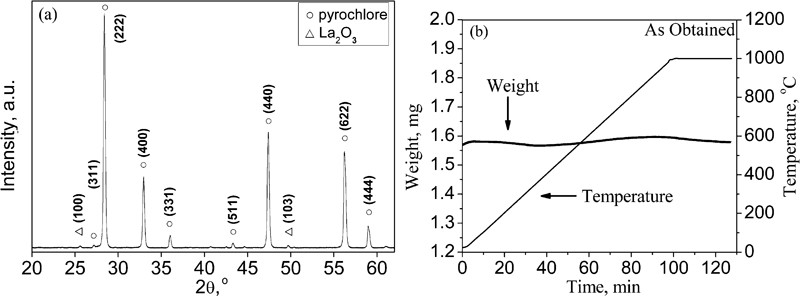
a X‐ray diffraction of La1·97Sr0·03Zr2O7 powder recalcined at 1350°C and b thermogravimetric analysis of ‘as obtained’ La1·97Sr0·03Zr2O7 powder
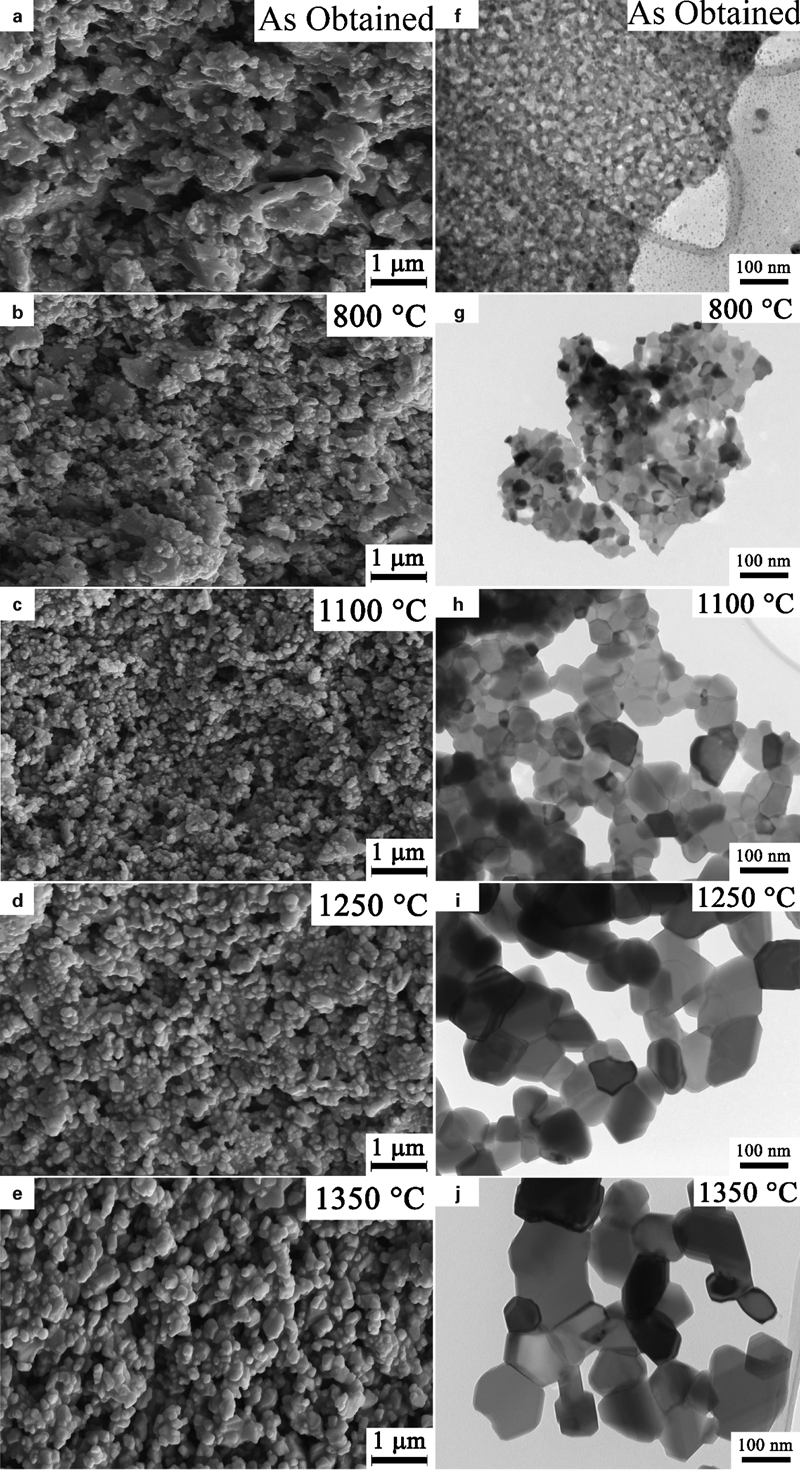
Images (a–e SEM) and (f–j TEM) of La1·97Sr0·03Zr2O7 powders after calcination at different temperatures
Selected characteristics of La1·97Sr0·03Zr2O7 powders after glycine–nitrate synthesis and calcination at high temperatures
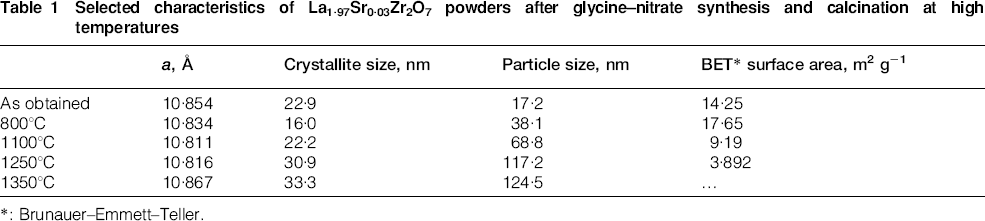
*: Brunauer–Emmett–Teller.
The calcination of ‘as obtained’ powders at 800°C led to a decrease in the crystallite size measured from the broadening of the XRD peaks and an increase in SSA (Table 1). Contradictorily, the particle size measured from TEM images indicated an increase in the particle size after calcination at 800°C for 2 h. A further increase in the calcination temperature of the ‘as obtained’ powders led to a significant increase in particle and crystallite sizes as well as the SSA down to 3·8 m2 g−1 for the powder after calcination at 1250°C. The specific surface area of the powder was not measured after calcination at 1350°C. Both SEM and TEM show an increase in the particle size as calcination temperatures of the powder increase (Fig. 2a–f).
The Raman spectrum of LSZ powder consisting of five Raman active bands at 299, 315, 395, 492 and 515 cm−1 waveshift is presented in Fig. 3. The spectrum corresponds well to the previously reported Raman response of LZO pyrochlore.14,16,17 Based on the crystal structure and group theory analysis, there are only six Raman active modes for the pyrochlore structure

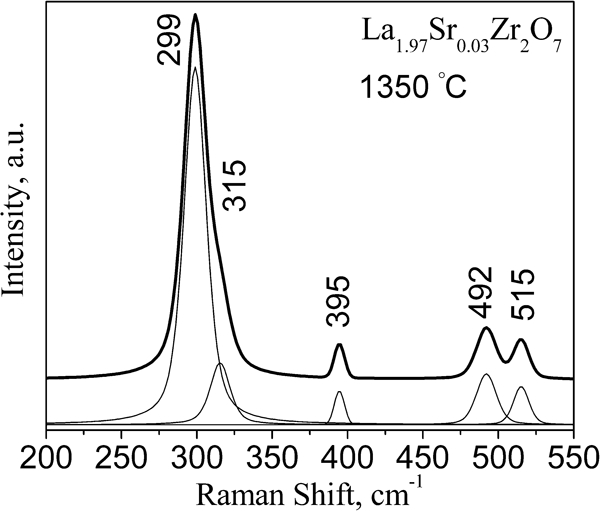
Raman spectrum of La1·97Sr0·03Zr2O7 powder calcined at 1350°C for 2 h
The full width at half maximum of the Raman active bands of the pyrochlore is significantly decreasing, which indicates coarsening of the structure and growth of the particle size when the powders are annealed at progressively higher temperatures. This corresponds well with the increase in the crystallite size measured by XRD and growth of the particle size observed by TEM.
Conclusions
As a result of the proposed work, LSZ pyrochlore powders were produced by glycine–nitrate synthesis. The ‘as obtained’ product was a well crystallised powder with a pyrochlore structure with minor traces of La2O3 impurity phase detected by XRD. After calcination at higher temperature, an increase in crystallite size and a decrease in SSA were observed, except for the calcination at 800°C, where the crystallite size of the powder was decreased and the SSA was increased relative to ‘as obtained’ powders. The synthesised powders were characterised by SEM, TEM and Raman spectroscopy.
Footnotes
Acknowledgements
The present work was supported by the Visiting Faculty Summer Program of Oak Ridge Institute for Science and Education (Oak Ridge, TN, USA) and in part by National Science Foundation Division of Materials Research project no. 0502765.