







Abstract
Long fibres of mullite were prepared by sol–gel method using aluminium nitrate, malic acid and tetraethylorthosilicate (TEOS). Thermogravimetry/differential scanning calorimetry (TG/DSC), Fourier transform infrared (FTIR) spectra, X‐ray diffraction (XRD), and scanning electron microscopy (SEM) analyses were used to characterise the properties of the gel and ceramic fibres. The gel fibres completely transformed to mullite fibres at 1200°C, with a uniform diameter and dense microstructure.
Introduction
Mullite (3Al2O3.2SiO2) has been recognised as an outstanding ceramic material for its high temperature strength, creep resistance, thermal and chemical stability, low thermal expansion coefficient and good dielectric properties.1 An important potential application of mullite is as a fibre reinforcement. In the Al2O3–SiO2 system, only mullite exists as the stable compound, which occupies the structure of edges shared AlO6 octahedron chains parallel to the c axis bounded by aluminium and/or silicon tetrahedron.2
Main processes for the manufacture of ceramic fibres can be classified as melt and sol–gel spinning processes.3 Usually, the melt spinning method was adopted for the synthesis of ceramic fibres with low melting point. Therefore, the method was not suitable for the preparation of the mullite fibres, as the mullite has a high melting point of 1850°C.
Many successful processes have been reported in the preparation of mullite fibres by the sol–gel method.4,5 In most of the starting materials, aluminium isopropoxide was selected as an aluminium source because its polymerisation was responsible for the appropriate spinning viscosity. On the other hand, since the expensive aluminium isopropoxide was involved in the synthesis process of mullite fibres, the process limits its widespread applications, although mullite fibres are obtained with smooth surface and dense microstructure. It is desirable to fabricate the mullite fibres using the Al source in low cost with high fibre quality.
In the present work, mullite fibres were prepared by sol–gel method using aluminium nitrate, malic acid and tetraethylorthosilicate (TEOS) as raw materials. The process, crystallisation phase and surface morphology were also investigated in detail.
Experimental
Preparation of samples
Starting materials used were aluminium nitrate (chemically grade; Xi'an Reagent Factory, Xi'an, China), malic acid (chemically grade; Sinopharm Chemical Reagent Co. Ltd, Shanghai, China), TEOS (chemically grade; Tianjin Kermel Chemistry Co. Ltd, Tianjin, China) and ethanol (chemically grade; Xi'an Reagent Factory).
The mullite fibres were prepared in the processing steps as shown in Fig. 1. The alumina sol was prepared by mixing H2O, aluminium nitrate and malic acid with a molar ratio of 10∶1∶0·85, followed by heating in water bath (80°C). The viscous sol was then dissolved in absolute alcohol. Then, a proper amount of TEOS was added in the alumina solution to obtain a stoichiometric Al/Si ratio of 3∶1. Then, the precursor solution was concentrated to obtain a spinning sol in water bath (60°C). The sol fibres were prepared by pulling a thin glass rod slowly from the sol after immersing. Then, the sol fibres were dried at 60°C for 24 h in an oven. The gel fibres were then sintered at various temperatures between 800 and 1200°C for 1 h with a heating rate of 1°C min−1.
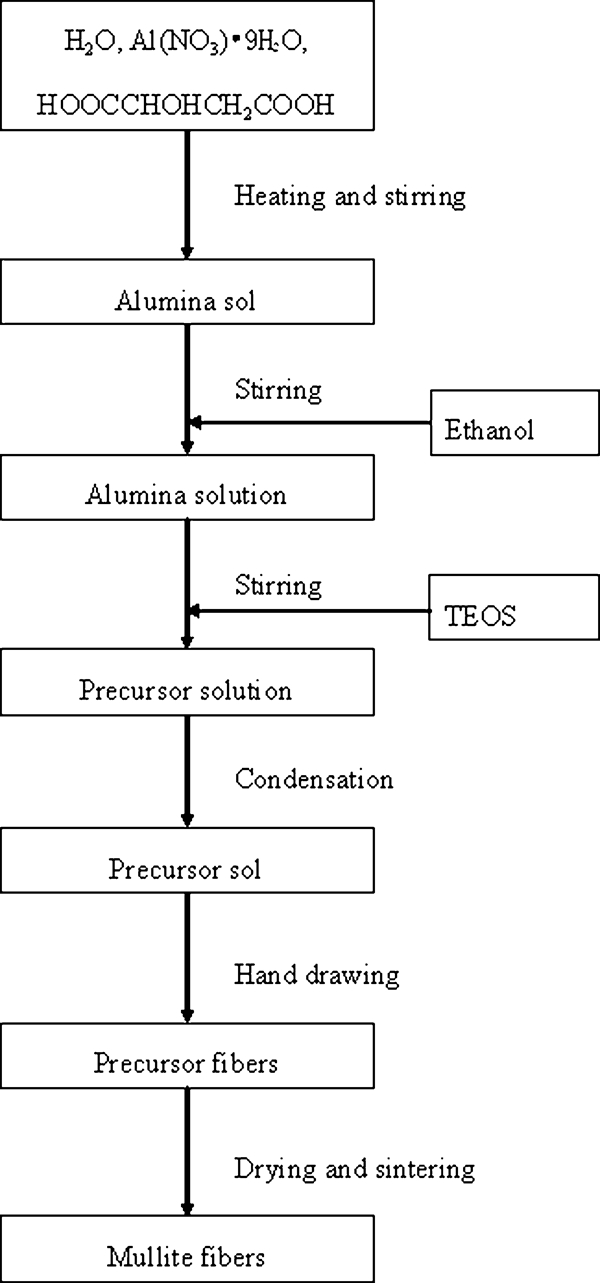
Schematic view of production route for mullite fibres
Characterisation techniques
For the gel fibres, thermal behaviours were measured by thermogravimetry/differential scanning calorimetry (TG/DSC) instruments (SDT Q600; TA Instrument, New Castle, DE, USA) with a heating rate of 10°C min−1 in flowing air, and Fourier transform infrared (FTIR) spectra were recorded on an infrared spectrometer (Nicolet Magna 6700; Nicolet Instrument Corp., Madison, WI, USA) with the samples as KBr pellets. X‐ray diffraction (XRD) analysis was carried out on an X‐ray diffractometer (D/max2400; Rigaku, Tokyo, Japan) using Cu Kα radiation and a step width of 0·05° s−1. Morphologies of heated treated fibres were characterised by SEM (JSM‐6390LV, JEOL, Tokyo, Japan). All tests were done at room temperature.
Results and discussion
Alumina sol was prepared by synthesis and hydrolysis reaction, which took place between aluminium nitrate and malic acid in aqueous solution during the stirring and heating. The main chemical reactions may be simplified as the following equations (1)–(3), although the actual reactions were complex6,7
Synthesis:



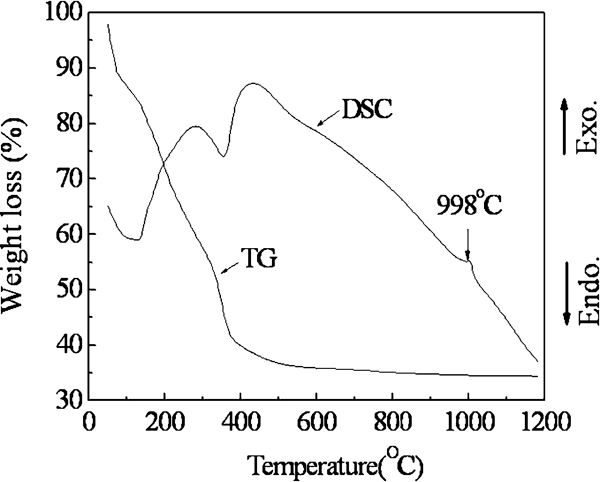
TG and DSC curves of mullite precursor gel fibres
In the above thermal analysis, the most interesting phenomenon is the exothermic peak at 998°C. The exothermic peak indicated better homogeneity of the Al and Si components at a molecular scale,8,9 which will be beneficial for obtaining mullite phase at a lower temperature.
The FTIR spectra of alumina gel and precursor gel fibres are shown in Fig. 3. As can be seen, the bands at 3440 and 1110 cm−1 are assigned to the O–H stretching and bending modes of adhesive and constitution water as well as malic acid and alcoholic respectively. The band at 2480 cm−1 is assigned to the O–N stretching mode of nitric acid. The bands at 1720 and 480 cm−1 are assigned to the C = O stretching and bending modes respectively. The band at 910 cm−1 is assigned to the C–C stretching mode. The bands at 1320 and 830 cm−1 may be assigned to the C–O stretching and bending modes respectively. As can be seen, a little of nitric acid was present in the samples.
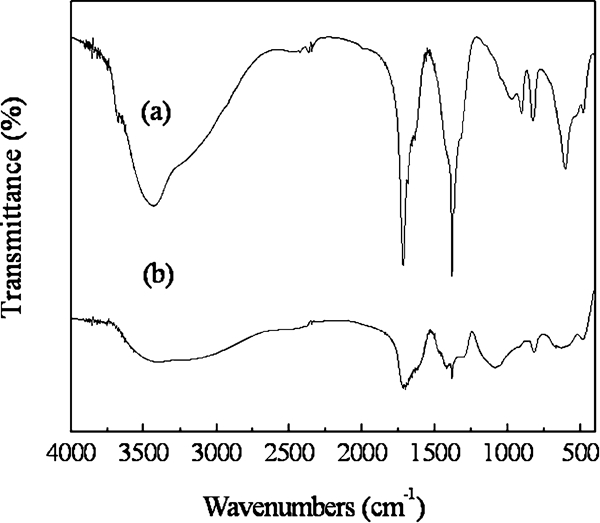
FTIR spectra of a alumina gel and b mullite precursor gel fibres
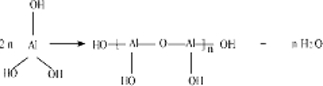
The alumina gel was obtained by condensation of alumina sol in water bath (80°C). As shown in Fig. 3a, the band observed at 1400 cm−1 corresponds to the Al–OH bonding mode.10 The stretching modes of Al–O–Al linkages are observed at 620 and 820 cm−1.11 When the alumina solution was condensed, condensation polycondensation could occur. Therefore, the stretching modes of Al–O–Al linkages are observed. The main reactions may be simplified as the following equation (4) 5.
Condensation polymerisation:
As shown in Fig. 3b, the bands at 1100 and 480 cm−1 are assigned to the stretching and bending modes of Si–O–Si of the network. The band at 630 cm−1 has a shoulder at 735 cm−1, which may be assigned to the (Si, Al)–O–(Si, Al) linkages bending mode.12
TEOS hydrolysised under acidic condition, and condensation polymerisation took place when the sol was concentrated. The main reactions can be simplified as the following equations (5) and (6).


Moreover, condensation polymerisation reaction between aluminium and silicon hydroxide occurred simultaneously according to the following equation (7) 5

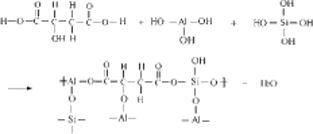
Moreover, the hydroxyl and carboxyl groups of malic acid could react with the aluminosilicate sol, and an organic–inorganic hybrid structure was formed. These overall reactions can be written as equation (8)
After a concentrating process in a water bath (60°C), a spinnable sol was obtained, as the linear molecular chains were present. The length and diameter of the fibres were influenced by viscosity and surface tension of the spinning sol, speed of hand drawing and so on. The long fibres can be obtained by the addition of suitable spinning additives in sol, e.g. polyethylene glycol, polyvinyl alcohol, lactic acid, poly(ethyleneterephathalate)/dimer fatty acid, poly‐4‐vinylphenol, etc.13 Further research about these factors is being carried on.
The XRD patterns of gel fibres sintered at 800, 1000 and 1200°C are shown in Fig. 4. Only the amorphous phase was present when fibres were sintered at 800°C. Mullite phase was obtained in the samples sintered at 1000°C, while complete mullitisation was obtained at 1200°C. From the DSC and XRD results, it can be concluded that mullitisation of the gel started to occur at a temperature of ∼1000°C.
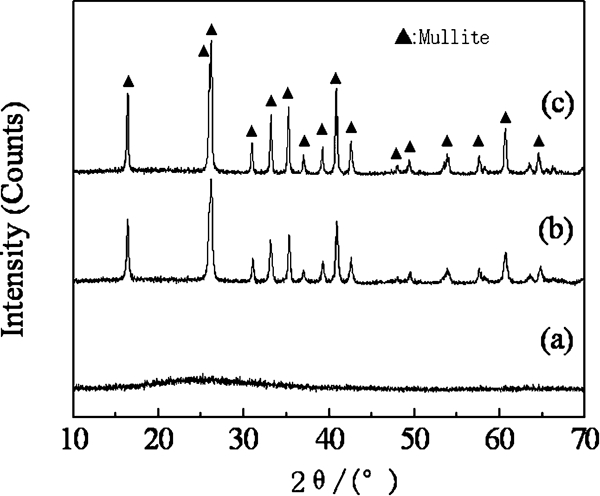
XRD patterns of mullite precursor gel fibres heated at a 800°C, b 1000°C and c 1200°C for 1 h
The formation temperature of the mullite nucleation sites (AlO5 sites) closest to 1000°C, together with the further densification by the growth of particles and clusters to exceed the critical size of mullite nuclei, resulted in rapid mullitisation with a very high nucleation density.14
The complete transformation to mullite was obtained at 1200°C. The mullitisation temperature was considered to be an important criterion in the assessment of the mixing scale of the Al and Si components in the gels. Temperatures in the range of 1600–1700°C are required to achieve complete mullitisation by mixing alumina and silica particles in the micrometre size range. Complete mullitisation temperatures of 1000–1100°C can be attained for the mixing scale at molecular level.15
SEM images of mullite fibres sintered at 1200°C are shown in Fig. 5. The fibre had diameters of about 12 and 30 μm, with a coarse surface and dense microstructure.
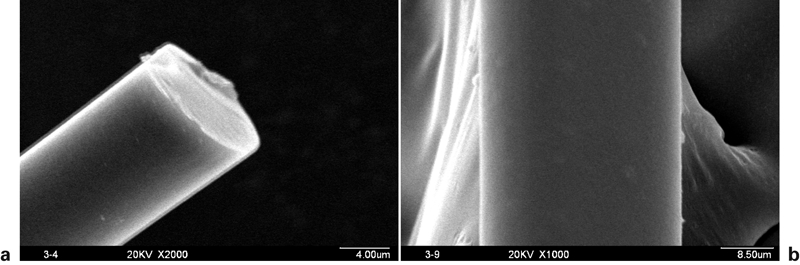
Microstructures (SEM) of mullite precursor gel fibres heated at 1200°C for 1 h a cross-section of fibers, b mullite fibres
Conclusion
Long fibres of mullite were prepared using alumina sol and TEOS. The alumina sol was obtained from the composition of aluminium nitrate/malic acid molar ratio of 1∶0·85. The main phase was the mullite phase at 1000°C, without other crystal phases present. The complete mullitisation was obtained at 1200°C, with a uniform diameter and dense microstructure.