







Abstract
Mesoporous C/N doped TiO2 (MCNT) samples were prepared, and Pt was deposited on their surfaces. The hydrogen production capability of this material was investigated by irradiating it with UV light at two different wavelengths. It was found that MCNT could be used to produce hydrogen gas. The highest hydrogen production rate was obtained when 0·003 mol Pt was deposited on the surface of 1 mol MCNT. Since this optimal Pt concentration is the same as that for P-25, it was concluded that the mesopore surface was not directly deposited with Pt. More hydrogen was produced when Pt deposited MCNT was irradiated with 350 nm wavelength UV light than with 370 nm wavelength UV light at similar intensity. This implies that the wavelength of UV light strongly affects hydrogen production.
Introduction
Important current issues include methods to conserve energy, generation of renewable energy and the production of environmentally friendly products. For example the Clean Coal Project of Western Australia 1 has been proposed as a feasible method for reducing CO2 emissions. It may be the world's first coal fired power generation project to be fully integrated with carbon capture and storage. It could also be the first project of its kind to use saline formation to store CO2. Unfortunately, engineering studies found that the geological structure proposed for storing CO2 was unsuitable for the permanent storage of CO2. 2 This finding has significant implications for hydrogen production from sunlight.
Hydrogen is one of the most important clean renewable energy sources because it can be produced from water. Several methods have been known to produce hydrogen from water, including splitting water using electricity. The method employs electricity produced by other techniques. Sunlight is an abundant natural energy source for producing hydrogen using photocatalyst. Using sunlight to directly produce hydrogen will reduce greenhouse gas emissions.
Titanium dioxide is the most extensively investigated photocatalyst3,4 because it is inexpensive, chemically stable and non-toxic. 5 However, because of its large bandgap energy (3·2 eV), it can only utilise the UV region of the solar spectrum. Therefore, considerable efforts have been made to extend the photoresponse of TiO2 based systems further into the visible light region using dopants.6,7 Anionic dopants, such as carbon, sulphur and nitrogen, may be possible for extending the photocatalytic activity of TiO2 into the visible light region because the related impurity states are expected to be close to the valence band maximum.8,9 However, no studies have investigated the effect of wavelength in the UV region on the photocatalytic activity of TiO2. On the other hand, mesoporous materials with three-dimensional porous structures provide highly porous hosts that offer easy and direct access to guest species, thereby facilitating inclusion or diffusion through the pore channels without blocking the pores. We have developed a method for synthesising highly crystalline mesoporous TiO2 codoped with carbon/nitrogen (C/N). 10 This material is expected to be effective for decomposing organic compounds. However, it is not known whether a material with such a narrow bandgap can be used to decompose a water/alcohol mixture to produce hydrogen gas. Therefore, the present study seeks to determine whether mesoporous C/N doped TiO2 (MCNT) could be used to produce hydrogen gas and to investigate the effect of the wavelength of UV light on hydrogen production using MCNT.
Experimental
To produce mesoporous silica (hexagonal SBA-15), we followed the procedure developed by Zhao et al. 11 Three different temperatures (100, 130 and 150°C or 373, 403 and 423 K) were used when drying the powder products, which are referred to as SBA-15 (100), SBA-15 (130) and SBA-15 (150) respectively. The Si in SBA-15 was then replaced by Ti to form mesoporous TiO2. In a typical synthesis of MCNT, calcined SBA-15 11 was added to ethylenediamine (99%; Wako Pure Chemical Industries Ltd, Japan) and carbon tetrachloride (99·8%; Wako Pure Chemical Industries Ltd, Japan), and they were thoroughly mixed. To this mixture, titanium tetraisopropoxide (97%; Sigma-Aldrich, USA) dissolved in 1-propanol (99·5%; Wako Pure Chemical Industries Ltd, Japan) was added, and the resultant mixture was heated in an oil bath at 363 K for 5 h. The solid mixture obtained was then dried at 423 K and ground into a fine powder. The C/N doped TiO2 composite was then heat treated in a nitrogen/oxygen flow at 773 K to obtain well crystallised highly ordered MCNT [MCNT SBA-15 (100), MCNT SBA-15 (130) and MCNT SBA-15 (150)]. The TiO2 sample at this stage was slightly grey in colour. This procedure is schematically depicted in Fig. 1.
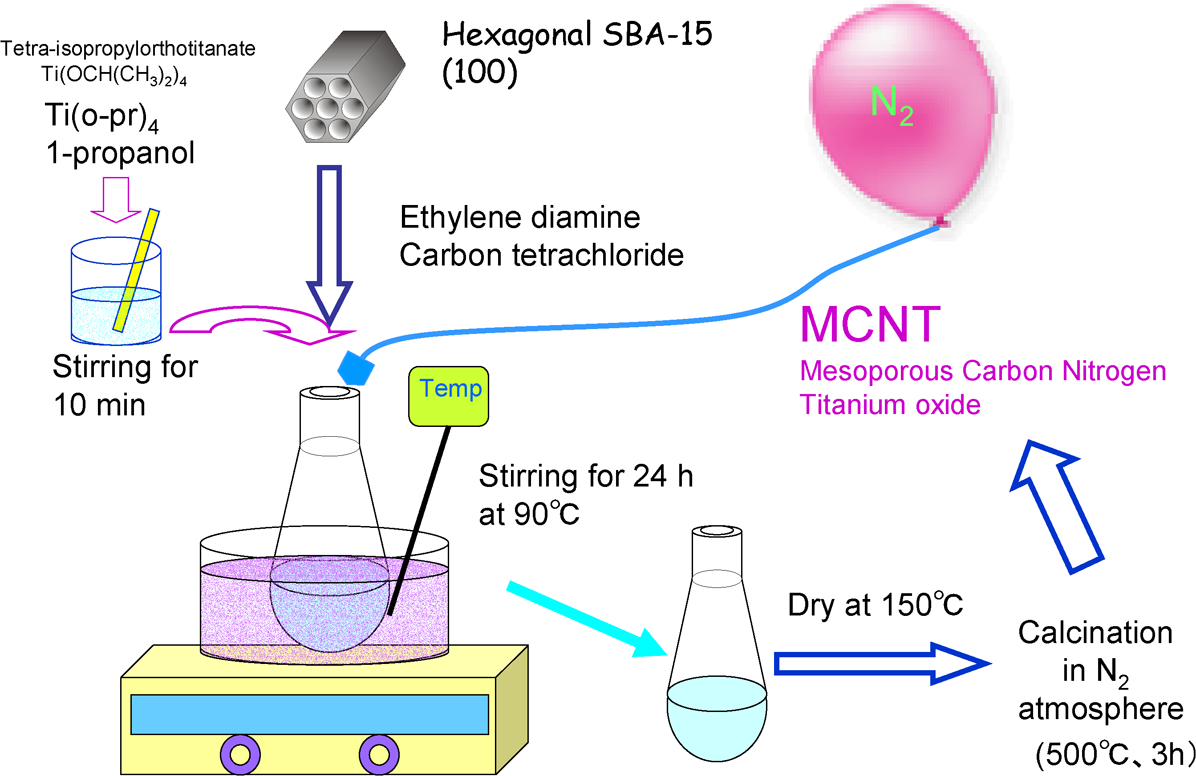
Schematic of procedure for preparing MCNT SBA-15
Powder X-ray diffraction analysis of MCNT was performed using a Rigaku diffractometer with Cu Kα radiation (λ = 0·154 nm). The results have been reported elsewhere; 12 they revealed that the samples were mainly anatase TiO2 containing a very small amount of rutile TiO2. The specific surface area and pore volume and pore size distributions of the samples were determined from N2 adsorption–desorption isotherms at 77 K obtained using a Belsorp mini II sorption analyser. The materials were outgassed at 573 K for 3 h before nitrogen adsorption measurements. The specific surface area and pore size distributions were calculated using the Brunauer–Emmett–Teller equation 13 and the Barrett–Joyner–Halenda method 14 respectively. The samples were also studied by diffuse reflectance spectroscopy (DRS) using a spectrophotometer (Shimadzu) equipped with an integrating sphere. BaSO4 was used as a reference. Spectra were obtained at room temperature in the wavelength range of 200–700 nm.
Pt was deposited on the surface of MCNT SBA-15 using the procedure reported by Ikuma and Bessho. 15 The size of Pt deposited on the surface of TiO2 is <2 nm. 15 The Pt concentration is expressed in terms of the ratio of the number of moles of Pt to the number of moles of TiO2 (e.g. 0·001 mol Pt MCNT SBA-15 contained 0·001 mol of Pt per 1 mol of TiO2). Pt deposited MCNT SBA-15 was placed in the hydrogen production system shown in Fig. 2. A 40% methanol aqueous solution was used in this system. 15 We used two different lamps as UV light sources: lamps A and B. Figure 3 shows their spectra. Lamp A has a maximum intensity at a wavelength of 370 nm, while lamp B has a maximum intensity at 350 nm. The hydrogen concentration was determined by gas chromatography.
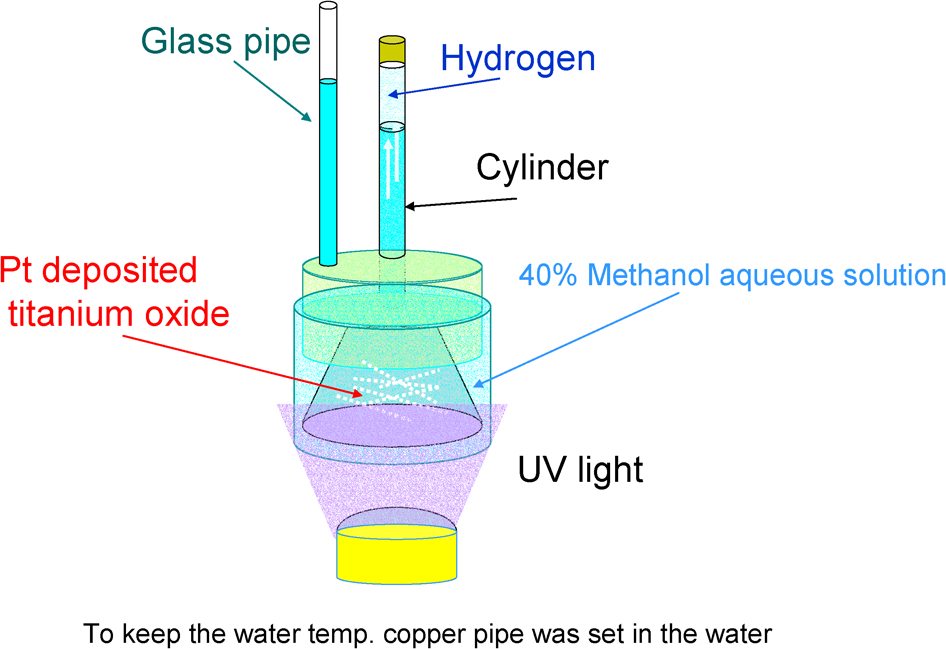
Hydrogen production system
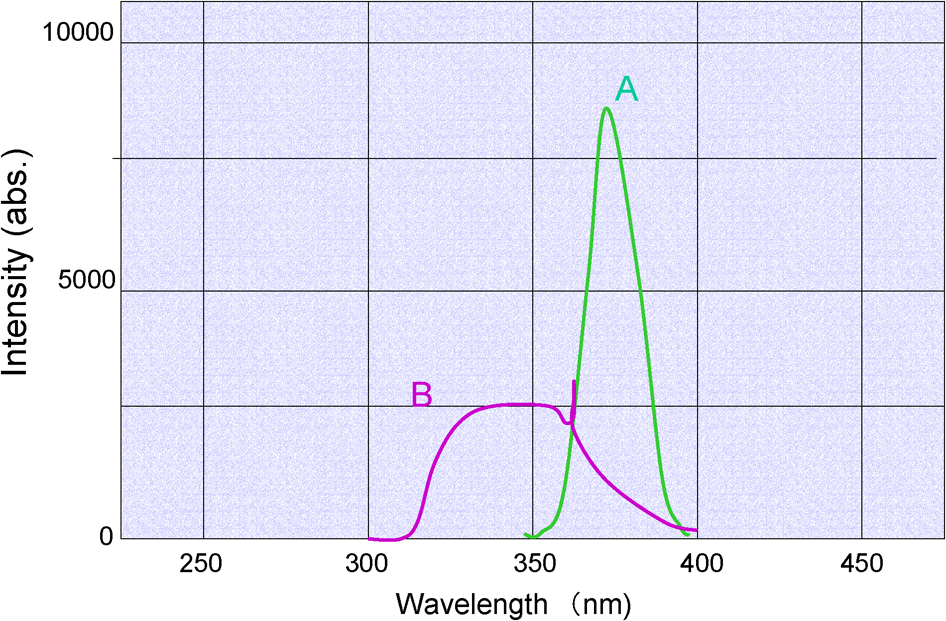
Spectra of UV light used in this study: lamps A and B
Results and discussion
Table 1 shows the results of the surface area measurements. This table also includes the surface areas of P-25 (Degussa) and P-25 deposited with Pt for comparison. Since the pore diameter of P-25 will not change when Pt is deposited on its surface, the difference in the pore diameters of P-25 and 0·003 mol Pt–P-25 will lie within the experimental error. Synthesised titania shows almost the same pore volume as standard titania P-25. However, its average pore diameter is about a factor of 4 smaller than that of P-25. Its surface area is also 4–6 times larger than that of P-25 after Pt deposition. The main difference is the surface area, which is probably due to the sample being mesoporous.
Results of surface area and pore volume measurements

Figure 4a and b shows the amounts of hydrogen produced using Pt deposited MCNT SBA-15 (130) and MCNT SBA-15 (100) respectively. In this figure, the amount of hydrogen is defined as the total amount of hydrogen produced between a data point and its previous data point. Thus, the data points do not represent the accumulated hydrogen volume; rather, they represent the amount of hydrogen produced during the intervals of 10–40 h. For 0·001 mol Pt MCNT SBA-15 (130) (Fig. 4a), only a very small amount of hydrogen is produced during the irradiation time of this experiment. The situation is different for 0·003 mol Pt MCNT SBA-15 (130). In the initial stages of UV irradiation, the amount of hydrogen increases gradually until reaching a maximum of 2600×10–6 H2 mol/TiO2 mol/h at 44 h. The amount of hydrogen then decreases rapidly. For 0·005 mol Pt, the maximum production is 500×10–6 H2 mol/TiO2 mol/h at 112 h. From Fig. 4a, we conclude that Pt MCNT SBA-15 produces hydrogen when it is irradiated by UV light and that the amount of hydrogen depends strongly on the Pt concentration at the surface. The amount of hydrogen produced also depends on the UV irradiation time.
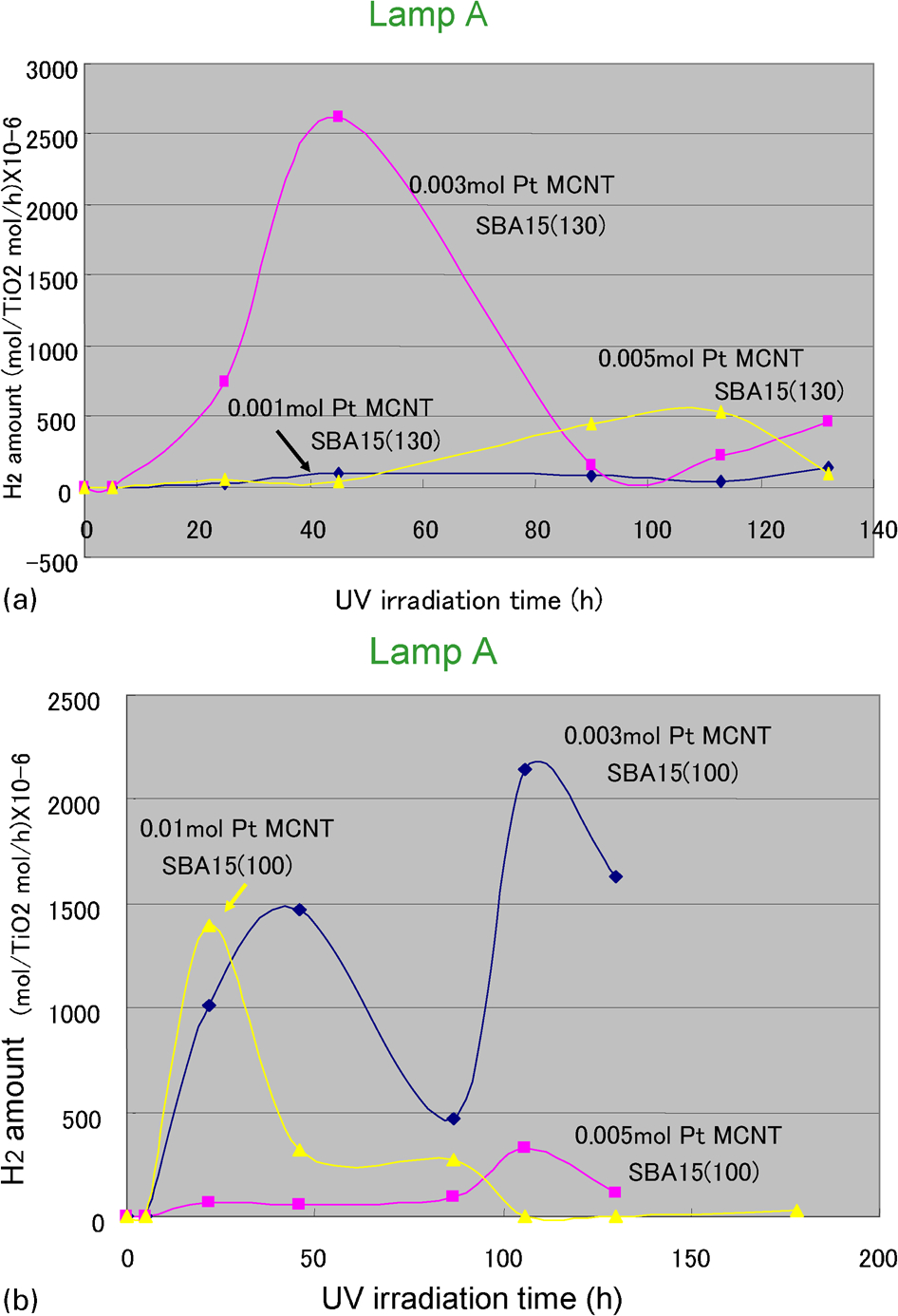
Amount of hydrogen produced during UV irradiation at different Pt concentrations: lamp A was used in this experiment:
The results for Pt MCNT SBA-15 (100) shown in Fig. 4b indicate that similar conclusions can be drawn for this sample. Of the Pt concentrations on the TiO2 surfaces used in this study, the Pt concentration of 0·003 mol gave the highest hydrogen production. In a previous study, 15 we found that a Pt concentration of 0·003 mol gave the highest hydrogen production for P-25. The surface area of MCNT SBA-15 is 4–6 times larger than that of P-25. We expected that the Pt concentration that maximised hydrogen production would vary depending on the surface area, assuming that the entire TiO2 surface is available for both Pt deposition and hydrogen production. The fact that the Pt concentration that maximises hydrogen production is almost the same for both P-25 and MCNT SBA-15 indicates that P-25 and MCNT SBA-15 have the same surface areas available for hydrogen production. The large surface area of MCNT SBA-15 is due to its mesoporous pores, which originate from the mesoporous silica. Since only the external surface of MCNT SBA-15 can be used to produce hydrogen, most of the surface of the mesoporous sample is not used to produce hydrogen.
The results shown in Fig. 4 were obtained using lamp A. To investigate the effect of the UV wavelength on hydrogen production, we studied the hydrogen production capability of 0·003 mol Pt MCNT SBA-15 using lamp B. The results are shown in Fig. 5. The samples used in this experiment were Pt MCNT SBA-15 (100), (130) and (150). Pt MCNT SBA-15 (130) gave the highest amount of hydrogen. Since hexagonal SBA-15 was dried at 130°C (403 K), the manufacturing temperature of SBA-15 also affects the hydrogen production of MCNT SBA-15. The amount of hydrogen produced using 0·003 mol Pt MCNT SBA-15 (130) was almost 4000×10–6 H2 mol/TiO2 mol/h, which is much higher than the maximum amount of hydrogen (2600×10–6 H2 mol/TiO2 mol/h) shown in Fig. 4a for the same MCNT sample. The only difference in the conditions used to obtain the results in these two figures was the lamp that was used: lamp A was used to obtain the results in Fig. 4a, whereas lamp B was used to obtain those in Fig. 5. Lamp B has a shorter maximum wavelength (350 nm) than lamp A (370 nm). Thus, the results in Fig. 5 indicate that the UV wavelength strongly affects the amount of hydrogen produced by UV irradiation of TiO2.
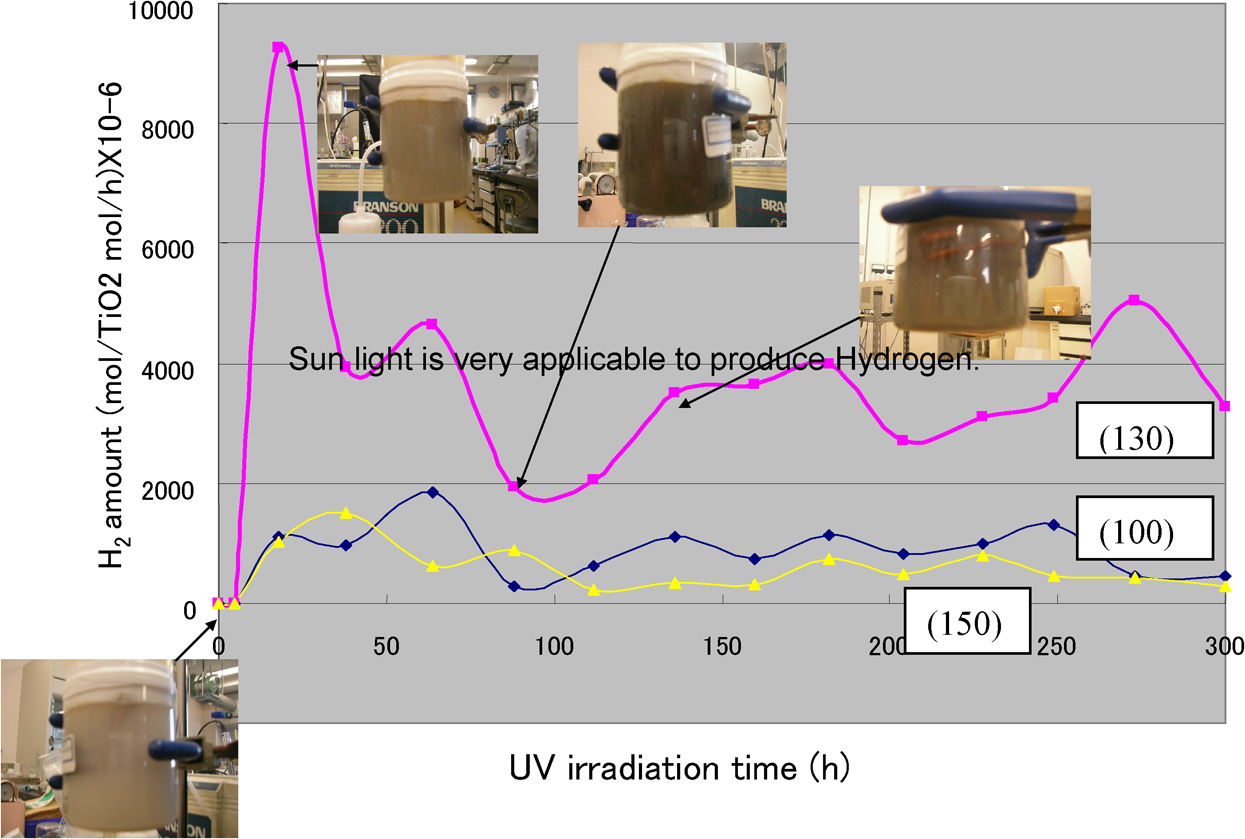
Amount of hydrogen produced during exposure to UV light at constant Pt concentration: lamp B was used in this experiment; samples were 0·003 mol Pt MCNT SBA-15 (100), (130) and (150)
Figure 5 also shows photographs of the TiO2 samples, which reveal that the colour of TiO2 changes during UV irradiation. At the beginning of the experiment, the TiO2 sample was brown in colour (see online version for colour detail). However, during the production of hydrogen, the surface of the Pt deposited titania became contaminated (probably by carbon or possibly by Pt), which caused the colour of the aqueous solution to turn black. After this colour change, the efficiency of hydrogen production decreased. After ∼100 h, the colour changed from black to light brown, and the efficiency of hydrogen production increased again. This result suggests that the titania surface cleans itself of carbon contamination. This explains why cycles alternating between high and low hydrogen production rates were observed.
Figure 6 shows the UV–DRS results. It indicates that standard P-25 powder absorbs light at wavelengths shorter than 400 nm, whereas it absorbs very little light at wavelengths of >400 nm. However, both MCNT SBA-15 and Pt MCNT SBA-15 absorb light below and above 400 nm. All the samples deposited with Pt exhibit a lower transmittance for light with wavelengths higher than 400 nm than samples without Pt. Therefore, the presence of Pt enhances the absorbance of light in this region.
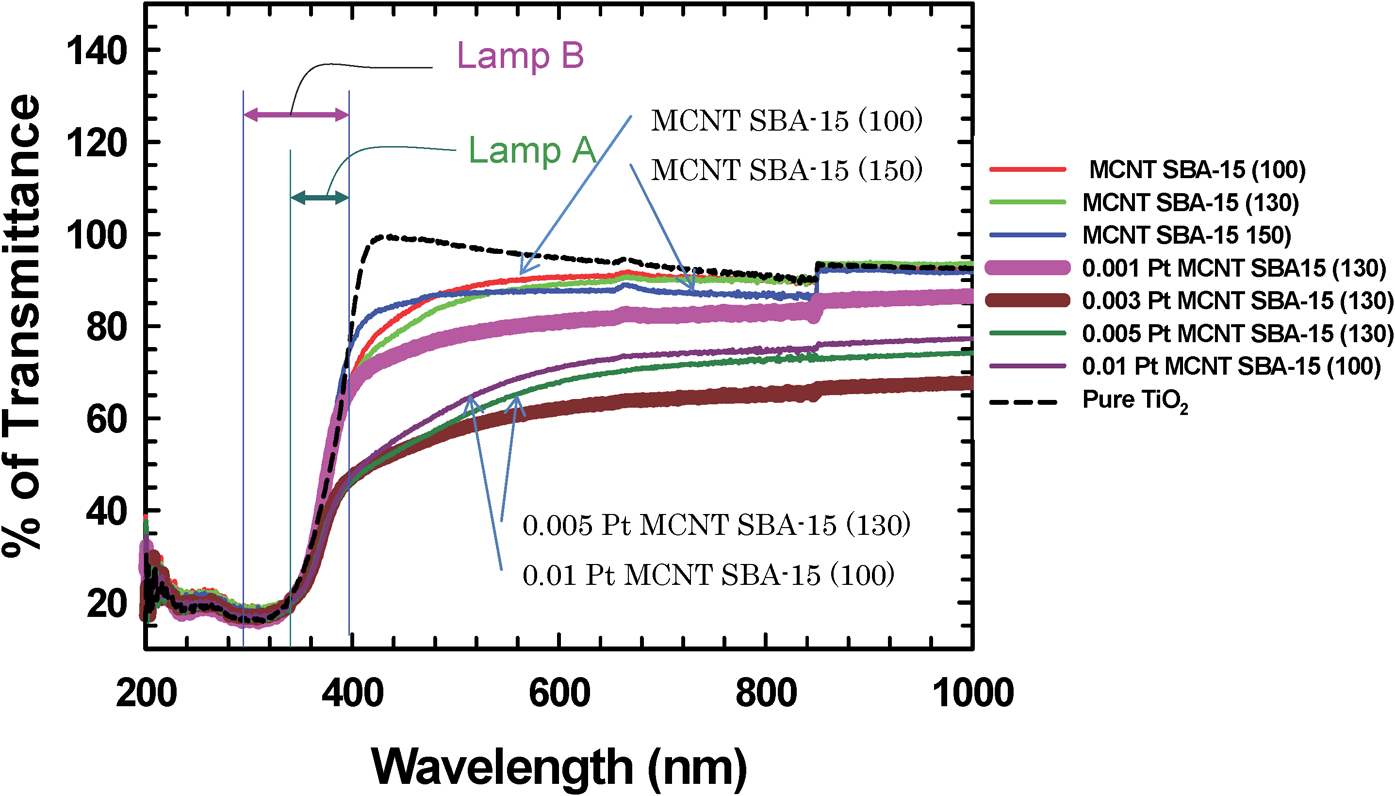
Results (UV–DRS) for samples fabricated in this study
Figure 6 also shows the wavelength ranges of lamps A and B. In these wavelength ranges, P-25 and MCNT have almost the same absorbance properties. About 30% of UV light at 370 nm was transmitted, whereas ∼25% of UV light at 350 nm was transmitted. In other words, TiO2 absorbed ∼70% of 370 nm UV light and ∼75% of 350 nm UV light. The difference in these absorbances is only 5%, and thus, it cannot account for the observed increase in hydrogen production of 60% [ = (4000×10–6–2500×10–6)/2500×10–6] between Figs. 4a and 5. Thus, UV light with a wavelength of 350 nm must have a higher hydrogen production efficiency than 370 nm UV light. In the future, we intend to study how MCNT SBA-15 reacts with visible light (i.e. light with wavelengths longer than 400 nm).
Conclusion
The hydrogen production capability of Pt deposited MCNT SBA-15 irradiated by UV light with two different wavelengths was studied. We draw the following conclusions.
Pt deposited MCNT SBA-15 can be used to produce hydrogen when it is irradiated by UV light.
The highest hydrogen production was obtained when 0·003 mol of Pt was deposited on the surface of MCNT SBA-15. This Pt concentration is the same as that for which P-25 has its highest hydrogen production. This is because the mesopore surface is not directly used for producing hydrogen in MCNT SBA-15 since Pt was deposited on only the external surface.
A sample irradiated by UV light with a maximum intensity at a wavelength of 350 nm produced 60% more hydrogen than the same sample irradiated by UV light with a maximum intensity at a wavelength of 370 nm. This shows that TiO2 exhibits a strong wavelength dependence even in the UV region.