







Abstract
Polycrystalline ceramic samples of magnesia doped GdSm1–xMgxZr2O7–x/2 have been prepared by conventional solid state reaction method using high purity oxides. The influence of magnesia dopant content on densification, microstructure and electrical properties of GdSm1–xMgxZr2O7–x/2 ceramics are investigated. Magnesia doping promotes the sintering densification behaviour of GdSm1–xMgxZr2O7–x/2 ceramics. GdSm1–xMgxZr2O7–x/2 (x = 0, 0·05, 0·10) ceramics have a single phase of the pyrochlore type structure, while GdSm1–xMgxZr2O7–x/2 (x = 0·15, 0·20) ceramics consist of the pyrochlore type structure and a small amount of magnesia as the second phase. The total conductivity of GdSm1–xMgxZr2O7–x/2 ceramics obeys the Arrhenius relation, and gradually increases with increasing temperature from 723 to 1173 K. GdSm1–xMgxZr2O7–x/2 ceramics are oxide-ion conductors in the oxygen partial pressure range of 1·0×10–4 to 1·0 atm at each test temperature. The maximum value of the total conductivity is 1·29×10–2 S cm–1 at 1173 K for the GdSm0·85Mg0·15Zr2O6·925 ceramic.
Introduction
Solid oxide fuel cells (SOFCs) have currently attracted significant attention due to their considerable potential applications for efficient power generation.1 The main advantages of SOFC technology are low emissions of pollutants and high conversion efficiency of chemical energy into electrical energy.2, 3 The core component of SOFCs is the dense solid oxide electrolytes with high oxide-ion conductivity, which are usually made of polycrystalline oxides. The current SOFC electrolyte of choice is 8 mol.-% yttria stabilised zirconia (YSZ), and anode is the Ni–YSZ cermet and cathode is strontium substituted lanthanum manganite (La1–xSrxMnO3) respectively.4–6 However, the high SOFC operating temperature results in unwanted chemical reactions, especially at the electrolyte/cathode interface. La2Zr2O7 and SrZrO3 resistive layers were reported to form at the electrolyte/cathode interface,7, 8 and lead to an increase in the total resistance, which greatly degraded the performance of SOFCs. As a result, substantial efforts have focused on reducing the SOFC operating temperature and developing solid oxide electrolytes with higher electrical conductivity than YSZ.9–12
Rare earth zirconates with a general formula Ln2Zr2O7 (Ln = lanthanide) have attracted great attention for a long time owing to various potential applications such as solid electrolytes, oxygen electrodes, catalysts, thermal barrier coating materials, and so on.13–16 The pyrochlore type Ln2Zr2O7 oxides show the well known ability of the structure to accommodate oxygen nonstoichiometry, and are good oxide-ionic conductors. Van Dijk et al.17 and Burggraaf et al.18 investigated the electrical properties of Ln2Zr2O7 (Ln = Nd, Sm, Gd) cermics, and found that activation energy for oxide-ion conductivity of pyrochlore type compositions is smaller than that of defect fluorite type compositions. Recently, new Ln2Zr2O7 type compounds are of considerable scientific interest due to variable cation radius ratios of r(Ln3+)/r(Zr4+) and oxygen nonstoichiometry.12, 19–21 The electrical conductivity of Ln2Zr2O7 type complex oxides can be improved by doping with some metallic cations. For (Sm1–xYbx)2Zr2O7 (0⩽x⩽1·0) ceramics, the electrical conductivity of pyrochlore type compositions is clearly higher than that of defect fluorite type compositions in the temperature range of 723–1173 K.19 Sm2Zr2O7 co-doped with 5 mol.-% Gd3+ and Yb3+ shows higher electrical conductivity than undoped Sm2Zr2O7 in the temperature range of 723–1173 K.20 GdSmZr2O7 ceramic exhibited the highest electrical conductivity in the (Gd1–xSmx)2Zr2O7 (0⩽x⩽1·0) systems in the temperature range of 623–873 K.21 In the present work, the pyrochlore type GdSmZr2O7 doped with magnesia, GdSm1–xMgxZr2O7–x/2 (x = 0, 0·05, 0·10, 0·15, 0·20), were firstly prepared by pressureless sintering method at 1973 K for 10 h in air, and the objective of this work is to investigate the influence of magnesia doping on structure and electrical conductivity of the pyrochlore type GdSmZr2O7.
Experimental
Complex oxides with nominal chemical formula of GdSm1–xMgxZr2O7–x/2 (x = 0, 0·05, 0·10, 0·15, 0·20) were prepared by the solid state reaction method using appropriate amounts of the relevant oxides, namely Gd2O3 (Rare-Chem Hi-Tech Co. Ltd, China; purity⩾99·99%), Sm2O3 (Rare-Chem Hi-Tech Co. Ltd, China; purity ⩾99·99%), MgO (Tianjin Hengxing Chemical Preparation Co. Ltd, China; Analytical pure), and ZrO2 (Dongguan SG Ceramics Technology Co. Ltd, China; purity ⩾99·9%). All oxide powders were calcined at 1173 K for 2 h in air prior to weighing. The powders were mixed for 24 h using zirconia balls and analytically pure alcohol. The resulting mixture was then dried and uniaxially pressed into pellets (∼13 mm in diameter and ∼3 mm in length). Subsequently, the pellets were further compacted by cold isostatic pressing with a pressure of 400 MPa for 5 min, and then sintered in air at 1973 K for 10 h.
Room temperature X-ray diffraction (XRD) studies were carried out for the sintered pellets in the Bragg angle (2θ) range of 10°⩽2θ⩽70° using Cu Kα radiation. X-ray diffraction data were collected on an X-ray diffractometer (Rigaku D/Max 2200VPC, Japan), and recorded in a continuous scan mode with a scanning rate of 5° min−1. Nine scans on the (622) peaks of pyrochlore structure were recorded in a step scan mode with a step width of 0·02° and a step time of 3 s. In order to evaluate the lattice parameters, silicon powder was used as the external standard. The bulk density of sintered pellets was measured by the usual volume and weight measurement technique. The microstructures of the sintered samples were examined using a scanning electron microscope (FEI Quanta 200F, the Netherlands), while the local compositions were particularly analysed with the equipped energy dispersive X-ray spectroscopy. For SEM observations, a thin carbon coating was evaporated on the surfaces of the samples.
The electrical properties were investigated via AC impedance method using an impedance/gain phase analyser (Solartron SI 1260, UK) at temperatures ranging from 723 to 1173 K in air. The applied frequency range was from 20 Hz to 2 MHz, and the signal amplitude was 20 mV under open circuit voltage conditions. The dimensions of the pellets for impedance measurements were about 8 mm in diameter and 1 mm in thickness. A platinum paste was sprayed on each side of the pellets and then baked at 1223 K in air for 2 h. Platinum wires were attached to the surface of the pellets for measurements. The impedance spectroscopy was also measured as a function of oxygen partial pressure to identify the conduction carrier. Various partial pressure conditions were established using pure N2–O2 gas mixture, and were monitored by an YSZ sensor. The data analysis was carried out with appropriate equivalent circuit by Zview 3·1c software.
Results and discussion
Figure 1 depicts the XRD patterns of the GdSm1–xMgxZr2O7–x/2 (x = 0, 0·05, 0·10, 0·15, 0·20) ceramics sintered at 1973 K for 10 h in air. GdSm1–xMgxZr2O7–x/2 (x = 0, 0·05, 0·10, 0·15) ceramics were identified as a single phase pyrochlore type structure, which is characterised by the presence of typical superlattice diffraction peaks at 2θ values of about 14° (111), 28° (311), 37° (331), 45° (511) and 51° (531) using Cu Kα radiation.19–21 However, a small MgO peak appears when the magnesia content is increased to 20 mol.-%. Figure 2a shows the evolution of the (622) peaks of GdSm1–xMgxZr2O7–x/2 ceramics. Clearly, the (622) peak slightly shifts towards the high angle direction with increasing magnesia content from x = 0 to x = 0·15, and no noticeable peak shift is observed when the magnesia content continues to increase to x = 0·20. The lattice parameters calculated from the (622) peaks of GdSm1–xMgxZr2O7–x/2 ceramics are displayed in Fig. 2b. Clearly, the lattice parameters exhibit an approximately linear decrease with increasing magnesia content from x = 0 to x = 0·10; however, GdSm1–xMgxZr2O7–x/2 (x = 0·15, 0·20) ceramics have almost the same lattice parameters. It indicates that the pyrochlore type GdSmZr2O7 has only a limited solubility of 10–15 mol.-%MgO to form solid solutions in this study. The MgO doped GdSmZr2O7 can be simply expressed using the defect equilibrium reaction as

 ,
,
 and 2OO represent a divalent Mg cation at a trivalent Gd or Sm cation site, an oxygen vacancy and two oxygen anions on regular oxygen anion sites in the crystal structure respectively.
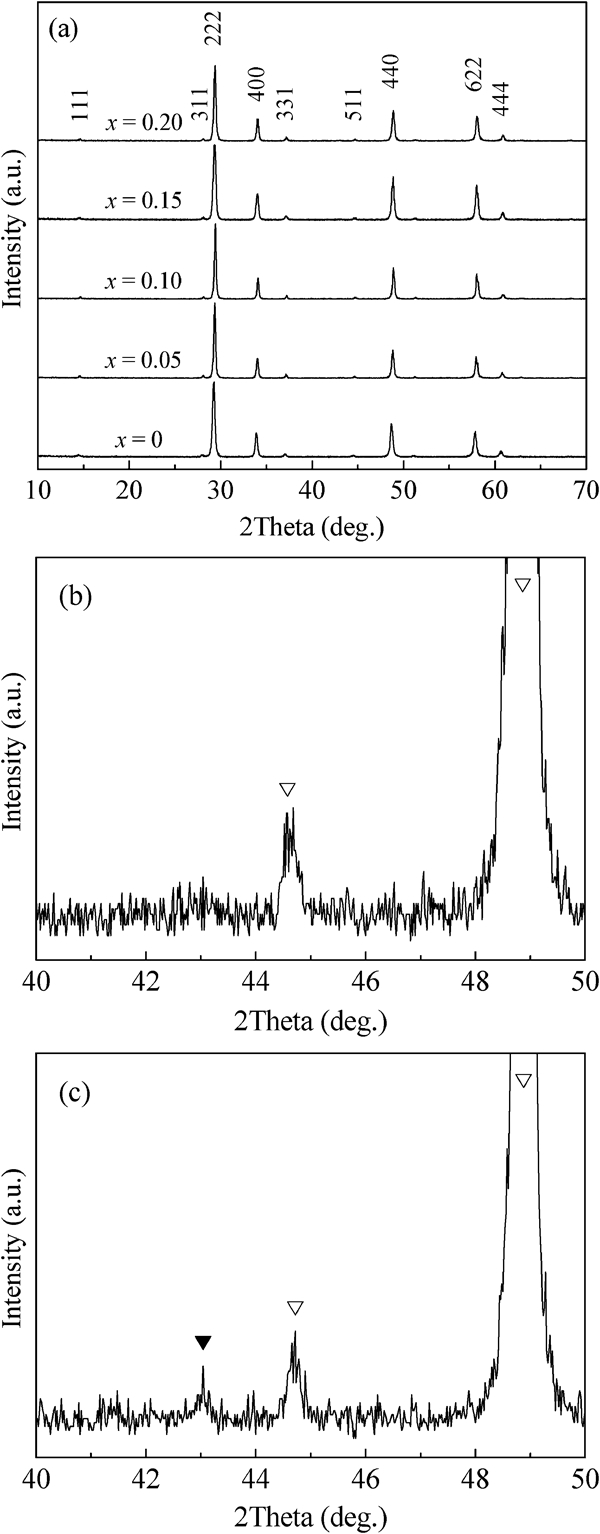
X-ray diffraction patterns of GdSm1–xMgxZr2O7–x/2 ceramics sintered at 1973 K for 10 h in air: a 2θ range of 10–70°, b, c 2θ range of 40–50° for x = 0·15 and 0·20 respectively (▾: MgO; ▽: pyrochlore)
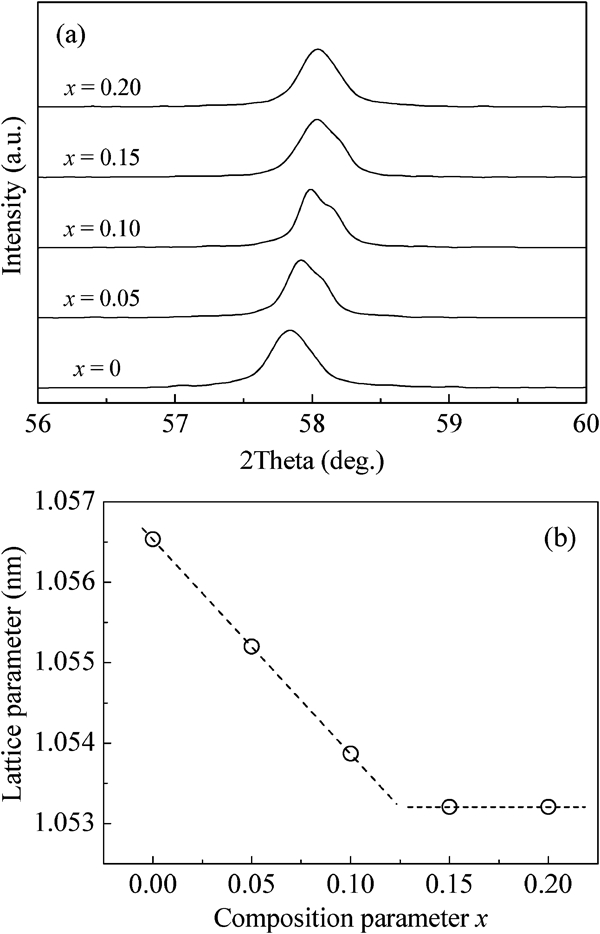
Nine scans XRD patterns and derived lattice parameters of GdSm1–xMgxZr2O7–x/2 ceramics sintered at 1973 K for 10 h in air: a change in (622) peak position, b lattice parameters derived from a
The relative densities of GdSm1–xMgxZr2O7–x/2 (x = 0, 0·10, 0·15) ceramics sintered at 1973 K for 10 h in air are 96·0, 98·7 and 98·0% respectively, and GdSm1–xMgxZr2O7–x/2 (x = 0·15, 0·20) ceramics have a higher relative density over 98·0%. The relative densities of magnesia doped samples are higher than that of GdSmZr2O7, which indicates that magnesia can promote the sintering densification behaviour. Figure 3 shows typical surface micrographs of as sintered GdSm1–xMgxZr2O7–x/2 samples. As can be seen, there are some fine pores in the GdSmZr2O7 sample owing to its lower relative density than MgO doped samples. The grains are nearly uniform for each sample, and the grain boundaries are very clean. From Fig. 3, the average grain size of the magnesia doped samples is obviously larger than that of undoped samples. From Fig. 3d–e), the dark second phase can be clearly observed as contrasted with the results in Fig. 3a–c, although XRD pattern of the GdSm0·85Mg0·15Zr2O6·925 sample does not identify the existence of the magnesia second phase. It indicates that the amount of the second phase in the GdSm0·85Mg0·15Zr2O6·925 sample is low and is not able to be identified by XRD. The EDS spectra obtained at different positions of A and B in Fig. 3e confirm the presence of the pyrochlore type phase (position A) and magnesia phase (position B), as shown in Fig. 3f–g, which is consistent with above XRD results.
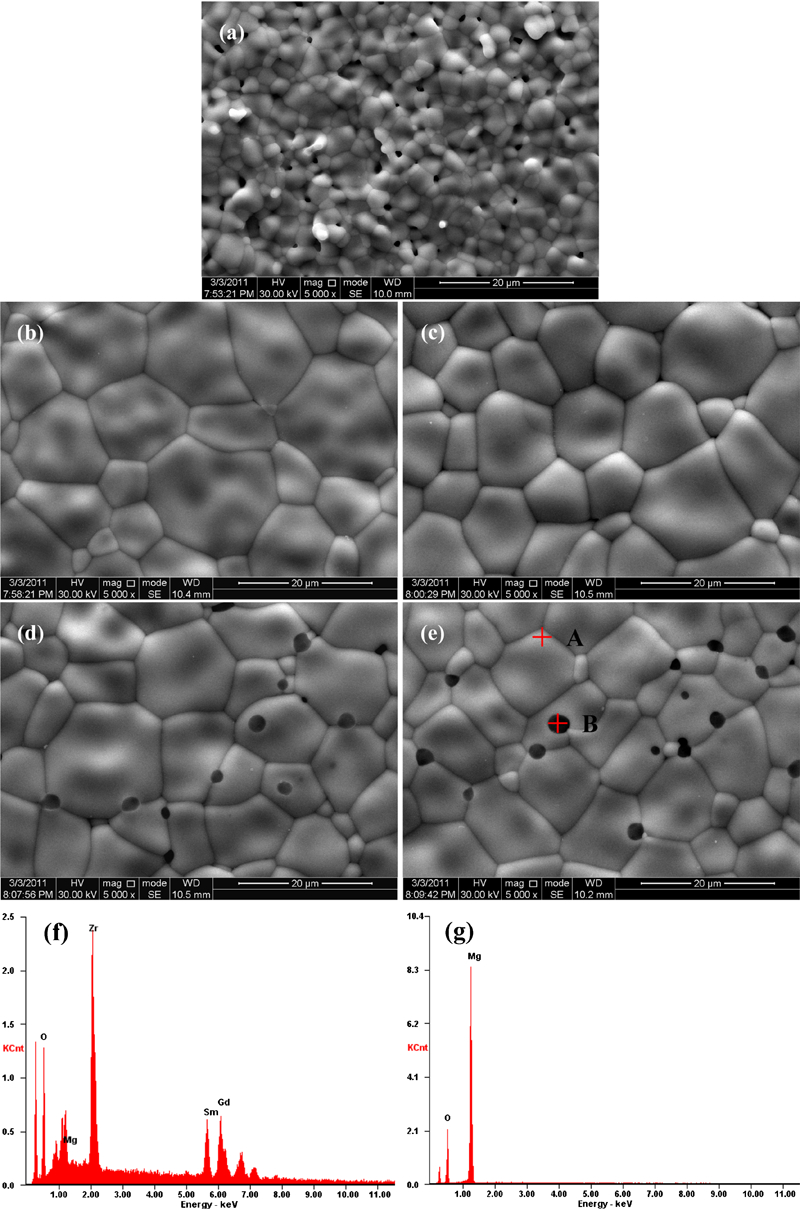
Microstructures of GdSm1–xMgxZr2O7–x/2 ceramics sintered at 1973 K for 10 h in air: a x = 0, b x = 0·05, c x = 0·10, d x = 0·15, e x = 0·20, f and g EDS spectra at locations of A and B in e respectively
Figure 4a–c shows typical complex impedance plots at 723 K in air for GdSm1–xMgxZr2O7–x/2 (x = 0, 0·10, 0·20) ceramics respectively. The impedance plots of GdSm1–xMgxZr2O7–x/2 ceramics is composed of three distinct contributions, and therefore the measured data were well simulated by the proposed circuit models,22, 23 as shown in Fig. 4d. The impedance plots were fitted with the equivalent electrical circuit models presented as dotted lines in Fig. 4a–c. It is convenient to obtain the grain resistance (RG) and capacitance (CPEG), and the grain boundary resistance (RGB) and capacitance (CPEGB) of GdSm1–xMgxZr2O7–x/2 ceramics. From fitted results, the capacitance for the three distinct ranges is determined to be in the order of pF, nF and μF respectively, which are typical capacitance values for the grain, grain boundary, and electrode contributions in the solid oxide electrolytes. It can be seen from Fig. 1c and Fig. 3e, the MgO second phase content is very few, and most of the MgO second phase exists in the grain boundary. Therefore, the MgO second does not give an additional feature in the Fig. 4c. The total resistance (RG+RGB) of GdSm1–xMgxZr2O7–x/2 ceramics is determined to better understand the influence of magnesia doping on the total conductivity of the GdSmZr2O7 ceramic. In practice, the total conductivity may be more relevant than the grain or grain boundary conductivity. The total conductivity of GdSm1–xMgxZr2O7–x/2 ceramics is calculated from the total resistance at the corresponding temperature and the geometrical dimensions of the measured samples.
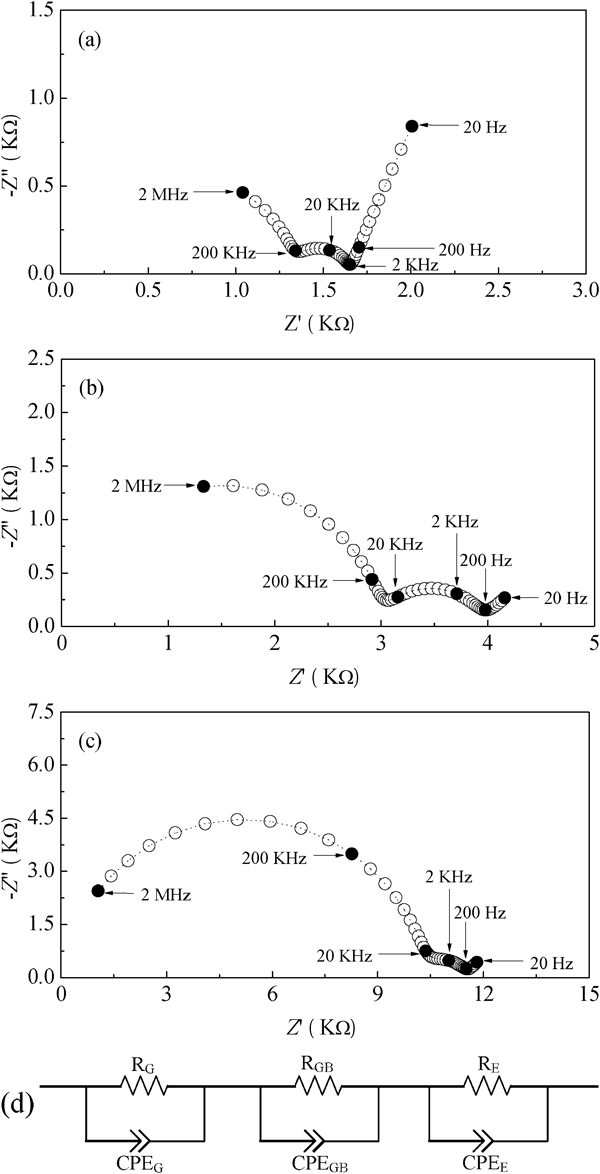
Complex impedance and schematic equivalent electrical circuit plots of GdSm1–xMgxZr2O7–x/2 ceramics at 723 K in air: a x = 0, b x = 0·10, c x = 0·20, d equivalent electrical circuit
As demonstrated in Fig. 5, the temperature dependence of the total conductivity of GdSm1–xMgxZr2O7–x/2 ceramics in the temperature range of 723–1173 K can be satisfactorily fitted by a conventional Arrhenius type law with the following expression

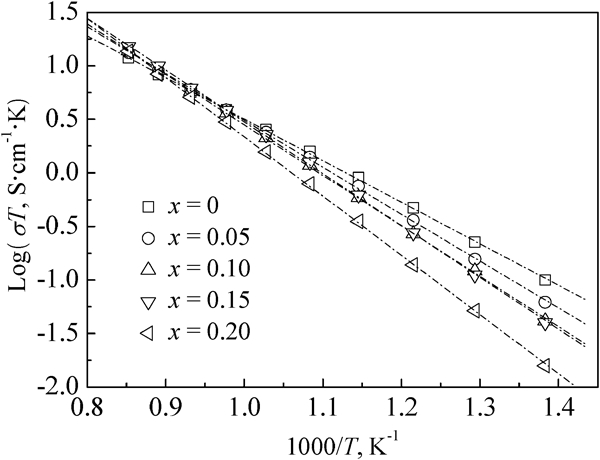
Arrhenius plots of total conductivity of GdSm1–xMgxZr2O7–x/2 ceramics
Activation energy and pre-exponential factor for total conductivity of GdSm1–xMgxZr2O7–x/2 ceramics

Figure 6 shows the total conductivity of GdSm1–xMgxZr2O7–x/2 ceramics as a function of magnesia content at different temperatures. At 723–1073 K, the total conductivity of GdSm1–xMgxZr2O7–x/2 ceramics slightly decreases with increasing magnesia content at identical temperature levels. At temperatures of 1123 and 1173 K, the total conductivity of GdSm1–xMgxZr2O7–x/2 ceramics slightly increases with increasing the magnesia content from x = 0 to x = 0·15, and slightly decreases with further increasing the magnesia content from x = 0·15 to x = 0·20. The highest total conductivity is about 1·29×10–2 S cm–1 at 1173 K for the GdSm0·85Mg0·15Zr2O6·925 ceramic, which is higher than that of the GdSmZr2O7 ceramic (1·01×10–2 S cm–1 at 1173 K). The increase in the activation energy would hinder the oxide ion migration; however, the increase in the pre-exponential factor would lead to an increase in the total conductivity. Thus, these two processes are competing. With an increase in x, both the activation energy and pre-exponential factor increase, as shown in Table 1. From Fig. 6, the total conductivity of GdSm1–xMgxZr2O7–x/2 ceramics gradually decreases with an increase in x. This indicates that the increase pre-exponential factor is not able to compensate for the increase in the activation energy, and finally causes the decrease in the total conductivity.
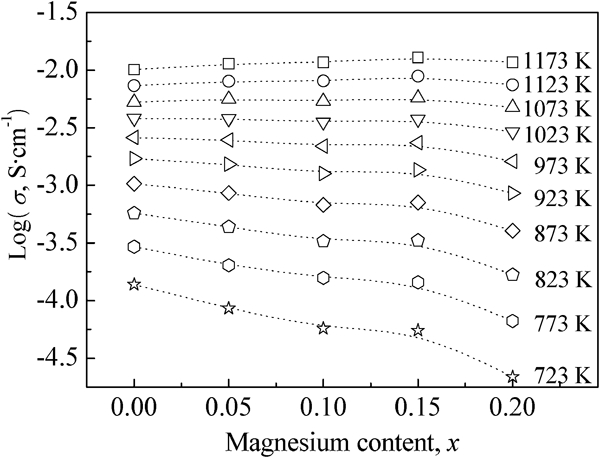
Compositional dependence of total conductivity of GdSm1–xMgxZr2O7–x/2 ceramics
In order to clarify the conduction carrier of GdSm1–xMgxZr2O7–x/2 ceramics, the oxygen partial pressure p(O2) dependence of the total conductivity was measured, as shown in Fig. 7. Clearly, the total conductivity of the GdSm0·85Mg0·15Zr2O6·925 ceramic is almost independent of oxygen partial pressure from 1·0×10–4 to 1·0 atm at each test temperature, which indicates that the conduction is purely ionic with negligible electronic conduction.24 As shown in the defect equilibrium reaction (1), the doping of MgO in the GdSmZr2O7 leads to generate oxygen vacancies to balance the charge missing. Because the conduction is dominated by oxygen ions in this material, the conductivity should increase with MgO doping. However, in fact the total conductivity did not increase with MgO doping, as shown in Fig. 6. The total conductivity of the material is usually affected by many other factors, such as grain distribution, grain size, porosity and so on. The total conductivity of GdSm1–xMgxZr2O7–x/2 ceramics is slightly lower than that of conventional solid oxide electrolytes such as YSZ, samarium or gadolinium doped ceria (CSO or CGO) and strontium, magnesium doped lanthanum gallate (LSGM),25 and therefore the most likely applications of GdSm1–xMgxZr2O7–x/2 ceramics in SOFCs are high temperature solid oxide electrolytes, or thick film electrolytes, or as protective layers applied onto CeO2 or LaGaO3 based solid oxide electrolytes.26
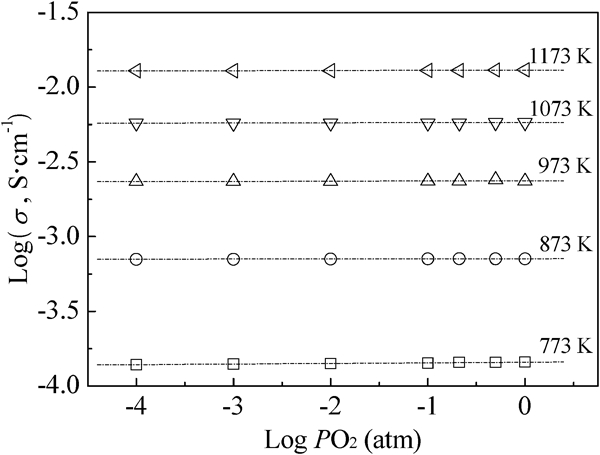
Oxygen partial pressure dependence of total conductivity of GdSm0·85Mg0·15Zr2O6·925 ceramic
Conclusion
GdSm1–xMgxZr2O7–x/2 (x = 0, 0·05, 0·10) ceramics exhibit a single phase of the pyrochlore type structure, while GdSm1–xMgxZr2O7–x/2 (x = 0·15, 0·20) ceramics are composed of the pyrochlore type structure and a small amount of magnesia as the second phase. Magnesia doping promotes the sintering densification behaviour of GdSm1–xMgxZr2O7–x/2 ceramics. The total conductivity of GdSm1–xMgxZr2O7–x/2 ceramics obeys the Arrhenius relation, and gradually increases with increasing temperature from 723 to 1173 K. GdSm1–xMgxZr2O7–x/2 ceramics are oxide-ion conductors in the oxygen partial pressure range of 1·0×10–4 to 1·0 atm at each test temperature. The highest total conductivity is about 1·29×10–2 S cm–1 at 1173 K for the GdSm0·85Mg0·15Zr2O6·925 ceramic.
Footnotes
Acknowledgements
This work was financially supported by the National Natural Science Foundation of China (NSFC, Grant Nos. 50972030 and 51021002), and the Fundamental Research Funds for the Central Universities (Grant Nos. HIT.BRET1·2010006 and HIT.NSRIF.201132), and the China Postdoctoral Science Foundation funded project (CPSF-Nos. 20100471029 and 201104419).