







Abstract
Polypropylene based ferroelectret films exhibit a strong electromechanical activity and provide a promising solution for the air coupled ultrasonic (ACUS) transducers. Ultrasonic transmission between two air coupled ferroelectret transducers in dependence on the amplitude and polarity of the high voltage exciting pulse revealed a strongly non-linear electromechanical response of the ferroelectret transmitter which provides an increase in the transmitter efficiency. The authors present a simple model describing both promotion and competition of the piezoelectric and electrostriction contributions, as well as increase in the transducer constant under high voltage excitation. Enlargement of the inverse transducer constant of the polypropylene ferroelectret film by a factor of 4 was demonstrated. The non-linear properties of the polypropylene ferroelectrets result in a strong increase in their ACUS figure of merit under the high voltage excitation, which exceeds the results of their technological optimisation. Consequently, enhancement of the ACUS system transmission by 12 dB and signal to noise ratio by 32 dB was achieved.
Keywords
Introduction
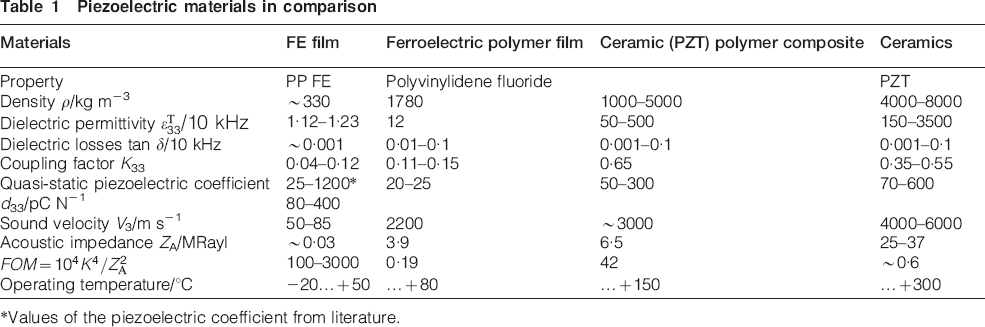
Air coupled ultrasonic (ACUS) transducers are welcome in a broad range of applications in industry, medicine, non-destructive testing, etc. The main challenge of all ACUS techniques is the enormous acoustic impedance ZA mismatch between air and transducers, which is responsible for the high attenuation of the information carrying signal between transmitter and receiver. One of the ways to overcome the problem is the use of piezoelectrics with low ZA. Recently developed ferroelectrets (FEs), which are charged polymer foams,1–3 possess the lowest known acoustic impedance among piezoelectric materials. Although several polymers were proposed,4,5 FEs based on the internally charged cellular polypropylene (PP) films are the mainly used ones. Their piezoelectric activity originates from macroscopic dipoles formed by the charges located at walls of the lens-like voids1,2 and provides, in combination with low density and extreme softness, a promising solution for the ACUS transducers.6–8 Polypropylene FEs have 2–3 order of magnitude lower ZA than ceramic, polymer and ceramic polymer composite piezoelectric materials (Table 1). Consequently, replacement of a ceramic piezoelement by the FE one allows reducing the attenuation of sound energy at transducer/air interface by ∼50 dB.
Piezoelectric materials in comparison
*Values of the piezoelectric coefficient from literature.
Ferroelectrets differ essentially from the ceramic based piezoelectrics not only due to their density but also softness. They are nearly ideal dielectrics with a very low permittivity (∼1·1), low losses1,5 and high breakdown voltage.3,6,7 Unusually for electrets but similar to ferroelectrics, they can be repolarised by electric field demonstrating ferroelectric and piezoelectric hysteresis loops.1 Ferroelectrets are anisotropic materials: they are extremely soft (Young's modulus9 Y∼1·5 MPa) and elastic only along the direction of remanent polarisation, i.e. perpendicular to the film surface. Therefore, only the longitudinal piezoelectric coefficient d33 is large, comparable with that of piezoceramics1,2 and can be practically used.
Two parameters characterise efficiency of piezoelectric materials for ACUS applications: coupling factor K33, which defines an efficiency of the energy transformation by the ultrasonic transducers, and acoustic impedance ZA, which defines the transmission energy attenuation due to the impedance mismatch between the transducers and air. Consequently, ACUS figure of merit was derived6,7

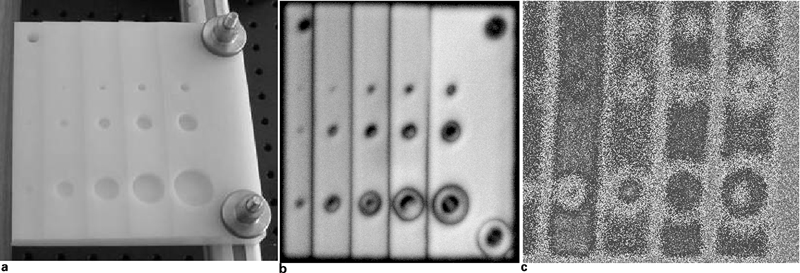
Non-contact ultrasonic imaging with PP FE transducers7:
Essential improvement of the important parameters of PP FEs such as piezoelectric coefficient, coupling factor and FOM was achieved by optimisation of the film mesostructure and softness using the inflation process.9,10 The optimisation results in the increase in d33 and K33 by a factor of 2, while ZA does not change essentially. The FOM increase by more than order of its magnitude is demonstrated (Fig. 2). Furthermore, FE PP transducers were better adjusted to the ultrasonic system. Integration of a preamplifier with high electric impedance matching increases sensitivity of the receiver by ∼40 dB.10 As a way of further progress, the authors propose to use non-linear electromechanical properties of the PP FE transmitter.
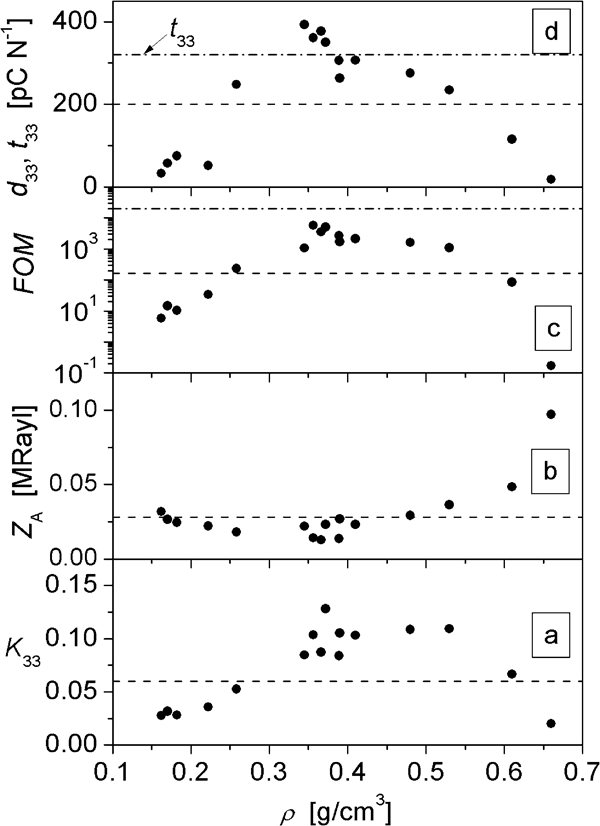
Optimisation of PP FE properties by inflation process:9,10 a coupling coefficient K33, b acoustic impedance ZA, c figure of merit FOM and d piezoelectric coefficient d33 of differently inflated PP FE films versus their density; symbols correspond to experimental points; dash lines denote reference values of standard not optimised PP FE film; for comparison, dash–dot lines denote values achieved by high voltage excitation of PP1 film with rather low sensitivity (see the section ‘Non-linear electromechanical response of FE transmitter’)
Non-linear electromechanical response of FE transmitter
Non-linear behaviour is a natural feature of a soft and sensitive material. One can suppose a considerable non-linear contribution to the electromechanical properties of FEs, more pronounced than in hard ceramic or composite piezoelectrics. Low dielectric losses1,5 and high breakdown voltage3,6,7 of PP FEs enable application of a high electric field to increase the expected non-linear contribution.
Indeed, ultrasonic transmission between two air coupled PP FE transducers in dependence on the amplitude of the high voltage exciting pulse V1 revealed a strongly non-linear electromechanical response of the FE transmitter.11 The same experimental set-up is used for extended investigations. Short rectangular electric pulses of both polarities with amplitude V1 from −3500 V to +3500 V and a length of 1 μs were applied to the FE transmitter with a rate of 15 pulses per second. The acoustic decaying sine burst generated at the thickness resonance frequency of the FE film propagates through 15 cm air path to the FE receiver where it is further transformed into the electric decaying sine burst with a peak to peak amplitude V2. The pulse amplitude V1 is considered as positive if the applied voltage polarity is the same as that of remanent polarisation Pr and as negative if the applied voltage polarity is opposite to that of Pr. Several kinds of the commercially available EMFIT PP FE films12 were used as an active part of FE transducer, including the less sensitive PP1 (nominal d33∼70–80 pC N−1) and more sensitive PP3 and PP4 (d33∼200 pC N−1). Polypropylene films of the same type were used in the transmitter–receiver pair.
Transmission characteristics V2(V1) of all studied transducers are significantly non-linear and asymmetric regarding polarity of the exciting pulse (Fig. 3). The second zero transmission point at positive exciting voltage (V1∼+1200 V for PP3 and PP4 transducers) evidences a compensation of the contributions of competing mechanisms. The authors describe these transmission characteristics by promotion and competition of the piezoelectric and electrostriction contributions following the simple model used in Ref. 11. Thickness change of the transmitter FE film Δh1 due to application of the exciting voltage V1 consists of the piezoelectric Δh1d and electrostriction Δh1α contributions (see Fig. 4a)

 is an inverse electromechanical transducer constant of the transmitter, d33 and α33 are piezoelectric coefficient and electrostriction constant respectively. Then
 is dependent on the exciting voltage

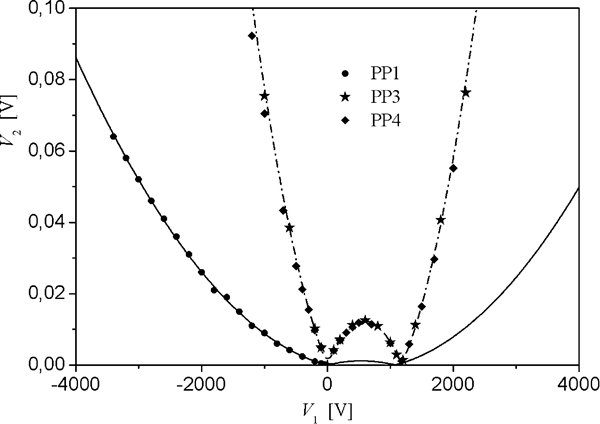
Transmission characteristics V2(V1) of PP1, PP3 and PP4 FE transducers: symbols denote experimental points; lines correspond to fits to equation (5) accounting for piezoelectric and electrostriction contributions
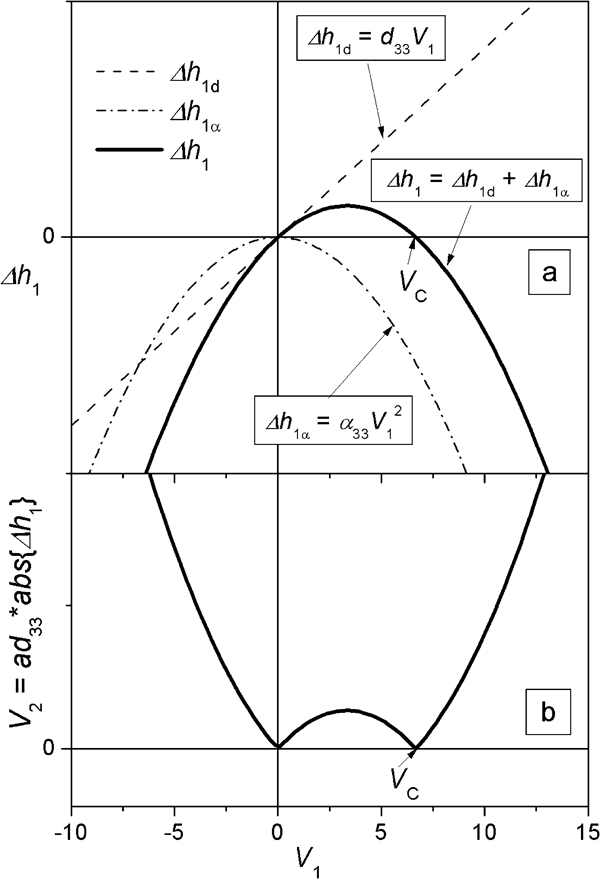
Schematic presentation of piezoelectric and electrostriction contributions to electromechanical response of FE transducer:
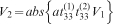
The V2(V1) relation can be written as following11
 and
and
 are inverse and direct electromechanical transducer constants of the transmitter and receiver, a>0 is a parameter accounting for the signal attenuation due to the acoustic impedance mismatch at transducer/air interfaces, absorption in the air path, experiment imperfections (relative transducer orientation, etc.) and difference in the V1 and V2 definition (rectangular pulse amplitude and peak to peak burst amplitude respectively). In the first approach a is considered to be independent on V1. The absolute value in equation (4) reflects the definition of V2 as a peak to peak burst amplitude. The phase of the received signal is not taken into account and the V2 value is always positive, independent on the sign of Δh1 and
 . The FE receiver works in a linear (low strain/low field) regime, at least for sound pressure below 3000 Pa.11,13 Therefore,
 , accounting that coefficients of the inverse and direct piezoelectric effect are equal14,15 for identical PP FE films of transmitting and receiving transducers. Then equation (4) can be rewritten as
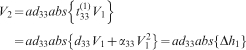
The piezoelectric contribution dominates only at a low exciting voltage; the electrostriction contribution should be taken into account at abs{V1}>100 V (Fig. 5a). In this case an amplitude transmission coefficient is defined by the voltage dependent inverse transducer constant (3)

 and
and
 . Then the normalised amplitude transmission coefficient TV(V1)/TV(0) is equal to the absolute value of the normalised inverse transducer constant

 .
.
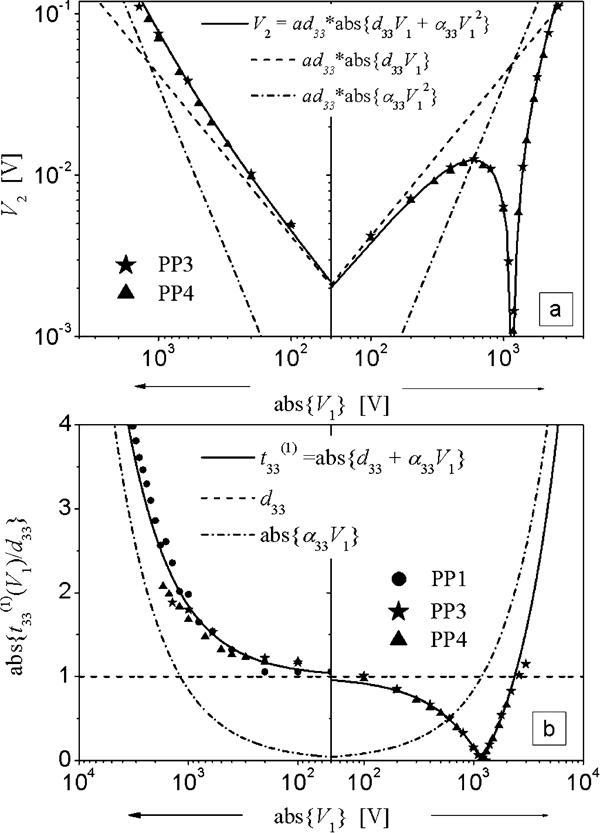
Piezoelectric (dash line) and electrostriction (dash–dot line) contributions to electromechanical response of PP1, PP3 and PP4 FE transducers: symbols denote experimental points; solid lines correspond to fits to equations (5) and (7):
The electrostriction contribution to t33 in PP FEs can be attributed to the electrostatic force between electrodes14 and Maxwell stress effect.16 Both mechanisms are particularly important in soft dielectrics with a low Young's modulus of elasticity and can provide essential contributions. Similarity of the dc bias effect3 and high voltage excitation11 supports attribution of the electrostriction effect to the electrostatic force between two electrodes, while the relation between electrostriction and piezoelectric coefficients11 supports presence of the Maxwell stress contribution in the electrostrictive response. In the case of PP FEs, the electrostriction constant α33 describes probably contributions of both mechanisms mentioned above.
Discussion
Increase in the input signal amplitude V1 in ∼10 times (from the standard 300 to ∼3000 V) results in the tenfold (20 dB) increase in the output signal amplitude V2 in the case of linear electromechanical response (t33 = d33). Electrostriction enhances piezoelectric effect (in the case of negative pulse amplitude) and provides significant enlargement of the transducer constant, e.g. by a factor of 4 comparatively to d33 for the PP1 transducer (Fig. 5b). It corresponds to increase in the transmission coefficient TV by a factor of 4 (in 12 dB). Added together, the output signal and the signal to noise ratio of the PP–FE based ACUS system can be increased by a factor of 40 (by 32 dB). Let us note that high voltage excitation of the FE film with a rather low sensitivity (such as PP1) enlarges its transducer constant to the d33 level of the best high sensitive films (Fig. 2d). Therefore, the use of high voltage exciting pulses with negative amplitude is strongly recommended for effective application of PP FE transmitters.
The non-linear electromechanical properties of the PP FE result in a strong increase in its ACUS figure of merit under the high voltage excitation11 which exceeds results of the PP FE technological optimisation (Fig. 2c). The FOM enlargement can be related to the increase in coupling factor and to the decrease in acoustic impedance. Acoustic impedance is defined by the FE film density ρ and sound velocity v (Ref. 15)

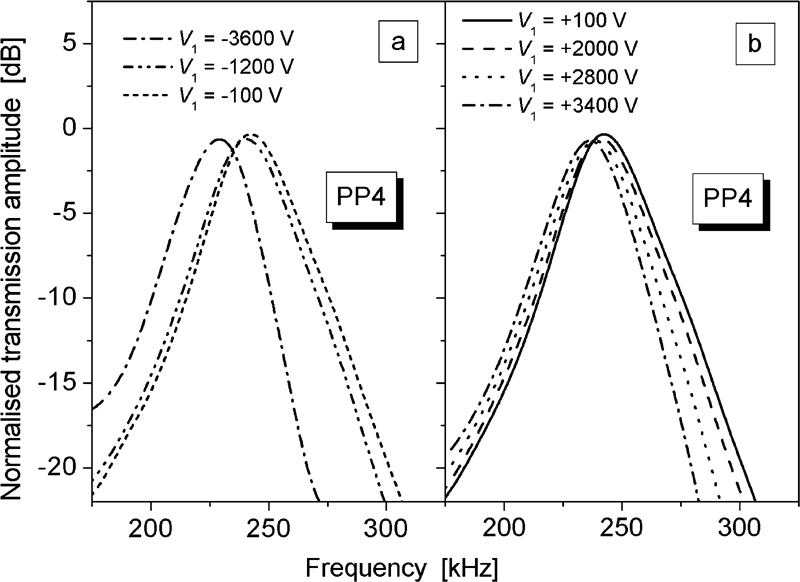
Frequency dependences of normalised transmission amplitude of PP4 transducers near their thickness resonance frequency at a negative and b positive excitation voltage V1 obtained by Fourier transformation of transmitted burst
The FOM enlargement describes improvement of transmitter parameters only, while the receiver parameters remain unchanged by the high voltage excitation. Therefore, a real benefit of the ACUS system from the non-linear electromechanical response of the FE transmitter should be described correctly by the square root of its normalised FOM enlargement11

Summarising, non-linear properties of PP FEs are very useful for their applications utilising an inverse piezoelectric effect. The high voltage excitation provides a significant (in a few times) enhancement of the FE actuator and transmitter efficiency. We recommend using the non-contact FE PP transmitters with a high voltage excitation in non-destructive testing and other ACUS applications. Enhanced efficiency of the FE transducers without matching layers allows realisation of their advantage of broad band response. This exactly meets the requirements of the pulse echo technique. The electromechanical non-linearity of PP FE transducers can additionally expand their bandwidth. These and other aspects the FE non-linear response will be the subject of our further study.
Conclusion
A strongly non-linear electromechanical response of the PP FEs was revealed and described by promotion and competition of the piezoelectric and electrostriction contributions. The non-linear electromechanical properties are proposed to be used for efficiency increase in the FE transmitter. Enlargement of the inverse transducer constant of the PP FE film by a factor of 4 was demonstrated. The non-linear EM properties of the PP FEs result in a strong increase in their ACUS figure of merit under the high voltage excitation which exceeds results of the technological optimisation. Consequently, enhancement of the ACUS system transmission in 12 dB and signal to noise ratio in 32 dB was achieved. The non-contact FE PP transmitters with a high voltage excitation are recommended for non-destructive testing and other ACUS applications.
Footnotes
Acknowledgements
The authors are grateful to Mr C. Lappöhn (BAM, Berlin) for his technical assistance and to Dr M. Wegener (Fraunhofer Inst. for Applied Polymer Research, Potsdam, Germany) for providing the PP FE films with optimised mesostructure and softness. This work was supported by the Czech Science Foundation (project no. P204/10/0616), by the Academy of Sciences of the Czech Republic (project no. AVOZ10100520) and by the MNPQ-Program of the German Federal Ministry of Economics and Technology.
This paper is part of a special issue on Piezoelectric Materials for End Users