







Abstract
Bi5−xNax/2Cex/2Ti3FeO15 (BNTF-100x, x = 0, 0·05, 0·10, 0·20, 0·30, 0·40 and 0·60) ceramics were prepared via solid state sintering process. With x increasing, the resistivity increases at first and then decreases. The lower the concentration of oxygen vacancies, caused by more (Na,Ce) dopant adding, the less the deep trap energies in the band gap for the activated electrons to be mobile. For the samples containing high concentration of oxygen vacancies, the conductivities are higher when they are annealed in the air and oxygen than that in the vacuum. On the contrary, for the samples containing low concentration of oxygen vacancies, the conductivities of the samples in different annealing conditions behave quite the same way. Most (Na,Ce) doped Bi5Ti3FeO15 ceramics exhibit intrinsic conduction at high temperatures with corresponding activation energies of 1·1–1·6 eV, while the extrinsic conduction has a close relationship with the concentration of oxygen vacancies and the activation ability of electrons.
Introduction
The bismuth layer-structured ferroelectrics (BLSFs), first discovered by Autivillius,1 are good potential candidates for non-volatile ferroelectric random access memory2, 3 and high temperature piezoelectric devices4 because they have high fatigue resistance and relatively high Curie temperature Tc respectively. The general formula of BLSFs is (Bi2O2)2+(Am−1BmO3m−1)2−, in which A is a mono-, di- or trivalent element (or a combination of them) suited to dodecahedral coordination; B is a transition element with octahedral coordination, e.g. Fe3+, Ti4+, Nb5+, Ta5+, Mo6+ or W6+; and m is the integer, ordinarily varying from 1 to 5, indexing the number of the oxygen octahedral layers between every other neighbouring (Bi2O2)2+ layers.5, 6 The two vital problems of the application of BLSFs are their relatively low resistivity7, 8 and their limited piezoelectric activity.9 These problems can be improved by many methods, such as doping10, 11 or special processing technology.12, 13 The conduction mechanisms of BLSFs have been investigated by many researchers, but none have been widely accepted. Generally, the conduction of BLSFs can be divided into two parts: intrinsic conduction corresponding to the high temperature range and extrinsic conduction at low temperatures.
The effect of annealing atmospheres on the electrical properties of BLSFs has been extensively investigated.14–17 However, the roles of different annealing atmospheres in the conduction process of BLSFs are still uncertain. For example, the leakage current of oxygen annealed Bi4Ti3O12 single crystal showed higher values than that of an air annealed one at room temperature, as electron holes arising from the incorporation of oxygen molecules at oxygen vacancies acted as detrimental factors for resistivity.15 A similar phenomenon was reported on SrBi4Ti4O15 thin films.16 Nevertheless, for the W6+ doped Bi3TiNbO9 ceramics, the roles of the two annealing atmospheres seemed to be opposite. The conductivity of the oxygen annealed Bi3TiNbO9 samples was lower than that of the as sintered ones.17
Bi5Ti3FeO15 (BTF) ceramic is one of the BSLFs with Fe ion on the B site. Ordinarily, materials containing Fe ions have the problem of high leakage current due to the existence of Fe2+ and oxygen deficiency,18, 19 especially in the BiFeO3 material. According to Scott et al.,20 oxygen vacancies had some relationship with the origin of space charges in some ferroelectrics. Qi et al.21 found that oxygen vacancies created deep trap energy in the band gap for the activated electrons to be mobile. Through the investigations on the Ti4+ and Ni2+ replacing of Fe3+, Qi et al.21 confirmed that oxygen vacancies rather than Fe2+ were the main reason of the high conductivity of the BiFeO3 film.
In order to study the effect of Fe ions and oxygen vacancies on the conduction process in Fe contained BLSFs, the conductivities of (Na,Ce) doped BTF ceramics after different annealing processes were investigated. So far, there have been few detailed reports on the conduction of Fe contained BLSFs.
Experimental
Bi5−xNax/2Cex/2Ti3FeO15 (BNTF-100x, x = 0, 0·05, 0·10, 0·20, 0·30, 0·40 and 0·60, hereinafter called BTF, BNTF-5, BNTF-10, BNTF-20, BNTF-30, BNTF-40 and BNTF-60 respectively) ceramics were prepared via conventional solid state reaction sintering. Bi2O3 (99·99%), TiO2 (99·38%), Fe2O3 (99·00%), Na2CO3 (99·80%) and CeO2 (99·99%) were weighted with the stoichiometric compositions and mixed by ball milling in ethanol for 8 h. The slurry was dried and calcined at 850°C for 2 h. The calcined powders were pressed into discs using a blinder, which was removed at 700°C for 1 h, and then they were embedded in the same component powders in a sealed Al2O3 crucible and sintered at 1060–1120°C for 2 h. The sintered samples were processed into 0·4 mm thickness and 8 mm diameter. To measure the electrical properties, electrodes were fabricated with a fired on silver paste. The BTF, BNTF-10, BNTF-20 and BNTF-40 samples were finally put into three different post-sintering annealing conditions: (1) sintered in air and cooled with the furnace, denoted as as sintered; (2) annealed in static oxygen at 700°C for 24 h (∼0·1 MPa) after sintering, denoted as oxygen annealed; and (3) annealed in vacuum at 700°C for 24 h (∼102 Pa) after sintering, denoted as vacuum annealed.
The dc resistance was measured over the temperature range from 150 to 550°C at a heating rate of 5°C min−1 and a stabilising time of 30 min at a measuring temperature. An applying voltage of 50 V and a holding time of 1 min are adapted to measure the resistances of the order of 1014–106 Ω using a high resistance meter (HP4329A; Hewlett-Packard, Palo Alto, CA, USA). A precision digital multimeter (Fluke 17B, Shanghai, China) was used to measure the relatively low resistances in the range between 106 and 10 Ω.
Results and discussion
According to our earlier work,22 pure BNTF ceramics can be obtained, and their relative densities are all >94%. Most grains have a plate-like shape with a diameter of 2–5 μm and a thickness of 1–2 μm for BTF, BNTF-10 and BNTF-20 samples, and a diameter of 5–10 μm and a thickness of 1–2 μm for BNTF-40 and BNTF-60 samples.
Figure 1 gives the dependence of room temperature resistivity on the dopant content x in BNTF ceramics (x = 0, 0·05, 0·10, 0·20, 0·30, 0·40 and 0·60). With the dopant increasing, the resistivity of BNTF increases at first and then decreases. In other words, with the increase in grain size, and especially with the increase in diameter/thickness ration, the resistivity of BNTF ceramics substantially decreases. When x = 0·10, the resistivity reaches the highest value, ∼1×10¹³ Ω cm, which is about two orders higher than that of BTF.
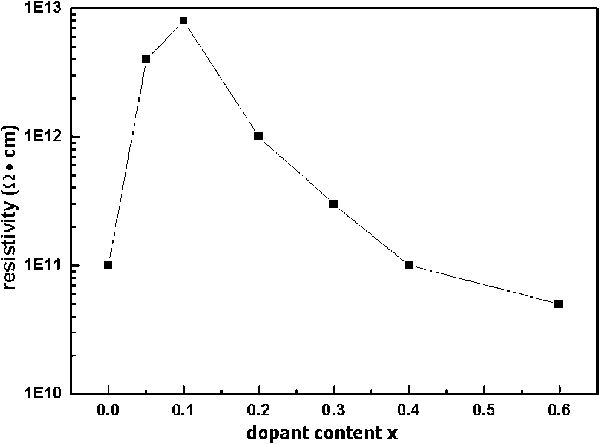
Dependence of room temperature resistivity on the (Na,Ce) dopant content x in BNTF-100x ceramics (x = 0, 0·05, 0·10, 0·20, 0·30, 0·40 and 0·60)
Figure 2 shows the logarithms of the dc conductivities of BNTF-100x (x = 0, 0·10, 0·20 and 0·40) versus the reciprocal temperature and the linear fittings of BTF ceramics according to Arrhenius relationship. The conductivity of BTF is higher than that of the doped samples in the temperature range of 150–550°C, demonstrating that proper (Na,Ce) doping improves the resistivity of BTF. Two different lines of each sample can be obtained in Fig. 2, like the two fitting lines of BTF.
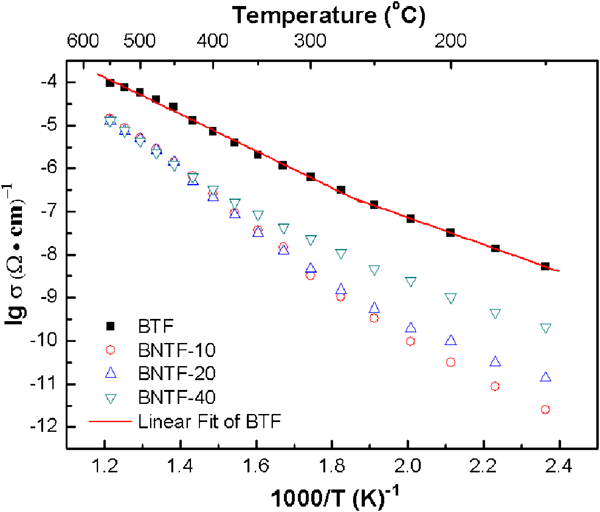
Logarithms of dc conductivities of BNTF-100x (x = 0, 0·10, 0·20 and 0·40) versus reciprocal temperature and linear fittings of BTF ceramics according to Arrhenius relationship
Figure 3 gives logarithms of the dc conductivities versus reciprocal temperature for BNTF-100x (x = 0, 0·10, 0·20 and 0·40) after different annealing processes. The conductivities of as sintered and oxygen annealed BNTF ceramics are quite the same, indicating that the conduction mechanisms of the two cases are similar. However, the conductivities of the vacuum annealed samples are lower. With (Na,Ce) dopant increasing, the conductivity differences between vacuum annealed samples and other samples become less obvious.
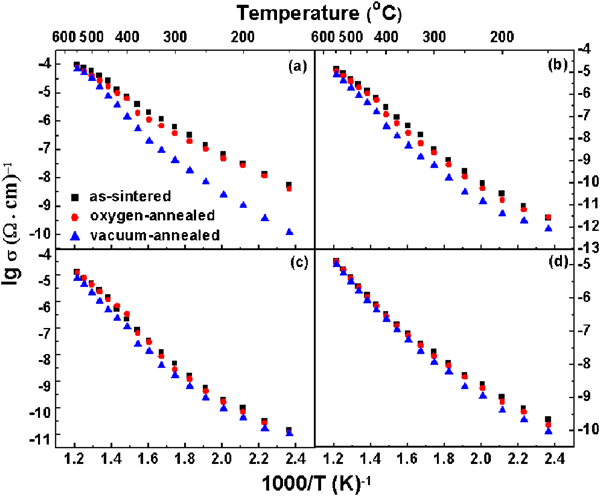
Logarithms of dc conductivities versus reciprocal temperature for a BTF, b BNTF-10, c BNTF-20 and d BNTF-40 after different annealing processes
From the ionisation energy point of view, the change of valence state of the Fe ions is much easier than that of the Ce ions. (The energy differences of Fe3+ to Fe2+ and of Ce4+ to Ce3+ are 1395·1 and 1598 kJ mol−1 respectively.) Thus, the behaviours of charge carriers in BTF based ceramics are mainly the change of valence state of Fe ions, whether doping or not. On the other hand, the mobility of the electrons causes the change of the valence state of the Fe ions, so the conduction type of pure BTF ceramics is probable n type. As is known, the defect equation of (Na,Ce) substituting for Bi is shown in equation (1)

The temperature dependence of conductivity can be fitted by the Arrhenius equation

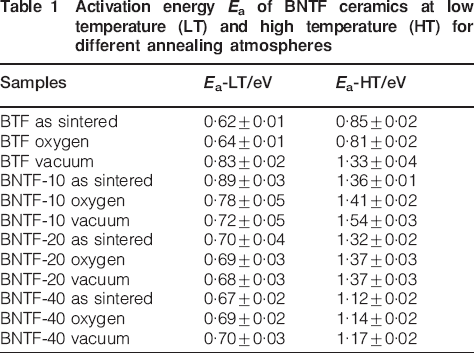
Activation energy Ea of BNTF ceramics at low temperature (LT) and high temperature (HT) for different annealing atmospheres
The generation or activation of charge carriers and the existence of possible paths for charge carriers’ mobility are the two main requirements to realise the conduction process. It is reported that Fe2+ would turn to Fe3+, and Fe3+ would turn to Fe4+ for the BiFeO3 ceramic when it was annealed in O2.23, 24 However, Fe3+ would hardly turn to Fe2+ when it was annealed in vacuum.23 This may shed a new light on the conduction of BTF based ceramics. The essence of the valence fluctuation of Fe ions is the activation of electrons. The valence fluctuation of Fe ions will be much easier in oxidising atmospheres as compared to that in the vacuum, which lacks the reducing atmospheres to make the Fe ion reduced. Therefore, the activation of electrons in oxygen annealed and as sintered samples will become easier than that in vacuum annealed samples. On the other hand, oxygen vacancy can be acted as the possible paths for charge carriers’ mobility. Our earlier investigations shows that (Na,Ce) doping can reduce the concentration of oxygen vacancies, especially for BNTF-20 and BNTF-40, which have much a lower concentration of oxygen vacancies than that of BTF and BNTF-10.22 Thus, there are less deep trap energies in the band gap for the activated electrons to be mobile in BNTF-20 and BNTF-40 ceramics.
From the above analysis, BTF and BNTF-10 can provide enough oxygen vacancies for the charge carriers to be mobile, while BNTF-20 and BNTF-40 provide limited oxygen vacancies. In the case of BTF and BNTF-10, because the concentration of oxygen vacancies is high and the activation of electrons in vacuum annealed samples becomes more difficult, the conductivities of the vacuum annealed samples are lower than those of other samples, as seen in Fig. 3a and b respectively. However, there will be much less deep trap energies in the band gap for BNTF-20 and BNTF-40. Thus, the conductivities of the samples will be almost the same after any annealing process, whether the electrons can be activated. This means that the conductivities of BNTF-20 and BNTF-40 in different annealing conditions behave quite the same way, seen in Fig. 3c and d respectively. Similarly, the fitting results of all the samples after different annealing processes by Arrhenius relationship are given in Table 1.
Table 1 shows activation energy Ea of different samples in different annealing atmospheres. For vacuum annealed BTF, Ea in the low and high temperature range are 0·83 and 1·33 eV, which are higher than those of as sintered and oxygen annealed BTF. This phenomenon is attributed to the high concentration of oxygen vacancies in BTF ceramics, and the activation of the electrons is prevented in the vacuum annealed samples. Ea in the low temperature range are all ∼0·70 eV for BNTF-20 and BNTF-40, while Ea in the high temperature range are ∼1·35 and 1·15 eV for BNTF-20 and BNTF-40 respectively, regardless of the annealing atmospheres. This phenomenon indicates that the behaviours of charge carriers at low temperatures are probably the same for the BNTF-20 and BNTF-40 samples. The conclusion that the conduction at high temperatures is much easier in BNTF-40 than that in BNTF-20 also can be drawn. Ea at high temperatures of BNTF ceramics are in the range from 1·1 to 1·6 eV, which are lower than those of other BLSFs reported. The Ea of intrinsic conduction is equal to the half the energy of the band gap.8 The band gap energies of Bi4Ti3O12, BaBi4Ti4O15 and BaTiO3 are all ∼3·3 eV.25 The BTF ceramics can be considered as Bi4Ti3O12–BiFeO3 ceramics. The Ea of intrinsic conduction for BiFeO3 based ceramics are in the range from 0·72 to 0·95 eV,26 so the Ea of intrinsic conduction for BTF based ceramics should be <1·6 eV. This is consistent with the values of Ea for BNTF ceramics at high temperatures shown in Table 1. In the low temperature range, the extrinsic conduction has a close relationship with the concentration of oxygen vacancies and the activation ability of electrons.
Conclusion
In summary, with the (Na,Ce) dopant content x increasing, the resistivities of Bi5−xNax/2Cex/2Ti3FeO15 ceramics (x = 0, 0·05, 0·10, 0·20, 0·30, 0·40 and 0·60) increase at first and then decrease, indicating an n type conduction of BTF ceramics. When x = 0·10, the resistivity reaches the highest value, ∼1×10¹³ Ω cm, which is about two orders higher than that of BTF. When the concentration of oxygen vacancies becomes lower with more (Na,Ce) doping, there are less deep trap energies in the band gap for the activated electrons to be mobile. For the samples containing high concentration of oxygen vacancies, such as BTF and BNTF-10, the valence state of the Fe ions will change easily when the samples are annealed in the air and oxygen, while it will hardly change in the vacuum. Therefore, the conductivities of the vacuum annealed samples are much lower than those of the as sintered and oxygen annealed samples. On the contrary, for the samples containing a low concentration of oxygen vacancies, such as BNTF-20 and BNTF-40, the conductivities of the samples in different annealing conditions behave quite the same way. The activation energies of intrinsic conduction for BTF based ceramics are lower than those of other BLSFs reported, and the extrinsic conduction has a close relationship with the concentration of oxygen vacancies and the activation ability of electrons.
Footnotes
Acknowledgements
This work was sponsored by the International Cooperation Program of SAST (grant no. 09520709200) and the National High-tech R&D Program of China (863 program, grant no. 2009AA03Z108).