







Abstract
The innovative multicomponent matrix for immobilising cadmium and caesium introduced in this paper consists of belite cement, gismondine type NaP zeolite and nanoadditions. With this innovative design, the solid blend was able to absorb a high proportion of simulated radioactive liquid waste. Matrix integrity and effect of the high waste/solid ratio were assessed by X-ray diffraction analysis, while BET-N2 surface area, pore size distribution and nanoporosity were determined with nitrogen adsorption isotherms. Matrices whose sole component was fly ash belite cement were used as a reference. This innovative material affords substantial social and environmental benefits, inasmuch as the cement used has a low CO2 content and low heat of hydration. Moreover, both the cement and the zeolite can be synthesised ecoefficiently from an industrial byproduct, thereby eliminating the need to stockpile waste while preserving natural resources and placing valorised byproducts on the market.
Introduction
This study forms part of a broad scale line of research whose ultimate aim is to design and develop innovative cement based matrices that can be used for safe and ecoefficient waste immobilisation (Goñi, Hernández, Guerrero and Lorenzo, 1996; Hernández, Guerrero, Goñi and Lorenzo, 1997, Guerrero and Goñi, 2002; Goñi, S., Guerrero, A., Lorenzo, M.P., 2006; Peña, Guerrero, Goñi, 2006; Bagosi and Csenteyi, 1999).1–6 Portland cement is the material most extensively used in the solidification and immobilisation of toxic as well as low and medium level waste. In this system, both the precipitation of the respective hydroxides in the highly alkaline pore solution and the so called C–S–H (calcium silicate hydrate) phase play a role in the governing immobilisation mechanism (Giergiczny and Król, 2008; Goñi, Guerrero and Lorenzo, 2006; Bosch, Caputo, Liguori and Colella, 2004).4,7–8 Portland cement is ineffective for caesium, however, which exhibits low levels of retention in such traditional matrices and consequently high rates of diffusion into the biosphere (Goñi, Guerrero and Lorenzo, 2006).4 Another factor to be taken into consideration in this context is the CO2 emissions associated with Portland cement manufacture. Many research groups are pursuing lower carbon alternatives to Portland cement as an immobilisation medium, focusing their studies on mineral additions, sand–cement–clay mixtures and zeolites, among others (Chang, and Shih, 1998; Giergiczny and Król, 2008; Hale, Evans and Lambert, 2012; Ma, Brown and Komarneni, 1998; Peña, Guerrero, and Goñi, 2006; Shawabkeh, 2005).5,7,9–12
Belite cements (BCs) exhibit properties indicative of their potential as matrices for confining radioactive liquid waste. The slow hydration rate that characterises this cement prevents shrinkage. Moreover, reactive, hydrothermally synthesised fly ash BCs such as those used in this paper exhibit lower pH values than conventional cements. The durability and potential applications of such cements (for which fly ash is the starting material) make them a viable alternative to traditional Portland cement (Guerrero, Goñi and Macías, 2000; Guerrero, Goñi, Campillo and Moragues, 2004).13, 14 Furthermore, the cement industry obviously benefits from the lower temperatures required to synthesise these products, which reduce its costs as well as its environmental impact. The present paper describes research that explored the efficiency with which an innovative cement based material containing BC, zeolite and nanosilica immobilised caesium and cadmium. The most prominent contribution of this research is the proof provided for these purposes of the viability of cement and zeolite synthesised from industrial byproducts.
Experimental
Synthesis of fly ash BC and zeolite
Spanish ASTM class F fly ash, here denominated FA-0, was used as a secondary raw material to obtain a gismondine type NaP1 zeolite (Z) and fly ash BC. Zeolite NaP1 (Z) was synthesised as described by Guerrero et al. 2000; Guerrero et al. 2004,13, 14 i.e. by stirring FA-0 in a 1M NaOH alkaline solution (ratio, 1∶3, w/w) for 2 h at 150°C. The solid phase was subsequently washed three times with demineralised water and dried to a constant weight at 50°C. The X-ray diffraction (XRD) and thermogravimetric findings for this material are shown in the section on ‘Characterisation of starting materials’ (Figs. 1 and 2).
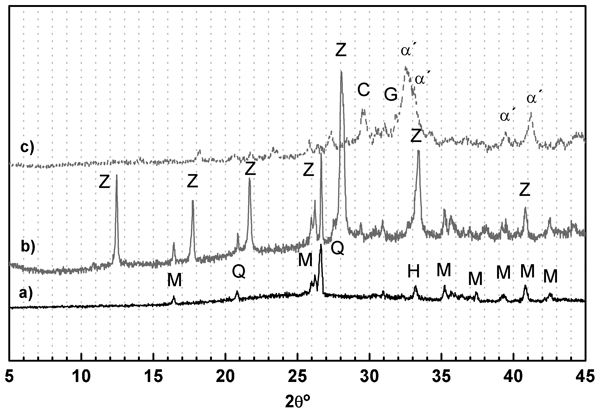
X-ray diffraction patterns for starting materials (M: mullite; Q: quartz; H: hematite; G: gehlenite; Z: zeolite; α′: α′L-C2S; C: calcite): a class F fly ash; b gismondine type zeolite; c fly ash BC
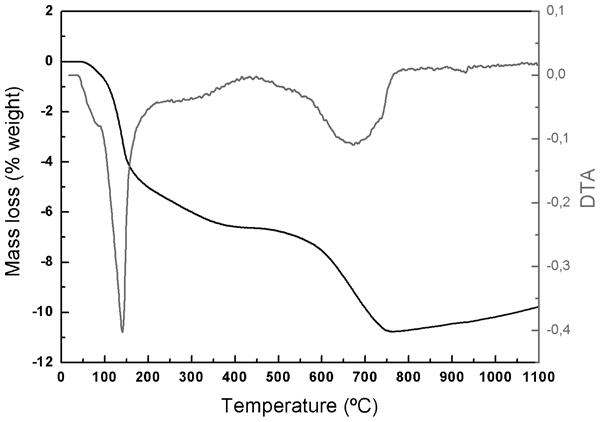
Thermogravimetric–differential thermal analysis curves for gismondine type NaP1 zeolite
Fly ash BC was synthesised from FA-0 as described in a prior paper.13 The chemical and mineralogical compositions of FA-0 and BC are given in Table 1 and in Fig. 1 respectively.
Chemical composition of starting fly ash (FA-0) and fly ash BC/wt-%
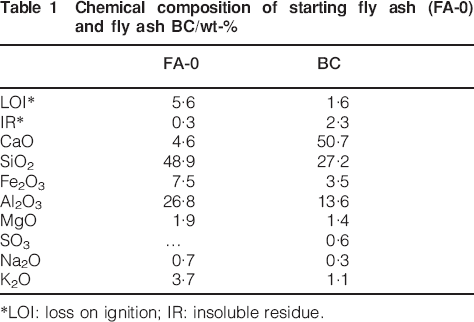
*LOI: loss on ignition; IR: insoluble residue.
Matrix mix design
Designing these new cement based matrices called for prior optimisation of the components: BC, zeolite (Z) and nanosilica (Ns). The Ns used was a commercial colloidal nanosilica with a specific surface area of 100 m2 g−1, a particle size of 30 nm and an SiO2 content of 45 wt-%. The matrices were prepared with or without 0·1M solutions of reagent grade CsCl or CdCl2.
This prior optimisation entailed first mixing 10 g of 0∶100 to 70∶30 blends of zeolite (Z) and BC with CsCl or CdCl2 at solution/solid ratios ranging from 0·7 to 1·2. The procedure was subsequently repeated, replacing 8% of the cement with nanosilica (Ns). The samples were cured for 1–7 days at 60°C, the latter proving to be the optimum curing time. Optimisation was established on the grounds of the waste solution/solid ratio, workability and hardening. In other words, the optimal design sought immobilisation of the maximum possible volume of CsCl or CdCl2 solution and the highest Z/BC cement ratio that would ensure good workability and hardening.
The mix was scantly workable at solution/solid ratio values of <1·1 of cadmium solution, while for values of >1·1, it failed to harden. A zeolite free matrix, denominated ZBC-0 and ZBC-0-Ns, was consequently prepared for this ion. Similar results were obtained with the caesium ion, except that the matrix with a 50% replacement ratio exhibited good workability and hardening at a waste solution/solid ratio of 1·1. The leaching trials for this ion were conducted with matrices ZBC-0, ZBC-0-Ns, ZBC-5 and ZBC-5-Ns. Table 2 lists the matrices chosen for each ion and their respective denominations.
Multicomponent matrices chosen for leaching test

The samples were poured into 5×10 cm cylindrical moulds and removed after curing for 7 days at 60°C and >95% relative humidity. Reference matrices were prepared with water instead of the waste solution.
Leaching test
Leaching was conducted as specified in ANSI/ANS-16·1-1986.5 The leaching solution used was demineralised water with a conductivity of <5 μΩ cm−1. The specimens were placed in individual plastic containers containing a sufficient volume to attain a solution/geometric surface area (of the specimen: 196·35 cm2) ratio of 10 cm and stored at 40°C for 0·083, 0·3, 1, 2, 3, 4, 5, 19, 47 and 90 days. Duplicate specimens of leachate were analysed.
Test parameters
The samples maintained their dimensional integrity during leaching. The substantial amount of data obtained indicated that internal bulk diffusion was most likely the predominant mechanism during the early leaching phases. The test parameters studied were described in detail in prior papers authored by this research group (Goñi, Hernández, Guerrero and Lorenzo, 1996; Hernández, Guerrero, Goñi and Lorenzo, 1997; Guerrero and Goñi, 2002; Goñi, Guerrero, Lorenzo, 2006).1–4 The most relevant equations and expressions are discussed below:
For specimens that may be regarded as semi-infinite media, mass transport equations (Fick's second law) may be used to calculate effective diffusivity De valid for leaching times of up to 5 days (abbreviated test), providing that diffusion is the predominant mechanism and consequently determines the leaching rate
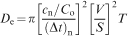
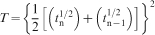
After 5 days, other methods must be used to calculate De, such as a graphical method or interpolation to find parameter G. In this case

The leachability index L is a normalisation factor related to the specific material tested

Instruments
The matrices were characterised by a number of techniques. X-ray diffraction analyses were recorded on a Philips PW 1730 diffractometer fitted with a graphite monochromator using Cu Kα1 radiation. Thermal analyses were conducted on samples weighing ∼50 mg using a simultaneous analysis system (model 409 STA; Netzch, Inc., Exton, PA, USA). Specific surface area measurements,16 pore size distribution17 and nanoporosity were found from nitrogen adsorption isotherms generated by a Micromeritics ASAP 2010 analyser. The cadmium and caesium concentrations in the leachate were determined by inductively coupled plasma optical emission spectrometry on a Perkin-Elmer Optima 3300 D/V spectrometer.
Results and discussion
Characterisation of starting materials
The chemical compositions of starting fly ash, FA-0 and fly ash BC determined as specified in Spanish standard UNE-EN 196-2 are given in Table 1. The FA-0 was found to conform to ASTM class F and European and Spanish standard EN-UNE 450 specifications, with a SiO2+Al2O3+Fe2O3 content of >70% and a low CaO content. The majority crystalline phases in the starting FA-0 (Fig. 1a) were quartz (α-SiO2), mullite (Al6Si2O13) and hematite (α-Fe2O3); the amorphous halo between 15 and 35° in the 2θ angular zone was generated by the vitreous component in the fly ash.
The XRD pattern for the zeolite synthesised from FA-0 is shown in Fig. 1b. The majority crystalline phases detected were gismondine type NaP1 zeolite (Na6Al6Si10O32.12H2O) (Joint Committee on Powder Diffraction Standards card no. 39-219) (the main product of hydrothermal synthesis) and mullite, present in the starting fly ash, FA-0. A thermogravimetric analysis (TG/ATD) was conducted from 25 to 1100°C to confirm zeolite formation. The first continuous massive weight loss observed on the thermogravimetric curve for the sample, between 25 and 400°C, concurred with a minimum differential thermal analysis value of ∼120°C, attributed to the release of water molecules from the NaP1 zeolite (Z). A second weight loss observed between 500 and 800°C was due to the release of CO2 molecules, possibly the result of sample carbonation or weathering. This loss concurred with a differential scanning calorimetry curve nadir at 690°C.
The anhydrous BC obtained from FA-0 (Fig. 1c) showed broad reflections in the 32–33° (2θ) angular zone, attributed to αL-Ca2SiO4, a poorly crystallised variety of belite; traces of gehlenite (Ca2Al2SiO7) appeared, while the absence of free lime suggested 100% reactivity.
Leaching analyses
The quantities of cadmium ion in the leachate were below the inductively coupled plasma detection limit (6·65 ppb) throughout the trial. The leaching study could consequently not be conducted, an indication of the good performance of these new cement based matrices (ZBC-0-Cd and ZBC-0-Ns-Cd). In the cement based matrices in which ordinary Portland cement was the main component, the 5 day effective diffusion coefficient De for this ion was ∼1·7×10−10. This finding will be discussed in a subsequent paper.
The cumulative fraction leached (CFL) from matrices ZBC-0-Cs, ZBC-5-Cs, ZBC-0-Ns–Cs and ZBC-5-Ns-Cs at 40°C is plotted versus the square root of leaching time in Fig. 3.
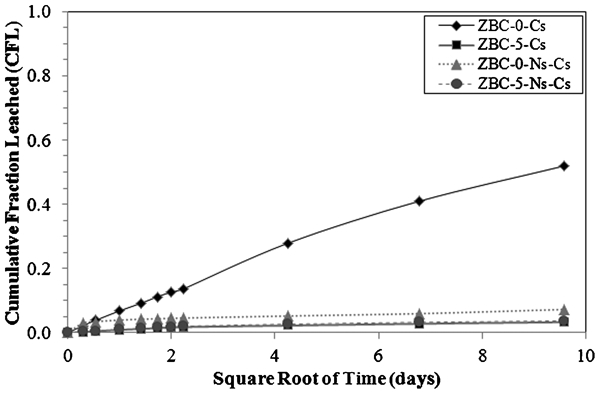
Caesium: CFL versus square root of leaching time
The caesium concentration in the reference specimens was the same as in the aggressive solution: 6·91, 6·85, 6·83 and 6·96 g kg−1 for matrices ZBC-0-Cs, ZBC-5-Cs, ZBC-0-Ns-Cs and ZBC-5-Ns-Cs respectively. The matrices containing Z or Ns (ZBC-5-Cs and ZBC-5-Ns) consistently exhibited CFL values one order of magnitude lower than observed in the plain ZBC-0-Cs matrix across all test times. In ZBC-0-Cs, the CFL values varied with the square root of time along a straight line (up to 5 days), which would suggest that up to that time, diffusion was the mechanism that governed leaching. In this case, however, an inflection was observed at 5 days in the CFL line. That may have been due to the formation of a film on the surface of the sample, which would hinder leaching, a development observed by other authors (Goñi, 1996; Hernández, 1997) in immobilisation systems for similar ions, such as calcium or sulphate.
The mean effective diffusion coefficients De for the four matrices studied in each leaching interval [(Δt)n (s)] are given in Table 3.
Effective diffusion coefficients (cm2 s−1) for matrices ZBC-0-Cs, ZBC-0-Ns-Cs, ZBC-5-Cs and ZBC-5-Ns-Cs
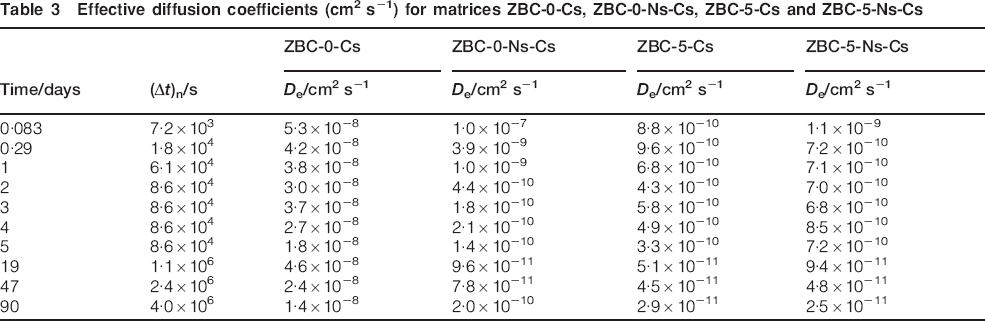
The mean effective diffusion coefficient De in the first 5 days of leaching (8·6×10 s) (abbreviated test) was 1·8×10−8 cm2 s−1 for matrix ZBC-0-Cs. After 90 days of leaching (4·0×106 s), the De for this matrix was very similar, 1·4×10−8, an indication that leaching continued over time. By contrast, the 5 day De value for the Ns containing, zeolite free matrix was 1·4×10−10 cm2 s−1, i.e. two orders of magnitude lower than the 1·8×10−8 cm2 s−1 calculated for matrix ZBC-0-Cs. This behaviour, indicative of a lower diffusion rate for the ZBC-0-Ns-Cs matrix, is observed to be present throughout the 90 days of the test.
In matrices containing zeolite with and without Ns (ZBC-5-Cs and ZBC-5-Ns-Cs), De was higher in the first 5 days than in the zeolite free matrix, with values of ∼3·3×10−10 and 7·2×10−10. De decreased after 90 days to 2·9×10−11 and 2·5×10−11 for matrices ZBC-5-Cs and ZBC-5-Cs-Ns respectively; these values, which were greater than reported by other authors2 in matrices with zeolite but no Ns, denoted the existence of different kinetic mechanisms depending on the presence or otherwise of Z and Ns in the cement based system.
The mean leachability index L is used to assess the efficiency with which a material immobilises waste; the threshold value for acceptance is 6. In all the matrices studied, the L value was above this threshold, at 7·5, 9·3, 9·6 and 9·6 for ZBC-0-Cs, ZBC-0-Ns-Cs, ZBC-5-Cs and ZBC-5-Ns-Cs respectively. Consequently, the four BC based matrices studied efficiently immobilised the caesium in nuclear waste. The highest efficiency was exhibited by matrices containing zeolite or nanosilica, however.
The pH values measured in the leachates obtained in the leaching test for cadmium and caesium ions are shown in Fig. 4. For the cadmium matrices, ZBC-0-Cd and ZBC-0-Ns-Cd, the pH value measured after 5 days was <11, and after 90 days, it remained between 11 and 12. While the pH was lower in the Ns containing matrix at both times, it was consistently >7, the critical value for cadmium immobility.7 In the caesium matrices, by contrast, the pH was >11 in all cases, reaching alkaline values upward of 12·5 for matrices lacking Ns, in particular the Z and Ns free matrix, ZBC-0-Cs.
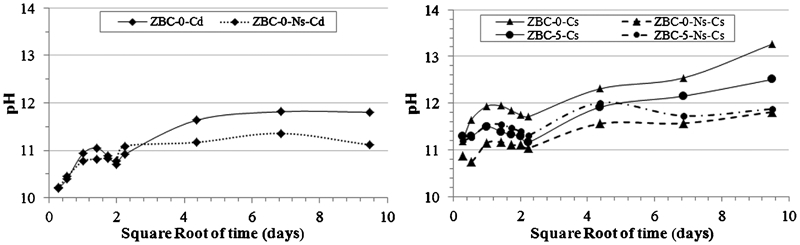
Change in leachate pH versus leaching time
In light of these findings, the authors are conducting further studies of the leachates, the results of which will be published in a future paper.
Matrix characterisation
X-ray diffraction
Given the large number of diffraction results obtained for each matrix, only the most significant findings are discussed here. Figures 5 and 6 show the most prominent differences in the XRD patterns for matrices ZBC-0-Cs and ZBC-5-Cs before and after the leaching attack. The diffractograms for the equivalent matrices prepared with demineralised water instead of the CsCl solution are shown for comparison.
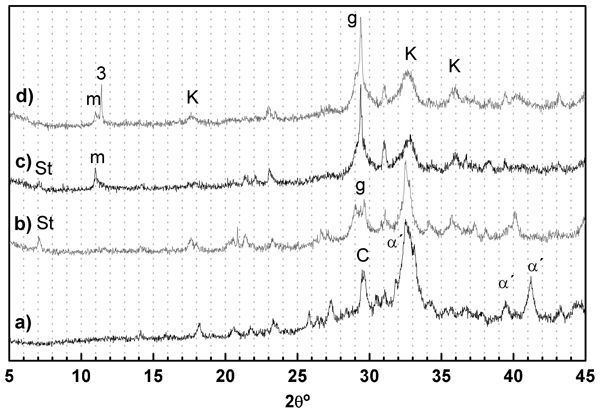
X-ray diffraction patterns for ZBC-0-Cs: a anhydrous BC, b after 7 days of curing at 60°C, without Cs, c after 7 days of curing at 60°C, with Cs and d after 90 days of leaching {St: strattlingite (Ca2Al2SiO7.8H2O); K: katoite [Ca3Al2(SiO4)(OH)8]; g: C–S–H gel (Ca1·5SiO3·5.xH2O); m: calcium monosulfoaluminate [Ca4Al2(SO4)O6.10H2O]; 3: α-Ca4Al2O6Cl2.10H2O}
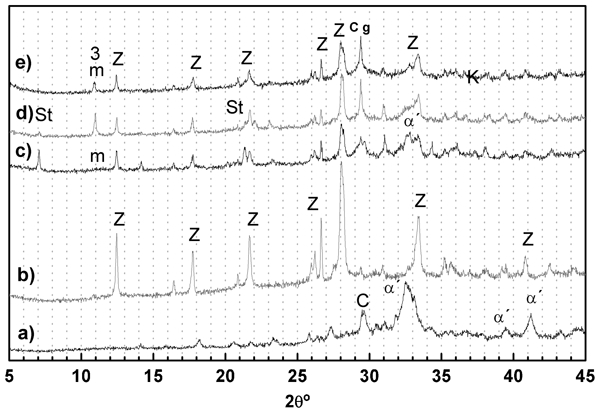
X-ray diffraction patterns for ZBC-5-Cs: a anhydrous BC, b starting zeolite (Z), c after 7 days of curing at 60°C, without Cs, d after 7 days of curing at 60°C, with Cs and e after 90 days of leaching {St: strattlingite (Ca2Al2SiO7.8H2O); K: katoite [Ca3Al2(SiO4)(OH)8]; g: C–S–H gel (Ca1·5SiO3·5.xH2O); m: calcium monosulfoaluminate [Ca4Al2(SO4)O6.10H2O]; 3: α-Ca4Al2O6Cl2.10H2O}
After 7 days of curing at 60°C with demineralised water (Fig. 5b), the main hydrated compounds detected in matrix ZBC-0-Cs were C–S–H gel (Ca1·5SiO3·5.xH2O), strätlingite (Ca2Al2SiO7.8H2O) and katoite [Ca3Al2(SiO4)(OH)8]. The main change induced by the presence of the CsCl solution (Fig. 5c) was the presence of calcium monosulfoaluminate [Ca4Al2(SO4)O6.10H2O] and α-Ca4Al2O6Cl2.10H2O. No changes were observed after leaching (Fig. 5d).
For matrix ZBC-5-Cs (Fig. 6), the main difference observed in the hydrated compounds was the absence of katoite (see Fig. 6b). In the presence of the CsCl solution, the intensity of the aforementioned hydrated compounds declined, while traces of α-Ca4Al2(Cl2)O6.10H2O appeared as the result of the uptake of chlorides in the Ca4Al2(SO4)O6.10H2O molecule. Note that crystalline caesium and cadmium compounds were not formed in any of the matrices studied, suggesting that these ions were not chemically bonded. The presence of Ns had no material effect that could be detected with XRD. The use of other techniques would be needed to track the effect of Ns in cement based matrices.
Nanoporosity
The BET-N2 surface area, nanoporosity (micropore volume) and differential pore size distribution of matrices determined with nitrogen adsorption, along with the changes induced by leaching, are depicted in Figs. 7 and 8. For the cadmium ion, no notable change was observed in the BET-N2 surface area over time (Fig. 7): only a slight increase was recorded in this parameter after 90 days of leaching, from 26 to 30 m2 g−1 for ZBC-0-Cd and from 61 to 65 m2 g−1 for ZBC-0-Ns-Cd.
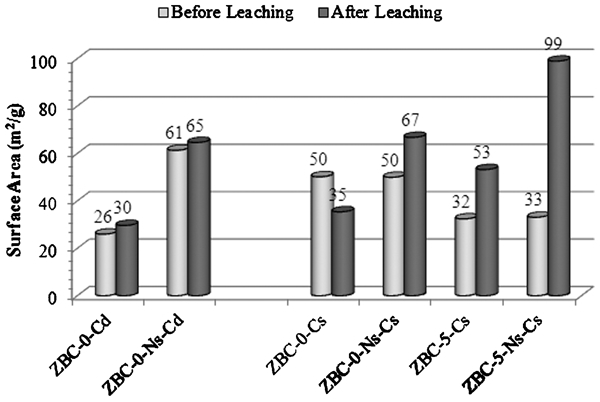
Leaching induced changes in surface area
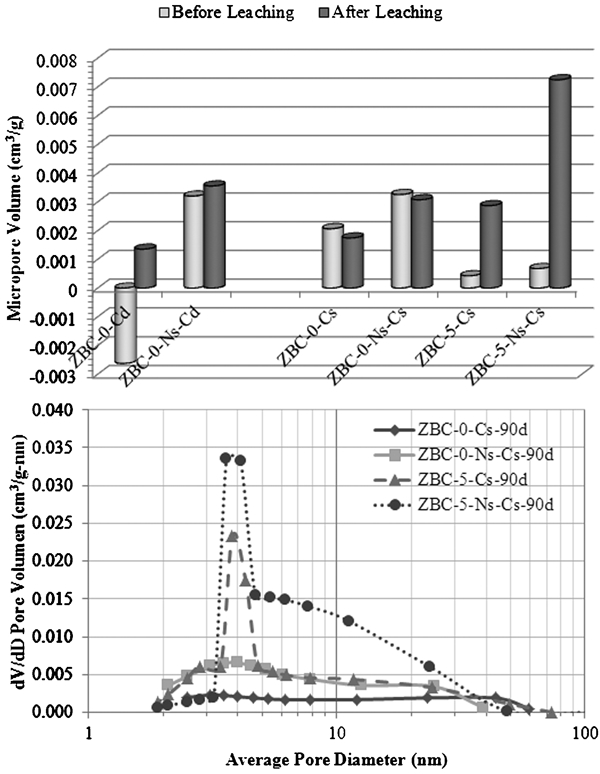
Effect of leaching on micropore volume and differential pore size distribution (dV/dD) in caesium matrices
Before leaching, caesium ion containing matrices ZBC-0-Cs and ZBC-0-Ns-Cs exhibited high surface areas of ∼50 m2 g−1, compared to 32 and 33 m2 g−1 in the matrices where part of the BC was replaced with zeolite (Fig. 7). The 90 day surface area values were higher in the matrices containing Z and Ns, however. The use of these new cement based matrices may therefore be said to constitute a safe and innovative immobilisation system, with surface area values of ∼99 m2 g−1 compared to a preleaching area of 33 m2 g−1.
A study of the variations in micropore volume (nanoporosity) revealed a number of developments (Fig. 8a). After leaching, this parameter rose in matrix ZBC-0-Cd from a negative (–0·002621 cm3 g−1) to a positive (0·001356 cm3 g−1) value. Moreover, the value attained with the preleaching microstructural refinement induced by the inclusion of Ns (matrix ZBC-0-Ns-Cd matrix) was practically unaffected after 90 days of leaching (varying from 0·003201 to 0·003553 cm3 g−1).
For the caesium ion, the matrices without zeolite (ZBC-0-Cs and ZBC-0-Ns-Cs) (Fig. 8a) had a higher micropore volume before leaching than the zeolite containing matrices (ZBC-5-Cs and ZBC-5-Ns-Cs): 0·002066 and 0·003255 cm3 g−1 versus 0·000428 and 0·000679 cm3 g−1 respectively. Leaching induced several effects in these matrices. First, in the Z free specimens, this parameter dipped slightly to values of 0·001745 and 0·003073 cm3 g−1. Second, in the zeolite containing matrices, micropore volume was found to rise one order of magnitude after leaching, from 0·000428 and 0·000679 cm3 g−1 to 0·002868 and 0·00725 cm3 g−1 respectively. This behaviour was associated with the differential pore size distribution after 90 days of leaching observed in caesium matrices (Fig. 8b). The peaks on the curves for matrices ZBC-5-Cs and ZBC-5-Ns-Cs, higher for the latter, centred at an average pore diameter of ∼4 nm denoted the high resistance of this matrix to leaching at 40°C.
These results are consistent with the rest of the findings presented here, according to which matrices ZBC-5-Cs and ZBC-5-Ns-Cs exhibited the lowest CFL values, De values of 2·9×10−11 and 2·5×10−11 and the highest L values, at 9·6 for the two matrices. More research is underway to explain the mechanism governing retention of these ions in zeolite and zeolite+nanosilica containing fly ash BC. The respective findings will be published in a future paper.
Conclusion
The results of the leaching tests conducted pursuant to ANSI/ANS-16·1-1986 suggest that the multicomponent BC based matrices studied constitute good solidification systems for cadmium and caesium.
For the cadmium ion, the use of a low pH cement based system is a promising point of departure for the design of safe immobilisation systems.
For the caesium ion, the replacement of 50% of BC with gismondine type NaP1 zeolite and 8% nanosilica lowered the mean effective diffusion coefficient De by three orders of magnitude (2·9×10−11 and 2·5×10−11 cm2 s−1 versus 1·4×10−8 cm2 s−1 for matrices ZBC-5-Cs, ZBC-5-Ns-Cs and ZBC-0-Cs respectively).
Matrix surface area and nanoporosity results indicate a high surface area and micropore volume and an average pore diameter of 4 nm in post-leached matrix ZBC-5-Ns-Cs, suggesting that caesium is mainly trapped in the interlayer spaces in C–S–H gel and the cavities in zeolite.
Footnotes
Acknowledgements
This study was funded by the Spanish Ministry of Science and Innovation (project no. BIA2007-61870). The authors gratefully acknowledge the fly ash supplied by the Soto de Ribera power plant.