






Abstract
In this paper, the fabrication and characterisation processes of both boron doped and undoped barium stabilised bismuth cobalt oxide nanocrystalline ceramic powders using polymeric precursor were reported. Obtained boron doped barium stabilised bismuth cobalt oxide nanocrystalline ceramic powders, which have been synthesised by polymeric precursor technique at temperatures below 900°C and at atmospheric condition, were characterised by X-ray diffraction, Fourier transform infrared and scanning electron microscopy techniques. According to X-ray results, fcc and bcc phases coexist in the samples of the nanocrystalline ceramic powders. Crystallite sizes for body centred cubic structure were calculated using Scherrer equation for both boron doped and undoped samples. In addition, lattice parameters were calculated for all samples.
Introduction
Recently, oxide systems such as barium stabilised bismuth cobalt oxide ceramic powders have attracted increasing attention and have been revealed to have potential as a thermoelectric material because BaO was observed as having the lowest transition temperature and one of the highest ionic conductivities of the Bi2O3 based systems.1–6 In addition, the addition of B2O3, which forms a network structure, creates Bi2O3 based ceramic powders with a higher melting point and a greater ability to withstand temperature changes.5–8
Bi2O3 based ceramic powders were conventionally prepared by solid state reaction process, where a mixture containing bismuth, barium and cobalt oxides was ball milled and finally calcined at desired temperature.9 This conventional ceramic preparation technique usually leads to inevitable particle coarsening and aggregation of the fabricated powder. The presence of agglomerates will also result in poor microstructure and properties. Many efforts have been made to avoid this problem. The polymer precursor technique has been proven to be one of the suitable techniques for the preparation of composite oxide, which employs complexing of metal acetate/nitrate precursor in a polymer solution, for example, polyvinyl alcohol (PVA). The formation of low cost resultant polymeric product is calcined at a high temperature to remove the polymer and obtain homogeneous and unagglomerated crystalline ceramic powders. The main advantages of polymeric precursor techniques (PPTs) are the homogeneity of the precursors on a molecular level and the low processing temperatures.10–17
To the best of our knowledge, we are here for the first time reporting fabrication of boron doped barium stabilised bismuth cobalt oxide ceramic powders at low temperature under 900°C and investigating the crystallisation behaviour and structural changes of the final composite Bi2O3 based ceramic nanocrystalline structure.
Experimental
In the experiments, PVA (average Mw of 85 000–124 000 g mol−1), bismuth(III) acetate and barium acetate were obtained from Sigma Aldrich, and cobalt(II) acetate and boric acid were obtained from Merck. Ultrapure deionised water was used as a solvent.
An aqueous PVA solution (10%) was first prepared by dissolving PVA powder in distilled water and heating at 80°C with stirring for 3 h, and then cooling to room temperature. In the experiments, three hybrid polymer solutions were prepared. As a general process, proper amounts of bismuth(III) acetate, barium acetate, cobalt(II) acetate and boric acid were added drop by drop to the 20 g aqueous PVA (10%) solution at 60°C separately (see Table 1). The solution was vigorously stirred for 1 h at this temperature. Stirring was continued for 3 h at room temperature. Finally, viscous gels of both boron doped and undoped PVA/Bi–Ba–Co acetate hybrid polymer solutions were obtained. Obtained solutions were poured into ceramic crucibles and then calcined at 850°C for 2 h. Resulting oxide ceramic composites obtained from solutions 1 to 3, named as PPT-1 to PPT-3, were ground into powder using a mortar. Prepared solutions and values of solution components are given in Table 1.
Value of polymer solution components

The pH and conductivity of the solutions were measured using Wissenschaftlich-Technische-Werkstätten WTW and 315i/SET apparatus. The viscosity of the hybrid polymer solutions was measured with an AND SV-10 viscometer. The surface tension of the complex hybrid polymer solutions was measured using KRUSS model manual measuring system. The crystal structures of the calcined powders were investigated by means of X-ray diffraction (XRD) (Ultima-IV XRD; Rigaku, Tokyo, Japan) with Cu Kα1 radiation at 40 kV and 30 mA and graphite monochromator.
Results and discussion
The pH, viscosity, conductivity and surface tension of the PVA/Bi–Ba–Co acetate solution were measured and given in Table 2.
Physical properties of polymer solutions

The XRD patterns shown in Fig. 1 reveal that the boron doped barium stabilised bismuth cobalt oxide was formed at the calcination temperatures of 850°C. Barium oxide stabilised body centred cubic bismuth cobalt oxide structure was identified with eight diffraction peaks that appeared at 2θ values and associated planes of 24·01° (220), 28·04° (310), 32·81° (321), 42·14° (332), 44·94° (431), 54·32° (600), 55·67° (611) and 58·10° (620). According to Joint Committee on Powder Diffraction Standards International Center for Diffraction Data [Joint Committee on Powder Diffraction Standards files 01-074-1228 for the BaO fcc phase and 01-082-1322 for the (Bi24−xCox)Co2−aO40 bcc phase], these peaks are in good agreement with Fig. 1.
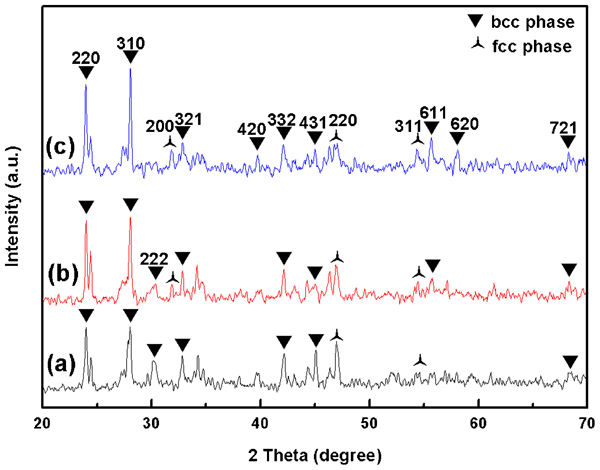
X-ray diffraction patterns of crystalline structure of calcined boron doped and undoped barium stabilised Bi–Co nanoceramic powders: a PPT-1; b PPT-2; c PPT-3 nanocrystalline powder samples
X-ray diffraction peaks became sharper with increasing boron content in the samples, and full width at half maximum decreased. Therefore, boron doping resulted in a progressive increase in the bcc crystallite size, indicating the crystallinity and stability of the barium stabilised Bi2O3–CoO2 system. This trend is in accordance with the SEM results given below. The crystal structure directly affects the mechanical and electrical properties of the composite material.18 As an example, the hardness and strength increase with the increasing amount of bcc phases, but the composite ceramic material gets brittle. It is certainly important to be able to control the formation of the bcc phases in the composite material.18–21
The crystallite size D was calculated based upon the main diffraction peaks’ broadening in the XRD pattern using the Scherrer formula.22–26 The lattice parameters of the composite samples were determined by comparing the peak positions (2θ) of the XRD patterns using the below relations27

Calculated structural parameters for bcc phase

The Fourier transform infrared (FTIR) spectra of the barium stabilised Bi–Co oxide nanocrystalline ceramic powders were given in Fig. 2. Absorption of IR below 610 cm−1 is attributed to various modes of Bi–O vibration in BiO6. As mentioned by Cong et al., the band at 664 cm−1 is attributed to Co–O stretching. The absorption band at 692 cm−1 is attributed to the bismuth oxide. At 855 cm−1, Bi–O stretching vibrations have been observed for all samples. The band at 765 cm−1 is assigned to the B–O–B bending vibration of bridges containing one trigonal and one tetrahedral boron and has approximately the same intensity for all the compositional range. At 1200 cm−1, B–O stretching vibration of trigonal BO3 units has been observed. The absorption band at 1414 cm−1 is thought to arise due to bismuth oxide, cobalt oxide or barium oxide.5,6,28–30
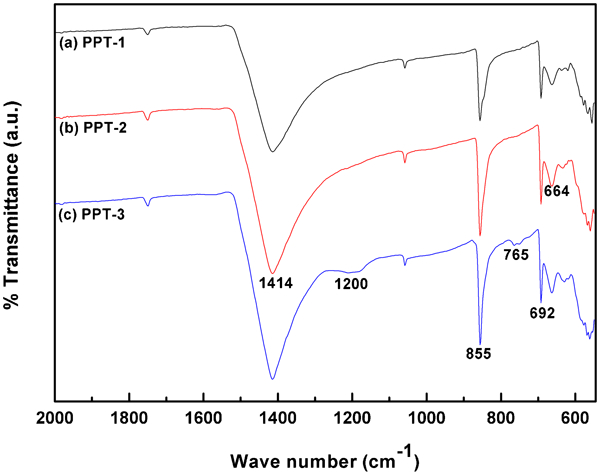
Fourier transform infrared spectra of a PPT-1, b PPT-2 and c PPT-3 nanocrystalline powder samples
Figure 3 presents the SEM images of boron undoped barium stabilised bismuth cobalt oxide nanocrystalline ceramic composite (PPT-1). As can be seen, the samples have a granular structure of spherical grains with a homogeneous mean grain size in the order of 60–80 nm for both materials. These values are in agreement with the XRD data.
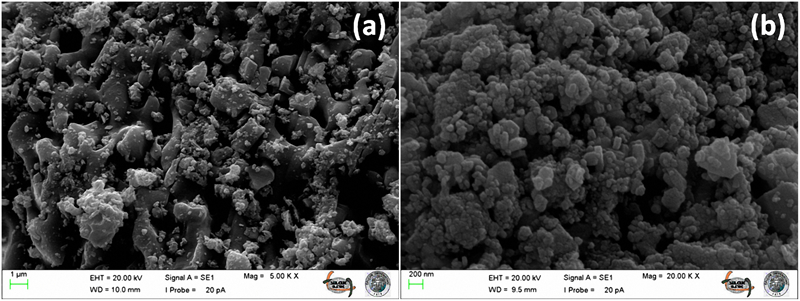
Scanning electron microscopy analysis shows that more severe agglomeration occurred in PPT-1 samples (undoped boron)
Figures 4 and 5 exhibit the SEM images of boron doped barium stabilised bismuth cobalt oxide ceramic composite (PPT-2). Plate-like grains were found in the sample possibly due to the anisotropic crystal structure on account of the anisotropic growth behaviour of such materials. It is known that plate-like grain formation is a typical characteristic of bismuth layer structured composite.31
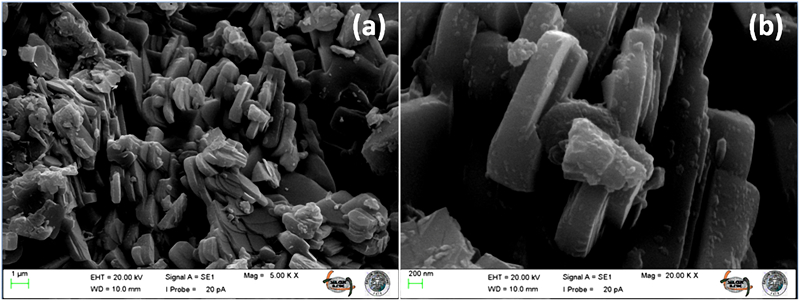
Images (SEM) show that B2O3 is effective calcining aid and boron doping leads to plate-like grain formation in PPT-2 sample
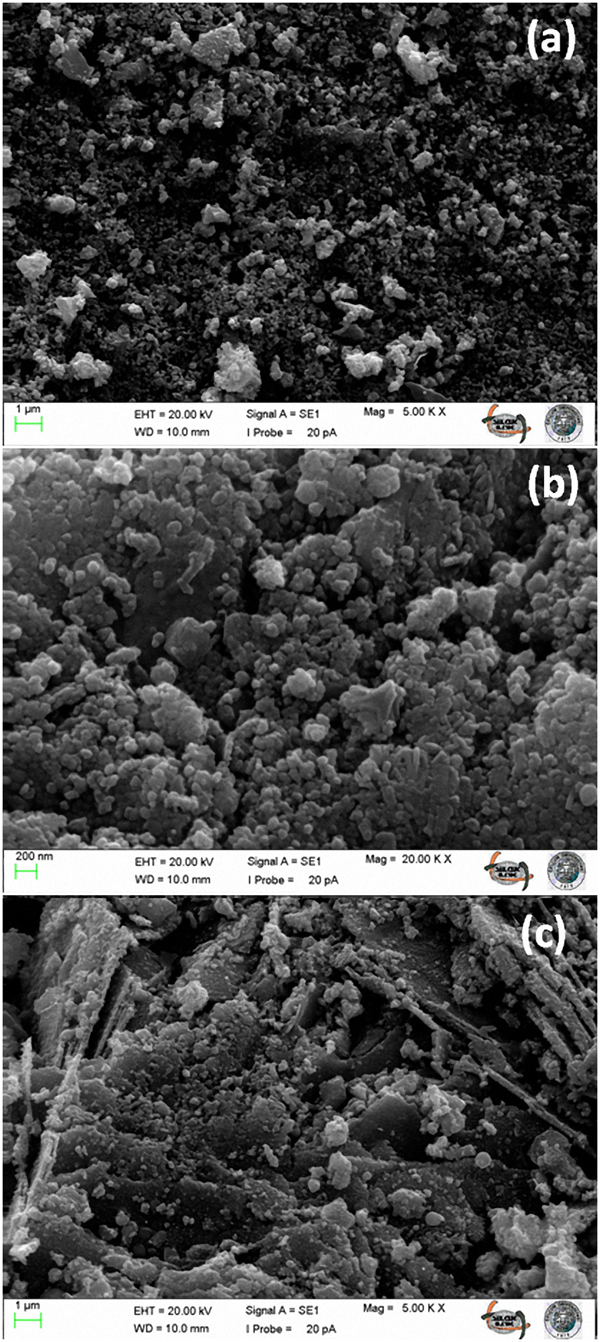
Images (SEM) show that grain size tends to become small and uniform when boron doping decreases agglomeration and grain sizes considerably (PPT-3)
Conclusion
Consequently, in this paper, we report the fabrication and characterisation of a bismuth oxide. Polymeric precursor technique is an alternative chemical method that allows for the fabrication of boron doped barium stabilised Bi–Co oxide nanocrystalline ceramic composite using precursors such as metal nitrates, acetates or carbonates. Obtained boron doped barium stabilised bismuth cobalt oxide nanocrystalline ceramic powders, which have been synthesised by PPT at temperatures below 900°C and at atmospheric condition, were characterised by XRD, FTIR and SEM techniques. According to X-ray results, fcc and bcc phases coexist in the samples of the nanocrystalline ceramic powders. Crystallite sizes for body centred cubic structure were calculated as 23, 57 and 48 nm for PPT-1, PPT-2 and PPT-3 respectively using Scherrer equation. In addition, lattice parameters were calculated as 10·0546, 10·0371 and 10·0546 nm for the PPT-1, PPT-2 and PPT-3 samples respectively.