







Abstract
Low friction silicon carbide (SiC) ceramic seals were prepared by liquid phase sintering in the presence of graphite fluoride. The addition of graphite fluoride as a lubricating additive restricted the sintering of SiC ceramics and worsened the mechanical properties to some extent, but obviously reduced the friction coefficient of SiC ceramic seals. With the graphite fluoride content increasing from 0 to 7 wt-%, the bending strength of SiC ceramic decreased from 507 to 357 MPa, while the dry friction coefficient dropped from 0·4 to 0·2. The graphite fluoride particles with lamellar structure did not vary the main crystalline phase compositions and distributed in the boundary of SiC grains. When the self-mated friction happened, graphite fluoride would fall off and stick to the friction surface, which improved the friction performance of SiC ceramic seals.
Introduction
Silicon carbide (SiC) ceramic has widely been used as one of basic mechanical sealing materials because of very high corrosion and wear resistance and special mechanical properties.1 SiC ceramic is particularly suitable for applications in radioactive, strong corrosive, inflammable and explosive, high temperature complicated environments.2 However, when the SiC ceramic seals carry out self-mated friction of each other without any media, the dry friction will occur on the sliding surfaces, and the sintered SiC will possibly cause premature seal failure owing to its high friction coefficient (above 0·4). At present, how to reduce the friction coefficient and improve friction property has become one of the tough problems for SiC sealing materials.
Studies on the friction and lubrication properties of SiC ceramics and their composites have been reported as follows. Zhang et al.,3 Yang et al.,4 Fan et al.5 and Zhou et al.6 have studied the friction properties of C/C–SiC composites and Cf–SiC composites with different microstructures and friction media. Wäsche et al.,7 Wäsche and Klaffke8 and Zhou et al.9 have discussed the effects of TiC–TiB2 and CNx on the friction properties of SiC based composites with water medium. Sang et al.10 and Reynaud et al.11 have discussed the dry friction, tribological and wear properties of the Si/SiC by doping with Ni and PbO and Cf–SiC composites. Zhou et al.12 have analysed the tribological characteristics of SiC and SiC–WC self-mated couples from room temperature to 1200°C in vacuum. However, the present researches mainly focus on the wear properties, tribological behaviours and friction media for SiC ceramics and their composites, and little attentions have been paid to how to reduce friction coefficient and improve friction property of SiC ceramics.
In this paper, graphite fluoride is used as lubricating additive to reduce the dry friction coefficient of SiC ceramics, and the effects of graphite fluoride on the sintering, properties and microstructure of liquid phase sintered SiC ceramic are investigated. The addition of graphite fluoride improves the friction performance of SiC ceramic seals. In addition, the friction mechanism of graphite fluoride in self-mated friction of SiC ceramic seals was also analysed.
Experimental
The main raw materials included SiC powder (average particle size 0·75 μm, purity >98·5%; Taizhou Dongxin Seal Limited Company), Al2O3 powder (average particle size 0·5 μm, purity >99%; Sinopharm Chemical Reagent Co. Ltd), Y2O3 powder (average particle size 0·5 μm, purity >99%; Sinopharm Chemical Reagent Co. Ltd) and graphite fluoride (average particle size 1·0 μm, purity >99%; Sinopharm Chemical Reagent Co. Ltd). Whereas Al2O3 and Y2O3 were used as sintering additives, graphite fluoride was used as a lubricating additive.
The compositions of all batches were listed in Table 1, and the detailed preparation of SiC ceramic seals was as follows. SiC powder and the additives (Al2O3, Y2O3 and graphite fluoride) were mixed in deionised water for 6 h. The SiC composite slurry with 40% solid phase content was obtained and then dried to SiC granules by spray drying method (GL-5 spray dryer). The SiC granules were compacted into green bodies by two-directional compaction technology (Y11-63T-type four-column hydraulic press) at 20–180 MPa. Then, isostatic pressing was conducted on green bodies at 200 MPa. Pressureless liquid phase sintering (LPS) was carried out in a vacuum furnace at 1850°C for 75 min. After the sintering, the seal samples were finished by washing and machining.
Composition of raw materials

The actual density of the samples was measured by conventional water displacement method. The phase compositions were analysed by the X-ray diffractomer (XRD) (Rigaku D/max-RA). The morphologies of fracture surface of the sintered bodies were observed by scanning electron microscopes (HITACHI S-4800). The three-point bending strength was performed by electronic universal test machine (CMT5205) with span of 30 mm and the crosshead speed of 0·5 mm min−1. The dimension of each sample was 3×4×40 mm, and each surface of the sample was polished. The measuring number of each sample was 15, and the measuring values were averaged to obtain the final bending strength. The hardness was measured by the Vickers indenter (Hv-10A) with 98 N load and 15 s loading time. The dry friction coefficient was measured by WTM-1E type controlled atmosphere minitype friction–abrasion testing equipment. The frication balls were 3 mm Si3N4 balls. The testing conditions were a load of 100 N and dry reciprocating friction (no oil lubrication) in air at room temperature.
Results and discussion
Sintering behaviours and mechanical properties of SiC ceramic seals containing graphite fluoride
Figure 1 shows the sintering behaviours and mechanical properties of SiC ceramic seals containing different graphite fluoride contents. With the increase in graphite fluoride content, the density and contractiveness of sintered body decrease, the mass loss increases and the bending strength and hardness decrease obviously. When the graphite fluoride content increases from 0 to 7 wt-%, the bulk density of SiC ceramic seals decreases from 3·2 to 3·0 g cm−3, and the bending strength drops from 507 to 357 MPa. It indicates that the addition of graphite fluoride will restrict the sintering of SiC ceramics and worsen the mechanical properties of SiC ceramics. On the one hand, during the sintering, lamellar structure from graphite fluoride will gradually dissociate and mismatch with the surrounding particles, which hinders the contraction and densification of SiC ceramics. On the other hand, graphite fluoride has low mechanical properties, and the addition of graphite fluoride will inevitably deteriorate the mechanical properties of SiC ceramics.
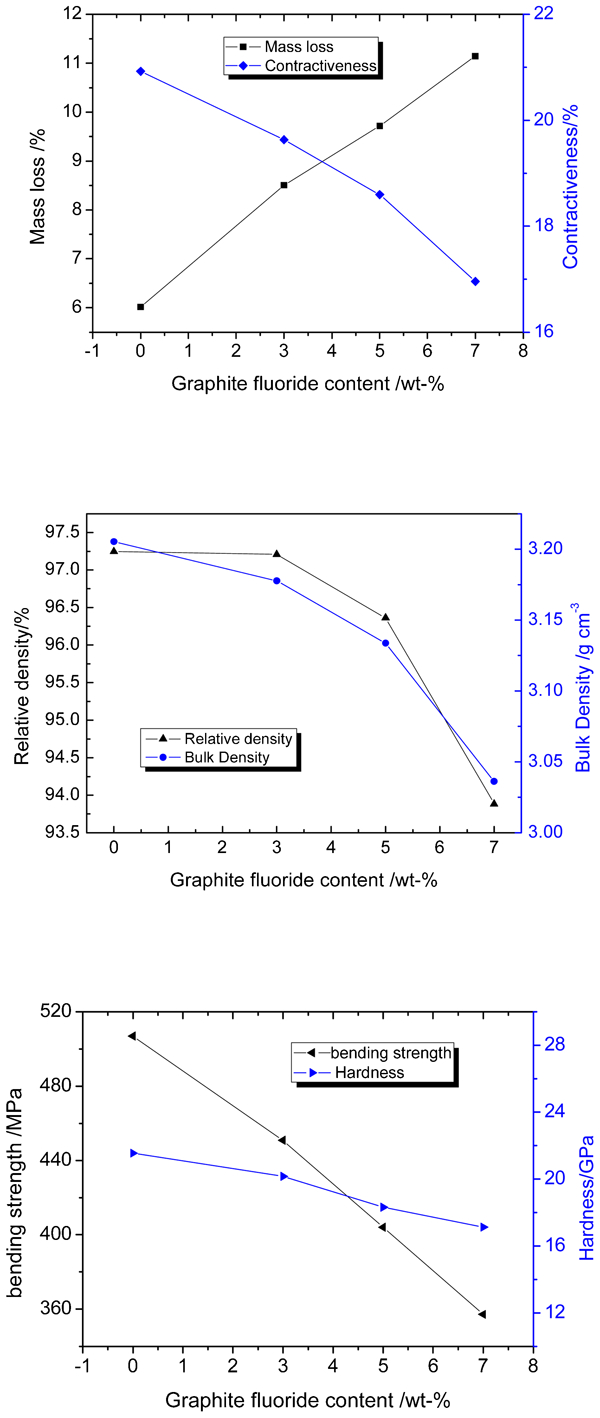
Sintering behaviours and mechanical properties of LPS–SiC ceramic containing different graphite fluoride contents
Microstructure of SiC ceramic seals containing graphite fluoride
Figure 2 shows the XRD patterns of LPS–SiC ceramic containing different graphite fluoride contents. The main crystalline phases include 6H–SiC, 4H–SiC, 2H–SiC and 3C–SiC, resulting from the SiC powder. There exist some Y3Al5O12 (YAG) and carbon (C) phases distributing in the XRD patterns. The YAG phase is attributed to the reaction between Al2O3 and Y2O3, and C derives from crystalline graphite fluoride. The main crystalline phases do not obviously vary with the increase of graphite fluoride content, although the carbon (C) peak becomes stronger.
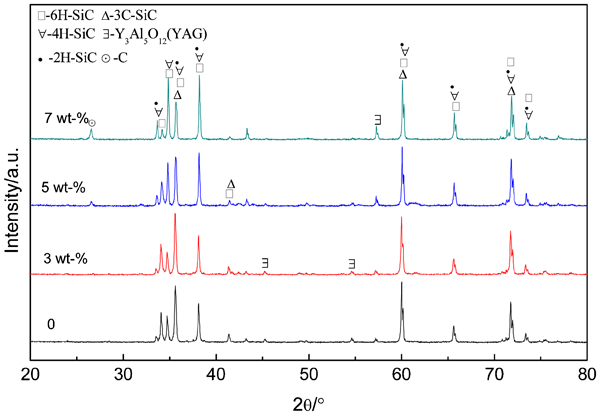
X-ray diffraction patterns for SiC ceramic seals with different graphite fluoride contents
Figure 3 shows the SEM images of fracture surface of LPS–SiC ceramics with different graphite fluoride contents. Compared with the sintered sample without graphite fluoride, the sintered samples containing graphite fluoride have a low densification with higher porosity, and the arrangement of SiC grains becomes relatively looser with different crystal size distributions. In particular, there exist flaky graphite fluoride particles (white circle) in the boundary of SiC grains. With the increase of graphite fluoride content, the amount of flaky graphite fluoride particles gradually increases and the size of SiC grains becomes finer. It confirms that the addition of graphite fluoride restricts the sintering of SiC ceramics and hinders the growth of SiC grains.
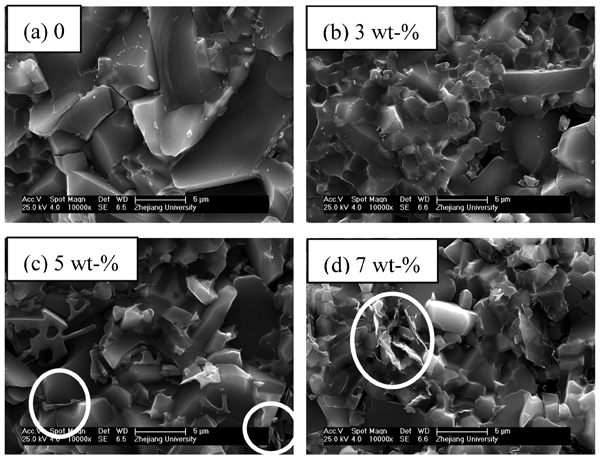
SEM images of fracture surface of SiC ceramics with different graphite fluoride contents
Friction properties of SiC ceramic seals containing graphite fluoride
As we mentioned above, the main aim of adding graphite fluoride is to decrease the friction coefficient and improve friction properties of SiC ceramic seals. Figure 4 shows the dry friction coefficient of SiC ceramic seals containing different graphite fluoride contents. It is seen that SiC ceramic seals without graphite fluoride have a dry friction coefficient as high as 0·4. The dry friction coefficient generally reduces with the increase of carbon content and reaches below 0·2 at 7 wt-% of graphite fluoride content, indicating the improvement of friction properties.
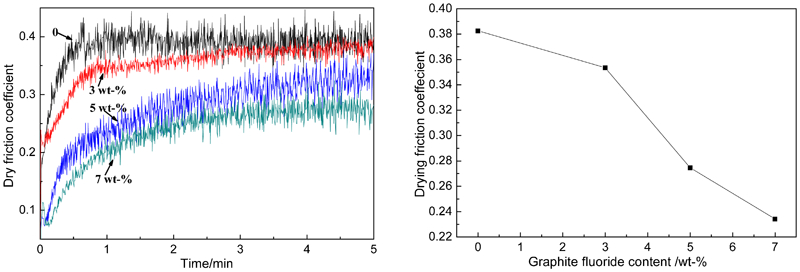
Dry friction coefficients of SiC ceramic seals containing different graphite fluoride contents
As a solid inorganic lubricant, graphite fluoride not only has the same structure and basic properties as the common graphite, such as lamellar structure, thermal stability, low shear strength and convenient adherence to substrate surface but also possesses more excellent lubricating performance than the common graphite or molybdenum disulphide.13–15 In particular, graphite fluoride can exhibit a smaller friction coefficient and longer lifetime in the high temperature (400–500°C) environment. When graphite fluoride is added into the SiC ceramic seals, on the one hand, graphite fluoride cannot be sintered by YAG sintering agent and distributes in the boundary of SiC grains to restrict the sintering of SiC ceramics and produces high porosity, which worsens the sintering and mechanical properties for SiC ceramics. On the other hand, the excellent lubrication properties of graphite fluoride and higher porosity of sintered body will reduce the dry friction coefficient of SiC ceramics. When the self-mated friction happens between SiC seals, graphite fluoride will fall off and stick to the friction surface, which improves the friction performance of SiC ceramic seals.
Conclusion
Low friction SiC ceramic seals containing graphite fluoride were prepared by LPS. The added graphite fluoride was not sintered by sintering agent and distributes in the boundary of SiC grains. The addition of graphite fluoride did not change the main crystalline phase compositions but restricted the sintering of SiC ceramics and decreased the mechanical properties. However, the presence of graphite fluoride obviously reduced the dry friction coefficient of SiC ceramic seals because of its excellent lubrication properties, which was beneficial to improve the friction performance of SiC ceramic seals.
Footnotes
Acknowledgements
This work is supported by the Innovation Fund for Technology-based Firms of China (grant no. 12C26113303061), High Science & Technique Brainstorm Project of Zhejiang Province of China (grant no 2012C01032-1), Zhejiang Key Innovation Team Projects (grant no. 2009R50010), Research Fund for the Doctoral Program of Higher Education (grant no. 20070335017) and Key Science & Technique Project of The Ministry of Education of China (grant no. 109088).