






Abstract
The 1 mol.-%Sr and 1 mol.-%Sn codoped (Ba0·84Ca0·15Sr0·01)(Ti0·90Zr0·09Sn0·01)O3 (BCSTZS) ceramics were synthesised by the normal solid state sintering method. The electric field and temperature dependence of the ferroelectric properties of the BCSTZS ceramics were investigated. Their energy storage density depending on electric field and temperature was determined from the polarisation–electric field (P–E ) hysteresis loops. According to the dielectric analysis, the BCSTZS ceramics experience three-phase transitions upon cooling. At room temperature, the pyroelectric coefficient p calculated from the remnant polarisation–temperature (Pr–T ) curve is 1116·7 μC K− 1 m− 2, and the figures of merit Fd is 18·1 μPa− 1/2, Fv is 0·013 m2 C− 1 and Fi is 479·3 pm V− 1 respectively. The pyroelectric figures of merit exhibit high frequency stability over a wide range from 100 to 2000 Hz, whereas these values vary gradually with the increase in temperature, which deserves further research to improve their stability. The excellent pyroelectric property of the BCSTZS ceramics is considered as correlating with a polymorphic phase transition occurring around room temperature. The present study demonstrates that the lead free BCSTZS ceramics are promising candidate for replacing the lead zirconate titanate based ceramics.
Introduction
Lead based ferroelectric ceramics, such as lead zirconate titanate, have dominated transducer and actuator devices due to the superior piezoelectric properties and the adjustability of properties via doping. 1 Lead zirconate titanate based ceramics are chemically and mechanically stable, which are low cost to achieve in mass production by the traditional oxide mixing method. 2 However, the containing lead element in the lead zirconate titanate based ceramics is harmful to the environment and human health. 3 Hence, much attention has been attracted to seek high performance lead free piezoelectric ceramics.4–6
Recently, a lead free Ba(Zr0·2Ti0·8)O3–x(Ba0·7Ca0·3)TiO3 (BZT-BCT, BCZT) system with superhigh d33 (∼620 pC N− 1) around the morphotropic phase boundary (MPB) composition was reported by Liu and Ren, 7 which could be regarded as a breakthrough in the research of lead free piezoceramics. The high piezoelectric performance was considered as a result of the MPB characterised by a cubic–tetragonal–rhombohedral tricritical triple point, which induced the instability of the polarisation. 7 Such result has attracted a significant interest and motivated further researches on the microstructure morphology and macroscale properties of the BZT–BCT/BCZT ceramics.8–11 The electrical properties of the BZT–BCT ceramics could be adjusted by many factors, including elements doping, altering the compositions, changing the temperature range of the polymorphic phase transition, tailoring sintering conditions, etc.7,12 Various dopants have been researched to enhance the piezoelectric properties of the BZT–BCT ceramics. Tan et al. investigated the effects of LiF on the structure and piezoelectric properties of the BCZT ceramics. They found that the LiF doped BCZT ceramics exhibit enhanced piezoelectric properties due to a polymorphic phase transition around room temperature. 12 Cui et al. investigated the effects of additives CuO, 13 CeO2 (Ref. 14) and Y2O3 (Ref. 15) on improving density, piezoelectric and ferroelectric properties of the BCZT ceramics. Their researches showed that appropriate addition of these dopants into the BCZT ceramics could improve the electrical properties.
In this work, SrCO3 and SnO2 were used to adjust electrical properties of the (Ba0·85Ca0·15)(Ti0·90Zr0·10)O3 ceramics. Such composition was chosen since it corresponds to the MPB composition where the orthorhombic and tetragonal ferroelectric phases coexist around room temperature. 16 The ferroelectric, dielectric and pyroelectric properties of the Sr2+ and Sn4+ codoped (Ba0·84Ca0·15Sr0·01)(Ti0·90Zr0·09Sn0·01)O3 (BCSTZS) ceramics were discussed.
Experimental
The 1 mol.-%Sr and 1 mol.-%Sn codoped BCSTZS ceramics were synthesised by the traditional oxide mixing method. All the stoichiometric raw carbonates and oxides, BaCO3 (99%), CaCO3 (99%), SrCO3 (99%), TiO2 (99·97%), ZrO2 (99%) and SnO2 (99·5%), were well mixed and calcined at 1250°C for 4 h. The calcined powders were dry pressed into discs after conglomeration using 8 wt-% polyvinyl alcohol aqueous solution as the binder. After removing the polyvinyl alcohol, the discs were sintered at 1550°C for 4 h in air.
Specific heat Cp of the BCSTZS ceramics was tested using a differential scanning calorimeter (Pyris DSC 8500, PerkinElmer Co. Ltd, USA). Silver paste was fired on upper and bottom surfaces of the ceramics at 600°C for 15 min to form electrodes. Polarisation–electric field (P–E ) hysteresis loops of the BCSTZS ceramics were measured by a Radiant Precision Premier LC ferroelectric measurement system (Radiant Technologies Inc., USA). Strain–electric field (S–E ) hysteresis loops were tested by a TF analyser 1000 test system (aixACCT Systems GmbH, Germany). Dielectric properties of the unpoled and poled BCSTZS ceramics were measured by a Novocontrol GmbH Concept 40 broadband dielectric spectrometer (Novocontrol Technologies GmbH & Co. KG, Germany) and a computer controlled TH2818 automatic component analyser (Changzhou Tonghui Electronic Co. Ltd, China) under a weak oscillation level of 1 Vrms respectively. Detailed procedures of electrical performance tests were expatiated elsewhere. 17
Results and discussion
Before the systematic discussion of the phase transition characteristic and electrical properties, the fundamental physical performances of the BCSTZS ceramics were determined. The fabricated BCSTZS ceramics exhibit densified microstructure and excellent piezoelectric properties, in which the relative density exceeds 94%, and piezoelectric constant d33 and electromechanical coupling coefficient Kp reaches 514 pC N− 1 and 52·62% respectively.
Figure 1 shows the electric field dependence of the P–E hysteresis loops of the BCSTZS ceramics measured at 5–30 kV cm− 1 and 1 Hz. With the increase in the electric field, the P–E hysteresis loops become more saturated together with the increase in the values of remnant polarisation Pr and coercive field Ec as shown in Fig. 2a and b. The Pr and Ec values reach 10·39 μC cm− 2 and 2·99 kV cm− 1 respectively at 30 kV cm− 1. The unipolar strain–E curve and bipolar strain–E curve are shown in Fig. 1a and b respectively. The typical butterfly-like curve reflects the ferroelectric domains switching during the bipolar external electric field drive. A maximum strain value of 0·13% is reached at E = 20 kV cm− 1. Such strain can even be comparable to some lead based piezoelectric ceramics.17,18
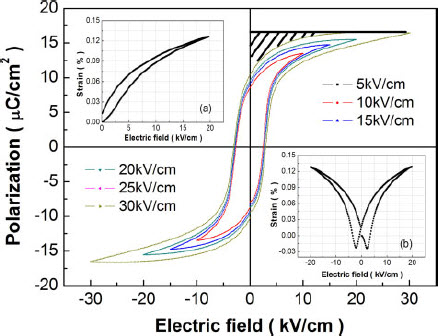
Electric field dependence of P–E hysteresis loops of BCSTZS ceramics measured at 5–30 kV cm− 1 and 1 Hz; inset shows a unipolar strain–E curve and b bipolar strain–E curve measured at 20 kV cm− 1 and 1 Hz
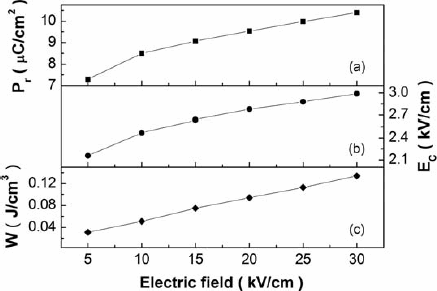
Electric field dependence of a remnant polarisation Pr, b coercive field Ec and c energy storage density W of BCSTZS ceramics
The energy storage density of the BCSTZS ceramics can be obtained by integrating the area between the polarisation axis and the hysteresis loops:
 , where E is the applied electric field and P is the polarisation.
19
By measuring the polarisation response from the P–E loops and excluding the dissipated energy, the stored energy can be estimated. According to the previous reports, higher energy densities can be achieved either by enlarging the difference between the saturated polarisation and the remnant polarisation in the P–E loops or by enhancing the dielectric breakdown strength.20–22 As shown in Fig. 2c, the values of energy storage density W increase nearly linear as the electric field increases, which reaches 0·134 J cm− 3 at E = 30 kV cm− 1. Such value of the energy storage density can be comparable to some other BCZT based ceramics.
23
The low energy storage efficiency can be attributed to the low coercive field, remnant polarisation and small electric field, or the early saturation polarisation of the BCZT based ceramics.
23
, where E is the applied electric field and P is the polarisation.
19
By measuring the polarisation response from the P–E loops and excluding the dissipated energy, the stored energy can be estimated. According to the previous reports, higher energy densities can be achieved either by enlarging the difference between the saturated polarisation and the remnant polarisation in the P–E loops or by enhancing the dielectric breakdown strength.20–22 As shown in Fig. 2c, the values of energy storage density W increase nearly linear as the electric field increases, which reaches 0·134 J cm− 3 at E = 30 kV cm− 1. Such value of the energy storage density can be comparable to some other BCZT based ceramics.
23
The low energy storage efficiency can be attributed to the low coercive field, remnant polarisation and small electric field, or the early saturation polarisation of the BCZT based ceramics.
23
Figure 3 shows the ferroelectric properties dependence on temperature of the BCSTZS ceramics. The P–E loops are saturate and symmetric, which become slimmer with increasing environmental temperature accompanied by the gradual decrease in Pr and Ec as indicated in Fig. 3b and c. The non-linear hysteresis loop could be observed even at 120°C. The existence of limited P–E hysteretic loop above the Curie temperature is mainly attributed to the residual polar microregions or ferroelectric clusters. 24 According to the previous reports, the degradation of piezoelectric and ferroelectric properties with the increase in temperature is mainly due to the lattice distortion (intrinsic contribution) and the domain walls motion (extrinsic contribution).25,26 However, the energy storage density remains stable with increasing temperature as indicated in Fig. 3d, which may be attractive for capacitor applications. 20
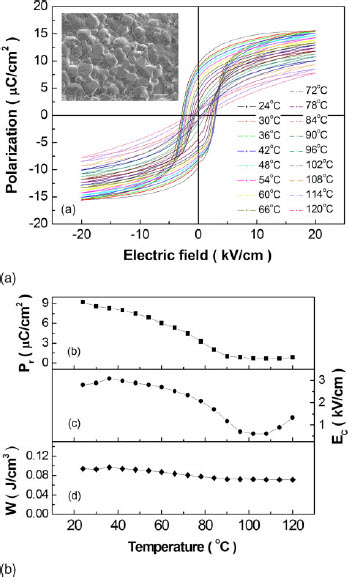
Temperature dependence of a P–E hysteresis loops, and b Pr, c Ec and d W of BCSTZS ceramics measured at 2 kV mm− 1 and 1 Hz; inset shows SEM image of free surface of BCSTZS ceramics after 2%HF etching
Temperature dependence of dielectric properties of the BCSTZS ceramics measured at several frequencies are shown in Fig. 4. It is interesting that the dielectric peaks are broad around the Curie temperature, indicating the diffusion characteristic of the relaxor ferroelectrics. However, the maximum dielectric constant εm keeps nearly unchanged with the variation of frequency, indicating that the BCSTZS ceramics are close to normal ferroelectrics. A polymorphic phase transition appearing near 20°C as indicated by the black arrows is a common phenomenon in the BCZT based ceramics, representing the orthorhombic phase transforming to tetragonal phase.16,27–29 Another dielectric anomaly appearing around − 17°C as indicated by the red arrow on the dielectric loss curves may be the rhombohedral–orthorhombic phase transition. Recently, Keeble et al. revised the phase diagram of the BCZT ceramics by high resolution synchrotron X-ray powder diffraction. They proposed that the MPB composition (Ba0·85Ca0·15)(Ti0·90Zr0·10)O3 ceramics undergo the successive phase transitions: cubic → tetragonal → orthorhombic → rhombohedral upon cooling. 16 Tian et al. investigated the phase evolution of the BCZT ceramics using in situ X-ray diffraction and dielectric analysis. They also suggested that the (Ba0·85Ca0·15)(Ti0·90Zr0·10)O3 ceramics experience an orthorhombic–tetragonal phase transition around room temperature and a rhombohedral–orthorhombic phase transition below room temperature. 27 Further researches on the structure evolution and phase transition characters of the BCSTZS ceramics are required.
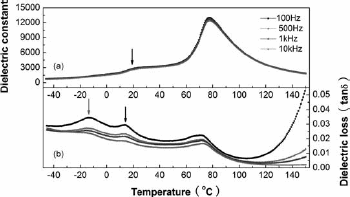
Temperature dependence of a dielectric constant and b loss tangent of unpoled BCSTZS ceramics measured at several frequencies
Figure 5 shows temperature and frequency dependence of dielectric properties of the BCSTZS ceramics poled at 25 kV cm− 1. As shown in Fig. 5a, the dielectric anomaly appearing around room temperature in the tan δ–T curve represents the polymorphic ferroelectric phase transition upon heating. 27 As compared to the unpoled samples, the dielectric frequency dispersion characteristic does not change, i.e. the poled BCSTZS ceramics still approach to the normal ferroelectrics. At 100 Hz, the Curie temperature TC, maximum dielectric constant εm and maximum loss tangent tan δm at TC of the unpoled BCSTZS ceramics are 77·3°C, 13 000 and 0·0224 respectively. After poling, the values of εm and tan δm decrease to 12 500 and 0·0191 respectively, while the TC temperature increases to 82·7°C. Such phenomena occur since polarisation stabilises the ferroelectric domains, leading to the increase in TC. 30 The growth and orientation of the ferroelectric domains induced by the poling process decrease the contribution of the movement of domain walls on dielectric response, leading to the decrease in εm and tan δm. 30 At 100 Hz, the room temperature values of ε and tan δ are 4200 and 0·0189 respectively, as shown in Fig. 5b, which keep almost unchanged between 100 and 2000 Hz. Such outstanding frequency stability of the dielectric properties shows the promising potential of the BCSTZS ceramics in the applications of electronic ceramic industries.
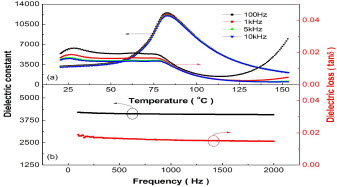
a temperature and b frequency (room temperature) dependence of dielectric properties of BCSTZS ceramics poled at 25 kV mm− 1
Temperature dependences of specific heat Cp and pyroelectric coefficient p of the BCSTZS ceramics upon heating are given in Fig. 6. The value of room temperature Cp is 0·431 J g− 1 °C− 1, which increases slightly to 0·444 J g− 1 °C− 1 at 119°C. The increase in specific heat with temperature may cause the fluctuation of the pyroelectric detecting performance. The bulk density of the BCSTZS ceramics is 5·40 g cm− 3 at ambient temperature, which keeps almost unchanged in the temperature range for the pyroelectric property measurement. Therefore, the calculated room temperature volume specific heat Cv = Cp × ρv is 2·33 × 106 J m− 3 °C− 1, where ρv is the bulk density.
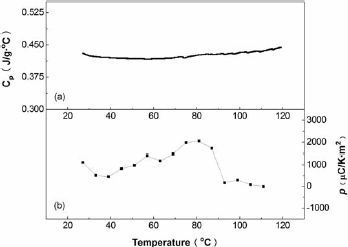
Temperature dependence of Cp and p of BCSTZS ceramics upon heating
Based on the P–E hysteresis loops upon heating, the values of Pr with increasing temperature are determined. In this work, the pyroelectric coefficient p is calculated using a static method:
 .
11
It must be pointed out that the main drawback of the static method is the offset of the P–E hysteresis loops. Such offset indicates the existence of defects or internal bias field, which may pin down the domain walls and stabilise the domains, leading to the deviation of p extracted from the measured P–E loops.
31
However, the internal bias field of the BCSTZS ceramics reported here can be negligible due to the high symmetry of the P–E loops, revealing that the calculated value of p is accurate. The calculated room temperature value of p is 1116·7 μC K− 1 m− 2, considerably exceeding that of the widely used LiTaO3 (230 μC K− 1 m− 2).32,33 The value of p decreases gradually as the temperature increases to 40°C. Such p extremum is a manifestation of the polymorphic phase transition, demonstrating that the orthorhombic and tetragonal phases coexist around room temperature.16,27–29 The coexistence of two ferroelectric phases significantly decreases the energy barrier of polarisation rotation, leading to the nearly vanishing of the polarisation anisotropy. Accordingly, the ferroelectric domains show high mobility, and the electrical properties are improved.
7
The p peak appearing ∼80°C in the p–T curve may be correlated with the tetragonal–cubic ferroelectric phase transition.
.
11
It must be pointed out that the main drawback of the static method is the offset of the P–E hysteresis loops. Such offset indicates the existence of defects or internal bias field, which may pin down the domain walls and stabilise the domains, leading to the deviation of p extracted from the measured P–E loops.
31
However, the internal bias field of the BCSTZS ceramics reported here can be negligible due to the high symmetry of the P–E loops, revealing that the calculated value of p is accurate. The calculated room temperature value of p is 1116·7 μC K− 1 m− 2, considerably exceeding that of the widely used LiTaO3 (230 μC K− 1 m− 2).32,33 The value of p decreases gradually as the temperature increases to 40°C. Such p extremum is a manifestation of the polymorphic phase transition, demonstrating that the orthorhombic and tetragonal phases coexist around room temperature.16,27–29 The coexistence of two ferroelectric phases significantly decreases the energy barrier of polarisation rotation, leading to the nearly vanishing of the polarisation anisotropy. Accordingly, the ferroelectric domains show high mobility, and the electrical properties are improved.
7
The p peak appearing ∼80°C in the p–T curve may be correlated with the tetragonal–cubic ferroelectric phase transition.
Pyroelectric figures of merit are calculated by three equations: current responsivity
 , voltage responsivity
 and detectivity
 .34,35 Figures 7 and 8 show the Fd and Fv values of the BCSTZS ceramics dependence on frequency and temperature. At 100 Hz, the values of room temperature Fd and Fv of the BCSTZS ceramics are 18·1 μPa− 1/2 and 0·013 m2 C− 1 respectively. The Fd and Fv performances exhibit excellent frequency stability between 100 and 2000 Hz, whereas the gradual variation of Fd and Fv with increasing temperature is unfavourable to the pyroelectric applications.
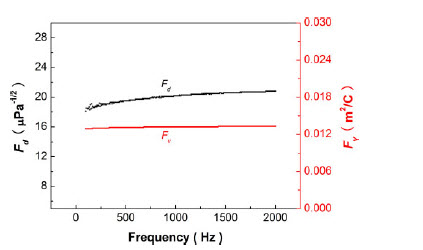
Room temperature frequency dependence of Fd and Fv of BCSTZS ceramics
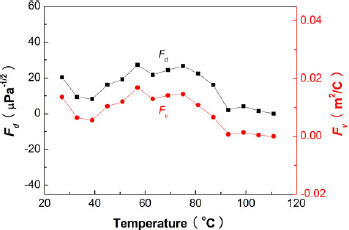
Temperature dependence of Fd and Fv of BCSTZS ceramics
Table 1 summarises the pyroelectric parameters of the BCSTZS ceramics and LaTiO3 for comparison.32,33 Of particular interest is that the pyroelectric properties of the BCSTZS ceramics are rather excellent, which shows promising potential for the uncooled infrared detectors.
Pyroelectric parameters of BCSTZS ceramics and LaTiO3 for comparison

Conclusions
In conclusion, the 1 mol.-%Sr and 1 mol.-%Sn codoped BCSTZS ceramics were prepared by the conventional solid state sintering method. The values of remnant polarisation Pr, coercive field Ec, maximum strain Smax and energy storage density W of the BCSTZS ceramics reaches 10·39 μC cm− 2, 2·99 kV cm− 1, 0·13% and 0·134 J cm− 3 respectively. Dielectric analysis indicates that the BCSTZS ceramics undergo three-phase transitions upon cooling, whereas further researches are required to clarify the nature of these phase transitions. The BCSTZS ceramics exhibit exceptional pyroelectric properties, the pyroelectric parameters p, Fd, Fv and Fi are 1116·7 μC K− 1 m− 2, 18·1 μPa− 1/2, 0·013 m2 C− 1 and 479·3 pm V− 1 respectively. Such excellent pyroelectric properties are correlated with the polymorphic phase transition around room temperature.
Footnotes
Acknowledgement
The authors thank the Priority Academic Program Development of Jiangsu Higher Education Institutions for financial support.