






Abstract
Effect of nano-TiN particles on the microstructure and mechanical properties of Si3N4 based cearmics were investigated. The nanocomposites were fabricated by hot pressing Si3N4 and TiN nanopowders. The main phases in nanocomposites were α-Si3N4, β-Si3N4, Si2N2O and TiN. Proper addition of TiN nanoparticles can significantly increase the flexural strength and the fracture toughness. The maximum values of the fracture toughness and the flexural strength were obtained when the content of TiN particles was 10 and 15 wt-% respectively. The hardness of the nanocomposite slightly decreased with the addition of nano-TiN particles. The main strengthening and toughening mechanisms are the crack tip bridging and the crack deflection by TiN particles.
Introduction
Silicon nitride (Si3N4) ceramics are high temperature materials with high mechanical strength, hardness and wear resistance. Extensive attentions have been paid on them owing to their two potential applications: engine components and cutting tools.1,2 Both of these applications required good mechanical properties, chemical stability and reliability at elevated temperature. Owing to the high covalent bonds and low atomic self-diffusion of silicon nitride, it is difficult to obtain dense materials by using solid state sintering techniques. Y2O3, Al2O3, MgO or Yb2O3 were used as oxide additives in order to obtain high density by means of liquid sintering.3,4 However, silicon nitride ceramics still possess several inadequacies such as insufficient resistances to brittle fracture and thermal shock. Therefore, improving the mechanical properties and wear behaviour of silicon nitride ceramic is an important object in developing Si3N4 based ceramics. Silicon nitride composites reinforced with Mo5Si3, MoSi2 and WC particles exhibit improved strength, fracture toughness and wear behaviour.5–9 Recent studies of ceramics reinforced by SiC whisker have revealed that the fracture toughness is improved substantially.10
Because of its good properties, such as high hardness, chemical inertness, electronic conductivity and low friction coefficient, TiN particles are widely used as the second phase in ceramic composites.11,12 In recent years, Si3N4–TiN composites have been investigated extensively in order to pursue a combination of high hardness, fracture toughness and low electrical resistivity.10,13–15 It was reported that the fracture toughness and hardness of silicon nitride had been enhanced with the incorporation of TiN particles.16 In addition, the resistivity of silicon nitride composites decreases with the increase in the TiN content which allowed for the possibility of using electrical discharge machining.17 Compared with the micrometre powders, nanopowders with high surface energy can benefit the densification of ceramics. Therefore, nanoceramics have attracted a lot of scientific interests because of their high mechanical properties, chemical inertness, wear and corrosion resistances.18–22 In most published papers, Si3N4 and TiN raw powders used were micrometre or submicrometre powders. In this work, Si3N4 and TiN nanopowders were used as raw powders in order to fabricate the nano-Si3N4 based ceramics, and furthermore, to show the effect of TiN nanoparticles on the microstructure and mechanical properties of nanosilicon nitride based ceramics.
Experimental
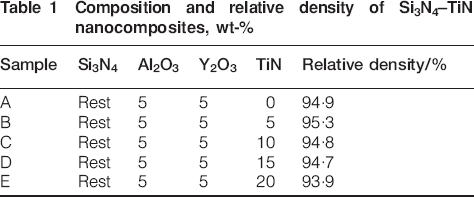
Amorphous and α phase Si3N4 were used as starting powders, and their average sizes were about 20 and 100 nm respectively. The amount ratio of amorphous Si3N4 to α phase Si3N4 is 1∶4 based on previous works.23 The content of nano-TiN powders (40 nm) varies from 5 to 20 wt-%. Yttrium oxide nanopowders (50 nm) and aluminium oxide powders (200 nm) were used as sintering aids and both of their amount were 5 wt-%. The compositions of the starting powder mixtures for ceramics are shown in Table 1. The morphology of Si3N4 and TiN nanopowders was determined by transmission electron microscopy (H-800, Hitachi Ltd, Hitachi, Japan), as shown in Fig. 1.
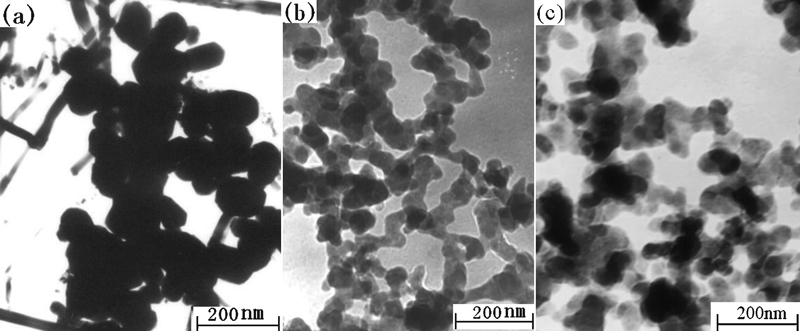
Transmission electron micrographs of Si3N4 and TiN nanopowders a α-Si3N4 powders; b amorphous Si3N4 powders; c TiN powders
Composition and relative density of Si3N4–TiN nanocomposites, wt-%
The powder mixtures are supersonically dispersed for 1 h, ball milled in ethanol for 16 h and dried at 80°C in a vacuum box. After being sieved with 200 mesh sieve, the dried mixtures are sintered at 1700°C in a hot press furnace which is full of nitrogen gas. The applied pressure is 30 MPa and the holding time is 1 h. The samples with the sizes 3×4×36 mm were prepared by diamond cutting from the sintered materials, then mechanically ground and polished to 1 μm. The density of the sintered ceramics was measured with distilled water at room temperature by the Archimedes method. The crystalline phases presenting in the sintered materials were identified by X-ray diffraction (D/max-rB X-ray diffractometry, Rigaku, Tokyo, Japan). An angular accuracy of 0·01° was achieved by careful alignment of the diffractometer.
The distribution of TiN particles in ceramics was identified by a field emission scanning electron microscope (SEM, LEO-1530VP, LEO Inc., Oberkochen, Germany) equipped with an energy dispersive X-ray spectrometer (EDS, INCA X-Sight, Oxford, High Wycombe, UK) using backscattered electron mode. The fracture surfaces of the samples coated with gold were analysed using a secondary electron mode.
The flexural strength at room temperature was measured by a universal testing machine (MTS tester), using the three point bending method. The span length was 30 mm and the crosshead speed was 0·2 mm min−1. The reported values are the mean of six bending samples. Vickers hardness (HV) is measured on an HV–120 hardness tester with a load of 5 kgf. The fracture toughness KIC is obtained by the Vickers indentation technique with a load of 5 kgf, based on the crack length measurement of the radial crack produced by the Vicker hardness indentations. The calculating formula used is KIC = 0·203 HV(c/a)−3/2a1/2.24
Results and discussion
Microstructure and phase
The relative density of the Si3N4–TiN nanocomposites is shown in Table 1. It can be seen that the relative density of the samples initially slightly increases then gradually decreases with the increase in the TiN amount. The initial increase in the relative density is due to the high sintering reactivity of nano-TiN particles which benefit of the densification of ceramics. However, with the further increase in nano-TiN particles, the relative density decreases probably related to the microcracks which caused by the different expansion coefficients between the Si3N4 and TiN grains, and would decrease the relative density of ceramics.
The X-ray diffraction patterns of the samples are shown in Fig. 2. In samples without TiN particle addition, peaks of α-Si3N4, β-Si3N4, Si2N2O and trace of the amorphous phase are detected. Y2O3 and Al2O3 are existed in the final state of amorphous phase. The β-Si3N4 grains should result from the phase transformation during the hot press sintering process. Besides the TiN phase, the phases detected in nano-Si3N4 based ceramics are the same with the samples without TiN particle addition. The intensity of TiN peaks gradually becomes stronger with the increase in the TiN content. When the temperature reaches 1600°C, the following reactions occur during the sintering process which can explain the existence of Si2N2O (Ref. 25)


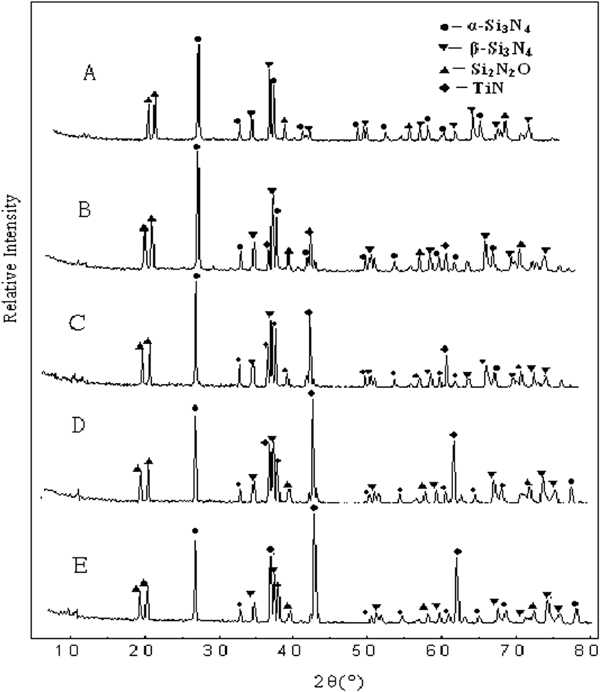
X-ray diffraction patterns of Si3N4 based ceramics: samples A–E
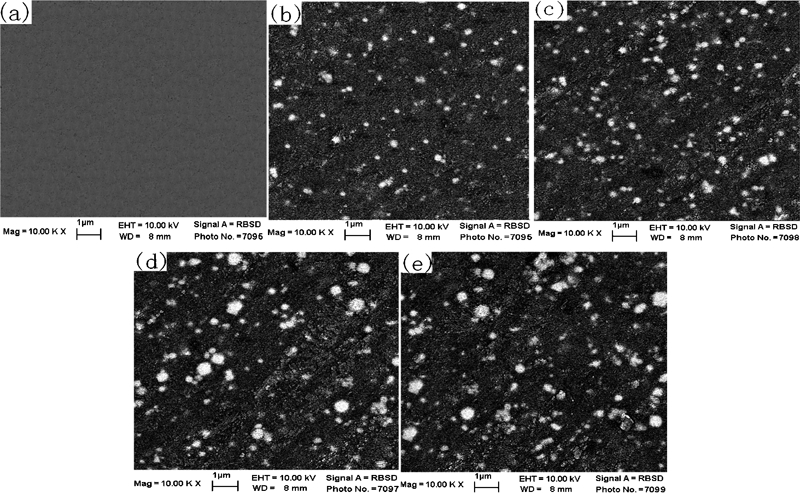
Images (SEM–BSE) showing TiN grains (white) a sample A; b sample B; c sample C; d sample D; e sample E
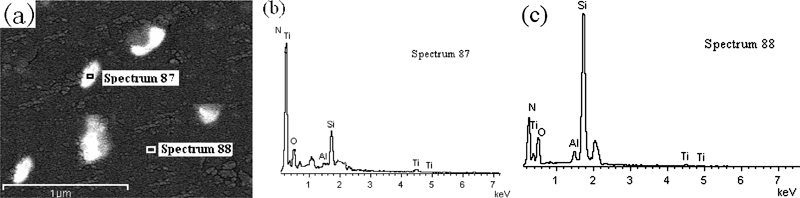
Images of SEM–BSE microstructure and EDS spectrum of selected area of sample C a BSE micrograph; b EDS spectrum of grey region; c EDS spectrum of white region
Scanning electron micrographs of microstructure of the nano-Si3N4 based ceramics are shown in Fig. 5. The microstructures of the nanoceramics consist of spherical grains with an approximate size of 100 nm or less. The addition of nano-TiN particles has no obvious effect on the morphology of the ceramic grains. The shaping of performs within the confined volume of a press mould prevented the removal of monoxide on the starting powders. For this reason, the microstructure of hot pressed Si3N4 ceramics lacks of the typical elongated β-Si3N4 grains.26 When the amount of TiN particles reaches 20 wt-%, it can be seen clearly that some microcracks with the length of 100–300 nm exist in the microstructure. These microcracks were caused by the different expansion coefficients between the Si3N4 and TiN grains, and would decrease the relative density of ceramics.
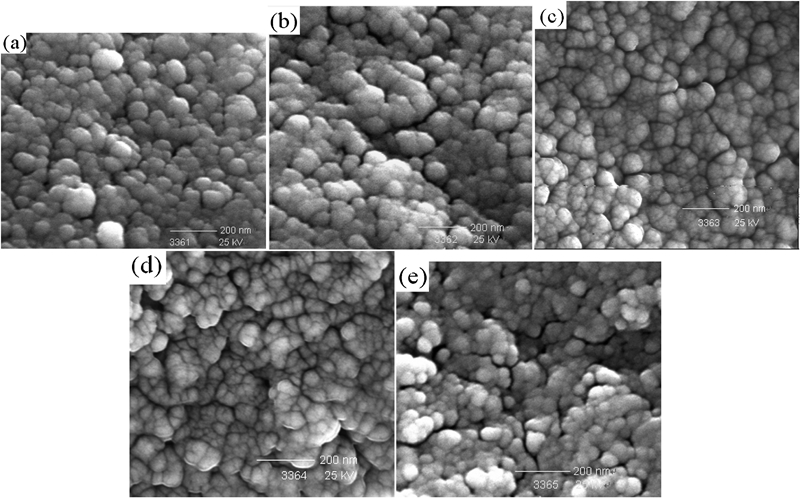
Images (SEM) showing microstructure of nano-Si3N4 based ceramics a sample A; b sample B; c sample C; d sample D; e sample E
The fracture morphologies of nano-Si3N4 based ceramics are shown in Fig. 6. The nanoceramic without TiN addition shows an intergranular fracture mode, and there is no obvious pullout phenomenon of β-Si3N4 grains in the fracture surface. But all nano-Si3N4 based ceramics show the pullout or protrusion effect of TiN particles from the fracture surfaces in a certain degree.
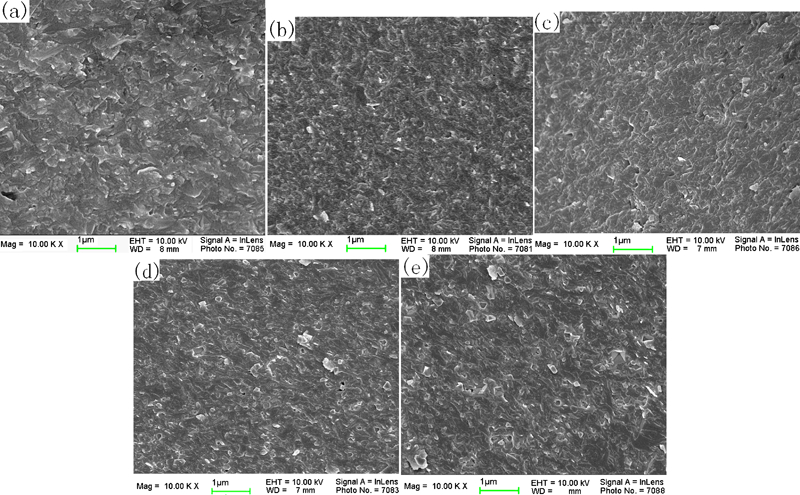
Images (SEM) of fracture surfaces of nano-Si3N4 based ceramics a sample A; b sample B; c sample C; d sample D; e sample E
Mechanical properties
The flexural strength, Vickers hardness and fracture toughness of nano-Si3N4 based ceramics are shown in Figs. 7–9 respectively. The effect of TiN content on mechanical properties was investigated.
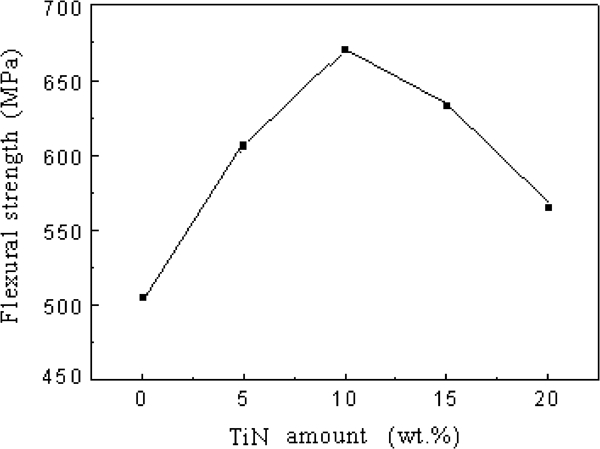
Effect of TiN content on flexural strength of nano-Si3N4 based ceramics
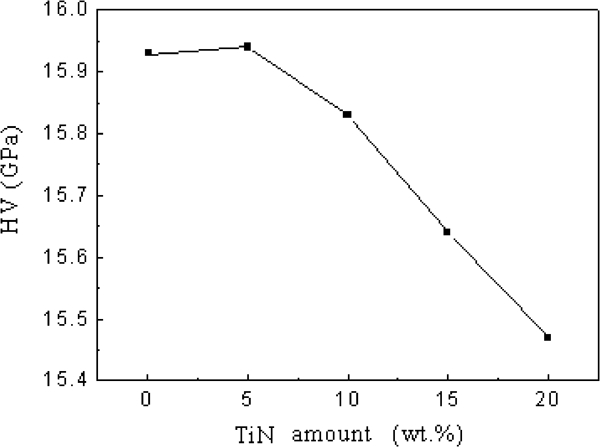
Effect of TiN content on Vivkers hardness of nano-Si3N4 based ceramics
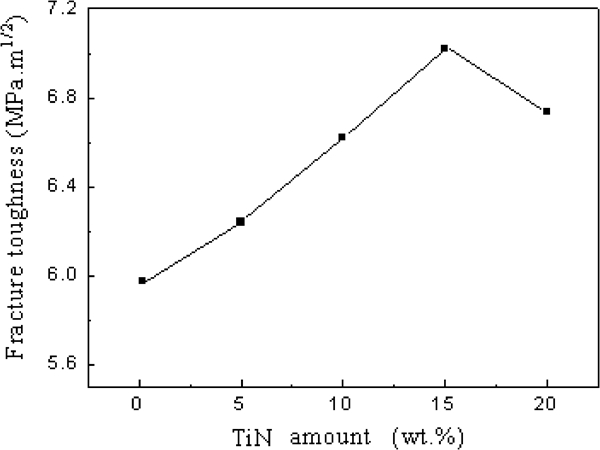
Effect of TiN content on fracture toughness of nano-Si3N4 based ceramics
The flexural strength of nano-Si3N4 based ceramics increases initially and then decreases with the further increase in the TiN content. The flexural strength reaches a maximum value when TiN amount is 10 wt-%. The increase in strength is mainly related to the crack face shielding effect of TiN particles. Moreover, the pullout of TiN particles during fracturing process will dissipate more energy which contributes to the increase in the flexural strength. When the amount of TiN particles is >10 wt-%, the agglomeration of TiN particles will inhibit the densification process during sintering which results in the decrease in density and flexural strength. In addition, the large internal stress induced by the thermal mismatch between TiN and Si3N4 in cooling process can cause obvious initial microcracks in the microstructure of nano-Si3N4 based ceramics (Fig. 5e), which is also harmful to the flexural strength.
The effect of TiN particles on Vickers hardness of silicon nitride nanocomposites is shown in Fig. 8. The hardness values of Si3N4–TiN nanocomposites slightly decrease with the increase in the TiN content. This is probably due to the decrease in the relative density as shown in Table 1. In general, the hardness is in the same level, i.e. 1547–1595 HV. Figure 9 shows the effect of TiN content on the fracture toughness of nano-Si3N4 based ceramics. The fracture toughness increases initially with the increase in the TiN content and then decreases. The highest fracture toughness was obtained in nano-Si3N4 based ceramics reinforced with 15 wt-%TiN particles.
In particulate composites, a principal source of increased fracture toughness is believed to be the crack deflection and bridging caused by reinforcing particles ahead of a propagating crack.13,27 Figure 10 shows a typical example of the observed cracks in the nano-Si3N4 based ceramics. The SEM–BSE micrograph indicates that the crack front never propagated in a straight line, but rather deflected or diverged around the TiN particles. Therefore, the propagation path of the crack is prolonged, and more energy will be dissipated, which results in the increase in the fracture toughness. It can be seen from Fig. 10 that the crack propagated along the particle/matrix interfaces rather than traverse the dispersed particles, which correlates well with the fracture surface observations of nano-Si3N4 based ceramics. The internal residual stress generated during cooling after sintering because of the different thermal expansion coefficients between the Si3N4 and TiN. In this case, compression and tension will occur, in the tangential and radial direction respectively, of Si3N4 matrix around TiN particle. The tangential stress will induce the crack to propagate toward the particles, which results in the deflection of the crack. This is contributed to the increase in the fracture toughness. However, when the TiN content is up to 20 wt-%, the microcrack will emerge around large agglomerated TiN particles due to the fact that the stress level increases with the increase in the particle radius. The existence of microcracks with the large scale will decrease the fracture toughness.
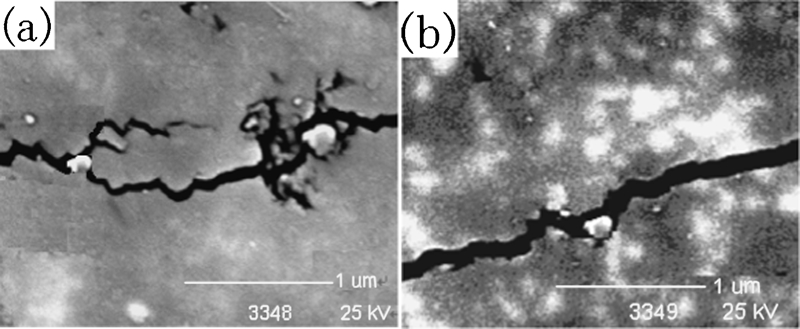
Morphologies of propagation paths of indentation crack in composites a Si3N4–5 wt-%TiN sample; b Si3N4–15 wt-%TiN sample
Conclusions
The microstructure of nano-Si3N4 based ceramics consisted of spherical grains with an approximate size of 100 nm or less, and the addition of nano-TiN particles had no obvious effect on the morphology of the Si3N4 grains. The principal phases were α-Si3N4, β-Si3N4, Si2N2O and TiN.
The flexural strength and the fracture toughness both increased initially and then decreased with the further increase in TiN particles. The maximum values of the flexural strength and fracture toughness were obtained in nano-Si3N4 based ceramics containing 10 and 15 wt-%TiN particles respectively. The hardness values of nano-Si3N4 based ceramics slightly decrease with the increase in TiN particles.
Crack deflection and bridging caused by TiN particles are the main strengthening and toughening mechanisms.