







Abstract
To develop new solid lubricant films based on low friction multilayer model, nanoperiod Au and Ag multilayer films are deposited. The results of nanoindentation tests reveal that multilayer films exhibit a higher elastic modulus, a higher hardness and a lower modulus of dissipation energy than single layer films. From the ball on disc tribological test, the friction coefficient of multilayer film μ is as low as ∼0·05. The friction life cycle of the nanoperiod multilayer films is longer than those of single layer films. The electrical resistivity of nanoperiod multilayer films induced by sliding is a little higher, and the change in that is less than that of single layer films.
Introduction
To improve the tribological properties of materials used in various fields, an investigation of the application of solid lubricant films, whose friction coefficient can possibly be lowered, is desired. Because the employment of conventional lubricant oils has not been successful in severe environments, such as clean, high temperature and vacuum environments, of moving components of machines, there will be an increasing demand to employ solid lubricant films instead of conventional lubricant oils. It is well known that there are many candidate solid lubricants including soft metal materials, such as Au and Ag, inorganic layer crystal materials, such as MoS2 and WS2, as well as polymer materials, such as polytetrafluoroethylene. Among such materials, soft metal materials, despite their higher friction coefficient and poorer durability than other solid lubricants, such as MoS2, are currently used in electrical and mechanical parts, such as electrical contacts, owing to their high electrical conductivity.1
Therefore, low friction wear resistant electroconductive solid lubricant films, rather than conventional self-sacrificing type solid lubricant films, are desired. Ion plated Au and Ag films have been studied and used for the space lubrication of mechanical and electrical parts.2–4 The increasing demands placed on electroconductive solid lubricant films have resulted in considerable efforts of improving their endurance.5 A significant enhancement of the sliding lifetime of Ag ion plated films due to ion implantation was realised. It was found that the Ar ion bombardment of an Ag film enhances the adhesion of this film to a substrate due to the mixing of the film and substrate and increased friction coefficient due to damage caused by high energy ion bombardment.6 The effect of other solid lubricant additives on coatings sputtered by co-deposition and in the form of multilayers was studied, 7 7,8 and the results showed significant improvements in lubrication and endurance properties. Research on the development of nanoperiod multilayer films to improve film hardness has recently been carried out. For example, hard (C/TiN)n films were deposited, and it was found that the hardness of these multilayer films is maximum at a certain period, as determined by nanoindentation testing.9 The hardness enhancement mechanisms in superlattice films are based on the restriction of dislocation movement within and between layers in a superlattice film.10 In our previous study, a nanoperiod (CN/BN)n multilayer film was deposited in order to increase hardness.11 The nanoindentation hardness and lowest observed modulus of dissipation of the 4 nm period multilayer film are the highest and lowest observed for such films respectively. The dependence of atomic order wear properties on the sliding cycles indicates that the wear resistance increased at the interface between the CN and BN layers of the multilayer films.12
Generally, in elastic deformation, the friction coefficient μ is defined as equation (1)


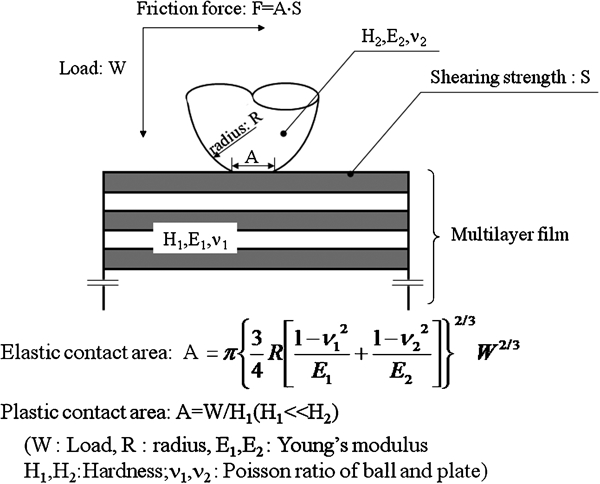
Model of nanoperiod multilayer solid lubricating films
In this study, to realise low friction, long lifetime electroconductive solid lubricant films using the nanoperiod multilayer solid lubricant model, Ag and Au nanoperiod multilayer films were deposited, and their nanoindentation and tribological properties were evaluated.
Experimental
Film deposition methods
Nanometre period (Au/Ag)n and (Ag/Au)n multilayer films composed of alternating Au and Ag layers were deposited using an radio frequency (rf) sputtering apparatus that can supply high frequency power to both the target and the substrate, as shown in Fig. 2. The two types of semicircular target of Ag and Au were repeatedly set facing the specimen in an Ar gas atmosphere. Reactive sputtering was accomplished by supplying a 2 Pa plasma pressure. The rf powers on the sample and target sides are 50 and 200 W respectively. Before deposition, sputter cleaning using Ar is performed as a pretreatment. Sample temperature is maintained at <70°C by water cooling. A Si(100) wafer was used as the substrate. The layer period of the deposited multilayer films that showed the best friction characteristic and hardness was 4 nm, using the same rf sputtering apparatus. 11 11,12 The nanoindentation hardnesses of the 2, 4 and 6 nm period (Au/Ag)n multilayer films were evaluated. The 4 nm period multilayer film has the highest indentation hardness among these multilayer films, such as (CN/BN)n multilayer films.11
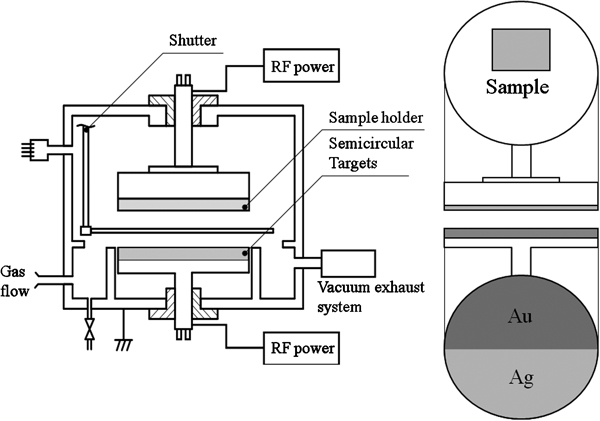
Schematic illustration of rf sputtering
In the deposition of a 4 nm period multilayer film (Ag/Au)n in which the top layer is Ag, the substrate was set opposite the Au target at first and then rotated opposite the Ag target. A 4 nm period multilayer film is 2 nm thick for each layer; therefore, the total number of layers of 4 nm period multilayer films was 100. The top surface is an Ag layer, as shown in Fig. 1. Nanometre period (Au/Ag)n multilayer films, in which the top layer is Au, were deposited by a similar method.
The time that the substrate was held facing each target was determined by deposition rate. The sputtering deposition rate of the Au film is nearly equal to that of the Ag film. Both deposition rates are similar as ∼0·5 nm s–1. Therefore, to obtain the same thickness for both the Au and Ag layers, the time that a substrate is held opposite the Au target is nearly equal to that in the case of the Ag target. Ag and Au single layer films were deposited on Si surfaces, which were opposite the Ag and Au targets respectively, in an argon atmosphere, without substrate rotation. Under these conditions, an Ag–Au mixed film was deposited by setting the substrate opposite the centre of the two targets. The total thicknesses of all the films tested were set at ∼200 nm.
Nanoindentation deformation test
Then, the nanoindentation deformation properties of the surfaces of the deposited films were clarified using atomic force microscopy (Digital Instruments Nanoscope III) together with a nanoindentation measurement system (Hysitron Inc.). The hardness of these films was evaluated using a nanoindentation test apparatus. The maximum load was changed from 50 to 200 μN. Plastic deformation depth was evaluated from the nanoindentation curve, and the contact area Ap was calculated. Pmax is the maximum load in the measurement. Then, H was evaluated from H = Pmax/Ap, 18 18,19 as shown in Fig. 3.
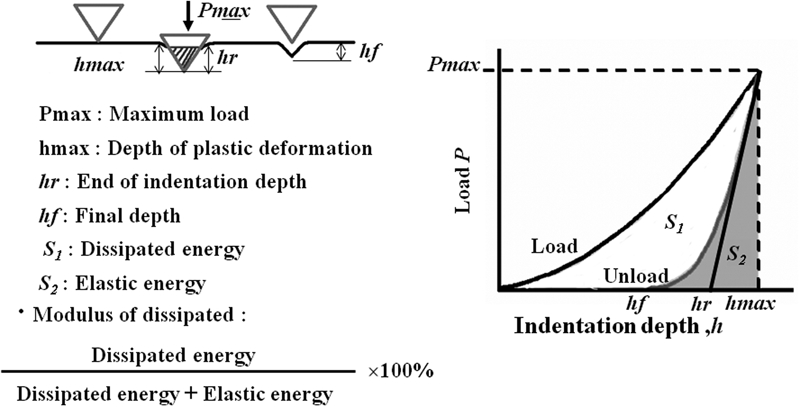
Evaluation method of nanoindentation test
To clarify the deformation mechanism of multilayer films, an energy analysis of nanoindentation was performed.20 Total deformation energy was calculated as the integral of the loading curve. Storage energy was calculated as the integral of the unloading curve. Dissipated energy was evaluated as total energy minus storage energy. The modulus of dissipation was calculated as dissipated energy divided by total energy. 11 11,12 The material factor E/H of the index of plasticity was evaluated by dividing E by H.21
Tribological test
Sliding tests were performed using a ball on disc type friction tester, as shown in Fig. 4, at 50–70% humidity. Disc specimens with deposited films were rotated. A stainless steel (SUS 440C) ball (radius, 3 mm) was made to slide against the specimen, and friction force was measured with a strain gauge attached to the plane spring. The test velocity and load were 31·4 mm s–1 and 1 N respectively. Friction coefficient was evaluated more than three times under the same conditions, and mean and typical data were discussed. The electrical resistivities of the friction tested and as deposited films were evaluated by the four-probe method apparatus (Kyowa Dengyo). The electrical resistivity of wear trace was measured using a 50 μm radius probe, more than seven times for 100 sliding cycles, after the endurance lifetime tribological test. The mean thickness of these films after sliding was evaluated by measuring the changes in the profile. The resistivity of the sliding area was corrected using the mean film thickness.
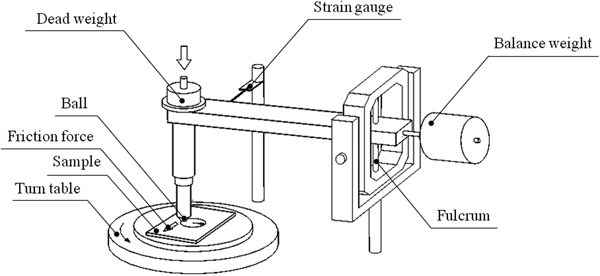
Ball on disc type friction tester
Results and discussion
Composition and structure
The composition of the multilayer films was evaluated by Auger electron spectroscopy analysis. The mean molecular percentages of Ag in the (Au/Ag)n and (Ag/Au)n multilayer films are nearly 50% equal to those of Au. X-ray diffraction analysis of the (Au/Ag)n and (Ag/Au)n nanoperiod multilayer films, and of Au, and Ag single layer films, was carried out. Peaks at 2θ = 38–39° corresponding to Au(111) and Ag(111) were observed in the (Au/Ag)n and (Au/Ag)n multilayer films and in Au and Ag single layer films. Peaks corresponding to (200), (220) and (311)of Au and Ag were also observed clearly in the multilayer films. Both the multilayer and single layer films had similar peak distributions. The multilayer films had a crystalline structure similar to single layer films, as determined by X-ray diffraction analysis. The roughness of these deposited films was <1·5 nm Ry, as determined by atomic force microscopy.
Nanoindentation hardness
The nanoindentation curves of the nanoperiod multilayer (Au/Ag)n films obtained at the maximum applied load at 50 μN are shown in Fig. 5. The maximum indentation depth of the (Au/Ag)n multilayer films is 7·1 nm, which is less than those of Au and Ag single layer films. The residual plastic deformation depths of the (Au/Ag)n multilayer films are one-fifth and one-seventh those of the Au and Ag single layer films respectively. The extent of plastic deformation corresponding to the residual depth decreases owing to the application of a nanoperiod multilayer structure under a high load. The thickness of the first Au layer is nearly 2 nm, and its surface roughness is 3·1 nm Rz. Therefore, up to a depth of nearly 3 nm, the slope, i.e. the indentation contact stiffness, is very small, similar to that of a single layer film. However, once the diamond tip reaches the interface between the Au and Ag layers of the nanoperiod multilayer film, the progress of plastic deformation is prevented. 11 11,21 Therefore, the slope increases rapidly at a depth of nearly 3 nm.
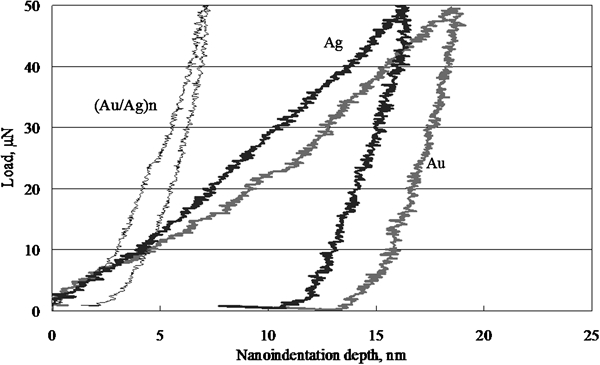
Nanoindentation curve of (Au/Ag)n films
The hardness and Young's modulus evaluated on the basis of the nanoindentation curve are shown in Fig. 6. The hardness of the nanoperiod multilayer (Au/Ag)n film is 1·5–2·0 times higher than those of the Ag and Au single layer films. The Young's modulus evaluated from the inclination of the unloading nanoindentation curve18 shows a similar tendency to hardness. The Young's modulus of the nanoperiod multilayer films is higher than those of the Au and Ag single layer films. The error bars show three times standard deviation (3σ). The hardness and Young's modulus are increased by the application of nanoperiod multilayer structures, such as the (CN/BN)n multilayer films prepared using the same deposition apparatus.11 Therefore, low friction properties are expected for the (Au/Ag)n nanoperiod multilayer films with increases in E and H, as shown in Fig. 1.
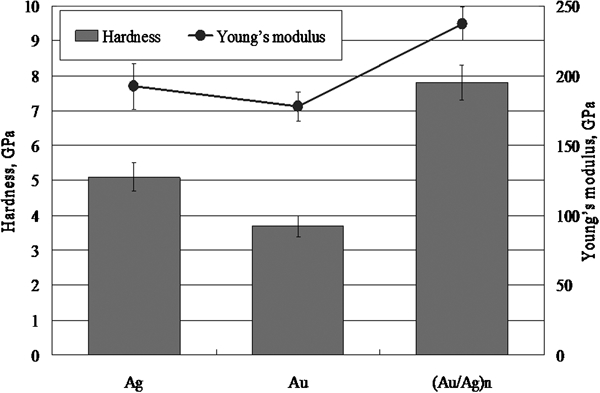
Nanoindentation hardness and Young's modulus of (Au/Ag)n films
The Young's moduli of the Au and Ag targets measured under the same conditions are 96·8±18·6 and 118·5±32·4 GPa (±3σ) respectively. The Young's modulus of the Au target corresponds to the bulk values of polycrystalline Au of 80 GPa and single crystalline Au in the [111] direction of 120 GPa.22 In contrast, the Young's moduli of the Au and Ag films are higher than those of the Au and Ag target materials measured under the same conditions. Young's modulus was evaluated because the maximum nanoindentation depth is nearly 15% of the film thicknesses; therefore, the Young's moduli of these films are affected by that of the substrate.23 The internal energy of the multilayer films was changed owing to their nanometre structure, resulting in their hardness and Young's modulus being significantly increased. It was clarified that the mechanical properties of the multilayer films were improved owing to the formation of the interfaces between the period layers.21 For these nanoperiod multilayer coatings, the mechanism of hardness enhancement is based on the restricted dislocation movement within and between layers in a multilayer film.10
Figure 7 shows the relationships between the modulus of dissipation E/H and nanoindentation hardness. The modulus of dissipation and E/H decreased with increasing hardness. E/H, evaluated as E divided by H, is the material factor of the index of plasticity. Nanoindentation hardness is defined as the resistance to plastic deformation per unit area. On the other hand, the modulus of dissipation and E/H of all these indentation tests correspond to the ease of plastic deformation. 24 24,25 The relationship between the modulus of dissipation and E/H of these nanoindentation tests is expressed approximately as the master curve shown in Fig. 8. A hard multilayer film shows a low modulus of dissipation and a low E/H; therefore, this multilayer film shows resistance to plastic deformation. Dissipated permanent deformation, such as cracks or dislocation formation, occurred with difficulty on the multilayer films, as observed in the nanoindentation test. Therefore, high wear resistance properties are expected for nanoperiod multilayer films.
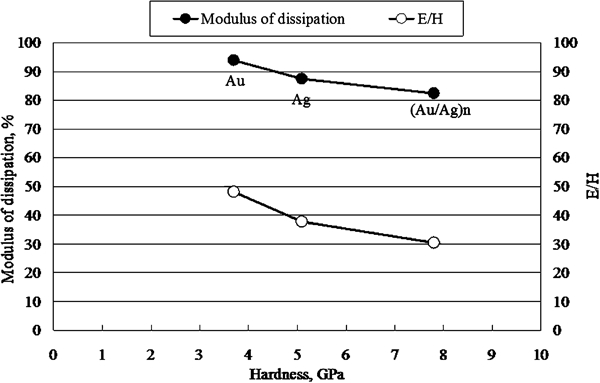
Dependencies of modulus of dissipation energy and E/H on nanoindentation hardness
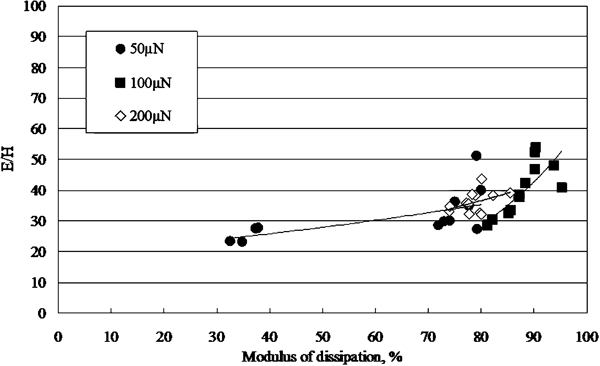
Relationship between modulus of dissipation and E/H of (Au/Ag)n films
Tribological properties
Figure 9 shows the typical dependences of friction coefficient on the number of sliding cycles. The friction coefficient of the Au single layer films is as low as μ = 0·1, but increases rapidly after ∼1300 sliding cycles. In contrast, the friction coefficient of the Ag single layer films increases at an earlier stage and reaches 0·9 after 1000 sliding cycles. The friction coefficient of the Ag–Au mixed films is large and changes from 0·1 to 0·4 after a small number of sliding cycles and then increases gradually to 0·9 after 1000 cycles.
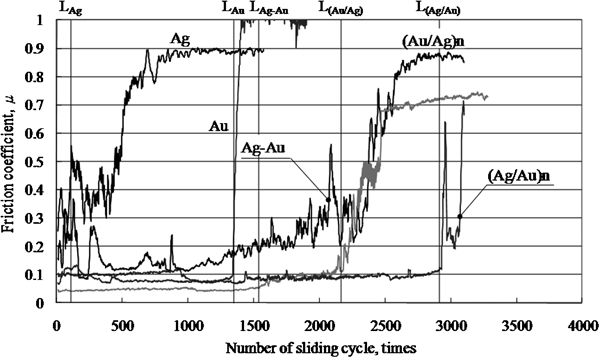
Tribological properties of multilayer solid lubricant films: dependence of friction on number of sliding cycles
Photographs of sliding scars after 100 cycles are shown in Fig. 10. The sliding surface of the Ag single layer film is severely damaged. This result shows that the friction coefficient of the Ag film is high and fluctuates in the early cycles, as shown in Fig. 9. Therefore, film material adhered to the ball, then sheared against the film and then was gradually peeled off by sliding. When part of the substrate is exposed, friction coefficient increases rapidly. The widths of the sliding tracks of the (Au/Ag)n and (Ag/Au)n multilayer films are smaller than those of the sliding tracks of the single layer films. In particular, the width of the scars on the (Au/Ag)n films is the smallest because the contact area is small owing to the high hardness of the films. From the cross-sectional profiles of the sliding scars, as shown in Fig. 11, the surface of Ag is rough and damaged and its substrate is exposed; therefore, the adhesion between the substrate and the ball is caused by the fracture of the film. In contrast, there are few wear scars in the sliding areas of the other films. The wear depths of these films are <100 nm. In this case, film material was partially transferred to the ball and was sheared between the ball and the film. The contact area of the nanoperiod multilayer films is smaller than those of the single layer films.
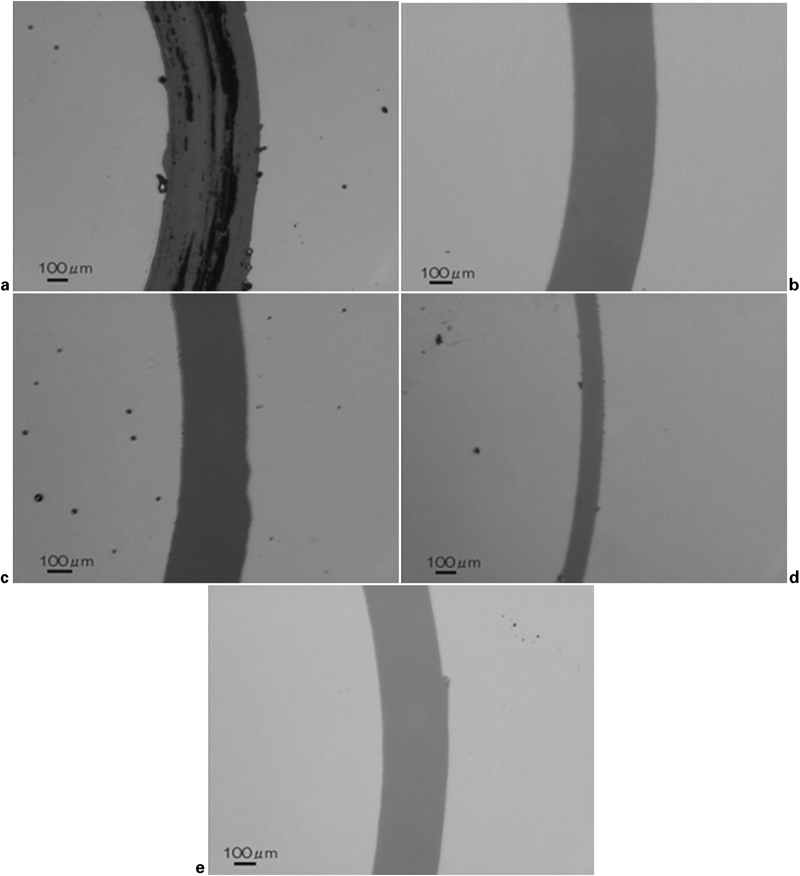
Photographs of sliding scars after 100 cycles:
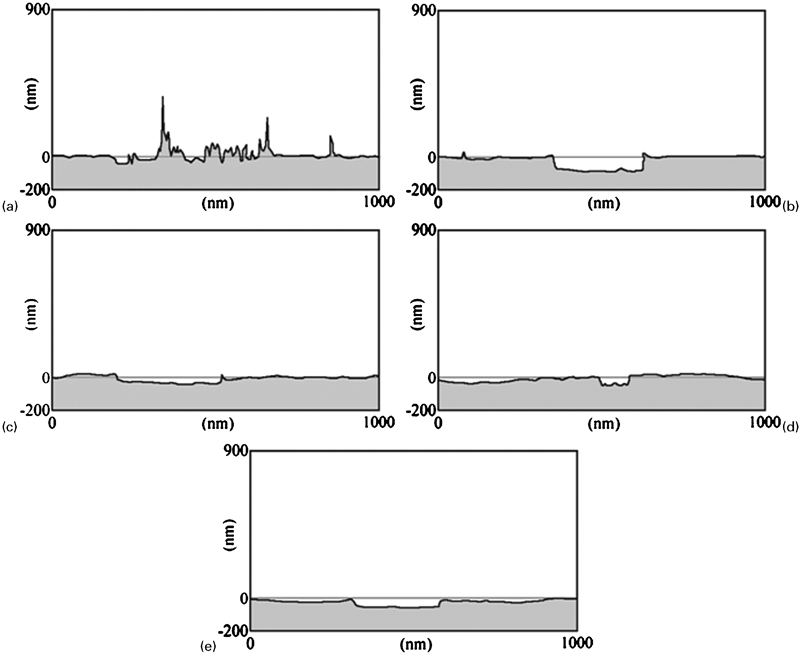
Cross-sectional profiles of sliding scars after 100 cycles:
The friction coefficient of the 4 nm period (Au/Ag)n multilayer film with an Au top surface is as low as μ = 0·05 at first, then increases gradually after 1500 cycles or more to reach approximately μ = 0·1 and stabilises with increasing number of sliding cycles. The friction coefficient increases rapidly after ∼2100 cycles. The friction coefficient of the 4 nm period (Ag/Au)n multilayer film is as low as μ = 0·08 to 0·1 and is stable up to ∼2900 cycles. After 2900 cycles, the friction coefficient increases rapidly. A 4 nm period (Ag/Au)n multilayer film with an Ag top surface shows a longer endurance life cycle than the Ag and Au single layer films, and (Au/Ag)n multilayer films.
Under lower load conditions, the contact is elastic, and therefore, the friction coefficient and the average friction coefficients of the 4 nm period (Au/Ag)n and (Ag/Au)n multilayer films are very low at nearly μ = 0·05 and 0·08 respectively. The wear depth corresponds to 50 nm; therefore, shearing in the film and surface occurred as shown in Fig. 2, which reduced the contact area as shown in Fig. 1. Therefore, these multilayer films show very low friction coefficients.
Very low friction coefficients for the 4 nm period (Ag/Au)n and (Au/Ag)n multilayer solid lubricant films can be realised by applying the low friction model shown in Fig. 1. The friction coefficients of the Au single layer film are lower than those of the Ag single layer film before the life cycle in which the friction coefficient rapidly increases. The friction coefficients of the (Au/Ag)n multilayer film with an Au top surface are lower than those of the (Ag/Au)n multilayer film. It is deduced that the extremely thin Au top surface has a reduced friction coefficient, similar to that of the traction coefficient of Au single layer film, which are lower than those of Ag single layer film. These results reveal that the 2 nm thick top surface affects tribological properties as in (C/BN) multilayer films.16
The friction life cycles L(Au/Ag) and L(Ag/Au) of the multilayer films, evaluated from the number of sliding cycles for which friction coefficient increases rapidly, are larger than those of the Ag and Au single layer films, as shown in Fig. 9. In particular, the life cycle L(Ag/Au) = 2900 cycles of the (Ag/Au)n multilayer film is the longest, being 3 and 20 times longer than LAu and LAg of the Au and Ag single layer films respectively. Three sliding tests show similar results, and the variation in life cycle is <15%.
The endurance life cycle was clearly improved owing to the application of a nanometre period multilayer structure. The reason for these longer endurance life cycles is that the multilayer films have a low modulus of dissipation and E/H, indicating difficulty of permanent deformation. The defects caused by sliding, e.g. elongations in the depth direction, were suppressed by interfaces between layers of the multilayer films, as in the carbon nitride and boron nitride multilayer films.11 Therefore, the wear rates of the multilayer (Au/Ag)n and (Ag/Au)n films are lower than those of the Ag and Au single layer films. Deep wear occurred with difficulty on these multilayer films with friction, and a long life cycle was obtained. (Au/Ag)n nanoperiod films have a high H/E; therefore, high durability and greater endurance were obtained under these low contact pressure conditions. 26 26,27 Figure 12 shows the electrical resistivity of the various deposited films with the number of friction cycles. Error bars show three times standard deviation (3σ). On the as sputtered surface, the electrical resistivities of the Ag and Au single layer films are as low as 0·5 and 1·8 μΩ cm respectively, and those of the multilayer films are higher in the vicinity of 18–30 μΩ cm.
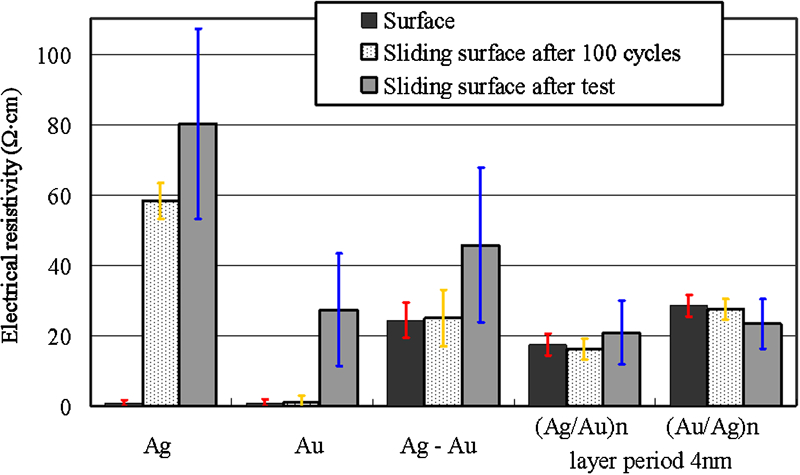
Changes in electrical resistivity due to sliding
The electrical resistivity of the single layer and Au–Ag mixed films tend to increase with the number of friction cycles. For example, the resistivity of the Au films changed only slightly after 100 cycles, but it increased to 27 μΩ cm after 1500 sliding cycles. The resistivity of the Ag film increased to 60 μΩ cm after 100 sliding cycles, owing to the removal of the Ag film material and to the exposure of the substrate layer. It increased to 80 μΩ cm after 2000 sliding cycles. The larger change in the resistivity of the Ag single layer film is considered to be due to Ag being easily oxidised and worn away by sliding. Au exhibits oxidisation resistance; therefore, its change in electroresistivity is less than that of the Ag film.
On the other hand, the resistivity of the (Ag/Au)n multilayer film hardly changed and was in the range of 16–20 μΩ cm after the friction test and that of the (Au/Ag)n multilayer film changed only slightly and was in the range of 23–28 μΩ cm. It is considered that the stability of electrical resistivity depends on the presence of weak surface damage. These results show that stable electroconductive solid lubricant films were obtained owing to the application of a nanoperiod multilayer structure.
Conclusion
To develop new low friction electroconductive solid lubricant films, Ag and Au nanometre period multilayer films were deposited by rf sputtering, and their nanoindentation and tribological properties were evaluated. The main results are as follows.
The results of nanoindentation tests revealed that the multilayer films showed a higher Young's modulus, a higher hardness, a lower modulus of dissipation energy and a lower material factor of plastic index E/H than the single layer films.
The friction coefficient of a 4 nm period multilayer (Au/Ag)n film was as low as μ = 0·05 in ambient atmosphere, following the low friction model of nanoperiod multilayer films. The friction endurance life cycles of the multilayer films evaluated from the number of sliding cycles were longer than those of the Ag and Au single layer films.
The electroconductivity of the above mentioned films was stable during the sliding tests. The change in the electrical resistivity of the nanoperiod multilayer films caused by the sliding test was less than that of single layer films.
Footnotes
Acknowledgements
This research was partly supported by a Grant-in-Aid for Scientific Research (B) (grant no. 21360076) from Japan Society for the Promotion of Science.