







Abstract
In this study, carbon based nanomaterials such as onion-like carbon (OLC), carbon nanotube and buckminsterfullerene (or buckyball) (C60) have been investigated as nanocolloidal additives for liquid lubricants. When tested under a range of contact pressures from 0·51 to 1·10 GPa, OLC provided the best overall friction reducing property in synthetic lubricant, although the friction reducing properties of all nanocarbon materials were dependent on the contact pressure. Detailed transmission electron microscopy revealed that the OLC kept its original structure intact and induced the formation during sliding of a thin ‘tribofilm’ composed of OLC, nanosized wear debris, amorphous carbon and graphitic layers on the wear debris. This tribofilm seems to be responsible for reduced friction under boundary conditions.
Introduction
Onion-like carbon (OLC), which belongs to the carbon fullerene families together with C60 and carbon nanotube (CNT), consists of multilayered concentric graphitic shells.1 Since the discovery of this material, a wide range of industrial applications have been proposed for OLC, especially in the areas of energy storage, superconductivity and biomaterials (due to its unique structure having large surface areas and excellent strength).2,3 One of the promising applications of OLC is in lubricants, mainly because OLC is considered as a closed, quasi-spherical form of graphite, which is a well known solid lubricant. Indeed, several groups in the past have tested a variety of nanomaterials such as OLC and other inorganic fullerenes of MoS2 and WS2 as additives in liquid lubricants. Several investigators showed that these materials can indeed enhance the friction reducing properties of liquid lubricants.4–8 A possible cause for the lower friction in these lubricants is the rolling motion of the nanomaterials with quasi-spherical shape. In the case of MoS2 and WS2 inorganic fullerenes, the spherical nanostructure is often fractured during the sliding action and turned into a lubricious planar lamellar layer on the sliding surface to reduce friction.8 According to a detailed transmission electron microscopy (TEM) study by Joly-Pottuz et al., unlike other inorganic fullerenes, OLC induced the formation of a lubricious γ-Fe2O3 phase during sliding.4 Despite all these studies, it is still unclear as to how OLC improves the friction reducing property of liquid lubricants. In this study, we concentrated our attention on the friction reducing property of OLC in a poly-alpha-olefin (PAO) oil under a wide range of pressures (0·50–1·10 GPa) in ball on flat sliding tests and conducted detailed TEM analysis of the cross-section of the sliding surface, including the tribofilm that formed during testing. We similarly tested CNT and C60 in order to compare the friction reducing properties of these nanocarbons against OLC. The mechanisms for the friction reducing property of OLC are discussed in detail on the basis of the fracture or non-fracture of OLCs during sliding.
Experimental
Onion-like carbon was prepared using the conventional method of vacuum heating of diamond nanoparticles whose nominal diameter was around 5 nm. The temperature and pressure were 1600°C and 10−4 Pa respectively. The diamond nanoparticle powder was heated for 10 min. The CNT particles were synthesised by plasma assisted chemical vapour deposition with a flow of C2H2 gas on a Fe catalyst deposited on an Si (001) substrate; the details of the process are described elsewhere.9 Mechanically scraped or removed CNT particles from the Si substrate were used in our experiments. The configuration (i.e. the diameter and length) and the crystalline structure of the synthesised OLC and CNT were confirmed using high resolution TEM (JEOL2010). In addition, commercially available 99% pure C60 was obtained from an outside vendor (MER Co., USA). The OLC particles (∼5 nm in diameter), CNT particles (∼40 nm in diameter and ∼2 μm long) and C60 samples were dispersed in the base oil by an ultrasonic generator for 10 min. The base lubricant was PAO 4 with a viscosity of 30 mm2 s−1 at 40°C. The friction of the carbon additives in PAO was measured with high frequency reciprocating rig sliding tests using cylindrical test samples against highly polished flats. The cylinders were 6·35 mm in length and 4·7 mm in diameter and were made of hardened AISI 52100 steel with nominal hardness of 850 HV. The steel plates were also made of the AISI 52100 steel and well polished to a nominal surface roughness Ra of 0·02 μm. The reciprocating tests were conducted with different normal force to achieve different Hertzian contact pressure; the reciprocating speed was 0·05 m s−1, the maintaining stroke length was 6 mm and total sliding distance was 180 m. The relative humidity of test environment was about 30%. The reciprocating tribo test was lubricated on the flat specimen before the test by wetting it with several drops (5 mL) of test lubricant before commencing the test at 100°C. All reciprocating tests were performed three times for each test for repeatability and reliability. After the friction tests, the surfaces of the samples were gently cleaned by ethanol to eliminate the PAO, then analysed by atomic force microscopy (AFM).
The ultrahigh vacuum scanning probe microscopy (Omicron UHV STM/AFM) was used to investigate the topographical features of the tribofilm formed during tribological testing of OLC based lubricant on the steel flat surface. Raman spectra were acquired with an UV enhanced charge coupled device (CCD) camera, and a ×40 UV objective was mounted on the microscope. Integration times ranged from 60 to 300 s. The power on the sample was kept at 0·3 mW. Raman spectra were thus collected by varying acquisition times and laser power, but no damages were detected. Visible Raman device was composed of an argon ion laser tuned at 514·5 nm and a visible CCD camera. Microscope objective was ×50 of magnification. Acquisition times were typically 120 s.
Results and discussion
The friction coefficient versus concentration and contact pressure of OLC dispersed in PAO is shown in Fig. 1a. The inset TEM image shows the structural details of quasi-spherical OLC particles composed of concentric graphitic shells. The diameter of the OLC particles is around 5 nm. At all the contact pressures (0·51, 0·70 and 0·94 GPa), the friction coefficients first sharply decreased with increasing additive concentration and then gradually increased. The optimum concentration of OLC regarding the friction coefficient is around 0·1 wt-% for all the contact pressures. The additive concentration in PAO was then fixed at 0·1 wt-% for the following experiments. The friction coefficients of pure PAO and PAO containing three kinds of carbon additives (OLC, CNT and C60) are shown in Fig. 1b. At relatively low contact pressures of 0·51 and 0·70 GPa, the addition of OLC, CNT and C60 reduced the friction coefficient compared with the pure PAO. At the high contact pressure of 0·94 GPa, the addition of CNT resulted in a little higher friction coefficient than that of the pure PAO. In contrast, C60 and OLC maintained friction reducing effects at 0·94 GPa, with OLC yielding the lowest friction coefficient (0·07). Therefore, we concluded that the friction reducing property of nanocarbon materials is highly dependent on the contact pressure. The inset to Fig. 1b indicates that the enhancement in friction coefficient compared with PAO alone occurs after about 35 cycles.
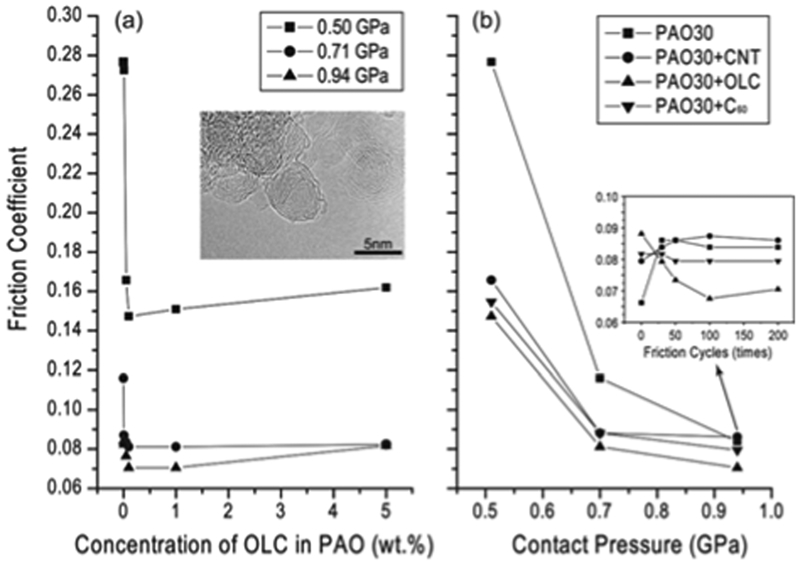
Friction tests results of PAO with OLC additives
Figure 2a–d shows AFM images of the flats after the friction tests at 0·94 GPa. Clear friction tracks are observed along the sliding direction, except for the test pair lubricated with CNT containing PAO. Additionally, the images indicate that the addition of the nanocarbon additives in PAO leads to higher roughness under our sliding conditions. This effect may be due to the deposition of the additives contained in PAO during the repeated sliding passes. Indeed, Fig. 2e, the Raman spectrum for the surface after the 200 sliding cycles lubricated by OLC shows D and G peaks at around 1350 and 1580 cm−1, which correspond to the existence of the graphitic components on the friction surface.
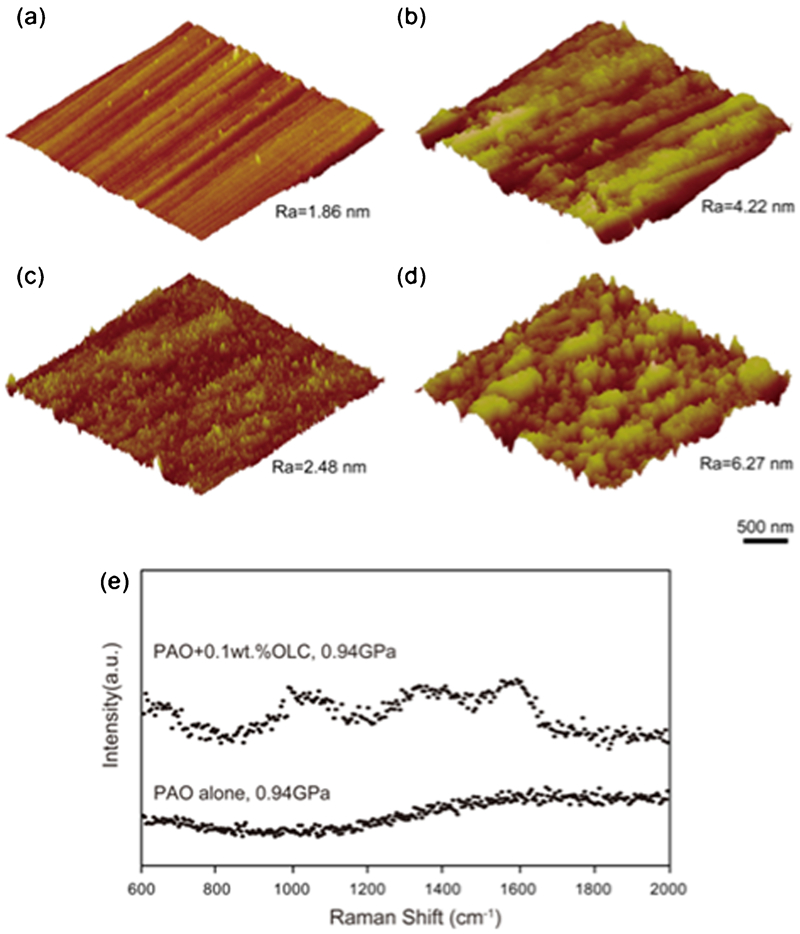
Images (AFM) of steel surface after 200 cycle friction tests lubricated by a pure PAO, b PAO with OLC, c PAO with C60 and d PAO with CNT, and e Raman spectra of steel surface lubricated by pure PAO and PAO with OLC excited by Ar laser at 514·5 nm
It is possible that surface modifications during friction take place with the high contact pressure. In fact, the friction reducing property of the OLC continued to improve at 0·94 GPa, as shown in Fig. 1b. However, it is not clear how OLC keeps the friction reducing property at such high pressure, that is, whether the carbon onions maintain their nanostructure or not. The OLC might be fractured to form a lubricious coating on the steel surface, as reported for the inorganic fullerenes MoS2 or WS2.8 To investigate this issue, we conducted cyclic load friction experiments. In this measurement, continuous friction tests were carried out under the alteration of the contact pressures (0·72–0·85–0·93–1·10–0·93–0·85–0·72 GPa repeated two times, 200 reciprocations for each pressure) by replacing the deadweights. Figure 3 shows the friction coefficients observed for pure PAO and PAO containing OLC under the cycle load changes. Significant hysteresis was not observed for pure PAO; on the contrary, the friction coefficient increased slightly with the progress of the cycles, as shown in Fig. 3a. For the PAO containing OLC, as shown in Fig. 3b, the friction coefficient decreased with the progress of the cycles. The wear coefficient of PAO alone was 140×10–18 m3 N m−1 and was 50×10–18 m3 N m−1 for OLC additivated PAO. Thus, there was significant improvement in wear performance for OLC additivated PAO compared to PAO alone. This friction reduction phenomenon was not observed for PAO containing CNT or C60 under the same measurement conditions. Although it is not clear whether individual OLC particles were fractured or not, these results show that higher contact pressure induces a modification on the steel surface lubricated with OLC containing PAO, and consequently, the friction coefficient decreased.
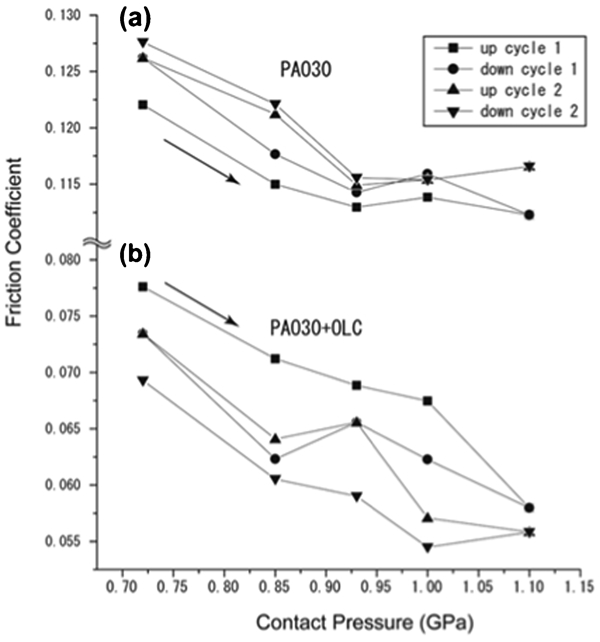
Transitions of friction coefficients under continuous cyclic load changes for a pure PAO and b PAO with OLC
A detailed cross-sectional TEM observation of the surface lubricated with OLC containing PAO is shown in Fig. 4. The friction induced modified layer, the so called tribofilm, at >100 nm in thickness is observed on the steel surface, as shown in Fig. 4a. This tribofilm is composed of nanoparticles. The high resolution TEM image in Fig. 4b shows that a nanoparticle composed of heavy elements (probably metal compound) at about 10 nm in diameter existed in the tribofilm (marked by i) with a surrounding amorphous structure. Thin graphitic layers are formed on this metal particle surface. Furthermore, it was confirmed that the OLC particles still kept their concentric graphitic structure with the spherical shape after the friction test, as shown in Fig. 4c, marked by ii and iii. Presumably, this metal nanoparticle is wear debris from the steel. These observations suggest that the tribofilm is composed of amorphous carbon from the PAO, which involved nanosized wear debris and OLC. The graphitic layers on the wear debris shown in Fig. 4b may have formed by the catalytic reaction of the surrounding amorphous carbon on the steel surface.10 The mechanism for the friction reducing property of OLC under high contact pressure is related to the fact that OLC survives during sliding at the contact pressure of around 1 GPa. Indeed, the estimated structural strength of the OLC calculated previously from electron energy loss spectroscopy was about 10 GPa,4 that is, 10 times greater than the present contact pressure. Therefore, the friction reduction mechanism for OLC differs from that of the inorganic fullerenes of MoS2 or WS2. Possible rolling, caterpillar motion, or slip between onion skins may explain this low friction, but at present, there is no direct evidence that elucidates this phenomenon. Further investigations on this point are needed.
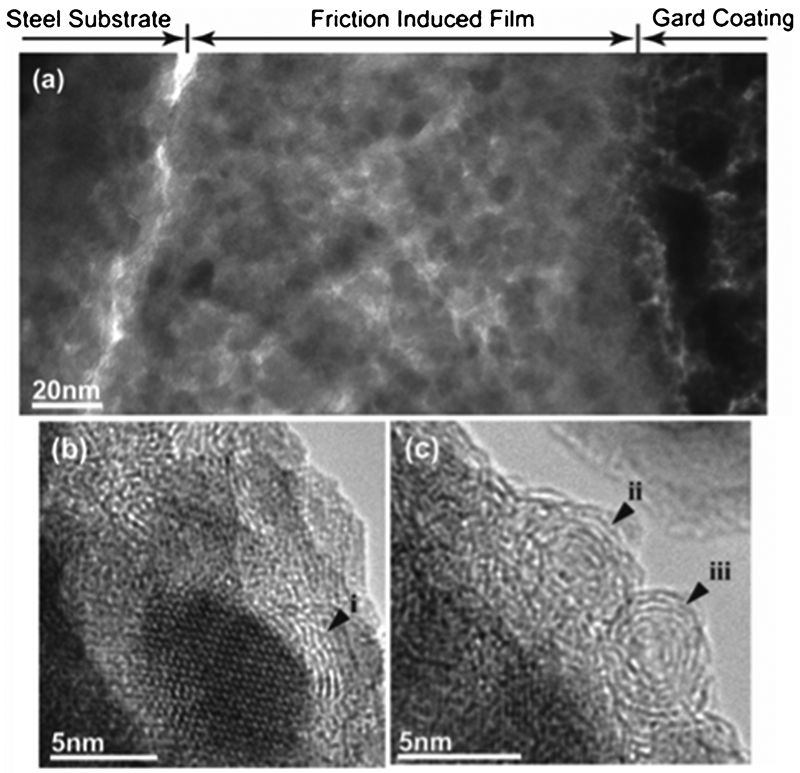
a cross-sectional TEM image of steel surface lubricated by PAO with OLC and b, c high resolution TEM images of friction induced film; formation of graphitic layers on metal nanoparticle is marked by (i), and structures of OLC after friction tests are denoted by (ii) and (iii) in TEM image
Conclusion
The friction reducing property of nanocarbon materials used as a lubricant additive depends on the contact pressure. Under higher contact pressure of 0·94 GPa, OLC keeps its friction reducing property and low wear characteristics by the formation of a friction induced tribofilm that is nearly 100 nm thick. This tribofilm consists of OLCs, nanosized wear debris, amorphous carbon and graphitic layers on the wear debris induced by the catalytic effect by the metal nanoparticle. The OLC maintains its concentric graphitic structure at the sliding interface even under 1 GPa. The friction reduction mechanism of OLC is different from that of the inorganic fullerenes as MoS2 or WS2. Presumably, OLC itself has low friction properties.
Footnotes
Acknowledgements
This research was supported in part by the Japan Society for the Promotion of Science. Additional support is provided by the US Department of Energy, Office of Energy Efficiency and Renewable Energy, Industrial Technologies Program, under contract no. DE-AC02-06CH11357.
This paper is part of a special issue on Enabling and Emerging Lubrication Technologies