







Abstract
The combined effects of surface roughness and viscosity variation due to additives on long journal bearing are analytically studied. The variation in viscosity along the film thickness is considered. The presence of solid particles in the lubricant is an increased effective viscosity, which increases the load carrying capacity and decreases the frictional coefficient, whereas the viscosity variation tends to decrease both the load carrying capacity and coefficient of friction for non-micropolar fluid case. The modified Reynolds type equation for surface roughness has been derived on the basis of Eringen's micropolar fluid theory. The generalised stochastic random variable with non-zero mean, variance and skewness is assumed to mathematically model the surface roughness on the bearing surface. Numerical results were obtained for the fluid film pressure, load carrying capacity and the coefficient of friction. It is observed that the combined effect is to increase the load carrying capacity and to decrease the coefficient of friction, which improves the performance of the bearing.
Notation
maximum deviation from the mean film thickness
radial clearance

coefficient of friction
eccentricity
frictional force per unit length

dimensionless frictional force
film thickness (given in equation (1))
stochastic film thickness measured from the mean levels of the bearing
oil film thickness

film thickness when pressure is maximum

dimensionless film thickness = (h/h1)

dimensionless film thickness when pressure is maximum
material length [ = (γ/4μ)1/2]
length ratio ( = h1/l)
coupling number { = [χ/(2μ+χ)]1/2}
lubricant film pressure

expected value of the lubricant film pressure [ = E(p)]
dimensionless film pressure

viscosity variation factor
journal radius
rotational velocity of the journal
resultant load carrying capacity
load component normal to the line of centres
load component along the line of centres

non-dimensional load carrying capacity per unit width
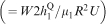

dimensionless load components corresponding to W0 and Wπ/2 respectively
Cartesian coordinates
non-dimensional form of α* ( = α*/h1)
mean of the stochastic film thickness
viscosity coefficients for micropolar fluids
eccentricity ration (e/C)
non-dimensional form of


measure of symmetry of the stochastic random variable
classical viscosity coefficient
Newtonian viscosity coefficient at h = h1
non-dimensional form of σ* ( = σ*/h1)
standard deviation of the film thickness
angle between the load line and the line of centres
Introduction
In recent years, the study of surface roughness effect on the hydrodynamic lubrication of various bearing systems has been a subject of growing interest, mainly because, in practice, all the bearing surfaces are rough. The study of journal bearings with an assumption of smooth surfaces will not predict the bearing performance accurately. In general, the surface roughness asperity height is of the same order as the mean separation between the lubricated contacts. In such situation, surface roughness effects on the performance of the bearing system must be considered. Several theories have been proposed for the study of surface roughness effects. The stochastic study of Tzeng and Saibel1 has fascinated several investigators in the field of tribology. Christensen and Tonder2 proposed a new stochastic averaging approach for the study of roughness effects on the hydrodynamic lubrication of bearings. The mean flow quantities in terms of pressure and shear flow factors as the function of surface roughness are studied by Patir and Cheng.3 Taranga et al.4 studied the effect of roughness parameter on the performance of hydrodynamic journal bearings with rough effects. Andharia et al.5 proposed the study of effect of surface roughness on hydrodynamic lubrication of slider bearings by modelling the surface roughness with a stochastic random variable having non-zero mean, variance and skewness. Recently, Naduvinamani and Siddanagouda6 extended the application of this theory to micropolar fluid lubrication of inclined stepped composite bearings with rough surface.
The viscosity of all liquids and particularly of hydrocarbon lubricants decreases with increasing temperature. This variation in viscosity with temperature is important in many practical applications where lubricants are required to function over a wide range of temperature.7 There is no fundamental mathematical relationship that will accurately predict the variation in the viscosity of an oil with temperature. The formulae proposed for defining the viscosity–temperature relationship are purely empirical and, for accurate calculations, require the experimental data. In this paper, it is assumed that thermal equilibrium exists and that the viscosity varies with temperature according to a given law. However, in order to apply this law, the temperature at each point should be known, which requires a complete thermal calculation. The viscosity–temperature relationship can be replaced by a relation between the viscosity and the film thickness. This is justified as it has been verified experimentally that the highest temperature occurs in zones where the film thickness is least.8 When the viscosity μ1 at h = h1 is known, then

Several experimental studies show the betterment of lubricating effectiveness on blending small amounts of long chained polymer additives with a Newtonian lubricants. In most of the industrial operating conditions, the lubricants are mainly the polymer thickened oils or lubricants blended with additives. Usually, these lubricants become heavily contaminated with suspended metal particles or dirt and they start to exhibit non-Newtonian behaviour. To predict the accurate flow behaviour of such fluids with additives, several microcontinuum theories have been developed. Among the several microcontinuum theories, Eringen's micropolar fluid theory is the generalisation of the classical theory of fluids, which accounts for the polar effects. This theory adequately describes the rheological behaviours of lubricants with polymer additives.9,10 Many investigators used the micropolar fluid theory for the study of various bearing systems such as slider bearings11,12 and journal bearings13,14 and have found some advantageous of micropolar fluids over the Newtonian lubricants such as increased load carrying capacity and decreased coefficient of friction.
In this paper, an attempt has been made to study the combined effect of viscosity variation and surface roughness due to lubricant additives in journal bearings. It is assumed that the probability density function for the random variable characterising the surface roughness is asymmetrical with non-zero mean.
Mathematical formulation of problem
The physical configuration of a rough long journal bearing is shown in Fig. 1. It is assumed that the bearing surfaces are rough and the lubricant in the film region is taken to be Eringen's9 micropolar fluid.
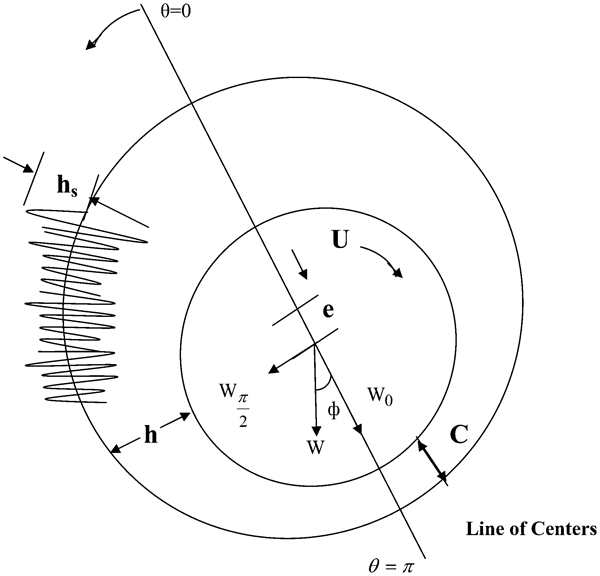
Physical configuration of journal bearing
To represent the surface roughness, the mathematical expression for the film thickness is considered to be consisting of two parts

 is the mean film thickness, C is the radial clearance, ϵ( = e/C) is the eccentricity ratio and hs is a randomly varying quantity measured from the mean level and thus characterises the surface roughness. Further, the stochastic part hs is considered to have the probability density function f(hs) defined over the domain −c≤hs≤c, where c is the maximum deviation from the mean film thickness.
The mean α*, the standard deviation σ* and the parameter
 , which is the measure of symmetry of the random variable hs, are defined as


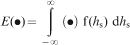
 are all independent of x. The mean α* and the parameter
 can assume both positive and negative values, whereas σ* can always assume positive values.
The constituted equation for micropolar fluids proposed by Eringen9 simplifies considerably the usual assumptions of hydrodynamic lubrication, i.e. laminar, incompressible fluid with negligible body forces and negligible inertia forces. The resulting equations under the steady state conditions are as follows:
Conservation of mass
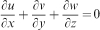
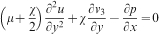


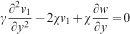
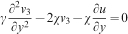
The relevant boundary conditions are as follows:
At the bearing surface (y = 0)


Solution of problem
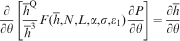
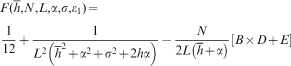
The modified Reynolds type equation governing a three-dimensional flow field for smooth journal bearing lubricated with micropolar fluid was obtained by Sinha et al.15 in the form




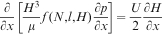

 is the expected value of the film pressure p.
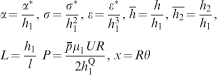
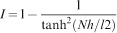
Introducing non-dimensional quantities




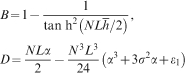

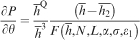


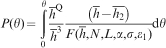
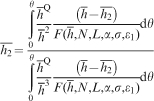
Load components
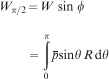
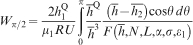
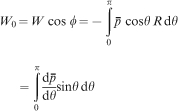
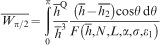
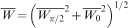
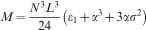
The load components per unit length along and perpendicular to the line of centres are obtained by integrating around the bearing from θ = 0 to θ = π.
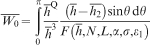
The load component normal to the line of centres per unit length is

Frictional force
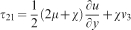
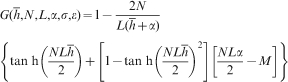
The shear stress along the surface is





Results and discussion
The combined effects of surface roughness and viscosity variations due to lubricant additives on the performance characteristics of the long journal bearings are studied. The micropolar fluid is characterised by two dimensionless parameters N and L*. The coupling number N characterises the coupling of the linear and rotational motion arising from the micromotion of the fluid molecules or the additive molecules. Thus, the coupling number N(0≤N≤L) signifies the coupling between the Newtonian and rotational viscosity. As χ tends to zero, N also tends to zero, and the expressions for the bearing characteristics reduce to their counterparts in Newtonian theory. The parameter L has the dimensions of length and can be identified with some property that depends on the size of the molecules, say the chain length of the polar additive molecule in a non-polar lubricant. Thus, L can be considered as a characterisation of the interaction of the fluid with the bearing geometry. The effect of surface roughness is characterised by dimensionless parameters α, ϵ1, σ and μ. As the roughness parameters tend to zero, the results obtained in this paper reduce to smooth case studied by Sinha et al.15 The following set of values is used for various non-dimensional parameters: α = −0·01−0·01, ϵ1 = −0·01−0·01, σ = 0·1−1, Q = 0−1, L = 7, N = 0·7 and ϵ = 0·7 for numerical computations of the journal bearing characteristics. The numerical values for the roughness parameters α, ϵ1 and σ are also chosen that the corresponding film shapes are feasible.
The variation of non-dimensional pressure with the angular coordinate θ for different values of Q, α, ϵ1 and σ are depicted in Figs. 2–5 respectively. From Fig. 2, it is observed that P decreases for increasing value of Q and increases for micropolar fluid. The effect of roughness parameters α and ϵ1 on the variation of P with Q is shown in Figs. 3 and 4 respectively. It is observed that P increases for negatively increasing values of α and ϵ1 and decreases for positively increasing values of α and ϵ1. From Fig. 5, it is observed that increasing values of σ decreases for P.
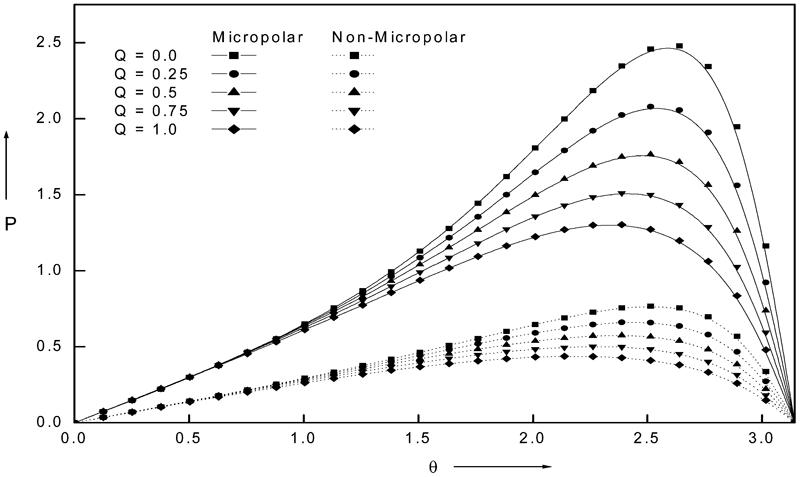
Variation of non-dimensional pressure P with θ for various values of Q at L = 7·0, N = 0·7 and ϵ = 0·7
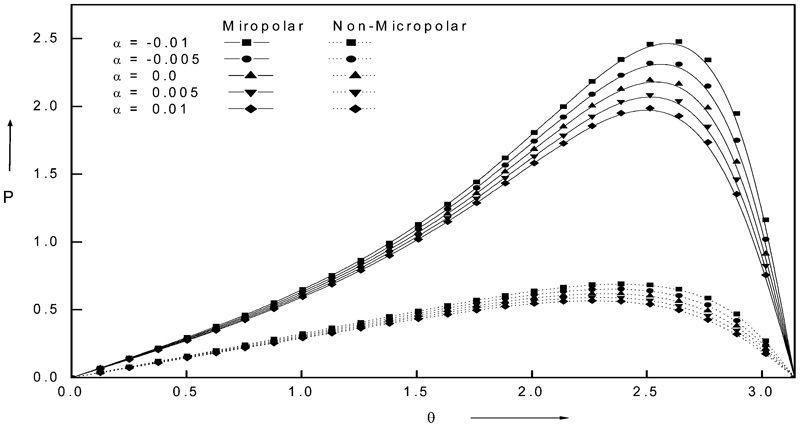
Variation of non-dimensional pressure P with θ for various values of α with Q = 0·5 at L = 7·0, N = 0·7 and ϵ = 0·7
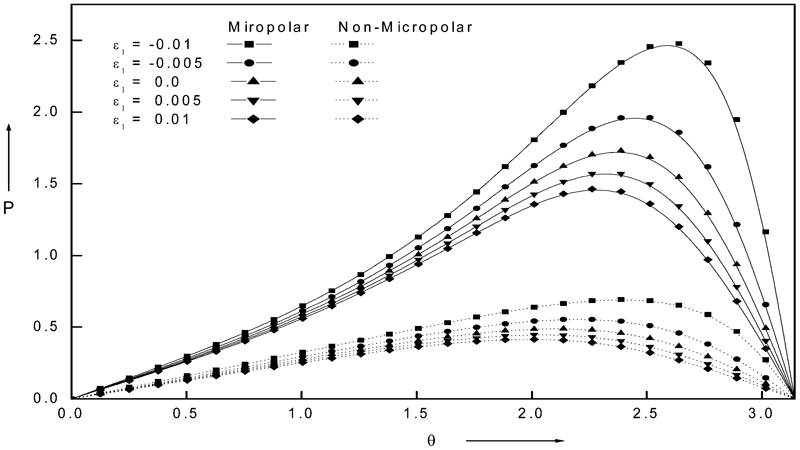
Variation of non-dimensional pressure P with θ for various values of ϵ1 with Q = 0·5, L = 7·0, N = 0·7 and ϵ = 0·7
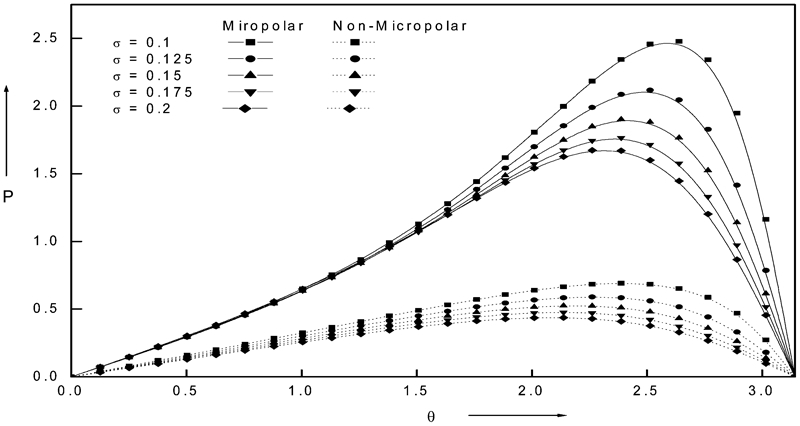
Variation of non-dimensional pressure P with θ for various values of σ with Q = 0·5, L = 7·0, N = 0·7 and ϵ = 0·7
The variation of non-dimensional load carrying capacity
 with N is shown in Figs. 6–9 for different values of Q, α, ϵ1 and σ. It is observed that
 increases for increasing values of N and decreases for increasing values of Q. The effect of roughness parameters α and ϵ1 on the variation of
 and N is depicted in Figs. 7 and 8 respectively. It is observed that
 increases for negatively skewed surface roughness but decreases for positively skewed surface roughness. From Fig. 9, it is observed that increasing values of σ decreases for
 .
.

Variation of non-dimensional load
with N for various values of Q at L = 5·0, ϵ = 0·7, α = −0·001, ϵ1 = −0·001 and σ = 0·01

Variation of non-dimensional load
with N for various values of α at L = 5·0, ϵ = 0·7, ϵ1 = −0·001 and σ = 0·01

Variation of non-dimensional load
with N for various values of ϵ1 at L = 5·0, ϵ = 0·7, α = −0·001 and σ = 0·01

Variation of non-dimensional load
with N for various values of σ at L = 5·0, ϵ = 0·7, ϵ1 = −0·001 and α = −0·01
The variation of non-dimensional load carrying capacity
 with L is shown in Figs. 10–13 for different values of Q, α, ϵ1 and σ. It is observed that
 decreases for increasing values of Q and L. The effect of roughness parameters α and ϵ1 on the variation of
 and L is depicted in Figs. 11 and 12 respectively. It is observed that
 increases for negatively skewed surface roughness but decreases for positively skewed surface roughness. From Fig. 13, it is observed that increasing values of σ decreases for
 .
.

Variation of non-dimensional load
with L for various values of Q at N = 0·8, ϵ = 0·7, α = −0·001, ϵ1 = −0·001 and σ = 0·01

Variation of non-dimensional load
with L for various values of α at N = 0·8, ϵ = 0·7, ϵ1 = −0·001 and σ = 0·01

Variation of non-dimensional load
with L for various values of ϵ1 at N = 0·8, ϵ = 0·7, α = −0·001 and σ = 0·01

Variation of non-dimensional load
with L for various values of σ at N = 0·8, ϵ = 0·7, α = −0·001 and ϵ1 = −0·001
Figures 14–17 depict the variation of non-dimensional load carrying capacity
 with Q for different values of Q, α, ϵ1 and σ. It is observed that
 decreases for decreasing values of Q and L. The negatively skewed surface roughness on the bearing surface causes an increasing
 , whereas the positively skewed surface roughness decreases the load
 (Figs. 15 and 16). From Fig. 17, it is observed that increasing values of σ decreases for
 .
.

Variation of non-dimensional load
with Q for various values of L at N = 0·8, ϵ = 0·7, α = −0·001, ϵ1 = −0·001 and σ = 0·01

Variation of non-dimensional load
with Q for various values of α at N = 0·8, ϵ = 0·7, ϵ1 = −0·001 and σ = 0·01

Variation of non-dimensional load
with Q for various values of ϵ1 at N = 0·8, ϵ = 0·7, α = −0·001 and σ = 0·01

Variation of non-dimensional load
with Q for various values of σ at N = 0·8, ϵ = 0·7, ϵ1 = −0·001 and α = −0·01
The variation of non-dimensional load carrying capacity
 with Q is shown in Figs. 18–21 for different values of Q, α, ϵ1 and σ. It is observed that
 increases for increasing values of Q and N. The effect of roughness parameters α and ϵ1 on the variation of
 and Q is depicted in Figs. 19 and 20 respectively. It is observed that
 increases for negatively skewed surface roughness but decreases for positively skewed surface roughness. From Fig. 21, it is observed that the increasing values of σ decreases
 .
.

Variation of non-dimensional load
with Q for various values of N at L = 7·0, ϵ = 0·7, α = −0·001, ϵ1 = −0·001 and σ = 0·01

Variation of non-dimensional load
with Q for various values of α at L = 7·0, ϵ = 0·7, ϵ1 = −0·001 and σ = 0·01

Variation of non-dimensional load
with Q for various values of ϵ1 at L = 7·0, ϵ = 0·7, α = −0·001 and σ = 0·01

Variation of non-dimensional load
with Q for various values of σ at L = 7·0, ϵ = 0·7, ϵ1 = −0·001 and α = 0·01
Figures 22–25 depict the variation of non-dimensional coefficient of friction
 with Q for different values of ϵ, α, ϵ1 and σ. It is observed that
 decreases for increasing values of Q and L. The negatively skewed surface roughness causes an increasing
 , whereas the positively skewed surface roughness decreases
 (Figs. 23 and 24). From Fig. 25, it is observed that increasing values of σ decreases
 .
.

Variation of non-dimensional frictional coefficient
with Q for various values of L with ϵ = 0·7, N = 0·7, α = −0·001, ϵ1 = −0·001 and σ = 0·01

Variation of non-dimensional frictional coefficient
with Q for various values of α with ϵ = 0·7, N = 0·7, ϵ1 = −0·001 and σ = 0·01

Variation of non-dimensional frictional coefficient
with Q for various values of ϵ1 with ϵ = 0·7, N = 0·7, α = −0·001 and σ = 0·01

Variation of non-dimensional frictional coefficient
with Q for various values of σ with ϵ = 0·7, N = 0·7, α = −0·001 and ϵ1 = 0·01
The variation of non-dimensional coefficient of friction
 with L for different values of ϵ, α, ϵ1 and σ is depicted in Figs. 26–29 respectively. It is observed that
 decreases for increasing values of Q and L. The negatively skewed surface roughness causes an increase in
 , and the positively skewed surface roughness decreases
 (Figs. 27 and 28). From Fig. 29, it is observed that
 increases for increasing values of Q and decreases for increasing values of L.

Variation of non-dimensional frictional coefficient
with L for various values of Q with ϵ = 0·7, N = 0·7, α = −0·001, σ = 0·01 and ϵ1 = −0·001

Variation of non-dimensional frictional coefficient
with L for various values of α at N = 0·7, ϵ = 0·5, ϵ1 = −0·001, σ = 0·01

Variation of non-dimensional frictional coefficient
with L for various values of ϵ1 at N = 0·7, ϵ = 0·5, α = −0·001, σ = 0·01

Variation of non-dimensional frictional coefficient
with L for various values of σ at N = 0·7, ϵ = 0·5, ϵ1 = −0·001, α = −0·01
Conclusion
The combined effects of surface roughness and viscosity variation due to additives on the performance characteristics of long journal bearings are analysed on the basis of Andharia et al.'s5 constitutive equations for micropolar fluids. A stochastic random variable with non-zero mean, variance and skewness is assumed to mathematically model the surface roughness of the long journal bearings. On the basis of numerical computations and results obtained, the presence of micropolar fluid increases load carrying capacity and decreases frictional coefficient of friction, whereas viscosity variation tends to decrease both load capacity and coefficient of friction for non-micropolar fluids. The effects of viscosity variation and micropolar fluid are to increase the load capacity and to decrease the coefficient of friction. The performance of the journal bearing is dependent on the bearing surface. It is found that the performance of the bearings improves due to the presence of the negatively skewed surface roughness, and the bearing performance suffers due to the positively skewed surface roughness. These effects are more pronounced for micropolar fluids.