







Abstract
The gap between academic science/engineering and industry concerning problem solving competencies is addressed in this paper by proposing the New Asian Case Method, an approach inspired by, but substantially different from, the trademark of professional education of the Harvard Business School. The paper puts forward the idea that knowledge in tribology shall be arranged in cases with practical examples that allow students and researchers to learn tribology on real world problems, and obtain a toolbox they subsequently use in their work as tribologists in academia or industry. Micro- and nanotribology are accentuated as high potential role model fields for successful interdisciplinary, inherently application oriented approaches. The New Asian Case Method increases quality approaches in tribology, by structuring the ways of thinking and addressing problems. Establishing the New Asian Case Method in tribology shall set the basis for an international standard in the field.
Keywords
Introduction
In 1940, Prof. Charles I. Gragg from the Harvard Business School stated in his classic book ‘Because wisdom can't be told’ that we cannot effectively use the insight of others; it must be our knowledge and insight that we use.1 Inspired by these words, the New Asian Case Method (NACM) was developed as a new research and teaching methodology in tribology research and education to increase problem solving competence. This new method is described here for the first time. The NACM is inspired by the case method that has routinely been applied in the Harvard Business School since the beginning of the twentieth century.2,3 The NACM provides a toolbox for research and teaching, and is tailored for the needs of and prerequisites provided by tribology students and researchers of our modern times, with knowledge at our fingertips and the Internet and cloud storage available for universal access. A major current challenge is to increase the quality of research rather than its quantity. Today's researchers are faced with an ever-increasing amount of information, and have less net time to intensively deal with single publications. The NACM attempts to bridge this gap between quality and quantity, from university education to research and industry work.
University industry collaboration in the United States started with the installation of agricultural experimental stations in 1887, but only in the 1980s it gained serious policy attention.4 The demand of industry towards higher education has changed: initially, industry requested highly trained specialists who could solve specific problems based on know-how and routines developed in their studies. Nowadays, increasingly, graduates are expected to bring competencies needed to solve complex problems with them when they enter industry (rather than acquiring them over a long period of practice in the respective company).5 Several attempts have been made to increase the problem solving capabilities of university graduates and researchers and to foster technology transfer through university-industry collaborations.4,6–8 Unfortunately, most of these attempts fail.9
Tribology is inherently application oriented; in research and development activities, scientists, engineers and business people meet and decide the way forward. They highlight recent developments and identify emerging and future areas, e.g., in micro/nanotribology research. Achievements in tribology can be used for teaching technical disciplines.10 The NACM shall allow for research guided by cases focused on real-world situations. It is closely related to the Harvard Case Method (HCM)11–14 with the main distinction that it provides best practice solutions and technologies combined with an inherent better structuring of tribology. NACM is a problem based approach rather than a field of specialisation based one. It prepares tribology students for a successful professional life in a more powerful way than would lectures and theory do alone. The NACM shall contribute to train students and researchers to more adeptly apply an expert toolbox with regard to their research, and shall increase the quality of the investigations rather than the quantity.
The structure of the paper is as follows: First, the Case Method will be introduced, with specific focus on the Harvard Case Method. Subsequently, the new methodology of the New Asian Case Method is presented in detail, starting from concept development to selection criteria of best of cases, detailed description of a single NACM case, an example for NACM cases in teaching and detailed treatment of the NACM information module Biomimetics. Conclusions and outlook round off the paper.
Cases in business and law schools
Cases in business and law schools are real life challenges with a true solution, wrapped in complicated and sometimes insufficient information. Each challenge confronts the students with a rich web of consequences and a demand for a prompt, responsible plan of action. With each case, one empathizes with a decision maker, analyses varied and frequently ambiguous data, and assumes responsibility for an action plan that effectively resolves the case's challenge. The solution of the students is compared with the solution from the real life situation that is established in economy. In this way, judgement is trained, and rather than listening to lectures or reading articles and books or online texts, the students actively engage in problem solving. Case study research helps to understand complex issues and objects and is useful in extending experience or strengthening already known research results.15
Harvard Case Method
The HCM has been routinely applied in the Harvard Business School (HBS) since the beginning of the twentieth century, and was already embedded in the original vision of the school. The teacher is ‘not a conduit of knowledge, but a choreographer of a dynamic and multi-faceted discussion’.15 Edwin Gray, the HBS first dean, called this method ‘problem method’ and kept on stressing how important it is in educating the young to become leaders and not followers. HBS is established on two pedagogical principles: to use cases in teaching, rather than rely on lectures and readings (today, 80% of the HBS classes are built on the case method) and ‘to engage the students in the learning process by getting them to teach themselves and each other’.15
When applying the case method to a university course in a different cultural background than HBS, the cultural differences between the students need to be considered. In 2005, the Harvard Business School began to successfully promote the HCM within the Asian region, in Taiwan, via implementation of the plan–do–check–act concept.16
Extensive covering of an HBS case study teacher in action, complete with teacher and students materials, movies, lecture notes and background information, can be accessed online.17 The classic book ‘Teaching and the Case Method’ is recommended reading for everyone who intents to learn more about this highly successful, participant-centred teaching method that does not provide answers but pathways to greater experience and understanding.11
The HCM is a method with a horizontal ABC approach: A: the students are given frame information; B: the students develop a solution; C: the solution is evaluated and compared to the real solution in economy.
Cases in tribology
The case method is not yet present in tribology research. However, one can locate various case studies, established by the case study method, in tribology. The case method overlaps with the case study method, but the two are not identical. Horst Czichos dedicated in the first volume of Elsevier's Tribology Series 35 pages to case studies in tribology.18 There, he dealt, amongst others, with friction between polymer and steel samples, wear-resistant diffusion surface coatings, materials for off-shore bearing applications, lubricants for instrument pivot bearings, failure investigation of electrical contacts and a compilations of characteristics of metalworking processes.
At the 2012 meeting of the Japanese Society of Tribologists (JAST) with the Malaysian Tribology Society (MYTRIBOS) in Kuala Lumpur (at the Malaysia-Japan Institute of Technology), former JAST president Prof. Takashi Yamamoto mentioned that JAST published ‘Case Studies of Tribology Failures and Countermeasures’ (but just in Japanese). This seems to be the only larger compendium on case studies in tribology.
Cases in a complex, highly interdisciplinary field as tribology need to serve a different aim than cases in business or law schools. Tribology students and researchers need to be provided with a toolbox that increases the quality of the research rather than the quantity.
Materials and methods: New Asian Case Method
In the New Asian Case Method, the solution is in the centre. It is a vertical approach, rather than the horizontal ABC structure of the HCM. From a cloud of real world problems, the optimum solution is selected as input for successful addressing of the own research problem. In the HCM the own solution is in the centre of attention (and the real world solution stays a secret until the very end of the methodology when it is compared to the student solution), in the NACM the problem is described as good as possible, and from a cloud of solutions the one that fits best is selected for further investigations. The NACM and the HCM are therefore inherently different, especially in the definition and treatment of cases. Cloud management is supposed to be performed by a non-for-profit organisation (similar to Wikipedia).
There are various methodological approaches in tribology. Generally, a solution needs to be provided for a problem. This might be a mathematical problem, a problem for computer modelling and subsequent simulation, a problem for a new type of measurement approach, a problem to bridge length scales (this is of specific importance in micro- and nanotribology – results on the micro- and nanoscale need to be linked to performance of devices and to macroscale phenomena), a problem to measure parameters or parameter combinations that were not measureable before, required increase in reliability, standardisation processes, etc. etc. The current approach to tribology is very much based on individual know-how and the abilities of a researcher or research group in problem solving (Fig. 1). This established approach concentrates on the individual researcher or research team; no best practice approach is defined. This kind of approach has been highly successful and brought tribology to the state where it is now, but can be improved by changing the individual focus to a best-practice focus. The newly proposed New Asian Case Method provides problem-solving methodology that is defined by collaboration and state-of-the-art know-how (Figs. 2–4). As opposed to the ABC approach of the HCM, the methodology is best described as PTS (problem–toolbox–solution). The general structure of the NACM comprises focused problem definition P, look-up of potential input regarding the solution by cases in the toolbox T and subsequent problem solving S guided by a step-by-step approach in the cases (Fig. 2). In this last step, an important part of the continuous improvement of the NACM takes place: the community provides a multitude of specific cases, the individual know-how increases by the information provided in the case package (theoretical, practical) and by the feedback from and to the community (discussion area in each case in the cloud) (Fig. 3).
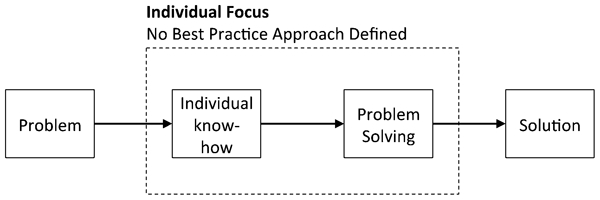
Current approach to tribology
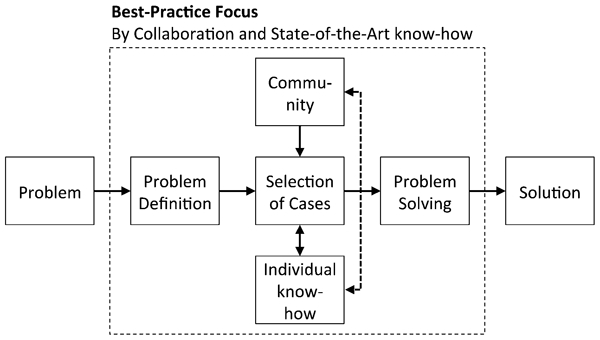
New Asian Case Method: a new approach to tribology
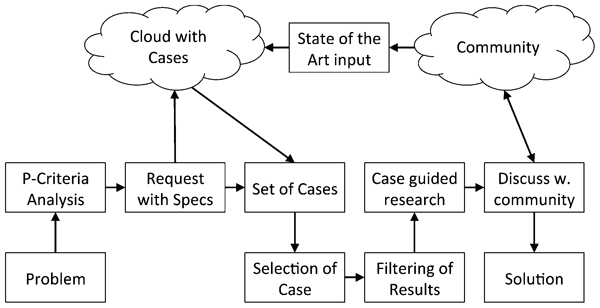
New Asian Case Method: general approach
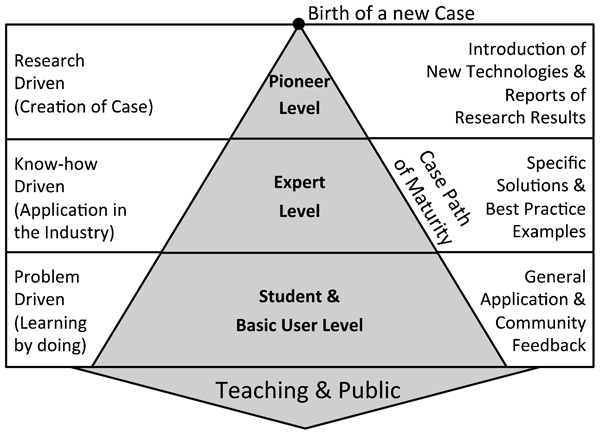
New Asian Case Method: case development
The HCM is a time intense teaching method. This raises questions such as: How can such a method be applied in normal, non-elite university environments? How can it be applied in mass universities, with thousands of students sitting in each course? The HCM is a method that needs time intense supervision from the teachers.19 The NACM on the other hand is ideal also for mass universities, because it provides the students with a toolbox that can be used in all their student and professional lives, and that will grow and develop further and further. The NACM contributes to the transformation from a focus on quantitative measurement to a focus on problem solving.
The NACM in tribology has the potential to become an important contribution to the successful addressing of three major issues we currently face: We need a new method of knowledge management in micro- and nanotribology to help find and organize information in an era of information overload.20 Engineers need an effective tool to provide competent solutions very early in their career path. And on a more global scale – in respect to addressing Global Challenge 14 ‘How can scientific and technological breakthroughs be accelerated to improve the human condition?’ of the Millennium Project – ‘[we] need a global collective intelligence system to track S&T advances, forecast consequences, and document a range of views so that politicians and the public can understand the potential consequences of new S&T’21 – with a structured approach to tribology.
Results and discussion
New Asian Case Method: Detailed methodology
The basic frame of the New Asian Case Method is: there is a problem that needs to be successfully addressed. In the first step, the problem is analysed via P-criteria analysis (see the section on ‘New Asian Case Method: P-criteria analysis’). Subsequently, a request with specific specifications is sent to the cloud, which provides a set of cases that has to be thoroughly analysed, to enable selection of the most adept cases. The results are subsequently filtered, and case guided research can be performed. In this way, the researcher does not have to come up with ideas for proper approaches every time, but can rely on approaches already proven successfully in similar problems previously reported by fellow researchers, uploaded and stored in the cloud – he is rather a selector than a creator. The results are finally discussed with the community, fed back to the cloud as new, state-of-the-art input, contributing to the richness of the cases in the cloud (Figs. 3 and 4). Thereby, with each problem solved the cloud database is getting stronger. The method saves time through a common cloud pool of cases that grows, learns, is universally accessible, amendable and expandable and through its agility, scalability, elasticity and multitenancy provides wide spread support for researchers. Cloud storage provides users with immediate access to a broad range of resources and applications hosted in the infrastructure of another organization via a web service interface. New cases, given a proper publication structure will be built around them, shall count as fully fledged publications.
New Asian Case Method: P-criteria analysis
The first step in the NACM is the P-criteria analysis that closely defines the problem P and yields the request with the specifications for the toolbox T. This is a step of paramount importance, because only with proper specifications useful cases will be recommended by the toolbox T, which is the expert system dealing with the request (this can initially be a team of experienced tribologists and be subsequently developed into an Artificial Intelligence Expert System).
The three main questions to answer in the P-criteria analysis are:
problem focus: which major type of tribology?
area focus: which specific type of tribology?
technology focus: which application area?
New Asian Case Method: A single case
New cases iteratively develop through three stages, with increasing maturity (Fig. 4). In the research driven pioneer level the case is created, new technologies are introduced and research results reported. In the know-how driven expert level specific solutions and best practice examples establish the connection to applications in the industry. And in the problem driven student & basic user level general applications are specified and the community provides the necessary feedback (Fig. 4). In this way only the best cases are finally provided for teaching and the general public. Thereby it is ensured that the community deals with the cases and ranks them, and newest technologies reach the market.
Figure 3 illustrates a potential general case structure of the suggested database. This database consists of three parts:
case identification part (three questions, see beginning of the section on ‘New Asian Case Method: P-criteria analysis’, with an expert system that suggests the proper cases for the problem)
the case cloud itself, with each case having a specified structure (Fig. 5)
a feedback and collaboration forum.
New Asian Case Method: a single case
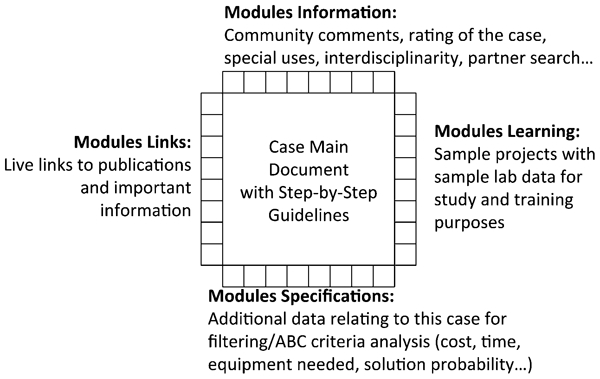
A single case in the NACM consists of the case main document with step-by-step guidelines and four types of modules (Fig. 5). The modules ‘Specifications’ consist of additional data, e.g. filters (time, money, depth of investigation), the modules ‘Learning’ provide sample projects that serve as teaching cases (‘best of’ cases), the modules ‘Links’ establish connection with academic and industrially relevant literature and the modules ‘Information’ contain specific applications (such as empiric reports, discussion forums, interest groups and expert communities, see the section on “New Asian Case Method: information module ‘biomimetics’”).
New Asian Case Method: Information module ‘biomimetics’
The modules ‘Information’ of a single case in the NACM (Fig. 5) contain, amongst others, communities such as experts in biomimetic tribology, a field that deals with knowledge transfer between biology and tribology, and subsequent development of novel approaches.22,23 In a nutshell (and as defined by the Centre for Biomimetics, Reading, UK) ‘Biomimetics is the abstraction of good design from nature’.
Biomimetics can in a certain sense be compared to the HCM method: also in the study of organisms, their relation between structure and function, in the study of the relationships between organisms and between organisms and the environment and in subsequent transfer to engineering applications only incomplete information is available – yet there is living proof that it works. In doing biomimetics, multifunctional materials, structures and processes have to be understood, and it has to be adjudicated via active decision-making which of the properties are important and are going to be transferred to tribology.
New Asian Case Method: ‘best of’ cases for teaching
The HCM has been applied highly successfully in teaching business and law. In teaching tribology with the NACM, selected cases serve as teaching cases, with exemplary data (Fig. 5). Over the course of the studies the cases get more and more complex and with entry of the professional or academic research world, the NACM has developed from a teaching methodology to a problem solving approach that accompanies the professionals. One important aspect of tribology education via the NACM method will be the provision of NACM cases in a toolbox. At university, the students learn how to use this toolbox, and in their professional lives they then have this powerful tool at their disposal. The NACM cases develop with time and shall develop to an international standard for successfully addressing of tribological problems.
Cloud functionality needs to be secured. For the toolbox itself and for further internal structures, smart structuring is important. For the cloud to be functional, involvement of international tribology experts is necessary in the single cases. This will be ensured as outlined below:
collaboration partners write first cases
additional cases come from the community (forum), and can subsequently be dealt with in university teaching
individual tribology experts and external consultants, who write and submit cases in course of their work.
The publication character of cases is helpful in securing a relevant number of submissions. Similar to Wikipedia, quality is ensured by ranking potential contributors as apprentice, fellow or master. An apprentice can ask questions. A fellow can submit cases, however, they need to be reviewed by a master. A master can submit cases to the database.
Conclusion and outlook
The New Asian Case Method is a new case based method for research and teaching approaches in tribology. Its major goal is to bridge the gap between academia and industry concerning problem-solving competencies and to provide a toolbox for high quality approaches in tribology research. Online available cases help to structure one's own ways of thinking and addressing problems, and provide a dynamic, continuously growing database at the fingertips of the tribologists, allowing constant inflow of newest technologies and solution methods via the community.
The new Asian Case Method provides a way to deal with inhomogeneous information and overinformation in tribology. At university, the students work with the NACM teaching cases and learn from them. But this is just the beginning. In their professional lives, they use the NACM for their problem solving, and subsequently, with increasing work experience, they themselves become teachers and feed back to the cases in the cloud, either by establishing new NACM cases, or by amending existing ones via feedback. Initial applications of the NACM (and its precursors) in the research and teaching of the author have already proven its potential to yield researchers and students with their own, unique, successful approach to problem solving: Various PhD students of the first author have already successfully tested the combination of the New Asian Case Method with biomimetics. Of specific interest is the fact that with the PhD students coming from fields of research as varied as physics, biology, tribology, engineering, fine arts, the applied arts and economy and from different cultural backgrounds (Europe and Asia), the application of the method in an interdisciplinary setting provides easy access to knowledge and experience across fields, and allows students to learn and incorporate concepts and long-standing knowledge from other fields rather fast in their own area of expertise.
Implementation of the New Asian Case Method allows tribologists easy access to newest technology and to newest optimization techniques. It provides a knowledge base for the practitioner and allows for adaptive, growing, continuously improving cases, with online discussions and an active user community improving the approach.
Implementation of the New Asian Case Method shall provide a systematic approach to tribology, and help in the continuing transformation of tribology from an art that depends on the skill of an individual to a science that has at its disposal a full scale problem solving toolbox, providing consistent high quality output.
Footnotes
Acknowledgements
This research was funded by Universiti Kebangsaan Malaysia, Arus Perdana Project UKM-AP-NBT-16-2010.