







Abstract
A complex approach based on atomic force microscopy (AFM) is developed to establish influence of nanoscale layer thickness on its elastic, adhesive and frictional properties of polymeric coatings for microelectromechanical systems. Thermoheating element was applied to perform AFM measurements with thermal effects in the temperature range from 20 to 120°C. Friction coefficients at high velocities of sliding and dependences of friction coefficient on the temperature of heated films at low velocities of sliding are defined. This study concludes that the Young's modulus of ultrathin polymeric films on silicon substrate is reduced when thickness or temperature is increased.
Keywords
Introduction
Studying material properties of thin polymeric layers with nanoscale thickness is necessary for defining the optimal coating thicknesses (of extremely thin films) for sliding components of microelectromechanical systems (MEMS). The main problems in the development and operation of MEMS are effects of adhesion (sticking), residual stresses in silicon details and contact deformation, which have an impact on the assembly. The research of these issues can provide the metrological support for production and testing of MEMS. Currently, there is no univocal physical explanation for adhesive interaction of contacting surfaces. The most common way of solving the problem is to apply thin coatings on contacting elements to minimise surface adhesion. It is necessary to define tribological properties of polymer films to predict properties of polymer films that can be changed significantly during friction and heating of MEMS components surfaces. The objective of this study is to find an approach to investigate the physical and mechanical properties of ultrathin layers, which allows determining the effect of coating thickness on its properties and explore the relationship between its local mechanical, tribological, adhesive and thermal properties.
Polymethylmethacrylate (PMMA) is well studied material, but the data on its nanosize films are ambiguous. It is known the dependence of temperature properties on molecular weight and type of substrate.1–3 The dependence of thermal properties on layer thickness of PMMA is non-linear. The glass transition temperature Tg of the film thickness of 60 nm is slightly lower in comparison with the Tg of the film thickness of 100 nm, but with a further decrease in the film thickness (<20 nm), Tg increases.2 According to Arriaga et al.,4 Tg slightly decreases with declining film thickness from 100 to 30 nm and, at 1–2 nm, decreases by 20–25%. The experiments on a thick layer of PMMA proved that the glass transition temperature of the surface layers is substantially reduced.5
Therefore, it is necessary to study the properties of thin polymer layers in the complex, finding the relationship between thermomechanical, tribological, adhesion properties and the substrate influence on the micro- and nanoscale contact area. For this purpose, atomic force microscopy (AFM) is an indispensable tool that allows to combine different techniques and develop methodology for specific tasks. These techniques are as follows: scanning in contact mode (receiving surface topography, lateral force microscopy and measurement of the tribological characteristics based on that); dynamic AFM methods; indentation of a surface to determine its local elastic, viscoelastic and adhesive properties; destruction tests by the probe (nanowear and layer by layer stripping a material); and thermal measurements. Choice of probe conditions the nano- or microsized contact area.
Experimental
In this research, AFM methods are used and developed on the basis of the scanning probe microscope ‘NT-206’ (Microtestmachines Co., Belarus). Standard scanning method is applied to get the morphology of surfaces. Static force spectroscopy is used to get indentation curves and estimate elastic and adhesion properties. The Young's modulus of extrathin polymeric samples may be calculated according to one of the models: the Hertz model for elastic contact of sphere and plane, the Johnson–Kendall–Roberts model for elastic contact with adhesion and the Makushkin model for elastic contact considering the thickness of layer.6–9 The adhesion force is defined as the maximum force during breaking of a tip-sample contact.7
Scanning lateral force tribometry allows to measure the cantilever torsion during direct and inverse sliding (dX1, dX2) of a tip over a sample surface. In this case, the frictional force can by calculated as F = 0·5k(dX1+dX2), where k is the torsional stiffness of the cantilever.10 The velocity of the probe on surface was <10 m s−1.
In these techniques, V shaped standard silicon AFM probes of the NSC11 type (side A) (Micromash Co., Estonia) are used. New probes have a tip curvature radius of 10 nm. Changes of the tip radius during the experiments are included in the calculated characteristics. The morphology, elastic properties of the three coatings and friction tests during heating of the layers 30 and 104 nm thicknesses were performed using probes of a spring constant 27 N m−1 and radius of tip curvature of 20–80 nm. Friction of the samples at room temperature and the layer 2 nm thickness during heating is measured by a probe stiffness of 2 N m−1 and radius of tip curvature of 10–150 nm. A probe spring constant and radius of tip curvature in the adhesion measurements were 8 N m−1 and 30–70 nm respectively.
Oscillation tribometry is a special technique based on oscillation at the resonance frequency of the ball probe parallel to the sample surface. The ball is fixed to one of the legs of the tuning fork and brought into contact with the sample surface. Energy dissipation due to the ball-surface friction leads to a change in the dynamic characteristics of the detected system (the amplitude, frequency and phase of the fork oscillations).10,11 The frictional force can be estimated as F = πkc(A0−A)/4Q, where kc is a spring constant of the probe cantilever, Q is its quality factor and A0 and A are the initial and working oscillation amplitudes.12
This method simulates situation of high velocity sliding (the resonance frequency of probe oscillation is 14 kHz) and allows testing materials with multicycle loading in a short time span. The steel ball of the tuning fork has a radius of curvature of 0·4 mm.
A thermoheating cell for AFM was used to keep temperature of samples in the range from 20 to 120°C during the process of measuring its elastic, adhesion and friction parameters.
Measured PMMA films with layer thicknesses of 2, 30 and 104 nm were made by deposition on silicon substrates by spin coating method. Thickness of films was defined by ellipsometry method and scratching with AFM.
Results and discussion
The surface morphology of all three layers is almost identical and amorphous and has a high degree of smoothness as shown in Fig. 1. Roughness Ra was found to be 0·2–0·3 nm for scanning area 5×5 μm and 0·1–0·8 nm for area 20×20 μm.
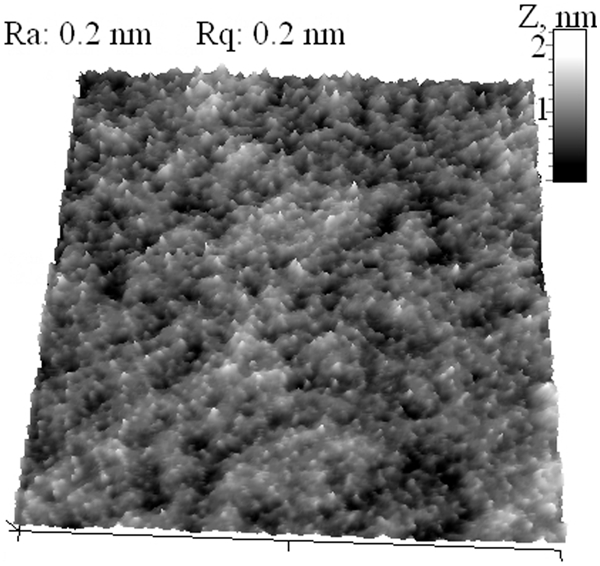
Three-dimensional topography AFM image of ultrathin PMMA layer on Si substrate (scan area, 5·1×5·1 µm)
The Young's modulus of coatings of 30 and 104 nm thickness was estimated with the use of static force spectroscopy. Since surface adhesion of the layers is low and does not affect the elastic property calculation,9 the sphere plane Hertz model of purely elastic contact was used.6 It was found that the Young's modulus of 30 nm layer is higher than that of the 104 nm layer due to substrate influence and decreasing elastic properties of both samples during heating (Fig. 2). The Young's modulus of 30 nm PMMA sample is reduced by an order when heated up to 120°C.
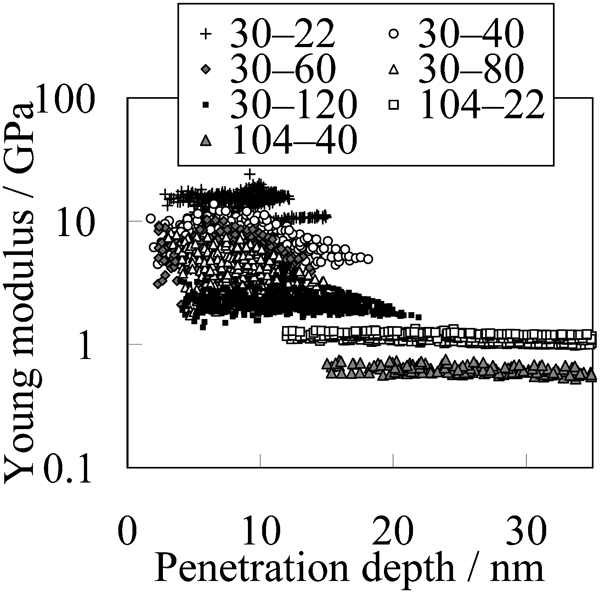
Young's modulus of PMMA layers of 30 and 104 nm thickness on Si substrate versus penetration depth at temperatures 22, 40, 60, 80 and 120°C
Increase in the friction coefficient of the layer of 104 nm thickness with increasing load is caused by the extension of contact area as a result of coating deformation (Fig. 3). Contact area of thinner films increases slightly when loaded, so the contact pressure grows faster, and the films are destroyed at lower loads (Figs. 3 and 4). The 2 nm layer cannot be deformed in depth and was destroyed at 50 mN load.
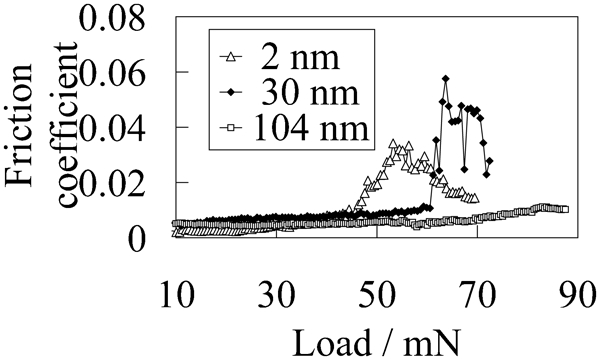
Friction coefficient versus load measured under high sliding velocities for thin PMMA layers
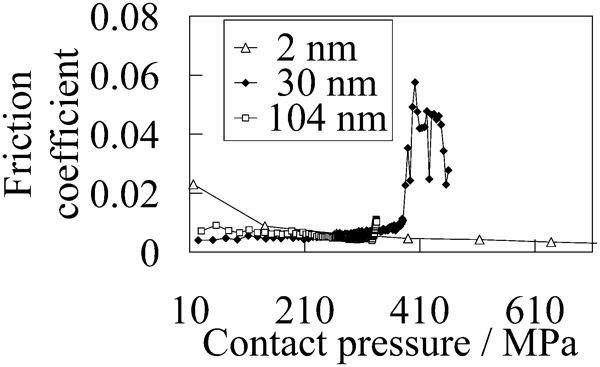
Friction coefficient versus contact pressure measured under high sliding velocities for thin PMMA layers
Classical AFM methods were used to measure such parameters as the friction coefficient at low sliding speeds and adhesion force. Conversion of adhesion was made to specific interfacial energy. The behaviour of the system at low sliding speeds has a different mechanism.
The specific interface surface energy of the 2 and 30 nm layers was decreasing during heating. That phenomenon can be explained by influence of the substrate on the behaviour of ultrathin films (2 and 30 nm). The specific interfacial energy of the 104 nm layer changes insignificantly versus temperature (Fig. 5).
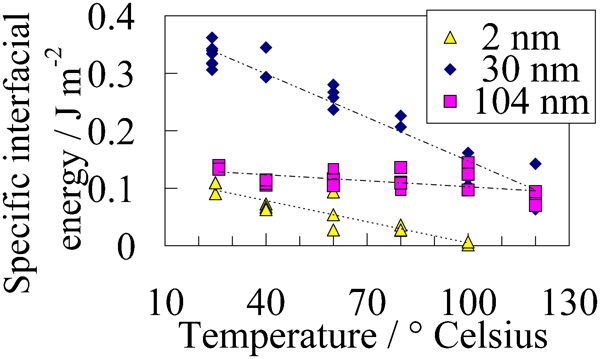
Specific interfacial energy during separation of tip sample contact versus temperature of heat for PMMA layers of 2, 30 and 104 nm thickness
The variation of the coefficient of friction of thin films at applied heating is different (Fig. 6). The friction coefficient of the 104 nm film has little changes and good correlation with its specific interfacial energy. Dependence of the friction coefficient on film thickness at room temperature correlates with the specific interfacial energy. The friction coefficients reach their maximum values for the thickness of the film 30 nm and minimum values for the thickness 2 nm. Presumably, behaviour of 2 nm film should be analysed from the perspective of tribology of lubrication, as for this film, there are only deposited five molecular layers. The friction coefficients of the 2 and 30 nm films are similar in the temperature range 40–80°C. Thus, the mechanism of the behaviour of the thick coating is different from the thinner coatings.
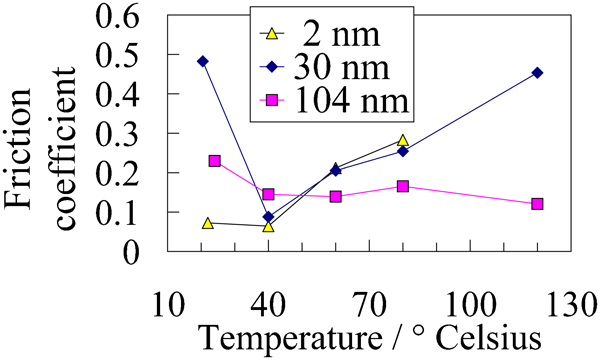
Friction coefficient versus temperature of heat for PMMA films of 2, 30 and 104 nm thickness measured under low sliding velocities
A complex approach can be proposed to study mechanical and tribological properties on micro- and nanoareas of contact on the base of the already performed experiments. The stages of investigation can be summarised as follows:
study of surface morphology with AFM and detection of the most characteristic and uniform regions of the surface
static force spectroscopy measurements on typical, uniform regions of surface, including with heating of samples during measurements using thermoheat element adapted for AFM
calculation of surface adhesion characteristics using experimental data and choosing the model of tip-surface contact considering or not considering adhesive interactions and layer thickness
calculation of the Young's modulus of samples according to the chosen contact model
estimation of contact pressure accounting fluctuation of the Young's modulus under heating (calculation of loads to keep the same contact pressure under friction with probe)
friction measurement at low velocities and heating of samples during process
friction measurement at high velocities using tuning fork tribometry adapted for AFM.
The results allow formulating recommendations for the use of thin PMMA layers. The coating of ∼100 nm thickness may be applied on moving parts of MEMS, because its friction coefficient and interfacial energy are quite low and change very little when heated (Figs. 5 and 6). Furthermore, this coating withstands multicycle loading (Figs. 3 and 4).
Thinner coatings are perspective for manipulation of microscopic objects with microgrippers: two nanometre thickness for nanosized objects and up to 30 nm thickness films can be used, because their surface adhesion decreases during heating (Fig. 5). That effect can be applied to release easily the gripped object.
Conclusion
A complex approach based on AFM method to study elastic, adhesive and tribological characteristics during the process of forming a microcontact is proposed. The morphology, Young's modulus, friction coefficient and specific interfacial energy are defined on micro-areas of PMMA coatings of thicknesses of 2, 30 and 104 nm on silicon substrates.
The values of stresses causing the destruction of the coatings are defined in the multicycle loading mode at high sliding speeds, i.e. close to actual operating conditions of the sliding contacts in MEMS.
Footnotes
Acknowledgements
The work is performed with a support of the State Committee on Science and Technology of the Republic of Belarus, the Belarusian Republican Foundation for Fundamental Research and the statutory activity programme in the Institute of Micromechanics and Photonics of the Warsaw University of Technology (Poland).