







Abstract
In this paper, the general Reynolds equation of finite porous journal bearing lubricated with couplestress fluid is solved numerically for the assessment of dynamic characteristics of the bearings. The Reynolds type equation governing the steady performance is obtained and solved numerically by finite difference technique. From the numerical results, it is observed that the effect of couple stresses is to increase the load carrying capacity and to lengthen the squeeze film time as compared to the corresponding solid case. The effect of permeability is to reduce the load capacity and to decrease the squeeze film time as compared to the solid case.
Notation
radial clearance
eccentricity
fluid film thickness,


non-dimensional film thickness,


non-dimensional minimum film thickness,

porous layer thickness
characteristic material length of the suspended particles,


couple stress parameter, l/C
length o the bearing
film pressure
pressure in the porous region

non-dimensional film pressure,


Darcy velocity vector,

cylindrical coordinates
radius of the journal
response time taken by journal centre to move from ϵ = 0 to ϵ1
fluid velocity components
load carrying capacity

non-dimensional load carrying capacity,

rectangular coordinates
ratio of microstructure size to the pore size

eccentricity ratio, e/C
material constant responsible for couple stress fluid
lubricant viscosity
non-dimensional response time,

permeability parameter
Introduction
Porous bearings contain the porous filled with lubricating oil so that the bearing requires no further lubrication during the whole life of the machine. This feature accounts for the use of the term self-lubricant bearings or oil retaining bearings. Self-lubricating porous bearings have the advantage of high production rate because short sintering time is required. To enhance the self-lubricating property, graphite is added. Porous metal bearings are of low cost and posses good bearing qualities, and hence, these bearings are widely used in home appliances, small motors, instruments and construction equipments. The analytical study of porous bearings with hydrodynamic conditions was first made by Morgan and Cameron. 1 There have been numerous studies of various types of porous bearings in the literature, namely, slider bearings by Uma, 2 journal bearings by Prakash and Vij, 3 squeeze film bearings by Wu 3 and thrust bearings by Gupta and Kapur. 5
Traditionally, the studies of porous bearings are focused on Newtonian lubricants. However, the use of non-Newtonian fluids as lubricants is of growing interest in recent times. In particular, the use of small amount of additives can enhance the bearing performance. These lubricants are fluids with microstructures. The failure of the classical continuum theory in representing the flow behaviour of such fluids led to the development of the microcontinuum theories Ariman et al. 6, 7 Stokes 8 couple stress theory is one such theory that accounts for the polar effects due to the presence of microstructures in the fluid. The Stokes couplestress fluid model describes adequately the rheological behaviour of the lubricants with polymer additives. This couple stress fluid model is important for engineering and scientific applications of pumping fluids such as synthetic lubricants, colloidal fluids, biofluids and liquid crystals. Several investigators in the field of tribology adopted the couple stress fluid theory for the study of performance characteristics of various bearing systems. The studies of static and dynamic behaviour of pure squeeze film in couple stress fluid lubricated short journal bearings is made by Lin. 9 The squeeze film characteristics of long partial journal bearings lubricated with couplestress fluids is also studied by Lin, 10 The influence of couple stresses in squeeze films is studied by Bujurke and Jayaram 11 and squeeze film lubrication of a short porous journal bearing with couplestress fluids by Naduvinamni et. al. 12
Recently, Naduvinamni et al. 13 studied the effect of couplestress fluids on the squeeze film lubrication of long porous journal bearings and reported that the increased load carrying capacity and delayed time of approach are due to couple stress lubricants. In the present study, the squeeze film characteristics of finite partial journal bearings lubricated with couplestress fluid studied by Lin 14 has been advanced to include the effect of porous facing on the squeeze film lubrication of finite partial porous journal bearings with couplestress fluids. The modified Reynolds equation is solved numerically using finite difference technique. The load carrying capacity and time–height relation are compared with the classical Newtonian case.
Mathematical formulation of problem
The physical configuration of the problem under consideration is shown in the Fig. 1. The journal of radius R approaches the porous bearing surface at a circumferential section θ with velocity Vθ. The film thickness h is a function of θ and is given by

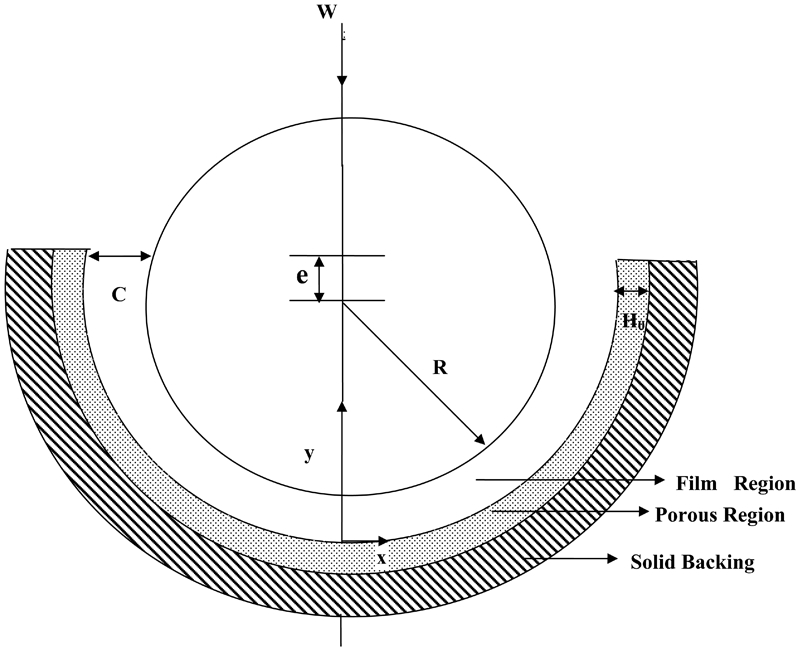
Physical configuration of partial porous journal bearing
The lubricant in the film region and also in the porous region is assumed to be a Stokes 8 couple stress fluid.
The basic equations governing the flow of couple stress lubricants by Stokes
8
under the usual assumptions of fluid film lubrication applicable to thin films,
15
the equation of motion of an incompressible couple stress fluid within the film region, when the body forces and body couples are absent, are given by
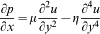
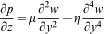


The flow of couple stress fluid in a porous matrix governed by the modified Darcy law, which accounts for the polar effects

 is the Darcy velocity vector, and
 . The parameter β represents the ratio of the microstructures size to the pore size. The ratio
 is of dimension length, and hence characterises the chain length of the polymer additives, and p* is the pressure in the porous region due to continuity of fluid in the porous matrix; it satisfies the Laplace equation
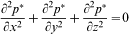
The relevant boundary conditions for the velocity components are
at the bearing surface y = h


at the journal surface y = 0


Solution of problem
The solution of Equations (2) and %(3) subject to the boundary conditions (8a), (8b), (9a) and (9b) are


 is the couple stress parameter. Integrating equation (7) with respect to y over the porous layer thickness H0 and using the boundary conditions of solid backing
 at y = −H0 we obtain
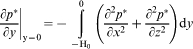
Assuming that the porous layer thickness H0 is very small and using the pressure continuity condition (p = p*) at the interface (y = 0) of porous matrix and fluid film, equation (12) reduces to
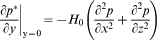
Then, the vertical component of the modified Darcy velocity v* at the interface (y = 0) is given by
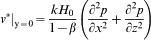
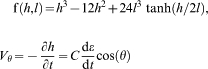
Integrating equation (5) across the fluid film and utilising the boundary conditions (8c) and (9c) and expressions given in Equations (10) and %(11) for u and w respectively, the modified Reynolds type equation is obtained in the form
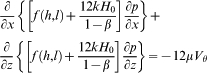
Introducing the non-dimensional quantities

 and
and
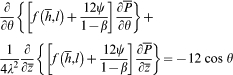
 into equation (15) gives
 .
.
As the permeability parameter ψ→0, equation (16) reduces to the corresponding solid case studied by Lin.
14
For the 1800 partial porous journal bearing, the boundary conditions for the fluid film pressure are


Numerical formulation
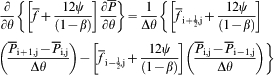
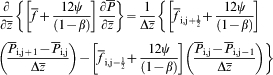
Since the modified Reynolds equation (16) is too complicated to be solved analytically, a finite difference scheme is adopted. First, the film domain under consideration is divided by the grid spacing shown in Fig. 2; then, the mesh for the film extent is constructed. To avoid the divergence of the finite difference scheme, the conservative form of finite increment formats is applied; in this case, the terms of equation (16) are given by
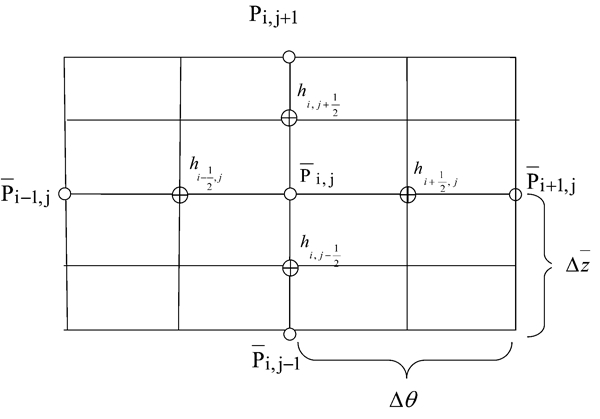
Grid Point notation for the film element
Substituting these expressions (18) and (19) into the Reynolds equation (16), we get

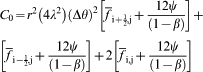
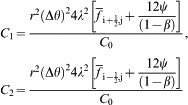

 with
with
 .
.
The pressure then calculated by using numerical method with grid spacing Δθ = 90 and
 .
.
The non-dimensional load carrying capacity of the 1800 porous partial journal bearing is evaluated by integrating the fluid film pressure field acting on the journal
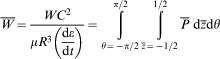
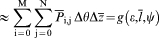
Time–height relation is calculated by considering the time taken by the journal centre to move from ϵ = 0 to ϵ = ϵ1 can be obtained from equation (22) as

 is the non-dimensional response time.
The first order non-linear differential equation (23) is solved numerically using the fourth order Runge–Kutta method with the initial conditions ϵ = 0 at τ = 0.
Results and discussions
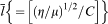
The squeeze film lubrication characteristic of finite partial porous journal bearings lubricated with couple stress fluids are obtained on the basis of Stokes microcontinuum theory. The modified Reynolds equation is derived using the Stokes constitutive equations to account for the couple stress effects due to the lubricant blended with additives. According to the Stokes theory, the new material constant η is responsible for the couple stress property. Since the dimension of l = (η/μ)1/2 is length, this length may be identified as the characteristic length of additives present in a Newtonian lubricant. The parameter
 is the ratio of microstructure size to the radial clearance. Hence,
 gives the mechanism of interaction of the fluid with the bearing geometry. As the value of
 approaches to zero, the dimensionless Reynolds equation reduces to the Newtonian lubricant case. When the value of
 is large, the couple stress effects are expected to be significant. The effect of permeability is observed through the non-dimensional permeability parameter,
 , and it is to be noted that as ψ→0 the problem reduces to the corresponding solid case studied by Lin
14
and as
, and it is to be noted that as ψ→0 the problem reduces to the corresponding solid case studied by Lin
14
and as
 , β→0 it reduces to the corresponding Newtonian case.
To solve squeeze film pressure in the equation (20), the mesh of the film domain has 20 equal intervals along the bearing length and circumference. The coefficient matrix of the system of algebraic equations is of pentadiagonal form. These equations have been solved using Scilab tools.
Squeeze film pressure
The variation of non-dimensional squeeze film pressure
 for different values of
 with ψ = 0·01 and ϵ = 0·1 is shown in Fig. 3. It is observed that
 increases for increasing values of
 . Increase in
 is more pronounced for larger value of
 . Figure 4 shows the variation of film pressure
 , for different values of eccentricity ration ϵ with ψ = 0·01and
 . It is observed that
 increases for increasing values of ϵ. The effect of permeability ψ on the variation of
 is shown in Fig. 5 for ϵ = 0·5 and
 . It is observed that the increasing values of permeability parameter ψ decreases
 .
.

Non-dimensional film pressure
for different values of
 with ϵ = 0·1 and ψ = 0·01

Non-dimensional film pressure
for different values of ϵ with
 and ψ = 0·01

Non-dimensional film pressure
for different values of ψ with ϵ = 0·5 and

The variation of maximum squeeze film pressure
 with the permeability parameter ψ for different values of
 with ϵ = 0·5 is shown in Fig. 6. It is observed that
 increases as
 increases. This increase in
 is more accentuated for smaller values of ψ.

Maximum film pressure
versus ψ for different values of
 with ϵ = 0·5
Load carrying capacity
Figure 7 shows the variation of non-dimensional load carrying capacity
 with ϵ for different values of
 . It is observed that the increasing values of
 increases
 as compared to corresponding Newtonian case
 . The variation of non-dimensional load carrying capacity
 with
with
 for different values of permeability parameter ψ is shown in Fig. 8. It is observed that the increasing values of ψ decreases
 , and this decrease in
 is more accentuated for larger values of
 . The effect of aspect ratio λ on the non-dimensional load carrying capacity,
 with ϵ is depicted in the Fig. 9. It is observed that
 increases for increasing values of λ, i.e. longer the bearing length larger is the load carrying capacity.

Non-dimensional load carrying capacity
versus ϵ for different values of
 with ψ = 0·01

Non-dimensional load carrying capacity
versus
 for different values of ψ with ϵ = 0·3

Non-dimensional load carrying capacity
versus ϵ for different values of λ with

Squeeze film time
The variation of the non-dimensional minimum squeeze film height
 with τ for different values of
 is depicted in Fig. 10. It is observed that the bearing with couple stress fluid as lubricants have longer response time as compared to Newtonian case. Figure 11 shows that the variation of
 with τ for different values of ψ with
 . It is observed that τ decreases for increasing values of ψ. This is due to the reduction in
 with increasing ψ.

Non-dimensional minimum film height
versus τ for different values of
 with ϵ = 0·1 and ψ = 0·01

Non-dimensional minimum film height
versus τ for different values of ψ with
 .
.
Conclusion
The effect of couple stresses on the squeeze film lubrication of finite porous journal bearings is studied using the Stoke's couplestress fluid theory. The finite modified Reynolds type equation is obtained for the problem under consideration and is solved numerically using finite difference technique with a grid spacing of Δθ = 90 and
 From the results obtained, the following conclusions are drawn.
The presence of microstructure additive in the lubricant provides an enhancement in the squeeze film pressure and the load carrying capacity as compared to the corresponding Newtonian case.
The squeeze film time is lengthened for the couple stress lubricants as compared to the corresponding Newtonian case.
The longer the bearing length is, the more the couple stress effect on the load carrying capacity is.
The effect of the porous facing on the bearing surface decreases the load carrying capacity and minimum permissible squeeze film height, whereas the journal centre velocity increases.
The adverse effects of the porous facing on the bearing surface can be compensated with the selection of the lubricants with proper microstructure additives.