







Abstract
Understanding the scratch behaviour of the composite materials is of primary importance. The scratch behaviour of glass fibre reinforced polyester composite was investigated. A new scratch device is designed and developed. Scratch tests at room temperature were carried out, using conical indenter and constant scratching velocity. The main aim of this study is to investigate the effects of tribological parameters on wear mechanisms and friction coefficient. Particularly, the effects of the normal load and the attack angle were presented. The different wear scenario of the composite material during the scratch test was deduced, then supported by an analysis of the glass fibre reinforced polyester composite wear modes using scanning electron microscopy (SEM) observations was performed. The correlation between tribological parameters and wear mechanisms was highlighted through the composite scratch map. Results were compared with those previously published associated with the metallic and the polymeric materials.
Keywords
Introduction
Composite materials have become increasingly used in various industrial applications. In addition to their attractive mechanical properties, composites have low densities. Their mechanical and physical properties are suitable for a wide range of applications (aviation, maritime…). The means of mechanical and microscopic characterization are effective in studying the behaviour of these materials and their wear modes. However, the tribological behaviour and the wear mechanisms of heterogeneous materials, particularly composite materials, require further development. In most studies, the five fundamental wear modes shown are adhesive, tribochemical, fatigue, abrasive and erosive wear. Especially, abrasive wear can be classified in two groups. The first is two body abrasive wear. The second is three body abrasive wear. This will help to investigate many interactions between the different parameters involved in the abrasive wear processes. In the specific case of the rectification or the grinding, the analysis of the abrasion process can be focused on the action of one particle on the part surface. In fact, the action of the abrasive paper can be decomposed into a succession of elementary actions of abrasive grains. Therefore, the investigation of this abrasive grain effect helps us to better understand the abrasive wear process. One of the most used tests to simulate this contact is the scratch test.
Many studies on the scratch resistance of the polymers have been conducted.1–4 Sinha et al. 5 have studied scratch deformation mechanisms of polymers. For high normal load, they have perceived the stick-slip type of polymers’ response. In addition, for some polymers, the zigzag shape of the scratch has been observed. They have demonstrated that the tendency to stick-slip is less perceptible for PMMA than other polymers (PVC, PEEK, PET, and PC). During scratching PMMA, a continuous removal of material was shown. Briscoe et al. 6 has constructed a number of scratching map for polymers subjected to different test conditions. They have demonstrated that the influence of the effective contact strain on the PMMA deformation mode is significant. A transition from a ductile to a brittle mode is shown. They have found that increasing the strain increase the severity of the brittle fracture. Under high strain and load, the surface damages observed are chip forming and machining. Iqbal et al. 7 have presented wear map for PEEK. The main observed deformations were ductile ploughing, ductile and brittle ploughing, rubber like or elastomeric deformation, ironing and elastic deformation. Kato 8 established, using a pin on disc configuration, a wear map of homogenous material (0·45% carbon steel). He found that three abrasive wear modes are dominants: cutting, wedge forming and ploughing. The same modes were found by Hokkirigawa 9 using a brass alloy. Actually, these mechanisms depend on test parameters. In addition to the different test parameters, such as normal load, sliding velocity and sliding length, abrasive wear mode is affected by the abrasive particle geometry.10–12 In fact, Mezlini et al. 12 have proved that wear mechanisms depend on the attack angle as well as the normal load. They have shown that the increasing attack angle provokes both transition of the wear mechanism from ploughing to cutting, and an increase in the friction coefficient. They showed also the correlation between tribological parameters and wear mechanisms by establishing the scratch map of both homogeneous and heterogeneous materials. On the other hand, they have shown that the tribological behaviour of heterogeneous material is different from that of homogenous materials. At large normal load the nodular cast iron behaviour is governed by the presence of the graphitic phase. However, the tribological behaviour of glass fibre reinforced polyester composite remains more complicated. The presence of the reinforcement and the additives can also modify the wear mechanisms. El-Tayeb et al. 13 have studied the wear and friction of glass chopped fibre reinforced polyester, using a pin on disc technique. They have shown that the wear mechanisms observed are micro- and macrocracks in the matrix, fibre matrix interface debonding, and fibre fracture. Besides, there are various abrasive wear modes of composite material; we can mention the interface fibre matrix separation 14 and fibre pull-out. 15 In order to have a better interpretation of the correlations between tribological behaviours and wear mechanisms, it is proved that establishing the wear map is effectively interesting. Briscoe et al. 16 realised a deformation map of the glass fibre reinforced polyester which shows the scratch mechanisms as a function of the cure temperature and the included angle of the conical indenter. They showed that increasing the cure temperature at a low conical included angle provokes transition of wear mechanisms from ductile or viscoelastic–plastic ploughing to the matrix breaking and forming fragmented wear particles. 16
As mentioned before, the scratch wear maps have been established in several studies on homogeneous and heterogeneous materials. As for fibre reinforced polymer composite materials, a lot of investigations on three body abrasion, 17 pin-on-disc 18 and bloc on disc 19 wear behaviour are made. However the composite scratch map has not been established yet. Special attention will be given to the correlation between tribological parameters and wear mechanisms.
The purpose of the present paper is to present an experimental study of the composite scratching. A conical indenter, with different attack angles, slides against unidirectional long glass fibre reinforced polyester composite. The influence of the normal load and the attack angle on the scratch and the composite wear behaviour has been investigated. An analysis of the wear modes using SEM observations has been performed. Correlation between tribological parameters, friction coefficient and wear mechanisms has been deduced. The scratch map has been established and finally the different wear ‘scenario’ of the composite material during scratching has been presented.
Material and experimental procedure
Material
In this work, the scratch behaviour of a composite material was experimentally investigated. A unidirectional E glass fibre reinforced polyester composite containing ASP400 clay filler (14 wt-%) was used. This composite was obtained by pultrusion as a rectangular section bar. The polyester matrix and glass fibre weight percentage were respectively of 21 and 65%. The glass fibre had an average diameter of 23 μm. Composite specimens with dimensions of 50×50 mm and 6 mm in thickness were prepared. The scratch was performed on 50×50 mm faces.
Scratch device
An investigation on friction and wear mechanisms of the glass fibre reinforced polyester composite material was carried out. A series of scratch tests with a conical indenter on a new designed and developed scratch device were conducted. This device, illustrated in Fig. 1, is able to perform scratches varying the normal load, the attack angle, the scratch length and the scratching velocity. This scratch tester is able to perform scratches on planar samples which were fixed on a displacement stage. This last was driven by a step controlled motor to draw the sample. The stage provided scratching velocity which ranged from 13 to 210 mm min−1. The sample surface was oriented to be parallel to the indenter motion via a specific system. The normal load was imposed by placing the dead weights upon the indenter holder. The load range was varied from 1 to 50 N. The indenter holder can move freely in the vertical direction. It applied, therefore, a constant normal load on the specimen surface during the test.
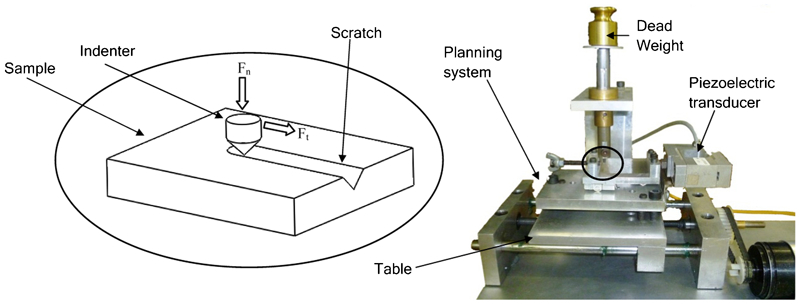
Scratch device
The indenters were high speed steel conical indenter of various internal cone angles. The attack angle was varied from 10 to 60° to investigate the effect of indenter geometry on scratching. Scratch length was kept constant at 20 mm. Constant scratching velocity of 210 mm min−1 was applied. The scratches were performed perpendicular to the glass fibre orientation. The normal loads were varied from 20 to 50 N (10 N increments), for a fixed attack angle, to observe their effects on scratch deformation. The piezoelectric transducer measuring the tangential force had a load resolution of 1 mN. The instantaneous tangential force was automatically measured and recorded by a computer system and the apparent friction coefficient was deduced.
Throughout the study, the contact between the conical indenter and the sample surface was unlubricated. Each test was repeated three times in the same conditions. The presented results were the average of three values. In order to assess the different damage mechanisms under different conditions, Scanning Electron Microscope imaging was carried out.
Results and discussion
Effects of tribological parameters
The variation of tangential force versus scratch length at different normal loads is represented in Fig. 2. As seen, for all applied loads, an obvious and a common feature is that every curve shows two regions. The first one corresponds to the transition period. During this period, the tangential force increases rapidly and tends, after that, to a mean value. The second one represents the steady regime during which the tangential force remains constant. The cut-off shown between the transition period and the steady period present the time taken to reach the mean peak load. It is observed that the tangential force and the apparent friction coefficient fluctuate along scratch length. This phenomenon is particularly pronounced at large normal loads. In fact, at low normal loads, the tangential force remained almost steady. The indenter penetration is low; no severe damage occurred and ploughing wear mechanism is dominant. Unlike, at normal load of 50 N, the scratch depth is larger and the frictional variation increased significantly. These observations can be essentially attributed to the fracture mechanisms which took place, particularly, fibre fracture and pull-out phenomenon. Similar observation has been reported by Xiao et al. 20 for other heterogeneous materials.
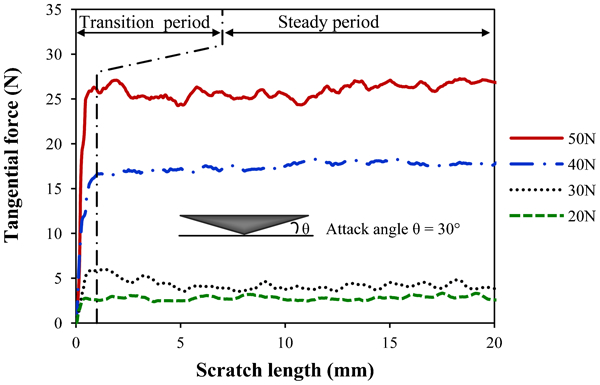
Variation of tangential force with scratch length for different normal loads
Figure 3 presents the variation of the mean apparent friction coefficient with normal load for different attack angles. The coefficient of friction was calculated by taking the ratio of the tangential force and normal load during scratching. Two regions can be distinguished. When the attack angle is less than 30° and the normal load is below 30 N, a constant low apparent friction coefficient is detected. The average apparent friction coefficient is ∼0·12. Therefore, in this range, the effect of normal load and attack angle is not significant. Once, the normal load increases from 30 to 40 N, the apparent friction coefficient increases considerably and then remains steady at an average value of ∼0·33 for 10° attack angle and increases slightly for 30° attack angle. However, for an attack angle >30°, the apparent friction coefficient is larger and it remains constant and independent of the normal load. The average apparent friction coefficient for an attack angle of 45 and 60° are respectively about 0·55 and 0·62.
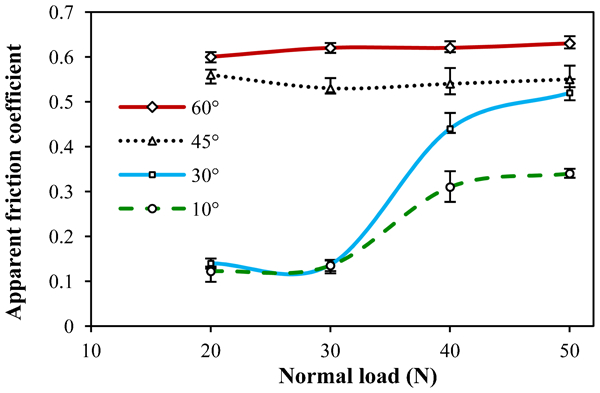
Variation of apparent friction coefficient with normal load for different attack angles
Figure 4a–d shows the variation of the apparent friction coefficient versus the attack angle for normal loads of 20, 30, 40 and 50 N respectively. For a large normal load increasing the attack angle causes a quasi-linear increasing of the apparent friction coefficient. This Last increase from 0·31 to 0·62 and from 0·34 to 0·63 for normal loads of 40 N (Fig. 4c) and 50 N (Fig. 4d) respectively. Similar results were found by Mezlini et al. on scratching aluminium alloy. 21 However, for a low normal load a non-linear variation has been observed. In fact, for a normal load of 20 N (Fig. 4a) and an attack angle ⋚30°, the apparent friction coefficient remains almost constant and takes a low value. During this period the average friction coefficient is ∼0·12. When the attack angle is >30° and a normal load of 20 N, the apparent friction coefficient increases with increasing the attack angle of the indenter and the average of friction coefficient is ∼0·56. In this period, the difference between the friction coefficients obtained at low and large normal load is not significant. Similar observation has been observed for a normal load of 30 N. Evolution of the friction coefficient depends on wear mechanisms and a close relationship has already shown for aluminium alloys. 21 To highlight this correlation relative to the composite material, the wear mechanisms will be analysed for different tribological parameters, particularly for different normal load and attack indenter angle.
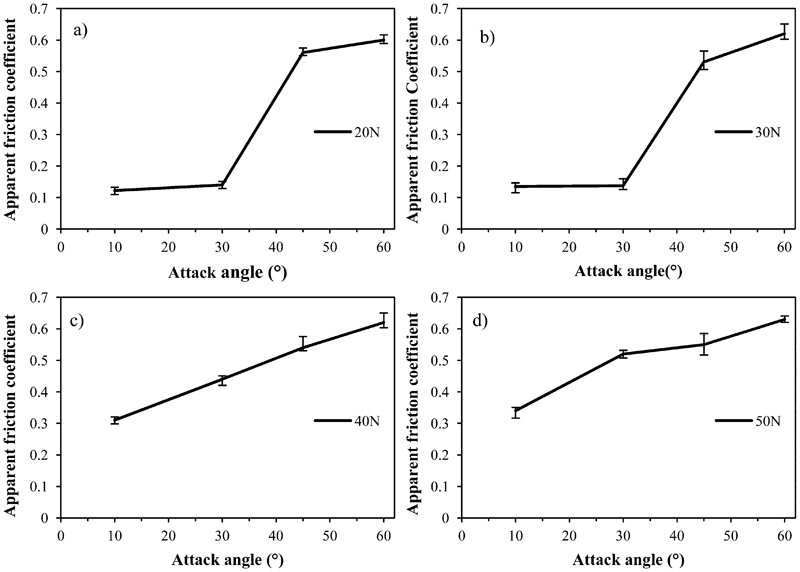
Comparison between apparent friction coefficients against attack angle for normal loads: a 20 N; b 30 N; c 40 N; d 50 N
Wear mechanisms of glass fibre reinforced polyester composite
When the loaded indenter slides over the surface of the glass fibre reinforced polyester composite, wear of the composite occurs. Therefore, different wear scenario can be involved. Figure 5a shows the schematic wear mechanisms of a glass fibre reinforced polyester composite scratch for 10° attack angle and for normal load of 30 N. When a lower attack angle and lower normal load are applied, the scratch depth stills always less than glass fibre size. Therefore, the indenter compresses the glass fibre without any fibre damage and matrix ploughing mechanism has been occurred.
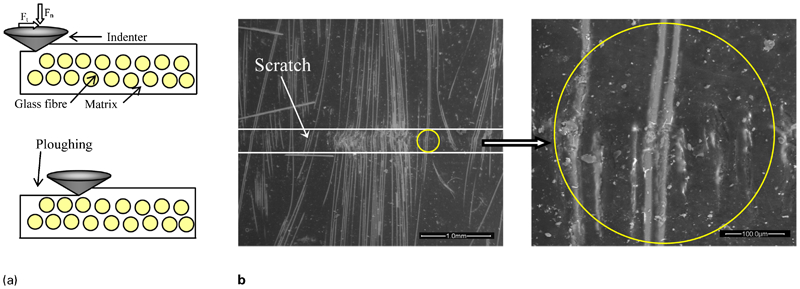
a schematic wear mechanisms for low attack angle (10°) and low normal load (30 N) and b SEM observation of glass fibre reinforced polyester composite scratch: Fn = 30 N; θ = 10°
Figure 5b shows the composite wear mechanism for 10° attack angle and for a normal load of 30 N. A scratch with a low indenter penetration forms a shallow groove and no material loss is observed. The matrix only is affected and plastic deformation of polyester is detected, the material is generally pushed to the scratch sides and wedge is formed at both sides and front of the indenter. Scratching with low attack angle compresses the surface under the indenter without reaching the fibre layer and fibres are not affected. Therefore, under these conditions, no sign of fibre breakage is observed only ploughing wear is dominant.
Nevertheless, increasing normal load generates an increase in scratch depth and just the first fibre layer is affected. Figure 6a presents a schematic wear mechanism occurred in the composite when it is subjected to scratching under 50 N normal load at an attack angle of 10°. Several fibre fractures occur and fibre debris is observed. Therefore, increasing normal load promotes the transition of wear mechanism from ploughing to fibre multifractures and produces wear particles from the fractured fibres.
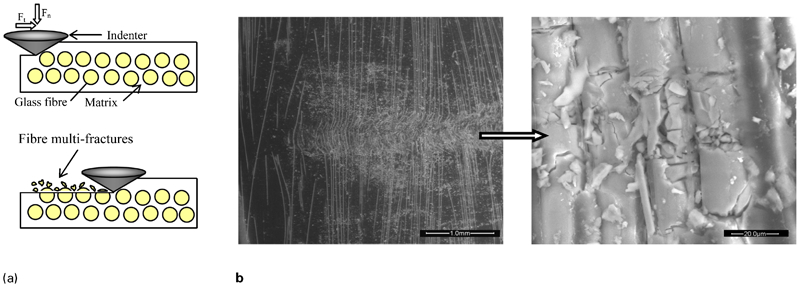
a schematic wear mechanisms for low attack angle (10°) and large normal load (50 N) and b SEM observation of glass fibre reinforced polyester composite scratch: Fn = 50 N; θ = 10°
When analysing wear mechanisms of the scratched glass fibre reinforced polyester composite surface, several fractures along the scratched fibre and wear debris are shown. For a low attack angle, when the normal load increases up to 50 N, compressive stresses increase and thus promotes the fibre multifractures wear mechanism. The fibres are ground and fibre debris is observed. The predominant wear mechanism perceived, in these scratch conditions, is fibre multifractures.
Figure 7a shows the schematic wear mechanisms of a glass fibre reinforced polyester composite scratch for 60° attack angle and for normal load of 30 N. When a large attack angle is used, the scratch depth is greater than glass fibre size for different normal load. For 30 N normal load some glass fibre layers are in contact with the indenter. When this last sliding, fibres are fractured.
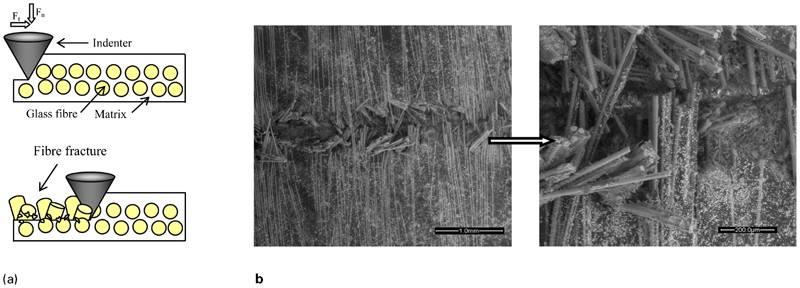
a schematic wear mechanisms for large attack angle (60°) and low normal load (30 N) and b SEM observation of glass fibre reinforced polyester composite scratch: Fn = 30 N; θ = 60°
Figure 7b shows the composite wear mechanism for 60° attack angle and for a normal load of 30 N. A scratch with a deep indenter penetration is shown. Indenter penetration is deeper than a few fibre layers and sliding of the conical tip provokes fibre breakage. In fact, glass fibres have a brittle character; they are broken perpendicularly to their lengths. As well, other wear mechanisms are present: matrix crack and fibre matrix interface debonding. The soft character of polyester matrix tends to stop cracks in the interface. A similar observation has been reported by Krenn, 22 on scratching a soft metallic matrix. Despite the fact that several wear mechanisms exist under these scratch conditions, the major wear mechanism observed is fibre fracture.
However, for large normal loads of 50 N the indenter penetration is deeper and more glass fibre layers are in contact with the indenter which can break them and pull them out of the matrix (Fig. 8a). Then, wear mechanisms like fibre fracture and fibre pull-out can be accelerated and become predominant. In this case, coexistence of several dominant wear mechanisms under the same test condition can take place. Especially, on under layer, multifractures mechanisms have probably occurred.
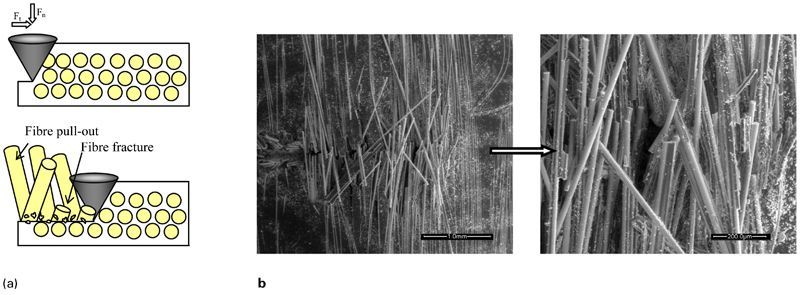
a schematic wear mechanisms for large attack angle (60°) and large normal load (50 N) and b SEM observation of glass fibre reinforced polyester composite scratch: Fn = 50 N; θ = 60°
The SEM images of the scratched glass fibre reinforced polyester composite surface with 60° attack angle and normal load of 50 N are observed in Fig. 8b. They show several wear mechanisms. Increasing the load up to 50 N increases the penetration depth and promotes the fibre fracture and pull-out phenomenon. Several different wear mechanisms involved in the process, and the dominant wear mechanism varies with the scratch conditions. The tribological behaviour of glass fibre reinforced polyester composite is governed essentially by the tribological parameters associated to the matrix, glass fibre and interface properties. In order to have a better phenomenon interpretation, correlation between scratch conditions and wear mechanisms is necessary.
Correlation between tribological parameters and wear mechanisms of glass fibre reinforced polyester composite
A scratching friction map for glass fibre reinforced polyester composite is shown in Fig. 9. The friction coefficient is plotted versus the tangent of the attack angle (tan θ) and for normal loads ranging from 20 to 50 N. The scratches are carried out under a constant scratch velocity 210 mm min−1 and under unlubricated contact conditions. The map presents also the observed wear mechanisms. For a low normal load (less than 30 N) and a low strain (less than 1) a low constant value of friction coefficient is detected. The dominant wear mechanism already observed, under these conditions is ductile ploughing. The friction map shows that both the strain and the applied load effect upon the apparent friction coefficient value and the wear mechanisms observed during the scratch test. For a higher level of strain a larger apparent friction coefficient is perceived and several brittle wear modes takes place. Brittle fracture phenomena related to the glass fibre reinforced polyester composite are observed. In fact, phenomena like fibre fracture, matrix cracking, fibre matrix interface debonding and fibre pull-out are noticeable. Similar observations were found by Briscoe et al. 6 for scratching PMMA. Another reading of the found results on scratching of the glass fibre polyester composite will give more details about the correlation between tribological parameters and wear mechanisms and will be discussed below.
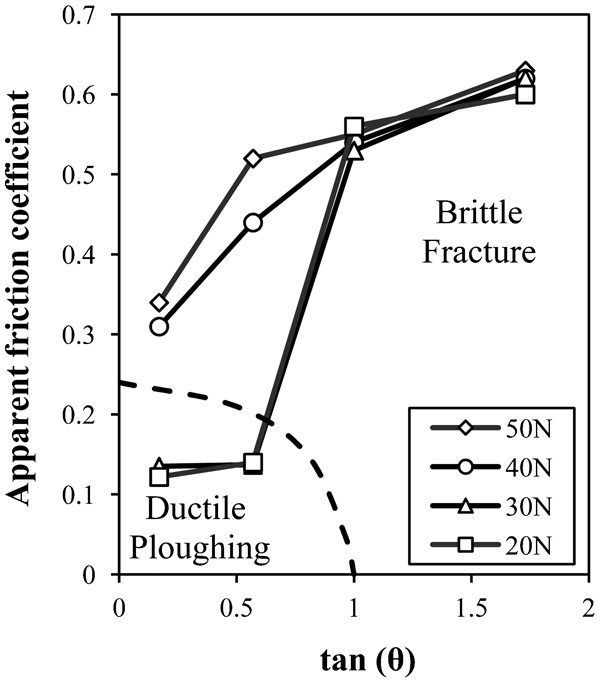
Friction map of glass fibre reinforced polyester composite
Finally, correlation between tribological parameters, particularly normal load and attack angle, and wear mechanisms is shown in Fig. 10. The map defines the surface damages observed after scratching the glass fibre reinforced polyester composite. The used range of conical indenter was from 10 to 60° attack angles and the applied normal loads range from 20 to 50 N. The scratching velocity was maintained at 210 mm min−1 and the contact was unlubricated. The map shows the significant influence of both the normal load and the attack angle upon the transition from ploughing towards several brittle wear modes. In fact, for a low normal load and an attack angle less than 30°, the wear mechanism is assessed as mainly being ploughing. Similar observations were shown by Mezlini et al. 12 for homogeneous and heterogeneous metallic materials and by Briscoe et al. 6 for polymers. Nevertheless, at larger normal loads (⩾30 N) and larger attack angles (⩾30°) a brittle fracture was detected on the scratched surface. For a value of attack angle ranging between 10 and 30° and for large normal loads wear mechanism, such as fibre multifractures, is dominating. The severity of the damage mode was found to increase with increase in the imposed attack angles. The surface damage is observed to become fibre fracture, or fibre pull-out, under the most severe contact conditions in terms of attack angles and normal loads. Indeed, when the attack angle is ⩾45° and the normal load is less than 30 N, fibre fracture is accelerating. Increasing the normal load provokes the apparition of fibre pull-out wear mechanism. However, at large normal load and attack angle, the tribological behaviours of the unidirectional glass fibre reinforced polyester composites are different from those of metals and polymers. Indeed, Mezlini et al. 12 have shown that at a large attack angle Metals wear mechanisms transit from ploughing to cutting. Besides, Briscoe et al. 6 have proved that polymer damage mechanisms transit from the ductile viscoelastic–plastic ploughing towards brittle deformation modes such as the chip forming or the machining. Several wear mechanisms of glass fibre reinforced polyester composite are shown: the fracture of the fibre, the matrix breaking, the fibre matrix debonding and fibre pull-out.
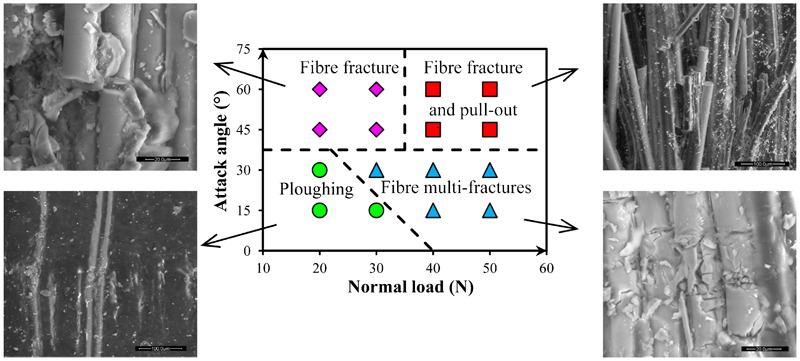
Correlation between tribological parameters and wear mechanisms of glass fibre reinforced polyester composite
Conclusion
Effect of attack angle and normal load on scratch damage of a composite material was investigated. The experimental study was performed to determine the apparent friction coefficient and wear mechanisms using a conical indenter.
Apparent friction coefficient of glass fibre reinforced polyester composite depends on tribological parameters. At a high attack angle the effect of normal load on the apparent friction coefficient is non-significant. However, at low attack angle increasing normal load increases the apparent friction coefficient.
The composite wear depends on the experimental test parameters, such as attack angle and normal load. The correlation between wear mechanisms and tribological parameters has been revealed. It shows that the increase of the normal load and the attack angle causes the transition of the wear mechanism from matrix ploughing to three main wear modes: fibre fracture, fibre pull-out and fibre multifracture. Moreover, based on SEM micrographs, composite wear mechanisms like fibre matrix interface debonding and matrix crack are observed. Therefore, the tribological behaviour of glass fibre reinforced polyester composite is governed essentially by the tribological parameters associated to the matrix, glass fibre and interface properties.