Abstract
IMPROVED RESIN PERFORMANCE IN MDF THROUGH DEVELOPMENT OF THE BLOWLINE BLENDING PROCESS
Blowline blending, the method of mixing the fibre with the adhesive used to make MDF (medium density fibreboard) in the blowline following the fibre preparation stage, has generally required higher resin addition rates than the alternative post dryer resin addition systems. Despite this, other advantages have ensured that the blowline blending process has become the dominant method of making MDF.
Kelvin Chapman first published a method of optimising the blowline blending process in 1998. His most recent paper, presented at IPPS 2011, reviews key studies in the area and provides insights into the processes determining the blending outcome. He also describes the most recent developments in the blowline blending process, while tackling the difficult area of quantifying resin consumption figures.
Improved resin performance in MDF through development of the blowline blending process. K. M. Chapman, pp. 9–14
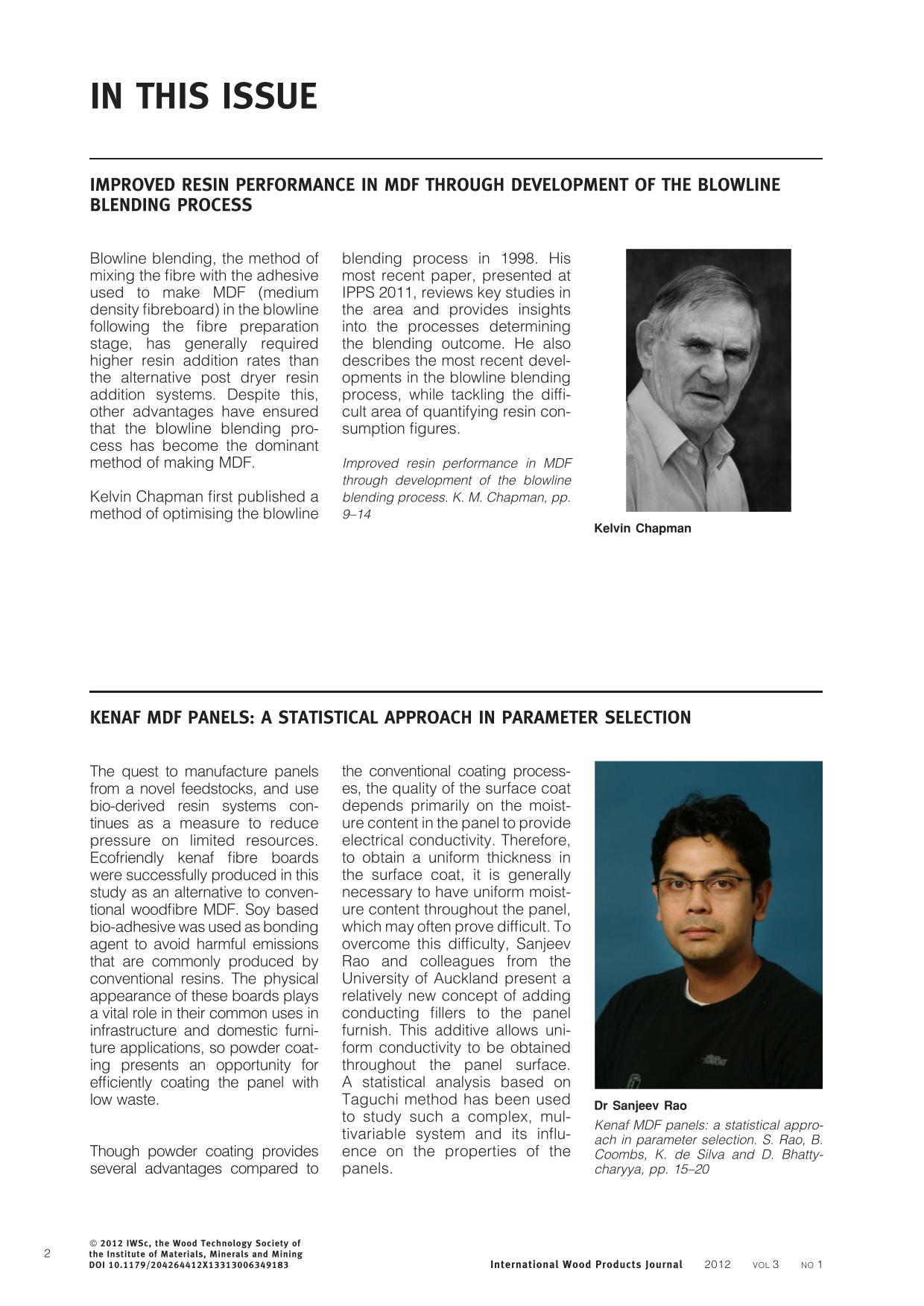
Kelvin Chapman

KENAF MDF PANELS: A STATISTICAL APPROACH IN PARAMETER SELECTION
The quest to manufacture panels from a novel feedstocks, and use bio-derived resin systems continues as a measure to reduce pressure on limited resources. Ecofriendly kenaf fibre boards were successfully produced in this study as an alternative to conventional woodfibre MDF. Soy based bio-adhesive was used as bonding agent to avoid harmful emissions that are commonly produced by conventional resins. The physical appearance of these boards plays a vital role in their common uses in infrastructure and domestic furniture applications, so powder coating presents an opportunity for efficiently coating the panel with low waste.
Though powder coating provides several advantages compared to the conventional coating processes, the quality of the surface coat depends primarily on the moisture content in the panel to provide electrical conductivity. Therefore, to obtain a uniform thickness in the surface coat, it is generally necessary to have uniform moisture content throughout the panel, which may often prove difficult. To overcome this difficulty, Sanjeev Rao and colleagues from the University of Auckland present a relatively new concept of adding conducting fillers to the panel furnish. This additive allows uniform conductivity to be obtained throughout the panel surface. A statistical analysis based on Taguchi method has been used to study such a complex, multivariable system and its influence on the properties of the panels.
Kenaf MDF panels: a statistical approach in parameter selection. S. Rao, B. Coombs, K. de Silva and D. Bhattycharyya, pp. 15–20
Dr Sanjeev Rao

PHYSICAL AND MECHANICAL PROPERTIES OF THERMALLY MODIFIED AND DENSIFIED MDF
Furniture designers and constructors seek new wood materials for their products or are interested in improving the properties of existing materials, such as MDF. One property of interest is swelling related to atmospheric moisture. The authors of this article have confirmed that it is possible to produce material with reduced swelling properties by thermally modifying MDF that is not water resistant in an oxygen environment. Additionally, by hot pressing MDF immediately after its thermal modification, material with constant density can be obtained.This property is an important factor in deep routing of this material in the process of producing such furniture elements as front panels or edge finishing. In contrast, cold pressing of MDF resulted in numerous internal cracks of this material (as a consequence of springback) which in turn reduced the panel mechanical properties. The density of thermally modified and cold pressed MDF varies throughout the thickness of the panel. The hot pressing technology offers better prospects from the point of view of the application of thermal modification of MDF.
Physical and mechanical properties of thermally modified and densified MDF. M. Grzeskiewicz, P. Borysiuk and K. Kramarz, pp. 21–25
Marek Grzeskiewicz

Piotr Borysiuk

Katarzyna Kramarz

EXPERIENCES WITH A NEW VENEER DRYING METHOD
Veneer drying consumes more than half of the energy used in the plywood manufacturing process. The drying process also has a big effect on the quality of the veneer and the final product, plywood. The current drying technology is based on convection; the heat is transferred onto the veneer through the flow of hot air. This is effective, but it has several problems, such as high energy consumption and uneven moisture distribution in dry veneer. To solve these problems, a new type of contact drying technology has been developed and patented in Aalto University in Finland. In the new dryer the veneer is pressed between a hot top plate and a cold bottom plate. There is also a vacuum inside the dryer. Olli Paajanen and his colleagues have been investigating the new drying method in practice. Experiments with birch veneer show that the new dryer is significantly faster compared to old technology and the quality of the dry veneer is good.
Experiences with a new veneer drying method. O. Paajanen, H. Holmberg, P. Lahti and M. Kairi, pp. 26–30
Olli Paajanen

LOW FORMALDEHYDE EMISSION MDF OVERLAID WITH WOOD VENEER: BONDING PROBLEMS ASSESSMENT
When thinking about strategies to reduce formaldehyde emissions in wood-based panels, their impact on boards processing is usually neglected. The group led by Jorge Martins and Luisa Carvalho at DEMad in Viseu and LEPAE in Oporto, has been developing new bonding systems and new pressing systems for reduced formaldehyde emissions. In parallel with this they have considered the impact of formaldehyde on the cutting (edge quality) and surfacing (surface soundness) operations in panels.
In this paper, they address the industry concerns about the increased number of panel rejects due to veneer delamination or debonding. This could be caused by adhesion failure related, not only with MDF surface characteristics (presence of scavengers in the surface layers), resin penetration, but also with the surfacing operation (conditions not adapted to the new low formaldehyde emission resins used in this operation). For that purpose, a variation of the ABES technique to assess wood bonding problems on MDF surfacing operations using decorative beech wood veneer has been developed.
Low formaldehyde emission MDF overlaid with wood veneer: bonding problems assessment. J. Martins, C. Coelho, J. Ferra, P. Cruz and L. Carvalho, pp. 31–35
Jorge Manuel Martins

Luisa Hora de Carvalho

THE TRANSVERSAL COMPRESSION AND STRAIN BEHAVIOUR OF MATURE WOOD STRANDS PRESSED AT HIGH TEMPERATURES AND PRESSURES
Computer models that are designed to help understand the consolidation of mattresses during particleboard and OSB production require data on the physical and mechanical properties of the particles/strands. These properties change with the location of a strand within a mattress because of the different temperatures and humidities it experiences during hot-pressing. In addition, strand dimensions and geometry alter mattress compressibility and the thermal and humidity profile which develops within the mattress. Here, Elisha Ncube, Mark Irle and Hugh Mansfield-Williams present a study on the compression behaviour of individual strands that are compressed in a controlled humidity and temperature environment, thus giving insights into the difference between radial and tangential faced strands. Data from the compression of strands in different conditions provides an insight on the mechanisms which cause the density profiles often seen within particleboards and OSB panels.
The transversal compression and strain behaviour of mature wood strands pressed at high temperatures and pressures, E. Ncube, M. Irle and H. Mansfield-Williams, pp. 36–42.
Elisha Ncube

Mark Irle

Hugh Mansfield-Williams

THE PERFORATOR METHOD IN BALANCE
Research work on the formaldehyde release from wood-based panels started early in the 1960s with three main objectives. Firstly, to find methods to quantitatively measure the formaldehyde liberation from wood-based panels. Secondly, to explore the different factors, both within the board and from its environment, affecting the release of formaldehyde. Thirdly, to develop practical methods designed to reduce the formaldehyde emission from boards. Enormous progress has been made in these fields. In Europe, the United States and Japan, methods have been developed to measure the formaldehyde release using different principles to assess subtle differences between boards of very low formaldehyde emission.
However, the correlation between the formaldehyde measurement methods developed is still open to discussion, particularly in the low emission range. Here Edmone Roffael of Göttingen University reports data relating to the perforator method (the most popular surrogate technique used in Europe to measure the extractable formaldehyde content in particle- and fibreboards) and shows its limitations in the low emission region.
The perforator method in balance. E. Roffael and B. Johnsson, pp. 43–50.
Edmone Roffael

B. Johnsson

STUDY OF THE INFLUENCE OF SYNTHESIS CONDITIONS ON THE PROPERTIES OF MELAMINE-UREA FORMALDEHYDE RESINS
Due to the recent classification of formaldehyde by the International Agency for Research on Cancer (IARC) as ‘carcinogenic to humans (Group 1)’, companies are compelled to produce low formaldehyde emission panels. The reduction of the formaldehyde to urea molar ratio was the most common approach for this purpose, but the minimum usable limit has already been reached. Alternative strategies have been used with success, such as incorporation of melamine in the resin polymeric structure. In this work, Nadia Paiva and colleagues from the University of Porto and the Polytechnic Institute of Viseu have studied the effect of some process variables on the synthesis of melamine-fortified UF resins, analysing the physico-chemical and physico-mechanical properties of the resulting resins and particleboards. A resin formulation was obtained that exhibits formaldehyde content within Japanese F**** requirements when evaluated both by the perforator and the desiccator method.
Study of the influence of synthesis conditions on the properties of melamine-urea formaldehyde resins. N. Paiva, J. Ferra, P. Cruz, L. Carvalho, F. Magalhaes, pp. 51–57.
Nadia Paiva

METHYLENE DIPHENYL DIISOCYANATE (MDI): EU CLASSIFICATION; THE IMPACT OF REACH; WORKER & CONSUMER EXPOSURE - PERCEPTION VERSUS FACTS
MDI resins have found an increasing market in wood based panels over the past twenty years. This was initially due to their superior moisture resistance for structural applications, but more recently as an alternative to formaldehyde based resins, to improve indoor air quality. During board manufacture using MDI resins sensible control measures are advised to control monomeric MDI at elevated temperatures or during atomisation processes. A study by Erik Vangronsveld and colleagues from Huntsman monitored nine composite wood panel mills in seven European countries, measuring MDI in the atmosphere at different work stations in the mills. Here he presents valuable insights from the data, identifying areas where extraction systems or other controls are advisable. The data are compared to acceptable levels, and to data for formaldehyde based resin production lines.
Methylene diphenyl diisocyanate (MDI): EU classification; the impact of REACH; worker & consumer exposure - perception versus facts. E. Vangronsveld, pp. 58–63.
Erik Vangronsveld

VISCOSITY DETERMINATION OF AMINO RESINS DURING SYNTHESIS USING NEAR-INFRARED SPECTROSCOPY (WINNER OF POSTER PRIZE)
Urea-formaldehyde resins (UF resins) are the most commonly used binder in the manufacture of wood-based panels. The conventional synthesis process is composed of two consecutive steps: basic methylolation and acidic condensation. The properties of the resin depend on precise control of these two steps. In industrial production, reaction progress is monitored by periodically removing samples from the reactor during condensation, so that viscosity can be measured after cooling. Ana Henriques and her colleagues have developed a chemometric calibration method based on FT-NIR spectra acquired using an optical fiber probe. This allows rapid estimation of the viscosity of the reaction medium, without time-consuming and labor intensive procedures, and avoiding the need to remove samples from the reactor.
Viscosity determination of amino resins during synthesis using near-infrared spectroscopy. A. Henriques, J. Ferra, P. Cruz, J. Martins, F. Magelhaes and L. Carvalho, pp. 64–66.
Ana Henriques