






Abstract
Strength grading of Norway spruce [Picea abies (L.) Karst.] side boards in the wet state was investigated. For a sample of 58 boards, density and dynamic modulus of elasticity in the axial direction (MOEdyn) were determined in the wet state. The boards were then split into two parts and the procedure of determining MOEdyn was repeated both before and after the boards were dried to a target moisture content of 12%. Finally, tensile strength of the split boards was measured and its relationship to MOEdyn for both wet and dried split boards was determined. The investigation also included an evaluation of a so called reversed lamination effect on the stiffness caused by the splitting of boards into two parts. The results show that strength grading of split boards in the wet state can give just as good results as grading performed after drying. The reversed lamination effect on the stiffness of split boards was found to be of lower order.
Introduction
Approximately 30% of the volume of sawn timber produced at a typical Swedish sawmill consists of side boards, i.e. boards of narrow dimensions sawn from the outer parts of a log. Large production volumes and small dimensions imply that considerable numbers of side board pieces have to be handled in the sawmilling process and the costs for production, storage and sales are, in many cases, not met by the selling price on the market.
Previous research has shown that several wood characteristics that influence the structural properties of sawn timber vary considerably in the radial direction, i.e. from pith to bark. For example, the modulus of elasticity (MOE) in softwood trees increases significantly from the pith and outwards (Wormuth 1993) and similar behaviour has also been found for density of Norway spruce (Steffen et al. 1997; Dahlblom et al. 1999). Accordingly, side boards possess excellent structural properties but due to their small dimensions, they are very seldom used for load bearing purposes. Since 2005, Växjö University (from 1 January 2010 named Linnæus University) and SP Technical Research Institute of Sweden have conducted research regarding the development of high-value products utilising softwood side boards. The research carried out by the University and the Institute concerns the possibility to use undried Norway spruce [Picea abies (L.) Karst.] side boards as laminations in wet-glued laminated beams for load-bearing applications. The beams consist of flatwise glued wet boards with cross-section dimensions of 25×120 mm. For wet boards, the moisture content (MC) could vary from the fibre saturation point, which for Norway spruce occurs at ∼30%, to ∼150% (Boutelje and Rydell 1995). After gluing, each beam is split, dried and planed into two new beams with a width of 50 mm (see Fig. 1).
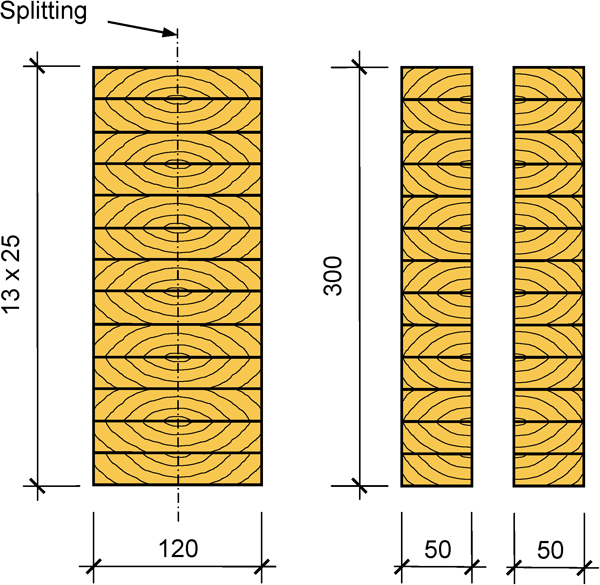
Wet-glued beams before (left) and after (right) splitting, drying and planing (Petersson et al. 2009; Serrano et al. 2010)
Structural properties of these split beams have been measured and analysed, and the results obtained so far are promising (Petersson et al. 2009; Serrano et al. 2010). Despite the fact that the beams have been produced from batches of un-graded boards, their stiffness and strength properties are consistent with both glued laminated timber of strength class GL32h, as defined in EN1194 (CEN 1999), and structural timber of strength class C35, as defined in EN338 (CEN 2009). Furthermore, by gluing boards in the wet state, directly after sawing, a higher yield and a much more cost-efficient handling in the sawmill production process would be obtained.
To improve the structural properties of the beams even further, defect elimination by finger jointing and strength grading of the wet side boards before gluing has been proposed. Grading of structural timber into different strength classes means that the grade-determining properties (namely bending strength, MOE and density of timber members) are predicted or measured by visual inspection or non-destructive machine testing. The market is, today, dominated by machine strength grading based on the relationship between a determined MOE value, which is used as the indicating property, and the other two grade-determining properties. One such approach is based upon dynamic excitation and measurement of the first resonance frequency fA1 (Hz) in the axial direction. The relationship between this frequency and the board length L (m), density ρ (kg m−3) and dynamic modulus of elasticity EAn (Pa) in the axial direction is expressed by equation (1) (e.g. Ohlsson and Perstorper 1992)

The approach described above is generally used for strength grading of structural timber in the dried state, i.e. typically timber with an MC of about 16–18%, but recently grading systems based on axial excitation have also been approved for wet state grading of structural timber (e.g. Initial type testing report; CEN 2010). In previous research carried out by Glos and Burger (1998), similar yields were found when structural timber with thickness >50 mm was graded in both the green state and after kiln-drying to ∼12%MC using a bending and radiation type machine. Unterwieser and Schickhofer (2007) investigated the possibility of grading sawn timber, both centre-cuts and side boards with thickness >41 mm, in the wet state. They found that the axial dynamic MOE showed no dependence on the MC above the fibre saturation point and that the relationship in terms of coefficient of determination R2 between wet and dried axial dynamic MOE was as strong as R2 = 0·96.
In this paper, the results from a study to investigate the possibility to grade narrow dimension side boards in the wet state by axial dynamic excitation are presented. For a sample of boards, EA1 was determined by dynamic excitation under both wet and dried conditions. Subsequently, tensile strength and local static MOE in tension were measured in the dried state and the correlation between results in wet and dried states was analysed. The reason why the tests were carried out in tension was that laminations in outer parts of the type of split beam that is shown in Fig. 1 are mainly loaded in this mode and, subsequently, the tension properties of such laminations are in most cases determinant for the bending strength of a beam.
In the context of wet-glued laminated split beams made of narrow side boards, the issue of a so called reversed lamination effect on the stiffness of split boards was also raised. The effect concerns to what extent the stiffness of such boards of narrow dimensions is reduced due to the splitting, relative to the stiffness of the corresponding un-split board. This paper includes an evaluation of such an effect.
Methods and materials
A sample consisting of 58 wet Norway spruce side boards of dimensions 25×120×3900 mm was used in this project. The length of the boards was reduced to 3000 mm by removing 450 mm from each end and a small specimen of 100 mm length was cut from one of the sections removed from each board. The MC of these specimens was determined according to the oven dry method described in EN13183-1 (CEN 2002). Boards and specimens were marked in corresponding consecutive orders from no. 1 to 58.
The first axial resonance frequency fA1 was then measured for each board using a Timber Grader MTG which is a handheld and wireless measuring instrument for strength grading of structural timber (Brookhuis Micro–Electronics BV 2009). A grading set includes grader, balance and computer software and hardware. When measuring fA1, the Grader is held against one of the board ends and longitudinal modes of vibration are excited by the blow of a metal piston incorporated in the Grader. Vibration data are measured by a sensor in the Grader and sent via a Bluetooth connection to the PC. From installed software, several axial resonance frequencies could be obtained, but only the first one is employed for determining the dynamic axial MOE. The Grader is approved as a machine grading system with settings listed in EN14081-4 (CEN 2009) and the approval concerns timber with mean MC between 10 and 25%. In this investigation, a board's weight and fA1 were obtained from the balance and the Grader respectively. Density and EA1 were calculated manually: the latter parameter from equation (1).
In the next step, each board was split in the longitudinal direction into two parts. One of them, randomly chosen, was marked with an ‘A’ and the other one with a ‘B’ to supplement the marking from the previous step. The procedure for determination of resonance frequency, density and EA1 was then repeated for each split board. After drying to an MC varying between 12 and 14%, the measurement procedure was carried out once again.
Finally, after the boards had been stored at standard climate 20°C/65% relative humidity for ∼7 months, tensile strength and local static MOE in tension were measured in accordance with procedures described in EN408 (CEN 2010). The test set-up is shown in Fig. 2 (left). The testing machine was of make MFL with hydraulic force generation, maximum load 3·0 MN and 2000 mm length of stroke. Wedge type grips were used, which prevented rotation of the board ends, and the distance between the grips was 1500 mm. The load application was force controlled with a constant loading rate of 7–8 kN min−1 and the average time to failure for the tested boards was 304 s.
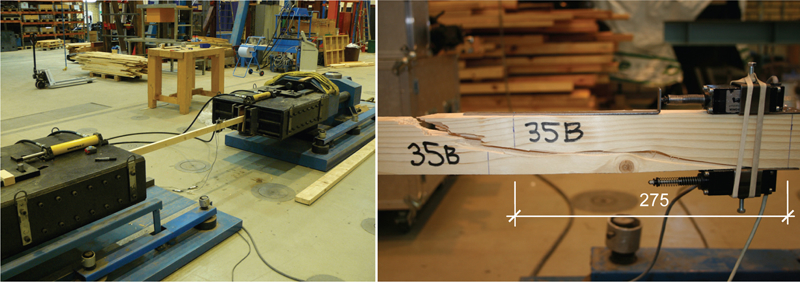
Test set-up for tension tests (left) and transducers and measurement length (275 mm) for elongation measurement (right)
The local static MOE was determined from the elongation, measured by two transducers, between two points 275 mm apart, corresponding to a length of five times the width of the boards. The transducers were placed on opposite narrow board edges [see Fig. 2 (right)], at the worst defect, i.e. at the board section where the fracture was expected to occur. This critical section was, in most boards, chosen as the one including the largest single knot. For boards that contained traversing edge knots or several potential critical knots of similar size, the grain disturbances around the knots were also considered.
The measurement results were analysed using simple linear regression. To evaluate the possibility of grading wet boards, the following relationships in terms of coefficients of determination R2 between different material parameters were calculated (indices ‘56’ and ‘120’ refer to the average widths of split boards and un-split boards respectively):
axial dynamic MOE measured for split boards in the wet state, denoted E56dynwet, in relation to axial dynamic MOE for split boards in the dried state (12–14%MC), denoted E56dyndry (Fig. 3a)
local static MOE measured for split boards in the dried state E56statdry in relation to the tensile strength for split boards in the dried state σt (Fig. 3b)
E56dynwet and E56dyndry respectively, in relation to σt (Fig. 3c and d)
density before drying ρwet in relation to σt (Fig. 3e)
density after drying ρdry in relation to σt (Fig. 3f).
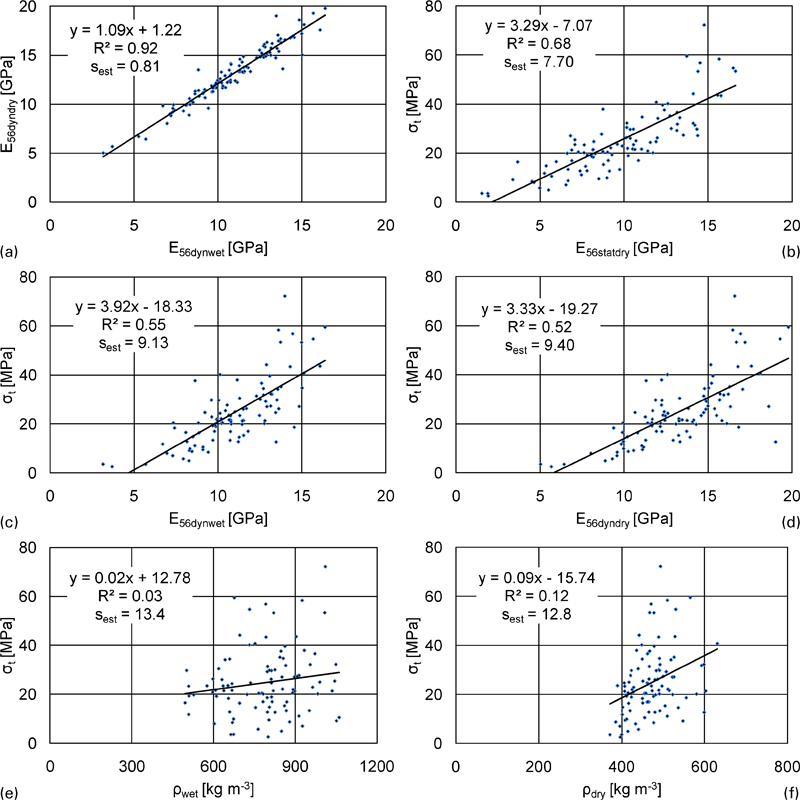
Relationship between a E56dynwet and E56dyndry, b E56statdry and σt, c E56dynwet and σt, d E56dyndry and σt, e ρwet and σt and f ρdry and σt
The reversed lamination effect was assessed on the basis of the relationship between E56dyndry, as defined above, and E120dynwet, i.e. axial dynamic MOE determined for un-split wet boards (Fig. 4).
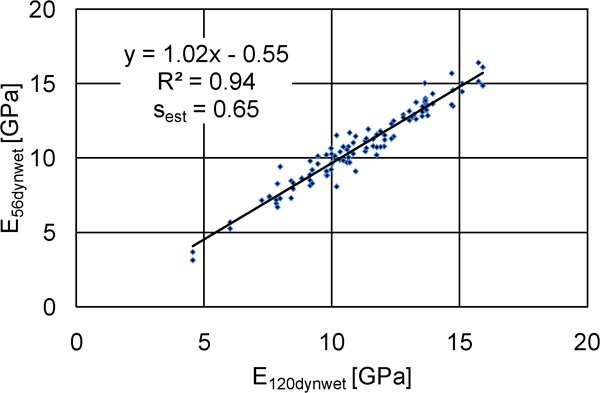
Relationship between E120dynwet and E56dynwet
In addition to the R2 values presented in the figures referred to above, standard errors of the estimate sest and equation of the regression lines y are also given in the same figures.
Results and discussion
Grading of wet side boards
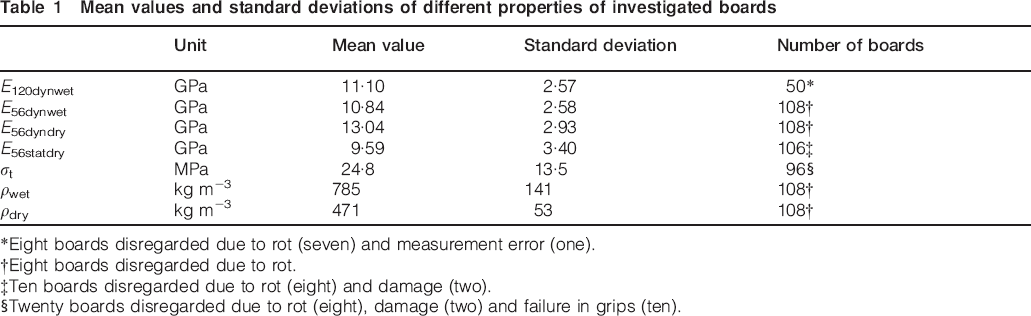
A number of seven out of the 58 un-split boards and eight out of the 116 split board appeared to contain rot and were eliminated from the subsequent analysis (see explanatory notes in Table 1). The MC of the remaining 51 un-split boards in their green state varied considerably, from a minimum value of 28% to a maximum of 180%. The mean MC value was 93% with a standard deviation of 43%.
Mean values and standard deviations of different properties of investigated boards
*Eight boards disregarded due to rot (seven) and measurement error (one).
†Eight boards disregarded due to rot.
‡Ten boards disregarded due to rot (eight) and damage (two).
§Twenty boards disregarded due to rot (eight), damage (two) and failure in grips (ten).
Mean values and standard deviations of determined parameters defined in the section on ‘Methods and materials’ are shown in Table 1. Relevant scatter plots are exhibited in Fig. 3a–f and the R2 values for selected interrelationships are presented in Table 2. The mean value of E56dynwet was ∼17% lower than E56dyndry, which corresponds fairly well with results referred to in Dinwoodie (2000), and the mean value of E56statdry is 26% lower than E56dyndry. The last observation is partly explained by the fact that the dynamically measured MOE of a board is related to an average MOE value of the entire board, whereas the local static MOE is measured locally, at the section where the worst defect is located. The difference is also related to the fact that the dynamically measured MOE of a board is, in general, larger than the corresponding statically measured MOE (Larsson et al. 1998).
Coefficients of determination R2 of different properties of investigated boards
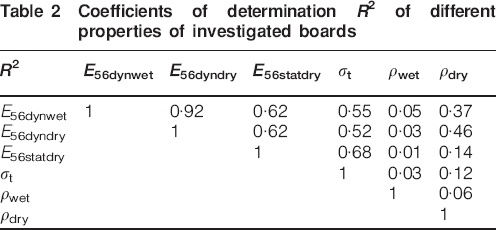
There was a strong relationship between dynamic MOEs measured for split boards in wet and dried states (R2 = 0·92, see Fig. 3a), similar to the one that was found by Unterwieser and Schickhofer (2007) for centre-cuts and side boards with thickness >41 mm.
A comparison of Fig. 3c and d shows that the relationship between dynamic MOE in wet condition and tensile strength was of similar strength as the corresponding relationship between dynamic MOE in dried condition and tensile strength (R2 = 0·55 in wet state and R2 = 0·52 in dried state). The coefficient of determination for the latter relationship increased to R2 = 0·58 when the dried state density was included as a second prediction variable in a multiple linear regression analysis. The relationship between local static MOE, measured in the dried state at the assumed weakest board section, and tensile strength was stronger (R2 = 0·68, see Fig. 3b) than the relationships between tensile strength and dynamic MOE in wet and dried conditions respectively (see Fig. 3c and d). This is presumably due to the fact that the local static MOE is measured at the board section where the fracture is expected to occur, whereas the dynamic MOEs reflect average values for the entire board.
There was a weak relationship between tensile strength and density in the dried state (R2 = 0·12, see Fig. 3f), whereas no such relationship was established between density in the wet state and the tensile strength (R2 = 0·03, see Fig. 3e). It was not surprising that the latter relationship was found to be even weaker than the former, since the density measured in the dried state is a good measure of the amount of wood cell material, whereas in the wet state at variable MC, it is not. Furthermore, the level of significance in terms of p values was calculated for the relationships between densities and tensile strength. The relationship in the dried state was found to be statistically significant (p<0·001), whereas the p value for R2 between wet state density and strength was, as expected, considerably higher (p = 0·12).
The results obtained in this study indicate that it is possible to grade split side boards in the wet state using axial dynamic excitation since, first, the dynamic MOE values measured in wet and dried states are strongly related and, second, the tensile strength is as strongly related to axial dynamic MOE measured in the wet state as it is to axial dynamic MOE measured in the dried state. However, the presented coefficients of determination require that the actual densities in wet and dried states respectively, are regarded when axial dynamic MOEs are calculated.
The idea of grading side boards in the wet state originates from ongoing research concerning wet-glued laminated split beams. For such beams, strength grading of laminations has to be carried out for un-split boards. Thus, the relationship between axial dynamic MOE measured for un-split wet boards E120dynwet and σt for dried split boards was also determined and it was found to be R2 = 0·45 for the entire sample. However, since E120dynwet is related to σt of two split boards, each split board observation is not truly independent. From Fig. 5a, it is clear that σt of A boards and B boards are correlated to a certain degree. Because of this, the relationships between E120dynwet and σt of A and B boards respectively, were determined. For A boards only, the relationship between σt and E120dynwet was R2 = 0·53 and for B boards it was R2 = 0·39. From the calculated coefficients of determination, it could be concluded that the relationship between E120dynwet and σt for dried split boards was, as expected, slightly weaker than the relationship between E56dynwet and σt (R2 = 0·55, see Fig. 3c).
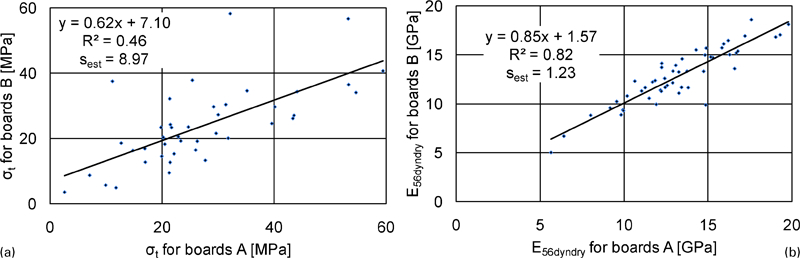
Relationship between a σt for pairs of split boards A and B and b E56dyndry for pairs of split boards A and B
In some of the split boards, there were knots larger than half the width of the board [see Fig. 6 (left and middle)], and in such cases strength values as low as 2·6 MPa were found. The strength of the strongest board was 72·1 MPa [see Fig. 6 (right)]. Furthermore, there was a considerable amount of variation in σt for boards split from the same original board (R2 = 0·46, see Fig. 5a). The strength of this relationship, together with the mean value and the standard deviation for σt given in Table 1, indicates that the scattering of measured strength values for the split boards could be considered as rather large, compared with other investigations of laminations for glued laminated timber (Johansson et al. 1998). This is not surprising as the boards examined here are of very narrow dimensions. In comparison, there was a much stronger relationship between values of E56dyndry for boards split from the same original board (R2 = 0·82, see Fig. 5b).
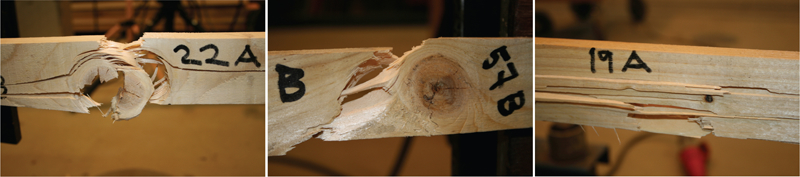
Fracture in two of weakest split boards (left and middle) and in strongest split board (right)
Even if the strength of many of the boards was very low due to the occurrence of knots, this does not necessarily reflect the behaviour of the boards when they are used as flatwise glued laminations in the type of glulam beams shown in Fig. 1. For example, large deformations, both longitudinal and lateral, in flexible sections of a lamination are restrained by adjacent laminations, and tensile forces in weak laminations could, to a certain degree, be transferred via bond lines to other laminations. This, in combination with the fact that the beams consisted of side board laminations, explains why high performance wet-glued beams could be achieved from un-graded batches of split Norway spruce side boards.
Reversed lamination effect
From Table 1, the mean value and standard deviation of the stiffnesses, in the wet state, of split and un-split boards (E56dynwet and E120dynwet) used in this investigation could be compared and the relationship between E56dynwet and E120dynwet is shown in Fig. 4. According to the obtained results, the mean value was 2% lower after splitting, the standard deviations were almost the same and the relationship was very strong (R2 = 0·94). The two variables, before splitting (E120dynwet) and after splitting (E56dynwet), were compared with a paired t-test and the difference in MOE, although small, was found to be statistically significant (p<0·01). In the analysis, the value for an un-split board was compared with values for both split boards. Consequently, the E56dynwet observations are not truly independent, as the stiffnesses of A boards and B boards are correlated (see Fig. 5b). However, the effect is small. For the A boards only, the relationship between E56dynwet and E120dynwet was R2 = 0·94, and for the B boards it was R2 = 0·93, i.e. almost exactly the same R2 values as was obtained for the entire sample of split boards.
Conclusions and future work
The objectives of this research were to investigate the possibility to grade Norway spruce side boards of narrow dimensions in the wet state using axial dynamic excitation, and to evaluate a possible reversed lamination effect on the stiffness caused by splitting wet boards longitudinally into two parts. According to the results, strength grading in the wet state using axial dynamic MOE as indicating property is just as reliable as grading carried out correspondingly after drying, provided that actual board density in both wet and dried states are measured and regarded when MOE values are determined. The relationship between axial dynamic MOE for split boards in the wet and dried states, E56dynwet and E56dyndry, was found to be as high as R2 = 0·92.
The results also show that the difference in strength between two split boards originating from the same un-split board could be considerable. However, the difference would most likely be reduced by implementation of defect elimination such as finger jointing of un-split side boards, since such a measure would result in a reduction in the inhomogeneity of material properties in both split and un-split boards. This is an issue to be addressed in future work.
Regarding the reversed lamination effect on the stiffness of split boards, it was in this investigation found to be of lower order.
Footnotes
Acknowledgements
This research was made possible by financial support from The Knowledge Foundation, The Swedish Research Council for Environment, Agricultural Science and Spatial Planning and CBBT – Centre for Building and Living with Wood.