







Abstract
Low permeability in wood can cause limited retention and penetration of preservative which ultimately affects the wood performance in the field. In the present study, Malaysian red, yellow and white meranti of the Shorea group were selected for evaluation of treatability using commercial copper–chrome–arsenate and ZiBOC – a new preservative system, by the vacuum pressure method at two pressure levels in unsealed and end sealed specimens. A significant difference (P<0·05) in retention levels of both the preservatives was observed in sapwood, heartwood and pith zones. White meranti exhibited treatability class ‘a’ while mottled penetration was observed in red and yellow meranti exhibiting class ‘c’. The spot test for boron, zinc and copper in unsealed and end sealed specimens revealed that longitudinal penetration was not the dominant flow in red and yellow meranti.
Introduction
Malaysia's timber and timber products are in great demand in overseas markets. There are many species in the genus Shorea which are sold commercially as meranti (Menon 1986). Meranti is an important species of the tropical forests of Asia, one of the most prominent places where the species grow is Southeast Asia. Ashton (2004) estimated that there are 200 subspecies of meranti. Some general characteristics that the species share include heights of 150–200 feet with straight cylindrical boles. It is categorised as LHW, i.e. light heart wood as per Malaysian standard and is non-durable under exposed condition (Choo and Lim 1982). About 70 species of Shorea belong to light and dark red meranti, 22 species to the white meranti group and 33 species to the yellow meranti group (Choo et al. 1998).
Under the Malaysian grading rules (1984), timbers having density of more than 800 kg m−3 are heavy hard wood and naturally durable, timber having density of more than 720 kg m−3 are graded as medium hard wood (MHW) which lack sufficient natural durability and LHW having density below 720 kg m−3 and not natural durable in exposed conditions. Timber Technology Bulletin published by Timber Technology Center, FRIM (1998) classified dark red meranti, light red meranti, yellow meranti and white meranti under LHW category and as susceptible to termites, borers and fungi.
Collardet (1976) reported that 80–85% of known tropical wood species are non-durable. The life span of non-durable timber can be increased by the use of preservatives. However, in recent years many wood preservatives are under close scrutiny due to environmental and health hazard concerns. The types of preservatives used commercially have changed greatly. Ammoniacal copper arsenate is no longer used in the US and the use of 47.5% chromium oxide, 18.5% copper oxide and 34.0% arsenic pentoxide in water (CCA-C) has been greatly reduced. For many markets, these preservatives have been replaced with copper based systems that do not contain arsenic and chromium.
In the present study, a new ecologically friendly wood preservative – ZiBOC, recently developed in the Forest Research Institute, Dehradun (India) was used. The objective of this study is to evaluate the performance of new potential and standard wood preservative systems based on metaborates in species imported to India. Before a wood species can be standardised for treatment with a particular preservative, it must be demonstrated that sufficient penetration and retention of preservative can be achieved through the use of conventional treatment processes. Boron compounds have been shown to have lower human toxicity than for some animals, and boric acid has been considered environmentally acceptable for many years. Boron compounds, especially boric acid, disodium octaborate tetrahydrate and zinc borate, are considered the best options for preserving lumber from insect, fungal and bacterial attack, the only problem associated is with inherent low solubility (Dev et al. 1997). Bhatia (2002) and Thévenon et al.
Freeman and McIntyre (2008) described copper an essential micronutrient and demonstrated activity as algicide, bactericide, fungicide and insecticide. Bonham (2002) presented the importance of copper in human nutrition and health which suggested that the recommended dietary allowance for adult men and women is 900 μg/day. Hambridge (2000) described that zinc is present in all body tissues and fluids. It is an essential component of a large number (>300) of enzymes participating in carbohydrates, lipids, proteins and nucleic acid as well as for the metabolism of other micronutrients. Wolfgang and Harold (2006) explained zinc requirements and zinc supplementation in human.
ZiBOC was tested against fungi and termites and found efficacious at 1·39 kg m−3 of retention in soil block bioassays (Tripathi et al. 2005). Stake test study of ZiBOC in Dehradun (30°20′N; 78°04′E), Chakrata (30°42′N; 77°51′E.) and Jodhpur (26°23′N; 73°08′E) exhibited complete protection at 3, 4 and 6% concentrations and average retentions of 10,16 and 21 kg m−3 against fungi, termites and both respectively (Tripathi 2008). ZiBOC is already tested in Pinus roxburghii and Populus deltoides, and its efficacy in imported wood species will justify the treatment of imported species for long lifespan of products.
Treatment variability among meranti varieties is not well documented with many preservatives and there is a lack of knowledge for decay resistance performance of many imported hard wood species like meranti with different preservatives systems. Pandey et al. (2007) reported that impregnation of timber in the meranti pa'ang group and meranti dammar hitam group involves drastic schedules to secure even small absorptions of preservatives. Ani et al. (2005) estimated around 1·1–3·6 years of service life for all types of meranti in ground contact and explains the non-durable character of wood. The light red, white and yellow meranti are non-durable in exposed conditions or in ground contact, whereas dark red meranti is moderately durable.
Studies on preservative systems which are retained at different levels and show difference in depths of impregnation of various constituents of preservative in wood may help partially to explain results of field performance test. Keeping in view the wide variability of treatability in plantation/imported species a new method of demarcation of sap, heart and pith was followed as was performed earlier in Pinus radiata of New Zealand (Tripathi 2005). It is essential to evaluate the treatability pattern of various parts, i.e. sap, heart and pith of imported timber to ensure judicious use of timber irrespective of the part of the log.
Experimental methods
Preparation of wood specimens
Groups of hardwood, i.e. dark red, yellow and white meranti were procured from Kandla Port, India. The material was shipped from Malaysia in log form. Six logs of white, yellow and red meranti (10–15 feet long) were marked at the cut end to demarcate sap, heart and pith portion of log on visual basis (Fig. 1a-d).
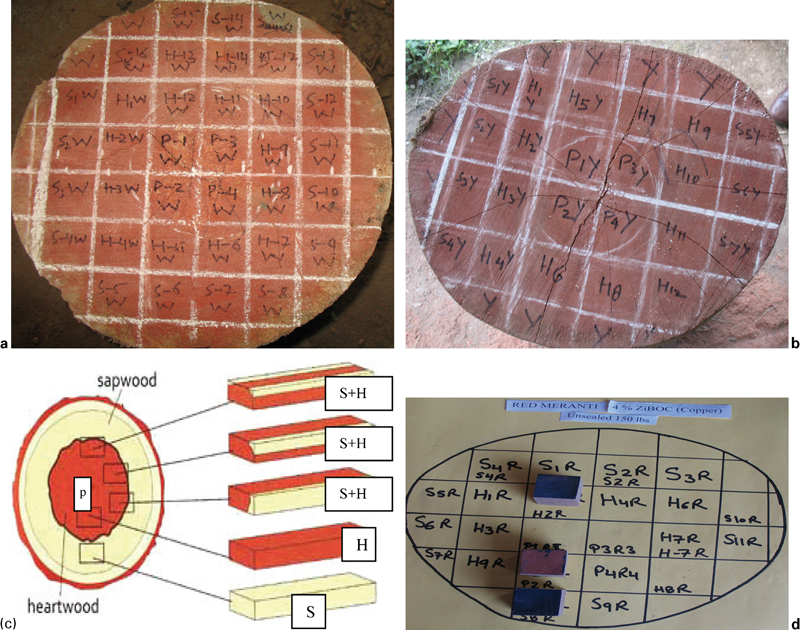
Cross-section of log marked to demarcate sap, heart and pith portion.
Planks of 6 cm thickness with full log width and length were converted and seasoned. Seasoned wood was converted into 3·8 cm (W)×3·8 cm (T) and full length. These battens were further processed into samples of size 3·8 cm (W)×3·8 cm (T)×30·5 cm (L). Specimens from pith were marked as ‘P’, heart wood as ‘H’ and sapwood as ‘S’ and grouped separately for treatment. Straight grained and defect free specimens were conditioned at 21°C and 65% relative humidity to equilibrate at 12% moisture content. Before vacuum/pressure treatment, specimens were further divided into two sets. One set of specimens were end sealed with an elastomeric sealant so that penetration and retention values would indicate radial and/or tangential pathways while other set of specimens were taken without end sealed condition to give an indications of absorption/penetration of preservative from all sides.
Treatment
Samples from three species were taken (pith, heartwood and sapwood) for treatment with CCA and ZiBOC preservative at two pressure levels in unsealed and end sealed condition, details of which are given below:
species: white meranti, yellow meranti and red meranti
size of specimens: 30·5×3·8×3·8 cm;
condition: unsealed and end sealed specimens;
pressure levels: 689·47 and 1034 kPa;
preservatives: CCA (As2O5.2H2O:CuSO4.5H2O:K2Cr2O7) and ZiBOC (ZnCl2:Na2B4O7.10H2O:CuSO4.5H2O);
concentration: 4%;
replicate: six in each set of conditions;
total number of specimens of one species: 144 (48 specimens each from heart wood, sap wood and pith portion);
total number of specimens of three species: 432.
Preservative formulation
Treatment was carried out with water soluble preservative copper–chrome–arsenate at 4% concentration (IS 401:2001) and ZiBOC at 4% concentration which was initially water insoluble, made water soluble with the help of cosolvent (Tripathi 2008).
Impregnation of preservative in wood
The full cell method of impregnation (IS 401:2001) was applied and two pressure schedules were used for the treatment. Preweighed specimens were treated in a pressure cylinder. In the first set of experiments an initial vacuum of −75 kPa (25 in Hg) for 30 m in was followed by pressure 689·47 kPa (100 lbs in2) for 1 h.
A final vacuum of −75 kPa (25 in Hg) for 15 min was given. In the second set of experiment, all procedures were the same except pressure of 1034 kPa (150 lbs in2). After each treatment, excess preservative was blotted off with filter paper and specimens were weighed immediately to determine the preservative uptake and retention (IS 401:2001). Treated specimens were allowed to dry for 21 days for proper fixation and distribution of preservative and conditioning of specimens by close piling and then left to air dry in the fourth week. The amount of the preservative solution absorbed by specimen (retention value R in kg m−3) was calculated as

C is the weight in grams of the preservative in 100 g of treating solution and V is the volume of the test block in m3.
Measurement of penetration
The penetration of the preservative in each sample was determined by cross-cutting the sample in the middle to expose a fresh cross-section. The exposed surfaces were then sprayed with Chrome Azurol S solution to indicate the presence of copper. The wood turned blue where the CCA and ZiBOC had penetrated, whereas the untreated zones were coloured red. Specimens treated with ZiBOC were also tested for the presence of boron and zinc by developing reddish brown colour with turmeric and salicylic acid showing penetration of boron while purple colour with potassium ferricyanide, potassium iodide and starch solution showing penetration of zinc (IS 2753 (Part 1): 1991).
The area of the treated zone and its percentage on total cross-section was calculated by measuring penetration at the midpoint of narrow faces of each specimen. All four measurements were averaged to obtain a single penetration value. The penetration data were analysed as per IS 401:2001, where different treatability classes are defined on the depth of impregnation and total area covered by colour developed for copper:
very permeable; impregnated cross-cut area (ICCA): 65–100% depth; 13–19 mm (3·8×3·8cm cross-section)
permeable; ICCA: 65–47% depth; 12–9 mm
moderately permeable; ICCA: 42–21%; 8–4 mm
very resistant; ICCA: 15–10%; 3–2 mm
impermeable; ICCA: nil; depth: nil
This classification is based on the criteria of preservative impregnated cross-cut area of timbers. Whenever the treatment data and the above classification criteria did not agree completely, classification was made to the nearest class. In the present study, the same scale was applied for sap wood also to see the variability in treatment which is very important for field application of treated wood. Statistical analysis with each concentration representing an independent treatment was performed using the analysis of variance test calculated using SPSS 17·0 package.
Results and discussion
Table 1 shows retention of preservative ZiBOC and CCA in yellow, red and white meranti in different wood portions at different pressure levels in unsealed and end sealed conditions. It is clearly demonstrated that mean values of retentions were found maximum in white meranti (7·6 kg m−3), followed by yellow (4·5 kg m−3) and red (2·9 kg m−3), irrespective of the two preservatives. Retentions of preservatives were significantly different from each other at 5% significance level, i.e. ZiBOC exhibited a mean retention of 5·5 kg m−3 while CCA exhibited only 4·5 kg m−3 for all three species groups.
Retention of preservative in yellow, red and white meranti in sap, heart and pith portion at different pressure levels in end sealed and unsealed
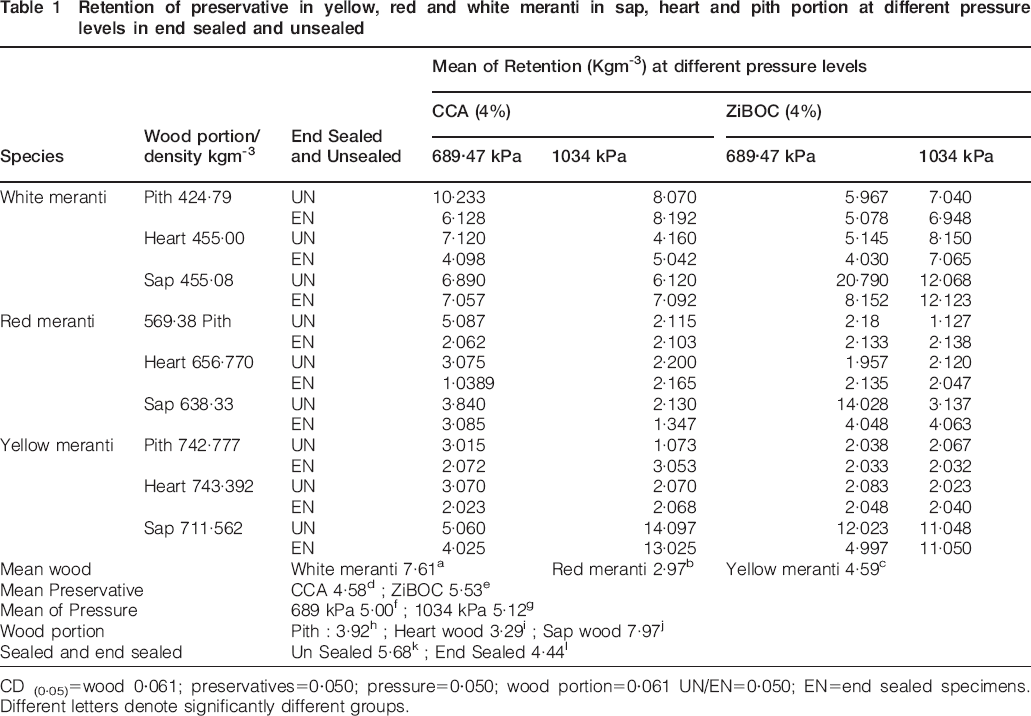
CD (0·05) = wood 0·061; preservatives = 0·050; pressure = 0·050; wood portion = 0·061 UN/EN = 0·050; EN = end sealed specimens. Different letters denote significantly different groups.
A significant difference in retention was observed due to two pressure levels. Retention was higher at the higher pressure level, i.e. 1034 kPa. Mean retention was found maximum in sap wood (7·9 kg m−3), followed by pith wood (3·9 kg m−3) and heart wood (3·2 kg m−3) (P<0·05). All were significantly different from each other (P<0·05). Unsealed specimens exhibited higher values for mean retentions (5·6 kg m−3) as compared to end sealed (4·4 kg m−3). This was expected since application of sealant at the end allows penetration only in the transverse direction.
Overall, data showed that white meranti has better capacity to absorb preservative followed by yellow meranti. Red meranti exhibited negligible amount of retention. It is interesting to note that it was easy to impregnate pith and sap wood as compared to heart wood. Therefore, a treatability difference was observed from pith to periphery. It is reported that permeability in meranti group varies, but generally, heartwood is extremely to moderately resistant to preservative treatment (Wiemann 2010). Generally, sapwood can be treated more easily than heartwood (British Wood Preserving Association 1956). In heartwood, extractives can infiltrate completely into the cell walls or they may occur as surface deposits or plugs in cell lumina. Their presence in wood affect the permeability and physical properties of wood (Hunt and Garratt 1967).
Correlation coefficient r was calculated between retention of preservative and density. It was noted that a negative and significant correlation (P<0·01, r = −0·381) could be observed between density and retention. It showed that the higher the density, the lower will be the retention of preservative which is also expected since the void volume decreases with increasing density. However, in the present study, it is interesting to note that white meranti had the lowest average density (mean) 445 kg m−3, followed by 621 and 733 kg m−3 for red and yellow meranti respectively. While retention could not be observed in this sequence, it supports the view that anatomical differences and inherent wood characteristics also, determine penetrability rather than just density alone (Kim and Kim 2001). A large variation in the density of four groups of meranti is reported, i.e. 640 kg m−3 for dark red meranti, 400–640 kg m−3 for light red meranti, 480–870 kg m−3 for white meranti and 480–640 kg m−3 for yellow meranti (Wiemann 2010). Therefore, the results reported here will validate for the wood having the same density range, but it may differ if the density varies drastically in the same group of meranti. Generally, it is believed that the difficulty in treating heartwood can be attributed to factors such as small pore sizes in the heartwood (Petty and Preston 1969; Stamm 1970), the irreversible nature of pit aspiration in the heartwood (Thomas and Nicholas 1966; Thomas and Kringstad 1971), the amount and type of extractives deposited on pit membranes during the formation of heartwood (Panshin and DeZeeuw 1980; Cote 1990), and, in addition, for hardwoods, tyloses formation in the heartwood (Panshin and DeZeeuw 1980; Cote 1990). It is difficult to ascertain the reason as anatomical properties were not studied in the present work.
Table 2 shows impregnation of preservative by colour test of copper on the cut cross-section of specimens and the average of all the four sides was taken. Six replicates were taken from pith, heart and sap wood in unsealed and end sealed condition at two pressure levels with two preservatives. Depth of impregnation for white meranti was statistically different from red and yellow meranti (P<0·05). As per the measurement of penetrability white meranti fall in treatability class ‘a’ exhibiting average value of 15·2 mm which exhibited 65–100% area of colour developed for copper test while red meranti exhibited 7·2 mm impregnation and yellow meranti 5·0 mm, both exhibited treatability class ‘c’ showing 21–42% average area for impregnation of copper. Results of Tables 1 and 2 show that red meranti exhibited greater depth of impregnation (i.e. 7·2 mm) but lower retention levels (i.e. 2·9 kg m−3) for preservatives. While yellow meranti exhibited shallower impregnation 5·0 mm but greater retention, i.e. 4·5 kg m−3. This may be due to more surface absorption of preservative on yellow meranti as retentions were calculated or wet weight basis only. Depth of impregnation of copper in different wood portions was maximum in sap, i.e. 13·2 mm followed by heart wood (7·4 mm) and pith (6·8 mm). Statistically, CCA exhibited a greater depth of impregnation, i.e. 9·3 mm compared with that of ZiBOC (8·9 mm). Similarly, higher pressure exhibited greater depth of impregnation for preservative compared to lower pressure. Similarly, unsealed specimens exhibited 10·6 mm impregnation as compared to end sealed, i.e. 7·6 mm which indicates that substantial absorption can take place from the end grain surface (Table 2).
Spot test observation of copper for mean depth of impregnation (mm) of preservative at different pressure levels
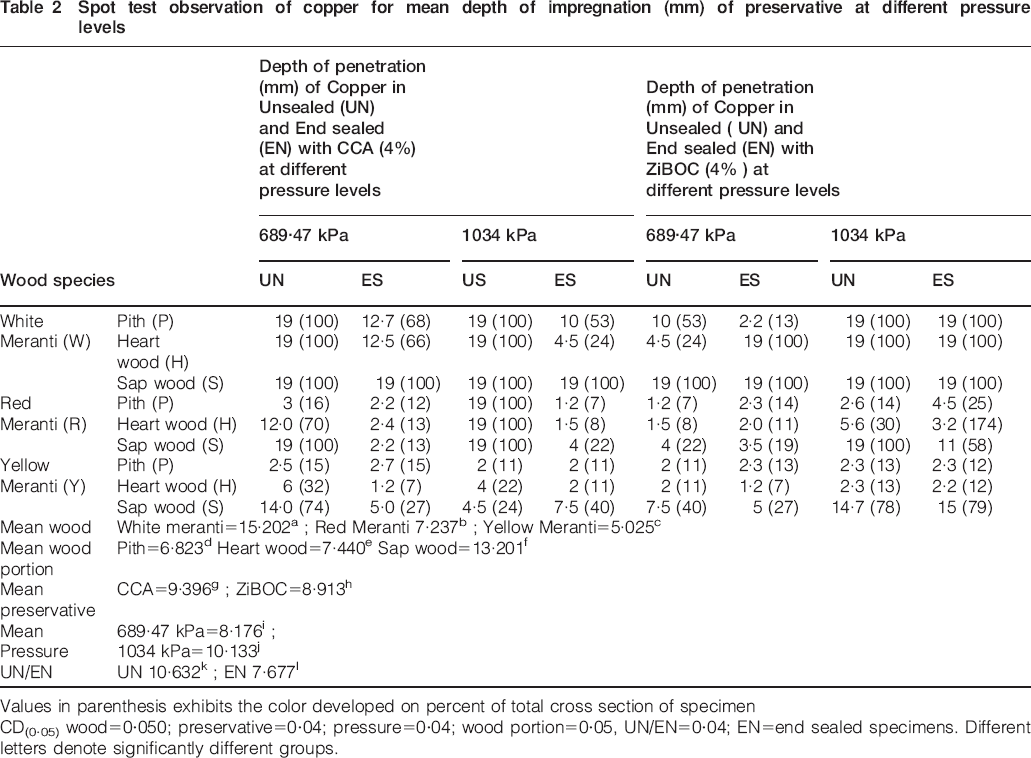
Values in parenthesis exhibits the color developed on percent of total cross section of specimen
CD(0·05) wood = 0·050; preservative = 0·04; pressure = 0·04; wood portion = 0·05, UN/EN = 0·04; EN = end sealed specimens. Different letters denote significantly different groups.
Table 3 (Fig. 1d) shows visual observations of spot tests for zinc and boron in the treated specimens in unsealed and end sealed condition. Colour was developed from the cut ends as for copper. Zinc exhibited good penetration, i.e. 74% in sap wood of white meranti at lower pressure levels which further increased to 100% at higher pressure levels. Similarly, 100% impregnation of zinc was also observed in heart wood of white meranti at higher pressure, whereas 40 and 60% impregnation could be found in heart and sap wood of red meranti at lower and higher pressures respectively. Only 58% impregnation of zinc could be observed in sap wood of yellow meranti at the higher pressure level, while pith and heart wood of yellow meranti exhibited only up to 15% impregnation of zinc of total surface area. Statistical analysis of depth of penetration of zinc and boron metal ions of ZiBOC at 0·05 significance level showed that maximum penetration of these metal ions was observed in white mearnti (15·3 mm), followed by yellow (3·7 mm) and red meranti (3·1 mm). Results revealed that Boron metal ions exhibited high penetration, i.e. 8·7 mm as compared to zinc (6·0 mm) in all the three species. Penetration improved with the increase in pressure, i.e. at 689·47 kPa depth of impregnation was 7·1 mm and at 1034 kPa, it was 7·6 mm. Depth of penetration of metal ions in different wood portions was maximum in sapwood (9·3 mm), followed by heartwood (6·7 mm) and pith (6·1 mm). Higher penetration was observed in end sealed specimens (8·2 mm) as compared to unsealed ones (6·6 mm), while it was not the same for copper. The reason may be that copper may had a tendency to absorb from all surfaces, while zinc and boron had more ability to absorb from the surface of specimens. The end sealing of samples in this study resulted in penetration, dependent on tangential and radial movement of preservative solution into the wood, extremely limiting the role played by vessels. An overall explanation of the generally poor penetration of metal salts for heart wood might be based on this minimised vessel penetration as concluded by Graves (1974).
Average penetration (mm) (depth or percentage of cross section) based on visual observations of Spot Test of Zinc and Boron in wood treated with 4% ZiBOC at different pressure levels
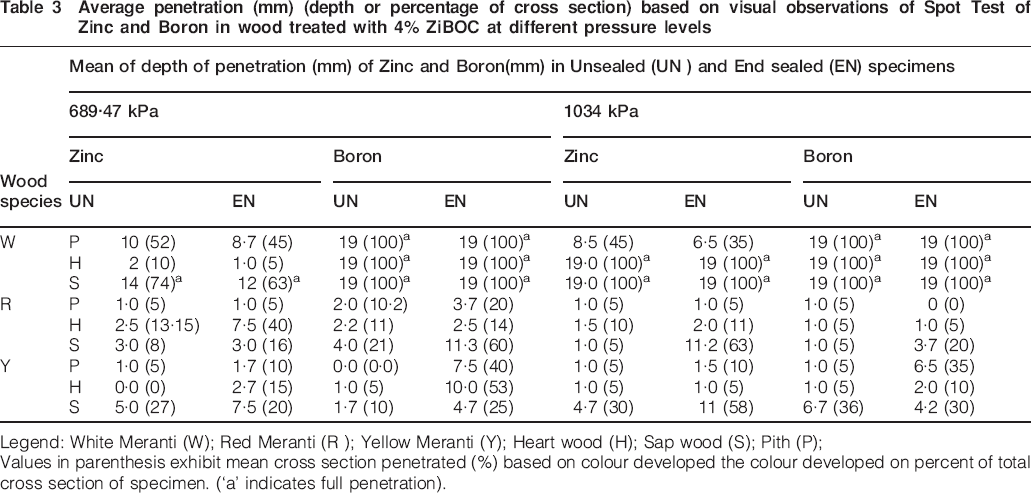
Legend: White Meranti (W); Red Meranti (R ); Yellow Meranti (Y); Heart wood (H); Sap wood (S); Pith (P);
Values in parenthesis exhibit mean cross section penetrated (%) based on colour developed the colour developed on percent of total cross section of specimen. (‘a’ indicates full penetration).
Unsealed wooden blocks allowed preservative penetration from all directions. End sealed wooden blocks allowed both tangential and radial penetration. Penetration of boron in white meranti in end sealed specimens was identical to that of unsealed specimens with regard to cross-section penetrated irrespective of pressure. Such results could not be observed in red meranti. Similarly, yellow meranti exhibited 40 and 53% of boron impregnation in pith and heart wood in end sealed specimens at lower pressure, while the same was not observed in unsealed specimens. This suggests that longitudinal penetration is not the dominant flow in red and yellow meranti. In hard wood species without tyloses, penetration in the longitudinal direction is usually greater than in the transverse direction, while the present study shows that transverse flow is more important than longitudinal flow in meranti. Therefore, the transverse flow of preservative will be the more important and limiting factor for the bigger size of samples.
Conclusion
Penetration of ZiBOC as well as CCA preservative varied from pith to periphery in white, red and yellow meranti groups. White meranti group specimens of density range 422–455 kg m−3 exhibited treatability class ‘a’, while red meranti group specimens of density 569–656 kg m−3 and yellow meranti group of density 711–743 kg m−3 exhibited class ‘c’. Pressure levels have significantly affected the distribution of individual metals in different wood portions. Results revealed that higher pressure levels during treatment and the density of wood in different wood portions have a significant role in the penetration of preservative.