







Abstract
Absences from work and other losses have a considerable effect on both the productivity of companies and the wellbeing of personnel. In this study, during a log factory trial within the Finnish wood production industry, any accidents that occurred were examined in an attempt to identify new approaches for increasing the level of safety and developing integrated management systems. Information was obtained from national statistics and through a study within a log factory. The investigation utilises the classification groups defined by Eurostat. The study showed that by using an applied approach, constructing core stories provides new practical ‘tools’. The pilot estimates that the economic consequences comprise of a new style incentive for improving integrated management systems. Results are easily obtained and can be quickly introduced into training, development, risk assessment and enhancing participation. The outcomes of safety improvements are vast, for example, huge potential savings at a company and national level.
Introduction
The Finnish forestry industry is currently going through a radical regeneration process. At the same time, as attempting to increase its profitability, efforts to establish new business activities and improve its competitiveness through research and development are underway (Forest Industries 2010). The forest cluster provides employment directly and indirectly for ∼200 000 Finns and for almost 100 000 people in other countries (Forest Industries 2010). This study concentrates on occupational accidents among personnel in the wood products industry which includes the manufacturing of wood and the products of wood and cork, except furniture, straw articles and plaiting materials. The number of personnel in the wood products industry was 26 800 (yearly average for 2003–2007).
There are several reasons for safety. Brauer (1994) sums up that the first and overriding reason for safety is humanitarianism, the second is law and the third is cost. Personal wellbeing at work and an improved company's image are both outcomes of good safety. New trends in work environment include new work organisational forms, new contractual relationships, new technologies and changes in the workforce (Koukoulaki 2010). The need to face new trends has led to the development of management systems. According to Hutchison (1997), the vision of management and the voice of the customer are linked to the company's capabilities, which include personnel, facilities, its safety component, equipment and financial resources. Integrated management system (IMS) is now seen as part of the organisation's management portfolio (Wilkinson and Dale 2007). The IMS meets the challenges of safety and quality supporting standards covering specific requirements. According to Kjellén (2000) many large companies, including those in Scandinavia, have developed safety, health and environment policies, on the argument that these aspects are of equal importance to the economy. Safety, health and environment plays a key role in IMS.
A work system comprises a combination of people and technological equipment within a space and environment, and interaction of these components within a managed organisation (European Standard 2004). Ergonomics aims to optimise work systems, as far as performance and effectiveness are concerned, including personnel in a key role without any detriment to their health, safety, or other factors of wellbeing at work. According to this holistic thinking, occupational risks threaten both factors of wellbeing and productivity at work, whereas an optimal work system can simultaneously promote personal wellbeing and productivity.
An occupational accident is defined as an accident that occurs to an employee at work or in work-related circumstances, causing an injury or illness (Statistics Finland 2004). The Health and Safety Executive defines an accident as any unplanned event that results in injury or ill health of people, or damage or loss to property, plant, materials, to the environment or a loss of a business opportunity (Hughes and Ferrett 2004). An accident can be considered as a special class of a process by which perturbation transforms a dynamically stable activity into the unintended interacting changes of states with a harmful outcome (Hendrick and Benner, Jr 1987). Occupational accidents are sudden and unexpected events that are traumatic to the injured person and co-workers, interrupt production or a project, increase costs and usually require medical treatment (Harms–Ringdahl 1993; Aaltonen et al. 1996; Kuusela et al. 1997).
In Finland, work-related accidents have been recorded in abundance for the past one hundred years. Statistics include all accidents for which compensation has been paid, and come under the role of the Federation of Accident Insurance Institutions (FAII) which has the responsibility of collecting and maintaining statistics on occupational accidents and diseases. Internationally, there are differences in systems such as the social security systems used (including the definition of industrial accidents and occupational diseases), how it carried out a comprehensive statistical and what kind of economic structure exists in the country.
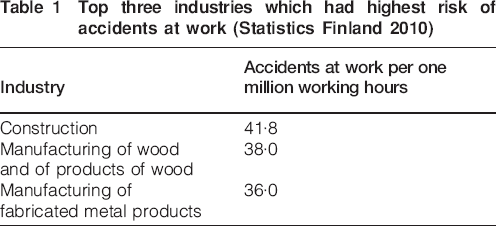
According to claims statistics filled by the FAII (2010a), the recorded number of accidents at work in Finland during 2007 was 119 007. In 2004, on average, five employees in every hundred were injured in occupational accidents (Federation of Accident Insurance Institutions 2006). In 2007, construction (41·8 accidents at work per one million working hours), manufacturing of wood and of products of wood (38·0) and manufacturing of fabricated metal products (36·0) were the top three industries which had the highest risk of accidents at work in terms of absences of >3 days when measured with accident frequency (Statistics Finland 2010) (Table 1). In recent years, the annual number of work accidents in the forestry industry has almost remained the same with 3706 being recorded in 2007 for the wood products industry (Tapaturmapakki 2010). However, it is very likely that these accidents are more serious than those found in other parts of the forestry industry (Karila 2010). On average, every fifteenth employee (in the wood products industry) was injured in an occupational accident with an absence of >3 days. In Sweden, within the timber industry, many serious accidents occur and the industry is now considered as a high accident statistic with many serious disability injuries, including fatal accidents (Arbetsmiljöverket 2010).
Top three industries which had highest risk of accidents at work (Statistics Finland 2010)
The true cost of accidents is difficult to perceive due to factors directly and indirectly affecting the final figure. Direct costs are directly related to the accident, whereas indirect costs may be insured (business loss, product or process liability) or uninsured (loss of goodwill, extra overtime payments, accident investigation time and production delays) (Hughes and Ferrett 2004). Indirect costs are for example, lost productivity and working hours, recruitment and temporary employment, decreased motivation and possible legal costs and fines (Häkkinen 2008). An employer is likely to pay between €100 and €10 000 in direct costs for a work accident. In recent years, on average, the insurer has paid <€3000 in compensation for each work accident, whereas the accident at work or occupational disease burden on the insurance premium was >€4000 (Tarvainen 2008). A big concern for Finnish companies which produce chemical and mechanical wood industry products is that 1 day absence from work costs €400 directly (Kemppainen 2010).
The aim of this investigation is twofold: to ascertain to what extent the chain analysis approach would be successfully applied to occupational risks, and to demonstrate the proposed approach. Finally, this paper describes an application case study in a log factory.
Method
The data used in this investigation include accidents at work, but exclude accidents which occurred on the way to and from work, as well as occupational diseases and accidents to self-employed persons. Another requirement was that the studied accidents resulted in absences from work of >3 days. The data were analysed with the variables of the European Statistics on Accidents at Work (ESAW) methodology which is based on several accident theories, thus forming a model on the nature of an accident phenomenon. The variables of the method are intended for collecting and recording of information on the causes and circumstances of accidents (Eurostat 2000). The data included occupational accidents from 2003 to 2007 (n = 18 195) among personnel working in the wood products industry. In this study, the following four ESAW variables with subcategories were used: specific physical activity, deviation, injured body part and type of injury.
The data were analysed by chain analysis, a continuation of cross-tabulation. Chain analysis was developed by Klen and Väyrynen (1984) for presenting and analysing accident data. In this study, the chronological sequence was of special importance, which makes this analysis technique well suited for presenting the data. The chain of events of each individual accident can be followed through variables of the nominal scale codes, and finally ‘the sum’ of all the separate case descriptions is collected in one illustration. This analysis method is widely used in many accident studies (see Klen and Väyrynen 1983; Väyrynen 1986; Niskanen and Lauttalammi 1989; Pekkarinen and Anttonen 1991; Väyrynen et al. 1994; Rajala and Väyrynen 2010). This method was chosen because it is at its best when analysing chronological and ‘causal’ chains (Klen and Väyrynen 1984; Rajala and Väyrynen 2010) that also form the basis for narrative illustration.
Heinrich suggested that indirect costs of work accidents are 4∶1 ratio to direct expenses (Kjellén 2000), while according to Hughes and Ferrett (2004), the uninsured costs are 8–36∶1 ratio to insured costs.
The field study used in this paper was performed in a log house factory located in northern Finland whose factory production is in wooden cottages, log houses, saunas, outbuildings and barns. The factory produces ∼2000 units of wooden buildings per year for customers in Finland and abroad. Around 200 employees are currently working in production. The method used for the field study was in the form of a focus group (FG) where a group of people are asked interactively about their attitudes and feelings towards a cognisable matter (Morgan 1998). A moderator guides the group thorough a discussion performing the specified questions and allowing the group to discuss arbitrary (Morgan and Scannell 1998). The benefits of FGs are the direct contact to participants and group dynamics, which can produce unique comments (Langford and McDonagh 2003). The FG was developed by the moderator with the aid of a prepared manuscript, flap table, and the session was recorded. The group consisted of six members: two production employees, two representatives from a work safety organisation and two members of management who represented the employer. The target was to constitute core stories of accident chain analysis.
Results and discussion
Based on theories and gathered statistics, work accidents in 2007 for the wood product industry cost ∼€11m directly. On proportion, this roughly works out to be €415 per employee or up to €15 000 in total expenses per employer based on the highest coefficient. However, estimations on the hidden costs in the entire wood product industry vary. According to Heinrich, hidden costs total €44m, whereas Hughes and Ferrett suggest that it lies between 88 and €396m. Based on calculations and statistics from the FAII (2010b), the average number of days absent from work is 11·7. These calculations clearly show the potential for savings to be high.
This paper discusses the findings of the proposed approach applied to working accidents in the wood products industry. Figure 1 shows that the most frequent accident chain of events (n = 167) in accidents which resulted in 7–14 days absence from work consisted of the following variables: carrying by hand; physical stress; back; dislocations, sprains and strains. The second most frequent accident chain of events (n = 148) consisted of the following variables: handling of objects; body movement, no physical stress; fingers; wounds and superficial injuries. The most frequent chain of events (n = 44) in accidents causing >30 days absence from work (fatal not included) consisted of the following variables: movement; slipping, stumbling and falling; lower extremities (not including ankle); dislocations, sprains and strains. The main advantage of this assessment approach is the chain of events which makes the accident narrative.
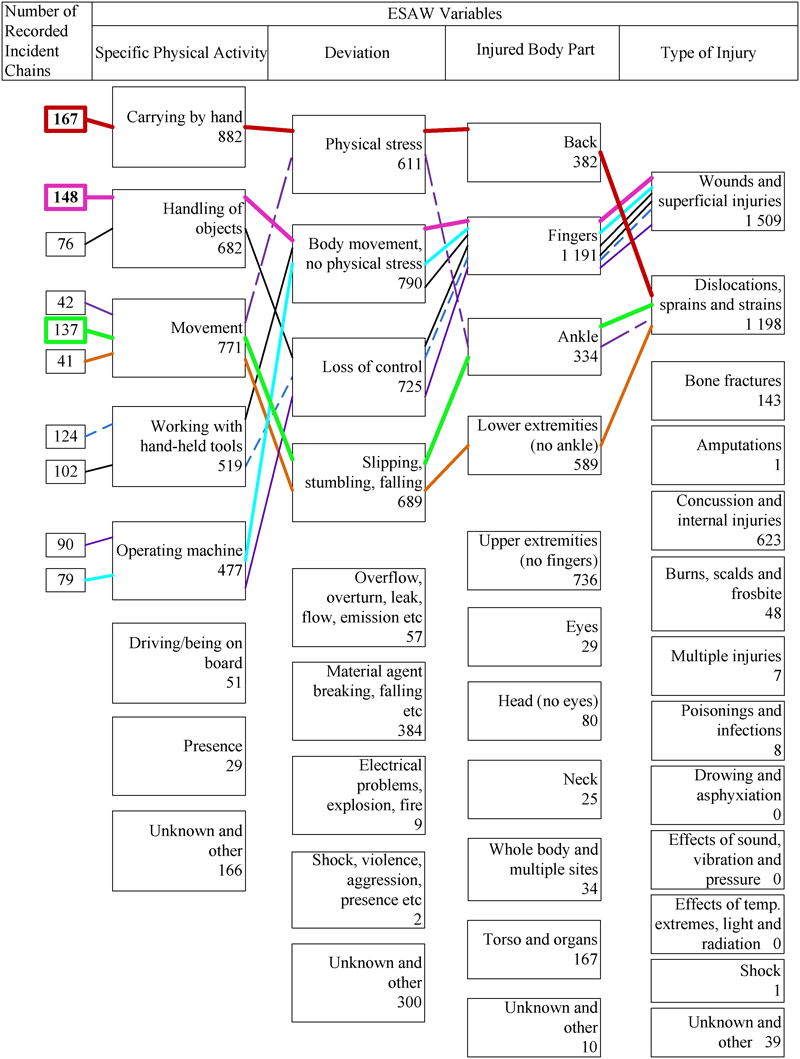
A chain analysis consisting of four ESAW variables and their work-related accident subcategories of the Finnish wood product industry (TOL20) resulting in 7–14 days absence from work. Lines show 10 most frequent posture combinations in accident situations. These cover 1006 cases (28%) out of a total of 3577 postural cases during 2003–2007. Colours of the three most common chains are: red (167), pink (148) and green (137). Number in each small box indicates the total frequency of cases in the collected data having the same value of the subcategory box in question. Online version of image in colour
Serious accidents usually occurred when a person slips, stumbles or falls resulting in a luxation or dislocation strain of a lower limb. On the contrary, accidents resulting in 7–14 days absence from work included physically strenuous activities such as lifting heavy items causing a sudden physical strain of the back. By applying the chain analysis with used variables, it is possible to identify the vital few accident mainstreams (compared with Pareto, see Logothetis 1992; Dale and McQuater 1998) to enhance the best possible results in prevention actions.
The identification of these accident mainstreams, completed with Fig. 1, was utilised to formulate the draft core stories. The above results were further processed to construct narratives of the mainstream of accidents. The following two drafts were constructed for generic core stories:
based on the gathered data of 167 accidents (Fig. 1): a person was carrying an object in his/her hands when during the activity, an uncontrolled body movement occurred causing physical stress to his/her back
based on the collected data of 148 accidents (Fig. 1): a person was holding an object when he/she stepped on or was wounded by a sharp object as he/she passed by. As a result, the person had a superficial wound or an injury to his/her fingers.
These two core stories can be used, for example, as stimuli for the FG of a workplace. These cases can then provide a starting point for the discussion of what kind of accident scenarios could occur or have occurred at a workplace and how they can be prevented in the future. Core stories can help to solve problems and develop a safer place to work. Weick suggested that a series of wins at small but significant tasks, however, reveal a pattern that may attract allies, deter opponents and lower resistance to subsequent proposals (Weick 1984). Taking this into consideration, there would be some worth implementing core stories in health and safety (H&S) training. According to a Canadian study (Geldart et al. 2005), a rise in H&S training from 1990 to 2001 at several levels of employees (e.g. new workers and management) may well have played an important part in the decline in loss time injury rates.
In the log factory accident history, there has been on average 17·4 accidents per year that has lead to >4 days absence from work. In the FG, the participants constituted two core stories from their own accident chains. These stories included their own working environment, tools, machines, products, etc. Health professionals are often so convinced of the importance of their advice that they expect managers to learn and understand their professional jargon (Zwetsloot et al. 2008). The empirical study showed that constituting core stories with a workplace's ‘own language’ makes numerical data more user-friendly and illustrative. One of the core stories was based on the most common chain of events for <4 days absence at work. The log factory had a machine (Fig. 2) which was quite noisy when it was on. One day, it was fixed and when an employee started to clean it up, a blade grazed his/her knuckles. He/she thought that the machine was off because there was not any noise. In this case, maintenance is good as long as you inform also the employees.
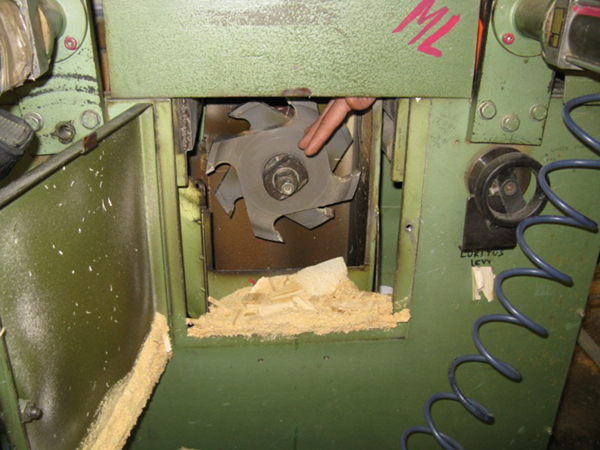
Rotary blade of milling machine where person has accidentally put his/her hand when cleaning it up
The economical benefits could be as much as €5·5m per year if the number of accidents could be halved; however, in the case study, the log factory has benefited financially when the number of accidents has increased (Karila 2010). On the other hand, additional investment is required. In Finland, a premium regulatory act of law of accidents has recently been confirmed. This means that safety work is more rewarding to small- and medium-sized enterprises because the fee is based on their own safety work. According to current work safety regulations, risk identification and assessment are obligatory for all employers in Finland. In particular, small- and medium-sized companies require safety tools supporting their work in measuring and reporting to other companies (Tappura et al. 2010). Furthermore, studies concerning small- and medium-sized companies in the metal manufacturing industry have determined that applying innovative methods also helps to enhance safety (Rajala and Kisko 2003, 2004).
Many global metal manufacturing companies have made a decisive commitment to improve occupational safety by implementing different policies and safety management (Outokumpu 2003, 2007). One such action which is known to contribute towards safety is the compiling of networks as performed by many companies in the process industry (see Niemelä et al. 2010a). The accident frequency rates of principal and supplying companies have clearly decreased while during the same period, the number of incidents being reported has increased significantly (Niemelä et al. 2010b). According to a Finnish study, safety measures can reduce losses, produce savings in expenditures, bring additional gains and enhance productivity (Työterveyslaitos 2007).
Both ‘defending’ and ‘empowering’ functions have to be included in contemporary work systems (European Standard 2004). The former is more related to the prevention of accidents, diseases and errors – risks in general, and the latter to the empowerment of people in processes, high performance and pleasure (as a part of their wellbeing). At its best, development in the areas of ergonomics and safety provides a double utility: it shows, first, how to act with today's existing artefacts in a better way, and second, how to develop improved artefacts and whole work systems for the future. Therefore, we suggest in future work that making a possible calculation on the return on investment is desirable. As Phillips et al. (2001) showed, the safety incentive program in a national steel company produced assets of 3·79 times back.
Conclusions
This paper has discussed a chain analysis approach for the assessment of occupational accidents and was demonstrated by a log factory case study. This study has shown the vast number of possibilities in which this approach can be implemented in occupational health and safety work. In addition to the based drivers, humanitarianism, law and economics are significant factors and new practical tools to management.
Based on the findings of this study, the following features should be emphasised further by highlighting the relevance of results to industry:
The outcomes of safety work are multiple: humanitarian, direct and hidden savings, personal wellbeing at work and improved image for stakeholders.
A typical accident chain of events in the wood products industry consist of: carrying by hand; physical stress; back; and dislocations, sprains and strains paying up to €415 directly and up to €15 000 indirectly.
Control measures can be applied more accurately and prioritised when using an applied approach.
The formation of core stories in the workplace makes them plausible. Exploitation possibilities are extensive, which enhances IMS-style safety management through training, risk assessment, development and design.