







Abstract
This study aims to define the proportion of juvenile wood of açoita-cavalo (Luehea divaricata), pecan (Carya illinoinensis) and London plane (Platanus x acerifolia) wood. Five trees of each species were selected in two regions of a state in the south of Brazil. Discs 2 cm thick were cut at 10 cm from the base, the proportion of juvenile wood was measured based on the radial distance of each annual ring and the segregation age of the juvenile wood was determined from the diameter of the base of the trunks. The results showed that Luehea divaricata wood had the lowest proportion of juvenile wood in both regions. Furthermore, the proportion of juvenile wood presented high correlation with both the age and the diameter of the trees.
Introduction
Juvenile wood is an area with cylindrical shape and relatively uniform diameter in the centre of a tree, extending from its base to the top. It can constitute part of the sapwood or of the heartwood, if the latter is already present in the tree. Mature wood, on the other hand, is formed in the mature phase of the tree, and is always subsequent to juvenile wood (Cown 1992).
To Ramsay and Briggs (1986), juvenile wood is secondary xylem, formed during the young stage of the vascular cambium of a tree. This period varies according to the species, and its proportion can be affected by environmental conditions. Juvenile wood is anatomically characterised by a progressive increase in cell dimensions and by corresponding alterations in their form, structure and disposition in successive annual rings.
The juvenile wood presents shorter fibres or tracheids and bigger angles of microfibrils than the adult wood and consequently has small plasticity. The juvenile wood of Pinus, for instance, can be represented by between 10 and 20 growth rings, and has lower basic density, shorter tracheids, more fine cell walls, bigger diameter of lumen, smaller percentage of latewood, bigger fraction of compression wood, lower strength, lower stiffness and bigger longitudinal shrinkage than the adult wood, mainly due to the big angles of microfibriles (Biblis 1990; McAlister and Powers, Jr 1992).
Most studies of tree variability show a tendency, a radial variation, in wood properties in the pith bark direction, frequently described in areas of juvenile and adult wood. In juvenile wood, the portion of timber surrounding the pith is characterised by a progressive change in cell characteristics and, consequently, in wood properties (Panshin and de Zeeuw 1970).
In general, most studies about juvenile wood emphasise both that fast growth in forests causes the formation of wood displaying lower quality, and that the proportion of juvenile wood being commercialised as sawn timber nowadays is high, resulting in problems in the quality of the products made from this kind of material (Brown and McWilliams 1990).
Since the amount of juvenile wood in the market is increasing, defining the segregation age of juvenile and mature wood is of utmost practical importance. With that information, the common values of juvenile and mature wood properties can be estimated, leading to ways of improving the technological use of the wood (Bendtsen and Senft 1986).
Therefore, the development of studies about juvenile and adult wood of trees from different species tends to help the timber industries, such as the pulp industries in defining of the best use of raw materials. According to Burger and Richter (1991), the wood with high proportion of fibres (angiosperms) or axial tracheids (gymnosperms) and few parenchymatic tissues are great features to produce pulp due to the properties of strength. Moreover, the quantification of juvenile and adult wood also helps to define the best age to fell the trees according to the utilisation.
Several methods have been used to identify this demarcation, from visual examination to verify empiric occurrence of juvenile wood to complex analysis of transversal sections of the log with the application of non-linear regression techniques (Zobel et al. 1958; Roos et al. 1990). The visual examination of graphical pictures of wood properties in annual rings from pith outwards is the method most frequently used (Bendtsen and Senft 1986; Clark and Saucier 1989). However, other studies (Ferreira et al. 2011; Lara Palma et al. 2010) have used the measurement of fibre length to determine the zone of juvenile and adult wood.
In this context, this study aims to define the proportion of juvenile wood in açoita-cavalo (Luehea divaricata Mart. Et Zucc), pecan [Carya illinoinensis (Wangenh) K. Koch] and London Plane [Platanus x acerifolia (Ait.) Willd.] wood destined to the timber industry.
Material and methods
The material was selected from two regions of a state in the south of Brazil, Rio Grande do Sul (29°14′30·91″S, 52°18′47·65″O), namely, the Centre Depression and the Upper Northeast Slopes, chosen in order to comprise the main variations of soil and climate of the state.
Five adult trees of each of the three species being studied were selected randomly (ASTM 1995), all of them presenting a good trunk with diameter over 30 cm at 1·30 m high (dbh) (Table 1).
Characteristics of trees of three species in both regions.
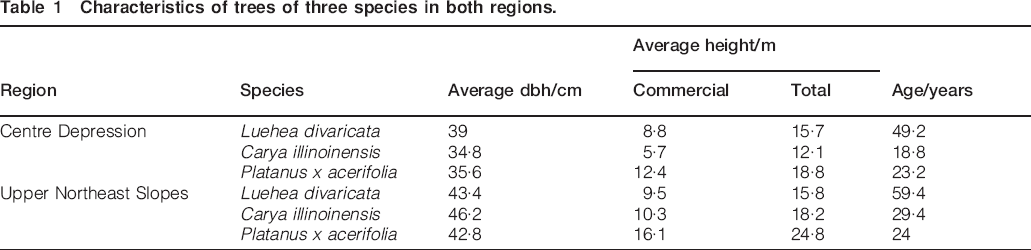
The Luehea divaricata trees were felled in native forests (licensing process by the State Ministry of Environment), whereas the Carya illinoinensis and Platanus x acerifolia came from planted forests.
The cross diameter, the height of insertion of the first live branch as well as the total and commercial height (10 cm diameter) of each felled tree were measured. Also, discs of 2 cm thickness were cut at 10 cm from the base.
The discs were taken to the Laboratory of Forest Products of the Federal University of Santa Maria and for each one, the radial distance was measured in two directions of each annual ring. The proportion of juvenile wood of the selected trees was then defined from the average of the radial distance of each annual ring and from the year of segregation of juvenile wood of the three species, the latter as estimated through the fibre length by Gatto et al. (2007, 2008, 2010) from the diameter of the base of the studied trunks.
The measurement of transverse section of wood did not need the use of a dye or other specific method because the three species studied have anatomical characteristics that allow easy visualisation and quantification of the growth rings.
The collected data were assessed using the analysis of variance (p<0·05). When the null hypothesis was rejected, the average values were compared with Tukey test at the level of significance of 5%. Moreover, simple linear regression models were used to obtain the correlation between the proportion of juvenile wood, the diameter and the age of the trees.
Results and discussion
The analysis of variance showed that the difference between the three species of trees is statistically significant in both regions, Centre Depression (F = 17·01; p = 0·0003) and Upper Northeast Slopes (F = 22·50; p = 0·0001).
Table 2 shows the proportion of juvenile wood in the three studied species.
Juvenile wood Pj in function of base diameter D and juvenile wood diameter d to tree species studied in both regions
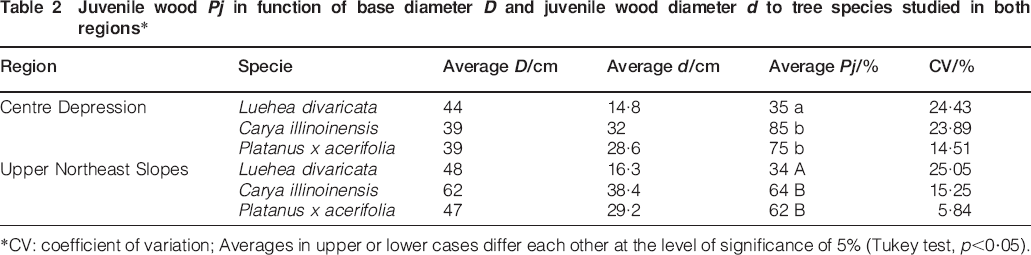
*CV: coefficient of variation; Averages in upper or lower cases differ each other at the level of significance of 5% (Tukey test, p<0·05).
Table 2 indicates that in both regions Luehea divaricata wood presented lower values of juvenile wood than Carya illinoinensis and Platanus x acerifolia. Therefore, according to Gatto et al. (2008), who affirmed that the proportion of juvenile wood has a direct influence on the quality of the products of sawing, forest management and administration of harvest, it can be said that Luehea divaricata wood presents higher wood quality than the other two species. Alteyrac et al. (2006) state that a high proportion of juvenile wood tends to reduce the strength of the timber and the yield of pulp production. Moreover, quality is affected by low bending strength and dimensional instability after wood drying, causing serious problems especially in solid wood products (Zobel and Sprague 1998).
The high proportion of juvenile wood observed in Carya illinoinensis and Platanus x acerifolia wood is closely related to the age of the trees. The Luehea divaricata trees were between 41 and 62 years old, whereas the Carya illinoinensis trees were between 20 and 40 years old and the Platanus x acerifolia trees between 18 and 30 years old. Cloutier et al. (2006) and Kretschmann (2008) state that logs obtained from low rotation forests present higher values in juvenile wood proportion.
The distribution of juvenile wood proportion depending on the diameter of the trees is shown in Fig. 1. For the three species, juvenile wood proportion decreased as the diameter of the trees increased. The regression models show high correlation respectively, to Luehea divaricata (
 = 78%) and Carya illinoinensis (
 = 72%).
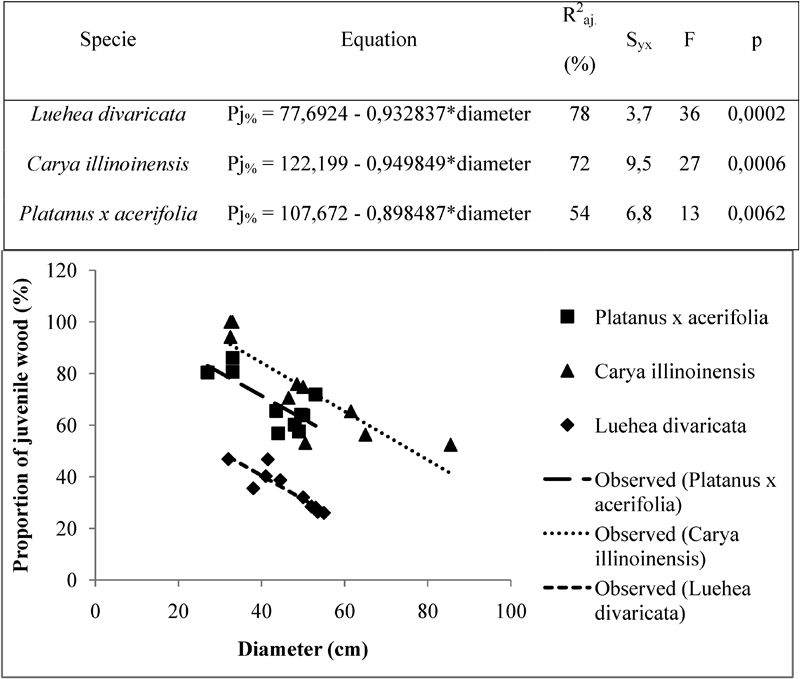
Proportion of juvenile wood as function of diameter of trees
The relationship between the proportion of juvenile wood and the age of the trees is shown in Fig. 2. It can be verified that it is inversely proportional, that is, the proportion of juvenile wood decreased as the age of the trees increased. The regression models indicated the best similar correlation to the tree species: between 60 and 62%.
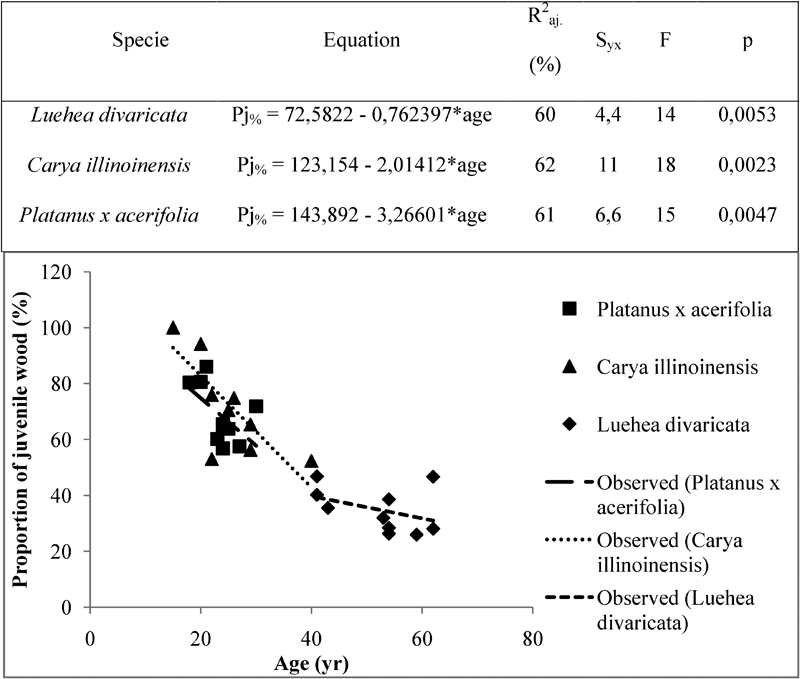
Proportion of juvenile wood as function of age of the trees
The proportion of each wood depends on the growth and the felling age of each tree (Kellison 1981). On the other hand, the growth of the trees depends on the site and on silvicultural practices, namely, spacing, fertilisation, pruning and thinning (Schneider 1993). The use of dense spacing in the first years of life of trees (segregation) decreases the growth rate and, consequently, the proportion of juvenile wood. Moreover, light thinning during the first years of life and profound thinning after the segregation age are recommended to increase the proportion of adult wood.
With that, the less the trees grow in the first years and the bigger and older they are when they are felled, the lower the proportion of juvenile wood will be.
The proportions of juvenile wood, except for the Luehea divaricata wood, can be considered high for the studied species. If the aim is to use timber of adult wood, described in the literature as being of better quality (Kollmann 1951; Biblis 1990; McAlister and Powers, Jr 1992), longer cycles and silvicultural practices that decrease the proportion of juvenile wood should be used. Vignote Peña and Jiménez Peris (1996) claim that the earlier the branches of trees start to be pruned, the earlier adult wood formation will start.
Conclusions
The Luehea divaricata wood had the lowest proportion of juvenile wood in both regions.
The proportion of juvenile wood showed high correlation with both the age and the diameter of the trees.
If the aim is to decrease the proportion of juvenile wood, felling trees from old forests (older than 40 years old), using denser spacing, based on the segregation age of the species in the first years of the forest, as well as correct forest management, are highly recommended.