







Abstract
The determination of surface free energy of wood is an important parameter in applications such as coating, painting and gluing. The simplest technique for that is measurement of contact angle. This technique has been used for the investigation of the effect of heat treatment of wood on the surface free energy. Two wood species – aspen and grey alder – have been treated in a range of temperatures from 140 to 180°C. With the sessile drop technique, series of contact angle data have been collected and used to determine the corresponding surface energies and changes in wettability. The most commonly used approaches, Zisman, Owens–Wendt, Wu, equation of state and acid–base theories, were applied. The results demonstrate that heat treatment affects wettability and solid surface energy, in particular, from the Owens–Wendt and Wu theories. We know that at higher treatment temperatures, the polar component of the surface energy for both wood species decreases, while the dispersive component is almost constant. The experiments have been conducted while trying to fulfil the same measuring conditions, but in any case, it was not possible to reach the thermodynamic equilibrium conditions assumed by Young's equation, due to chemical heterogeneity, surface roughness and capillarity. It is possible to improve the accuracy of results using a larger number of probe liquids.
Keywords
Introduction
Heat treatment is a widely investigated sector in wood chemistry as a valid alternative to other preservation methods based on the use of chemicals (i.e. biocides, metals and VOC), which have been restricted in the recent years, as they may create environmental hazards. Heat treatment affects all the chemical–physical properties of wood, composition, structure and density, compared with fresh wood (Biziks et al. 2008; Kocaefe et al. 2008). Attention is focused, in particular, on changes in wettability, which has a practical relevance and economic significance. Wettability is important in coating, painting and gluing: all these procedures can be enhanced by understanding the wetting behaviour of wood after thermal modification. To predict and understand the wetting of wood, it is necessary to study the surface free energy of wood, as already indicated in other publications (Good 1992; Scheikl and Dunky 1998), and the most widely used technique to obtain solid surface free energy is contact angle. Surface energy quantifies the disruption of intermolecular bonds that occurs when a surface is created. It measures the change of the total surface free energy G per surface area A at constant temperature T, pressure P and moles n (equation (1))


There are only two measurable quantities in Young's equation: the contact angle θ and γlv, so other equations are necessary to determine γsv and γsl. The total surface energy of solids and liquids depends on different types of molecular interactions, such as dispersive (van der Waals), polar and acid–base interactions, and is considered to be the sum of these independent components: it is the case of the Wu (1971), Owens–Wendt (Owens and Wendt 1969), Fowkes (1964, 1987) and acid–base approaches (van Oss et al. 1988a). On the other hand, there are the Zisman (Zisman 1963) and EOS (Neumann et al. 1974) approaches which evaluate the total solid surface free energy without information on the nature of the solid–liquid interactions. Young's equation represents an ideal situation, where the surface is perfectly smooth and the contact angle has a single, unique value, but for wood surfaces, these conditions cannot be achieved due to the complex nature of wood itself.
Wood roughness and chemical heterogeneity affect measurements, giving rise to contact angle hysteresis phenomena (Chibowski and Gonzalez–Caballero 1993). Wood is also a porous and hygroscopic material, and this influences the spreading of the droplet on the surface (Rodrıguez–Valverde et al. 2002), and gives rise to swelling, reactions and contamination of liquids by wood extractives (Walinder 2000).
In order to obtain meaningful values of contact angle, the surface must be as smooth as possible. Surface preparation can be done using a microtome or by sanding: different techniques that lead to different morphological surface properties (Sinn et al. 2004), which have an influence on spreading of liquid. The aim of this work was to investigate how wettability changes after heat treatment, and to evaluate the solid surface free energy using Zisman, Wu, Owens–Wendt, equation of state and acid–base approaches.
Surface energy
Historically, the first approach to solid surface energy determination is the work by Zisman. The key observation that he made was that, for a given solid, contact angles did not vary randomly as the liquid changed, rather cos θ changed smoothly with the liquid surface tension γl within a band of a linear fitting. The result is the critical surface tension, obtained from a linear extrapolation to cos θ = 1, as seen in Fig. 1. The Zisman theory simply defines the solid surface energy as being equal to the highest surface tension among those liquids that wet the solid completely.
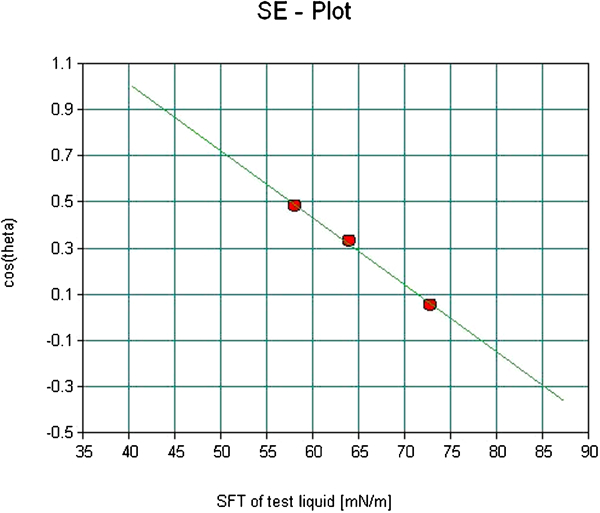
Example of Zisman plot from grey alder samples
After Zisman, two major directions developed, namely the component theories, which consider the different natures of intermolecular forces involved in surface wetting, and the equation of state theory, which can be seen as a further evolution of the Zisman method. The component methods are generally more complicated but have the advantage of giving more information than the equation of state and Zisman methods.
Owens–Wendt
The basic assumption for all the component theories is that the interactions between liquid and solid phases are the result of polar and dispersive components respectively γp (H bonding, acid–base and dipolar) and γd (Lifshitz–van der Waals, London interactions). Equation (3) can be used to obtain solid surface free energy and its components

Approximately in the same period, Kaelble (1970) also published a very similar equation. Often this method is referred to as Owens–Wendt–Rabel–Kaelbe. This theory is typically applicable to surfaces with low charge and moderate polarity.
Figure 2 represents a linear regression derived from the solution of the Owens–Wendt equation, the polar component is obtained from the square of the slope of the line and the dispersive part from the square of the ordinate intercept.
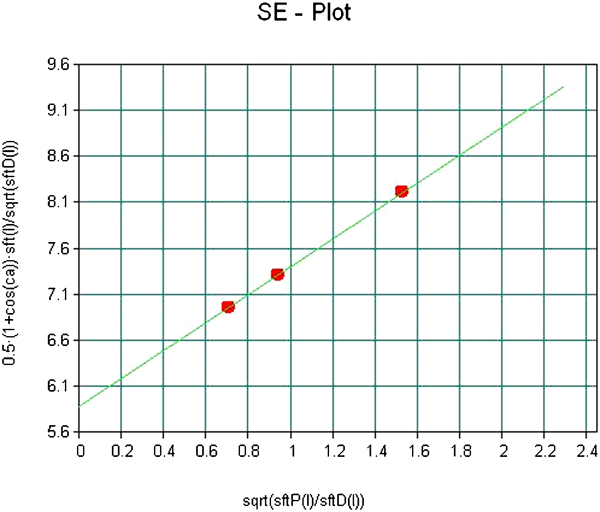
Example of Owens–Wendt plot from grey alder samples
Wu and harmonic mean
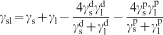
In his observations on interfacial tension, Wu also started with the polar and dispersive components of the surface energy of the participating phases. In his equation, however, instead of the geometric mean, Wu used the harmonic mean (equation (4)), for more accurate results, in particular for high-energy systems (Wu 1971).
At least two test liquids with known polar and dispersive components are required; one of the liquids must have a polar component greater than zero
Acid–base approach
This approach is based on Fowkes work. It is considered to be a generalisation of his approach and eventually developed by van Oss et al. (1987, 1988b), Good and van Oss (1992) and Chaudhury (1996) and is the most complex of the methods. The surface free energy is a sum of three components, the dispersive part, referred as Lifshitz–van der Waals component γLW and the polar part, referred as acid γ+
and base γ– components according to Lewis definition. The acid–base interactions do not include hydrogen bonding. Also the acid–base method uses the geometric mean (equation (5)). Having three terms to resolve, at least three probe liquids are needed for the measurements

Equation of state approach
The first examples of equations of state are the Antonow's rule, and the Berthelot's rule, the first being very simple and without theoretical basis, while the Berthelot's rule has a theoretical background, based on the interactions of like pairs, from the London theory of dispersion, and is a geometric mean equation. Both can obtain solid surface free energy using only one probe liquid. They show limits in evaluation of interactions of unlike pairs (Kwok and Neumann 1999). In this case, the geometric mean tends to overestimate the strength of these interactions, and it works better if solid and liquid have similar polarity (Israelachvili 1972).
The equation of state derives from a modification of the Berthelot's rule with an exponential term (equation (6)), in order to correct this overestimation


Experimental section
Materials and methods
Heat treated (hereinafter h.t.) wood samples of grey alder (Alnus incana) and aspen (Populus tremula) at 140, 170 and 180°C (length of treatment: 1 h) and 160°C (lengths of treatment: 1 and 3 h) and untreated samples, were used in this work. The one-stage heat treatment process consisted of three technological sub-stages: first, a temperature increase up to the modification temperature; second, holding at the modification temperature, followed by cooling. Wood boards were chosen without any visible defects. Their sizes were: length 1000 mm, width 75 mm and thickness 25–32 mm. Boards were treated in a saturated steam environment at high pressure (6·5–7·6 bar), a so-called ‘hydro-thermal’ treatment. They were stored in a climate chamber at 23±2°C and 65% relative humidity, for 2 months, moisture content was then gravimetrically measured, and as a difference of weight with the initial weight of samples, moisture content varied between 4% (180°C h.t. samples) and 7% (140°C h.t. samples).
For each temperature, six samples were selected, in order to measure contact angles in the radial direction, and cut ∼100 mm long and 10 mm wide. As noticed from de Meijer, in this way, the sorption of water into capillaries is reduced (de Meijer et al. 2000).
Contact angle and probe liquids
The goniometer used was a Dataphysics OCA20 device, equipped with a video camera and software for the determination and analysis of the drop contour, contact angle and solid surface free energy computation. From the drop contour, two values of contact angle were obtained on the left and on the right intersection point solid–liquid–air, and the final value was the mean of the two contact angles.
The static sessile drop technique was used, which consists of the deposition of a single droplet on the solid surface without any further addition of liquid (see Fig. 3). The liquids used were water, glycerol and formamide. The device is equipped with an automated dispenser that always dispenses the same volume of liquid (10 μL water and 7 μL glycerol and formamide).
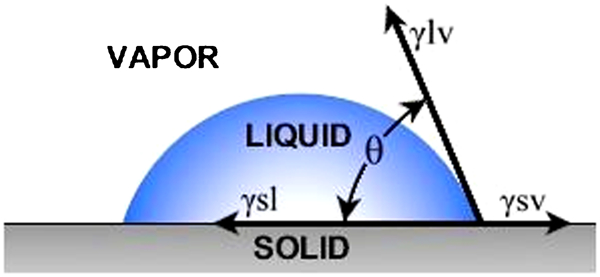
Schematic representation of static sessile drop measurement
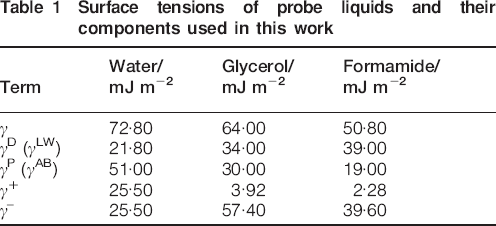
Table 1 lists the surface tensions of the three probe liquids and their polar and dispersive components.
Surface tensions of probe liquids and their components used in this work
Chemical changes in wood
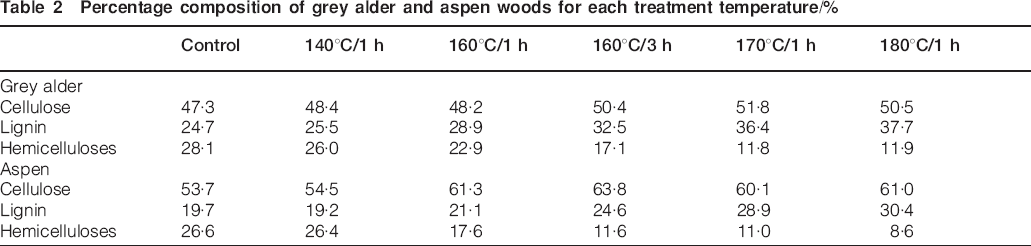
After each heat treatment, the composition of the wood was determined in terms of the three main components: cellulose, lignin and hemicelluloses, in order to find a possible correlation between increase in hydrophobicity and chemical changes in the wood. Chemical analysis was performed for both non-treated wood and the modified samples: 8–12 g of air dry chips of each sample were extracted in a Soxhlet apparatus with acetone for 8–10 h for extractives determination. After extraction, the excess of acetone from the solution was distilled, and the extract was dried under a vacuum at a temperature of 40°C. Cellulose was determined applying the Kürchner–Hoffer method, while for lignin determination, the Klason 72% sulphuric acid method was applied (Browning 1967). Hemicellulose percentage was calculated as a difference from cellulose and lignin amounts. It is known that the first polymer to degrade is hemicellulose (Tjeersma and Militz 2005), so the cell wall loses the most hygroscopic of its components. Lignin and cellulose are less affected by the temperature, thus increasing their percentage in the wood. Table 2 lists the wood composition for each heat treatment. Results confirm that there is a strong decrease in hemicelluloses, while content of lignin and cellulose increases, only because they degrade less. Only the amorphous part of cellulose degrades. The increase in lignin amount in the cell wall after heat treatment makes the wood less hydrophilic since the lignin itself is the least hydrophilic of the three main components of wood. It is not only the degradation of hemicelluloses that influences wood hydrophobicity but also the consequent reactions which take place at higher temperatures such as hydrolysis, cleavage of acetyl groups and rearrangement within the lignin matrix through cross-linking reactions of what remains of hemicelluloses, thus reducing the amount of available OH moieties for water. The changes are not only chemical but also affect the three-dimensional matrix of the cell wall. Crystalline cellulose is supposed to maintain its structure, and only the amorphous part is affected by temperature effects.
Percentage composition of grey alder and aspen woods for each treatment temperature/%
Procedure
Each sample was sanded with a fine grain size abrasive paper and cleaned with a vacuum water pump to eliminate residual dust. Immediately after sanding, the contact angle was measured so as to avoid phenomena of migration of extractives and reactions on the wood surface (Christiansen 1994). The spreading of the droplet was recorded for 30 s. and a picture per second was saved, with the corresponding contact angle. This procedure was previously described in the literature (Kalnins et al. 1988). In this case, the software greatly facilitated the measurements. At least six droplets per sample were measured. The final data are the average of all collected contact angles.
According to Liptakova and Kudela (1994), the droplet, after deposition, increases its diameter and the contact angle rapidly decreases (first stage), then the diameter stops increasing and remains approximately constant, and the contact angle slowly decreases due to the penetration of the liquid inside the wood (second stage). At the end of the first stage, the droplet can be considered at thermodynamic equilibrium, and the corresponding contact angle is used to compute solid surface free energy, while Kalnins proposed to measure contact angle 2 s after the droplet deposition.
We opted for the Liptakova's procedure, but with a variation: the contact angle is considered at thermodynamic equilibrium when the difference with the previous contact angle is about 1° and not when the diameter no longer increases, which happens few seconds later.
This choice is to minimise the effect of probe liquid penetration into the wood, which causes swelling and loss of liquid from the droplet, both influencing the correctness of the measurements.
Walinder and Gardner (1999) also reported that the sorption process is exothermic, so a part of the liquid converts into vapour which could also affect measurements.
Results and discussion
Surface energy of wood
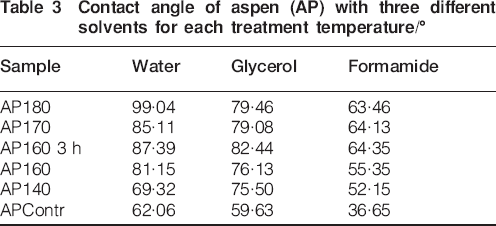
Tables 3 and 4 list the contact angle values for aspen and grey alder respectively. Water gives the highest contact angles, but grey alder control, grey alder and aspen 140°C h.t. samples have greater contact angle with glycerol. Formamide always has the smallest contact angle. During measurements, we observed that the contact angle is higher on latewood than earlywood, as already confirmed from other works (Herczeg 1965; Kamke and Lee 2007), due to the difference in surface roughness and different tracheid dimensions.
Contact angle of aspen (AP) with three different solvents for each treatment temperature/°
Contact angle of grey alder (GA) with three different solvents for each treatment temperature/°
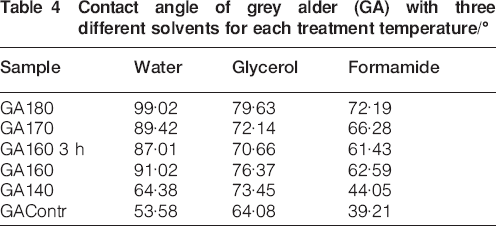
In some cases, droplets spread too quickly on the surface, when using formamide, and eventually it was not possible to measure a meaningful contact angle because of the lack of symmetry of the droplet (i.e. right and left contact angles were totally different). These data were used to compute solid surface free energy with five methods and results are listed in Table 5. The results obtained from each method are in a quite narrow range of values, except for the acid–base method which for control and 140°C h.t. samples gives higher values, even over 100 mJ m−2 for grey alder. Results confirm that wood is a low energy solid material.
Solid surface free energy (mJ m−2) of aspen (AP) and grey alder (GA) wood samples from average contact angles*
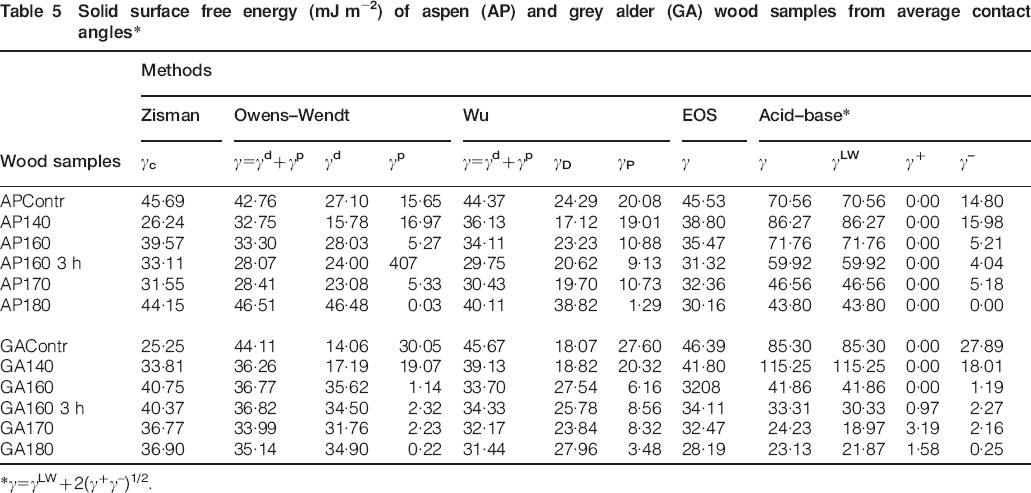
*γ = γLW+2(γ+γ–)1/2.
The comparison of the values obtained from each method, for the same sample, gives more detailed information. Basically the Owens–Wendt, Wu and EOS methods are in good agreement, γ values are very close to each other and only for 180°C h.t. samples solid surface energy is in a wider range and decreases passing from Owens–Wendt, to Wu, to EOS method. Zisman and acid–base methods are in better agreement with three other methods for higher treatment temperatures. This is not surprising if we consider that the Zisman method, even if not a very robust theory, is particularly suitable for non-polar surfaces.
From the analysis of the polar and dispersive components obtained with Owens–Wendt, Wu and acid–base methods, a further subdivision of the wood samples is possible. The dispersive component is always present and in general does not show large variations, while the polar component is the most susceptible to the changes after heat treatment. Control and 140°C h.t. samples have high polar components of the solid surface free energy, while in the other samples, this component is strongly reduced, (hydrothermal modification of 180°C gives, for all the methods, the most hydrophobic wood). We can divide samples into two groups: the first group, control and 140°C h.t. samples, which have more hydrophilic character and the second group, all other samples, which are more hydrophobic.
Untreated and 140°C h.t. samples are more hydrophilic and show contact angles of water (the most polar of the three solvents) lower than glycerol. The lower contact angle can be explained with a lower viscosity of water, which can spread on the surface faster than glycerol: at the equilibrium point, the baseline of the water droplet is larger and the contact angle consequently, is smaller.
In general, the polar component from Wu is higher than that from Owens–Wendt. As regards the acid–base method, which provides even more detailed information, the polar component is mainly due to a basic contribution, while the acid part is very small or equal to zero. This means that on the wood surface electron-donor groups are mainly present and the thermal modification reduces these groups.
This behaviour has already been reported in the literature (de Meijer et al. 2000). The absence of the acid component can result from the small number of probe liquids used – a greater number provides more accurate results (Gindl et al. 2001) – or from the nature of the liquids. All three probe liquids have high basic component of surface tension. Only water which is an amphoteric solvent has high values for both components.
It has been reported (Kwok et al. 1994) that the choice of the triplets, also has an influence on the surface free energy components, and this can lead to prediction of different surface properties, while in another study, it was proposed to use at least one non-polar liquid for the measurements (Wu et al. 1995).
Conclusions
Heat treatment clearly affects the solid surface free energy and wettability of wood. Solid surface energy in general decreases from untreated to 180°C h.t. wood.
The wood becomes more hydrophobic for higher treatment temperature. The dispersive component of surface energy does not change strongly, while the polar component dramatically decreases. According to these research data, the surface is more suitable for non-polar solvents. Results in some cases can be confusing, in particular from the acid–bBase approach. This could be due to the small number of solvents used. The chemical–physical properties of wood make it impossible to fulfil the conditions assumed in the Young's equation: surface roughness, absorption and capillarity affected the measurements. To minimise the absorption of water, we measured contact angle putting the droplets of water on latewood parts of the samples where possible.
Footnotes
Acknowledgements
The authors gratefully acknowledge the financial support by the Latvian State programme 10-4/VPP-5 ‘Sustainable use of local resources (entrails of the earth, forest, food and transport) – new products and technologies (NatRes)’.