







Abstract
This study aimed to characterise wood discolouration of three Brazilian eucalypt species exposed to the action of natural weathering in two distinct places. To achieve this, tests were performed at an exposed outdoor site and under a forest canopy; both located in the state of Rio Grande do Sul, Brazil. Colorimetric measurements were performed every 45 days during the period of 1 year in order to obtain the parameters L*, a*, b*, C* and h*. The main results showed significant darkening in the first 4 months and subsequently increased the greyish colour. Colour variations were observed between species, field and exposure time in service.
Introduction
Wood is a natural and versatile material that is highly regarded when compared to other building materials, and is used for both indoor and outdoor architecture and construction. The use of this material in different places, particularly in outdoor spaces, fosters the action of adverse weather conditions that cause natural degradation parallel to complex biological degradation processes (Feist and Hon 1984). Therefore, the utilisation of in natura wood limits its industrial and commercial applications. The Brazilian Eucalypt forest area is large and intended for various sectors such as bioenergy, pulp and paper, sawn, panels, architecture and construction.
Wood from Blue gum (Eucalyptus saligna), Forest red gum (Eucalyptus tereticornis) and Lemon scented gum (Corymbia citriodora) is widely used in Southern Brazil to produce floors, decks and structures in general, which are frequently exposed outdoors and, consequently, in different weather conditions. However, the service life of these natural woods (untreated) is unknown and can vary according to appearance when exposed outdoors. Therefore, the study of aesthetic limitations during wood service life is strongly recommended.
The short-term outdoor exposure of in natura wood cause changes in the colour of the material (Peña and Rojas 2005). According to George et al. (2005), the reason for changes in colour is associated to environmental factors such as sunlight, temperature, wind and rainfall, and occurs mainly because of the penetration of UV and visible light on the wood surface. Thus, the incidence of these types of radiation, aggravated by weathering action, produces chemical processes that develop in the cell walls of the wood and affect especially the lignin and extractives (Feist and Hon 1984), and results in the production of carbonyl and carboxyl chromophore groups. According to Deka et al. (2007) and Ghosh et al. (2009), these organic compounds produce colour changes on the wood surface.
The aging process (greying) of timber exposed directly to sunlight is usually divided into three steps. First, cell wall polymers are degraded solely by UV light, in which lignin is the most susceptible component to degradation, though holocellulose presents high loss also (Feist 1990; Hon 2001). The second step is characterised by the leaching of degraded components because of rainwater action and subsequently by fungal colonisation on the degraded surfaces that metabolise both the lignin and the photodegraded holocellulose (Eaton and Hale 1993; Schoeman and Dickinson 1997). Moreover, changes on wood colour by the action of light are related to the presence of extractives and the production of quinones (Ayadi et al. 2003; Mitsui and Tsuchikawa 2005).
Thus, weathering action on wood in service results in disadvantages related to its visual aspect. However, the mechanism of photodegradation of cell wall constituents, associated to the weather, directly affects the mechanical strength and surface roughness of the material in the medium-term (Hon 2001).
Colorimetry is an efficient technique for characterising wood samples because it is non-destructive and presents easy application through colorimeter and spectrophotometer equipments. This technique is based on standards established by CIE (Commission International de L'Éclairage) and permits the measurement of parameters L* (lightness), a* (green-red chromaticity coordinate), b* (blue-yellow chromaticity coordinate), C * (chroma) and h* (hue angle).
In this context, the present study aimed to evaluate the colour changes in three Brazilian eucalypt wood exposed to natural weathering.
Materials and methods
Selection and preparation of the material
Five trees of 20-year-old Blue gum (Eucalyptus saligna), Forest red gum (Eucalyptus tereticornis) and Lemon scented gum (Corymbia citriodora) were harvested from an experimental forest located at the State Foundation for Agricultural Research (FEPAGRO-Forestry) in the centre of Rio Grande do Sul state, Southern Brazil (29°42′39″S, 53°41′32″W).
Eighty-five heartwood samples measuring 150 mm (longitudinal), 20 mm (tangential) and 20 mm (radial) per species with straight grain and absence of defects (knots, cracks and warps) were prepared. The wood samples were then placed in a climatic chamber at 20°C and 65% relative humidity until exposure in the field test.
Installation and characterisation of the field tests
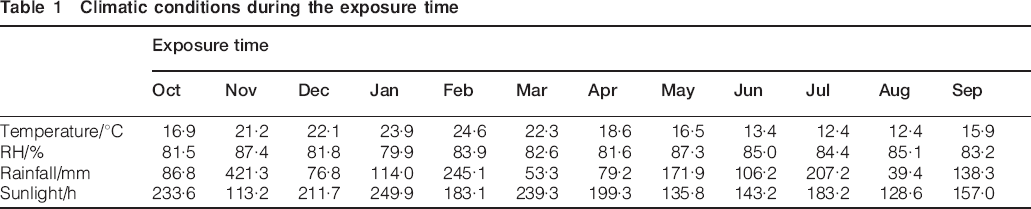
The field test was carried out in two sites with different types of vegetation. The samples were placed in an outdoor site dominated by low vegetation (wood samples not in shade) and inside a forest of Acacia mearnsii (6 years old) with planting spacing of 3×2 m. Both sites are located in Morro Redondo, Rio Grande do Sul state, Southern Brazil (31°58′18″S and 52°63′55″W), which has an altitude of approximately 245 m above sea level. According to the Köeppen classification, based on temperature and rainfall, the type of climate region is Cfa. Climatic conditions during exposure are characterised in Table 1.
Climatic conditions during the exposure time
The wood samples were divided in eight collections and then randomly vertically placed 30 cm above ground in a frame for both test fields. Five other wood samples remained in a climatic chamber for initial measurement (time = 0). Collection of the material was performed every 45 days (time = 1–8). After collection, the wood samples were placed in a climatic chamber until the colorimetric measurements.
Colorimetric measurements
The colorimetric evaluation was performed with a colorimeter (Konica Minolta CR-400) available at Federal University of Pelotas (Brazil). The equipment was configured to use a D65 light source and observation angle of 10° (CIE-Lab standard).
Five measurements of all exposure times were taken from the wood samples in order to obtain the colorimetric parameters, lightness (L*), green-red chromaticity coordinate (a*) and blue-yellow chromaticity coordinate (b*). Subsequently, C* (chroma) and h* (hue angle) were measured through equations (1) and (2)


Data analysis
The results of colorimetric evaluation were assessed through diagrams adapted from the Konica Minolta Manual (2007). The relationship between lightness (L*) and chroma (C*) was analysed through the chromaticity diagram, while the relationship between green-red chromaticity coordinate (a*), blue-yellow chromaticity coordinate (b*) and chroma (C*) was analysed through the displacement diagram. Both diagrams were used in order to evaluate the displacement of the original colour of wood to the colour after the photodegradation. This method enables observations in colour changes after photodegradation through a vector size. Likewise, colorimetric data were also assessed using a multivariate analysis of variance (MANOVA) according to exposure time (time = 0–8), field site (outdoor and forest canopy), wood species (blue gum, forest red gum and lemon scented gum) and its interactions.
Diagnostic checks (T-test of normality and Bartlett test of homogeneity of variances) were performed in order to evaluate whether the data is suitable for analysis of variance (ANOVA) tests. Control samples data was assessed using descriptive statistics and ANOVA. When the null hypothesis was rejected, the average values were compared with a Tukey Test at the level of significance of 1%.
Results and discussion
Table 2 shows through Tukey HSD test that wood colorimetric parameters presented statistical differences before exposure to natural weathering. All the colorimetric parameters of three wood species showed a significant difference. While lemon scented gum wood presented natural grey colour and close to dull opacity, the blue gum wood showed lighter shades, thus increasing its brightness.
Colorimetric evaluation of wood before natural weathering*
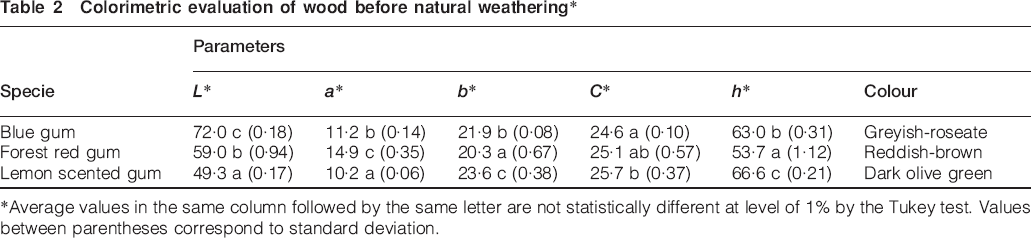
*Average values in the same column followed by the same letter are not statistically different at level of 1% by the Tukey test. Values between parentheses correspond to standard deviation.
Figure 1 shows that significant colour changes in the wood surface occurred in the first exposure times; however an increment of greyish colour because of the natural weathering occurred from 135 days of field exposure, which was also observed by Feist (1983). Small visual differences between field sites to the colour of wood were observed at the end of the exposure period.
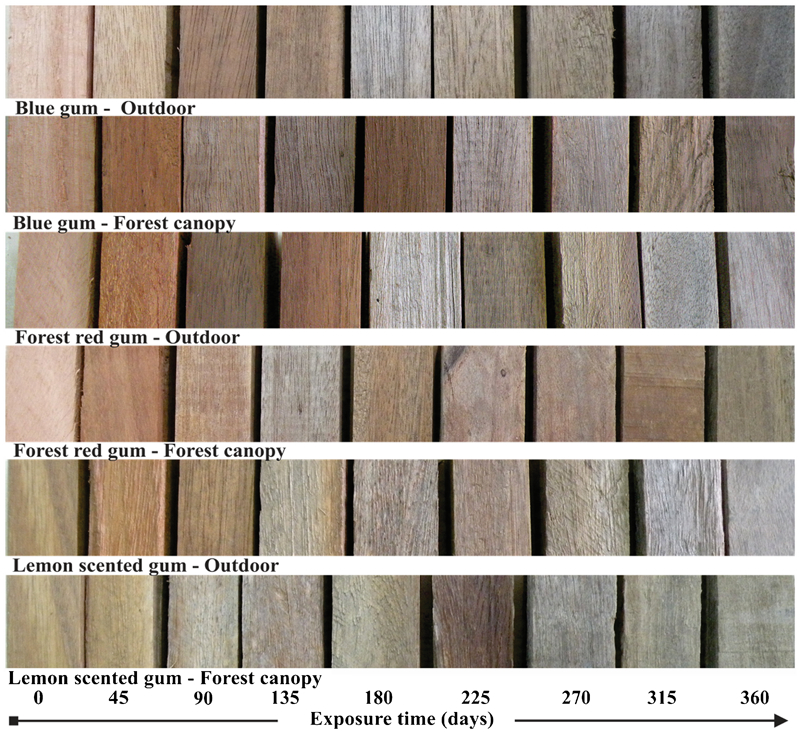
Visual evaluation of wood samples
The visual evaluation demonstrated that the discolouration was more aggressive in the samples exposed to the outdoors without shade than in the samples exposed in the forest canopy. Nevertheless, this is a subjective evaluation and according to Hung et al. (2012) quantitative visual analysis of wood colour modification is more difficult.
The multivariate analysis of variance presented in Table 3 shows a significant variation of parameters L*, a* and h* in relation to the wood species, time and type of field (outdoor and forest canopy). On the other hand, parameters b* and C* did not present changes as a function of the type of field, and only parameter C* did not change between wood species.
Multivariate analysis of variance of colorimetric parameters†
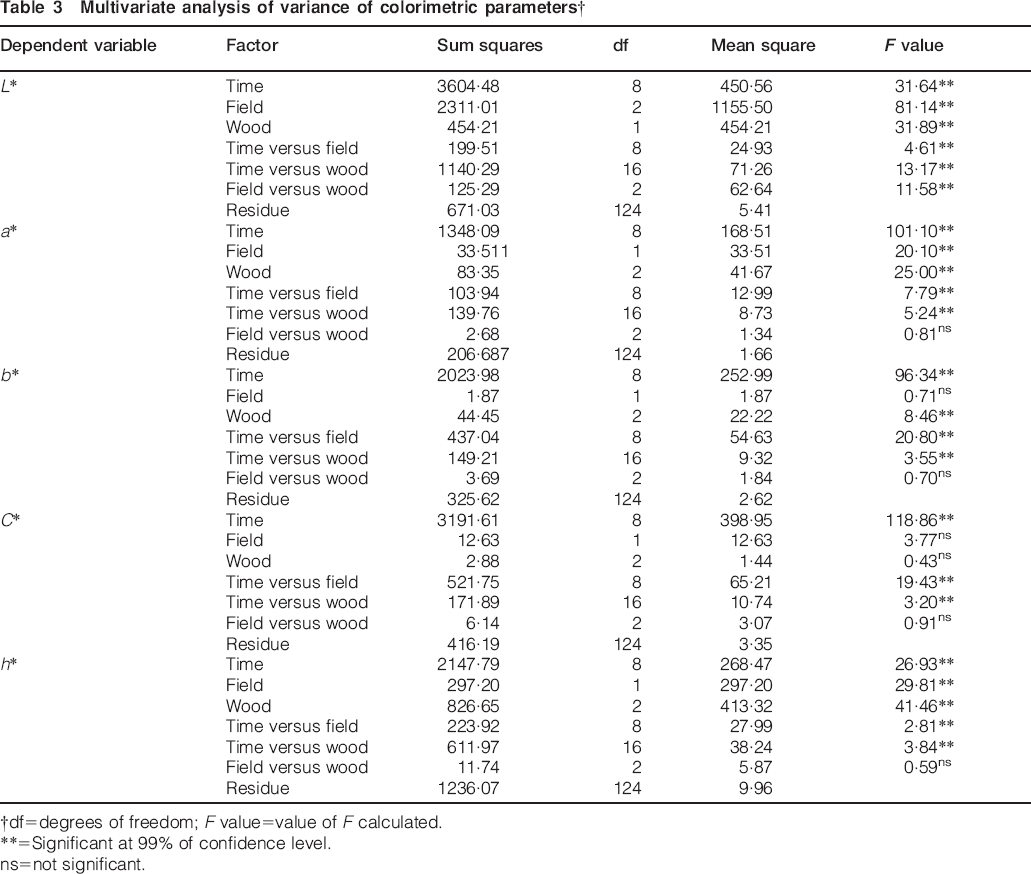
†df = degrees of freedom; F value = value of F calculated.
** = Significant at 99% of confidence level.
ns = not significant.
Significant interactions between time and field, time and wood were observed for all the colorimetric parameters. On the other hand, interaction between field and wood was significant only for lightness (L*), proving that the field factor directly influences in the greying ratios of wood samples.
Figure 2 shows the behaviour of colorimetric parameters (L*, a*, b*, C* e h*) for the three wood species exposed in two field sites. A darkening of the wood samples because of the decrease of L* as a function of the exposure time was observed. This result can be attributed to an increase degree of surface oxidation of the weathered samples (Evans et al. 1996).
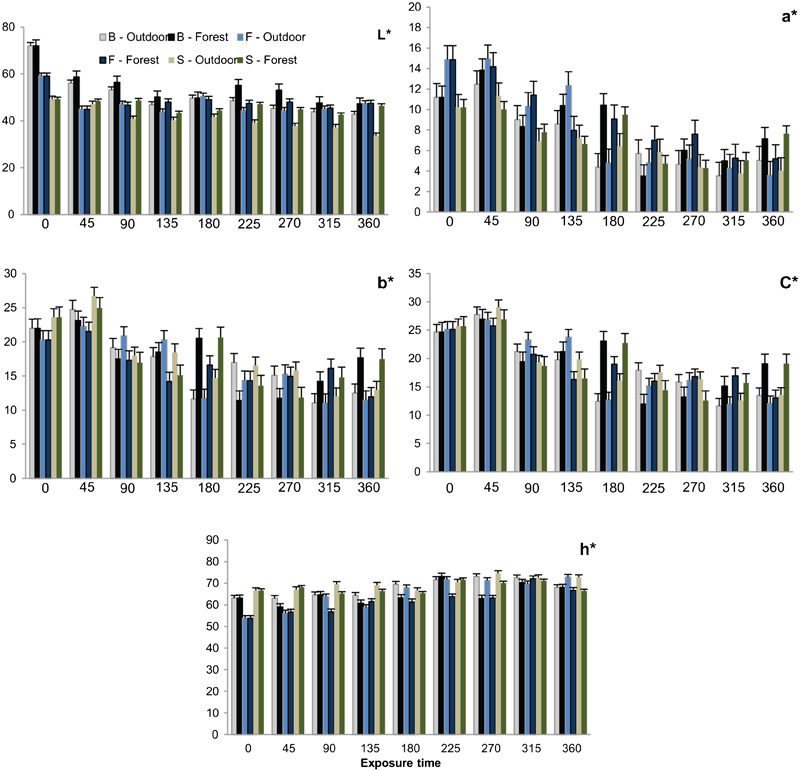
Behaviour of colorimetric parameters
In general, lightness (L*) decreased considerably in the first days of exposure, followed by a stabilisation. The lightness of wood samples exposed to the outdoors decreased more than the wood samples exposed in the forest canopy, except for Forest red gum, which showed similar behaviour in the two sites. In addition, the chromaticity coordinates (a* and b*) slightly increased in the first 45 days of exposure for the three species in both sites. After this period, a gradual darkening of wood samples was observed until 225 days of exposure, followed by a stabilisation until the end of the study (360 days) as previously shown by Bhat et al. (2010). After the end of the exposure period, blue gum and lemon scented gum wood samples showed the highest differences as a function of the type of sites.
Wood samples exposed outdoors presented the highest darkening. All wood samples exposed to natural weathering showed a reduction of coordinate b*, mainly in the samples exposed outdoors. On the other hand, a partial increment of chromatic coordinates (a* and b*) in the first days of exposure, followed by severe darkening and, subsequently, a constant darkening after a middle period was observed. Other authors have observed this behaviour for different wood species exposed to natural and artificial weathering, such as Norway Spruce and Douglas-Fir (Schnabel et al. 2009), Ash, Beech, Maritime Pine and Poplar (Ayadi et al. 2003) and Scots pine (Ghosh et al. 2009). However, studies of the behaviour of Eucalytpus wood are rare (Smit 2010).
Chroma (C*) presented the same behaviour of chromatic coordinates (a* and b*) in relation to reduction as a function of the exposure time. The vivacity decreased as grey colour increased. This variable is associated to colour purity in relation to white and a decrease of chroma indicates opacity of colour. Figure 3 presents a chromaticity diagram, which represents the relation of lightness L* to chroma C*, a great way to characterise these parameters.
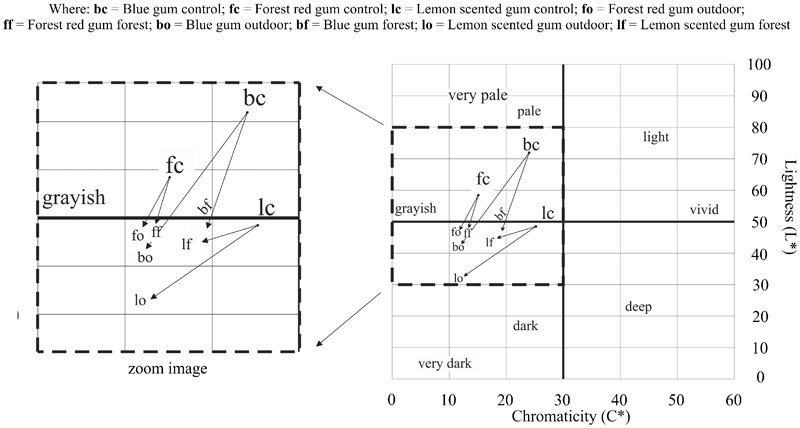
Chromaticity diagram of weathered wood (lightness versus chroma).)
The use of the aforementioned tool (Fig. 4) was valuable for this study and presents a practical way to assess weathered wood. The same grey tone for wood samples of the three species was observed after 360 days. However, the vector size, which indicates displacement of the original colour to the weathered colour, showed high effects from natural weathering in the blue gum wood. Darkening is more evident in wood exposed to the outdoors and more severe in lemon scented gum, probably because of this timber (L* = 45) being darker than the others (L* = 72 for blue gum e L* = 55 for forest red gum).
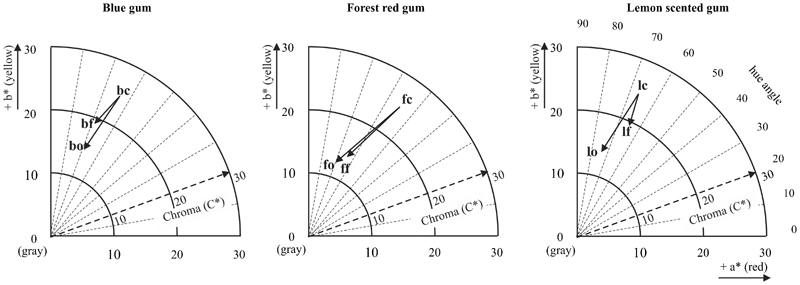
Hue angle displacement diagram of weathered wood
The h* versus C* diagram (Fig. 4) defines both the colour displacement in relation to the chromaticity coordinates (a* and b*) and the greyness levels of weathered wood. The slight increase of h* in the first instance indicates a displacement of wood colour in the direction of the chromaticity coordinate b* (blue-yellow). Nevertheless, a significant decrease of C* modified direction of the colour from an opaque yellow to greyish, i.e. the red tones of weathered wood decreased even more and at the same time as the yellow tones. Thus, similar to the relation of L* versus C*, the hue angle facilitates understanding the greyish level of the weathered wood samples.
The photochemical changes in surface are responsible for the greying of wood, which is widely influenced by relative air humidity and temperature (to a lesser degree) (Fengel and Wegener 1989). The rapid wood discolouration showed in this study is associated to the high levels of relative air humidity of the field site in all the exposure times (above 80%), as well the high levels of rain and sunlight during most of the time.
Thus, products such as organic acids, vanillin, syringyil and high molecular weight compounds are widely leached (Feist and Hon 1984), which causes severe damage to wood appearance and a significant strength reduction. Nevertheless, these modifications depend on where and when natural weathering will be carried out, since the results obtained in a particular location may not be transferred or reproduced in another place (Creemers et al. 2002).
Conclusion
Natural weathering was responsible for a significant discolouration of the three wood species, which showed a greyish colour as a function of exposure, with highest intensity after 135 days. In general, blue gum and lemon scented gum wood presented higher susceptibility to discolouration than forest red gum wood when exposed to the outdoors. Moreover, a high intensity of UV light in the outdoors compared to shaded canopy exposure caused great discolouration of wood of the three species.