







Abstract
The sap and heart wooden stakes of Acacia nilotica var. indica, after seasoning and castor bean (Ricinis communis) oil application for exposure to workers of the termites, Odontotermes obesus (Ramb.), were placed in soil pits in completely randomised design with three replications. In each of seasoning and oil application, per cent weight loss of the wooden stakes were recorded and statistically analysed. Minimum per cent weight loss of sap and heart wooden stakes was observed in maximum period of seasoning (100°C for 15 days in oven drying and 60 days in sun drying method) and highest concentration of castor bean oil (20%) by vacuum pressure application. These results are discussed in relation to seasoning and castor bean oil application for wood protection against subterranean termites.
Keywords
Introduction
Acacia nilotica (L.) Wild var. indica is a popular fire and furniture wood in Pakistan especially in Sindh and Punjab provinces (Nouman et al. 2006). A number of insects are attached with A. nilotica tree (Mohyuddin 1981) and its wood, though heavy (specific gravity 0·67–0·68), is considered susceptible to the termites (Scheffer and Morrell 1998; Pandey and Sharma 2005).
The termites, Odontotermes obesus Ramb. (Termitidae: Isoptera), is one of the most damaging termite species in India and Pakistan and its feeding preference towards living trees and their woods has been extensively reported (Roonwal 1978; Sheikh et al. 2010). The protection of wood from O. obesus and like other related subterranean termites has been practiced through the seasoning and use of the preservatives (Manzoor et al. 2009; Aihetasham and Iqbal, 2012). Seasoning of wood by drying them at different temperatures and various time spans has been reported (Mitchell 2002; Momohara et al. 2003). A little information is available on seasoning by submergence in water and solar drying of wood to prevent termite attack. The seasoning, usually meant to confer strength to the woods, also helps the penetration of the preservatives in the wood (Ssemaganda et al. 2011; Thlama et al. 2012).
In addition to the synthetic chemicals as wood preservatives, plant oils are receiving much attention because of the antimicrobial value and they have been found effective against the termites as well. The list of these oils is quite long; however, the most common, economical and effective plant oils include rape, soya, linseed, castor bean, sunflower and safflower (Oyewole et al. 2010). Regarding the application of oil on wood, vacuum pressure treatment was the most effective as it recorded minimum weight loss due to the termite (Coptotermes formosanus) feeding (Nakayama and Osbrink 2010; Liibert et al. 2011).
Castor bean, Ricinus communis, is a tropical plant distributed widely throughout the world, especially in the semiarid region of North Eastern Brazil, where it is produced as non-edible oil used in the manufacture of biodiesel. However, due to two important alkaloids, ricin and ricinine, it has shown insecticidal value (Kodjo et al. 2011). The insecticidal value of the castor plant oil, in controlling termites from damaging the wood of Mangifera indica and Pinus longifolia, was revealed when treatment with oil significantly reduced weight loss in wood pieces exposed to the termites (Sharma et al. 1990).
The objective of this study was to evaluate the effect of seasoning and application of castor bean oil on Odontotermes obesus feeding on A. nilotica seasoned wood while comparing it with unseasoned wood.
Materials and methods
Experimental material
The blocks of fresh sap and heart wood of Acacia nilotica were purchased from a local Timber Market, Jhang Road, Faisalabad. These blocks were divided into smaller stakes of dimension 13×5×2 cm with the help of an electric saw.
Experimental site
Three concrete soil pits 0·48×0·32 m wide and 0·4 m deep were built inside Entomological Research Laboratories, at Post Graduate Agriculture Research Station, University of Agriculture, Faisalabad. Pit floor was cemented leaving a border enough for the entrance of termites and to prevent rodents. Top of the pit was covered with iron sheet and soil was lined around the corners of iron top to seal it from rain etc. Ant colonies nearby the pits were destroyed by pouring hot water in their nest. The wood specimens were placed horizontally on the cemented floor for experiments.
Termites
Soil pits were constructed in vicinity of Odontotermes obesus nest as evidenced by the presence of nymphs in poly(vinyl chloride) corrugated monitoring pipes having cardboard as a bait. These pits are to date being visited by this termite species regularly.
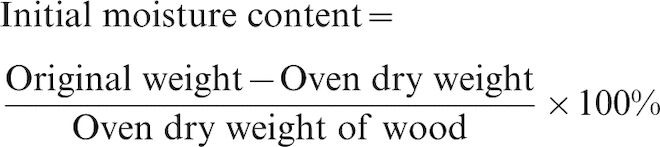
Initial moisture contents of sap and heart wood
Initial moisture contents of sap and heart woods were determined by following formula (Walker 2006)
Weight loss in non-seasoned sap and heart wood of A. nilotica due to termite attack
In order to obtain the temporal relationship of wood loss by O. obesus, stakes of sap and heart woods were placed in soil pits made for this purpose. These stakes were labelled correspondingly to be taken out at intervals of 5, 10, 15, 20 and 25 days. Equilibrium moisture contents (hygroscopicity) were determined by AWPA Method No. E6-05 (AWPA 2008). Stakes were then dried to its original moisture contents and then weight loss was calculated after exposure to termites in the pits. The woods were taken at stipulated regular intervals given above and per cent weight loss was calculated by the following formula

where W1 is the weight of the block before termite exposure and W2 is the weight of the block after termite exposure
Seasoning of wood
Sap and heart woods were seasoned by sun drying and oven drying to reduce moisture contents below 20% from its initial moisture contents. Submergence in water was also used for the seasoning of A. nilotica wood.
Sun drying
The sap and heart woods of A. nilotica were sun dried for 5, 10, 15, 20, 30, 45 and 60 days starting from May onward, 2011. Before putting seasoned woods in the pits, these were weighed, labelled and replicated thrice for each treatment. A control treatment of sap and heart woods without sun drying was also set. The moisture contents of these stakes were calculated at each interval, and these were exposed to termites in soil pits in three replications. After 1 month of the exposure to termites, the wooden stakes were cleaned of any debris and termites. The weight loss of woods was calculated after checking hygroscopicity.
Oven drying
The sap and heart wooden stakes in three replications were oven dried at 60, 80 and 100°C for 10 and 15 days. Stakes were weighed before oven drying. The moisture contents of these stakes were calculated in each treatment. After specified time points, stakes were weighed, labelled and exposed to the termites for 1 month. These stakes were reweighed at the end of experiment and after checking for hygroscopicity, weight loss was calculated.
Submergence in water
Wooden stakes of sap and heart wood were submerged in the floating water in small tanks for 20, 40 and 60 days in three replicates. At each interval, stakes were taken out and dried to less than 20% moisture contents. These stakes were then exposed to the termites in the soil pits for 1 month. Weight loss was calculated at the end of experiment as described in sun drying and oven drying.
Oil application
Castor bean oil was purchased from the local market of Faisalabad. Three concentrations of oil, i.e. 10, 15 and 20% in methanol, were used for application on wood. The surface coatings, dipping and vacuum pressure application of oil solution on best seasoned wood type were tendered.
Surface coating
A new set of best seasoned wood stakes of A. nilotica was used for surface coating. All three concentrations, 10, 15 and 20%, were applied with a paint brush to a runoff point. Three coatings were made and each subsequent coating was carried out after drying of preceding one. The control treatment was coated with respective concentration of methanol in water on the surface.
Dipping
In this method best seasoned woods of A. nilotica wooden stakes (three replicates) were immersed in 10, 15 and 20% of castor bean oil in methanol. The control treatment was immersed with respective concentrations of methanol in water. The duration of immersion was 6 h.
Vacuum pressure application
Wooden stakes of 30×40×4 cm were impregnated with 10, 15 and 20% concentrations of the oil methanol solutions. These stakes were placed in an air tight glass cylinder having a dimension of 45 cm long×25 cm diameter. The cylinder was then filled with solution of oil methanol solution in 10, 15 and 20% concentrations one at a time up to mark to ensure that all stakes were completely immersed. The chamber was evacuated for 10 min and then pressure up to 50 kPa was applied for 25 min. The oil impregnated stakes were removed and placed in an oven run at 80°C for 12 h to remove maximum methanol.
Weight gain of stakes due to oil application in treated and untreated woods was also determined by following formula: (weight after oil application–weight before oil application).
Untreated woods in oil application methods were non-seasoned woods of A. nilotica. All treated and untreated woods were exposed to the termites and weight loss was calculated as described in seasoning experiments.
The exposure of treated and untreated woods of all kinds to the termites was arranged in Completely Randomised Design using three replications. Difference of weight loss in various treatments was analysed by analysis of variance (Kruskal–Wallies test) using p<0·05 level of probability.
Results
The preliminary tests to figure out a linear relationship between weight loss versus number of exposure days of non-seasoned sap and heart woods revealed high correlation values (0·99 and 0·98 for sap and heart wood; p<0·05). The regression equations for sap and heart wood respectively were Y = 2·69x–9·98 and Y = 2·31x–8·56. About 50–60% weight loss was recorded after 25 days of exposure (Fig. 1). These results can be used to predict future limits on new observations.
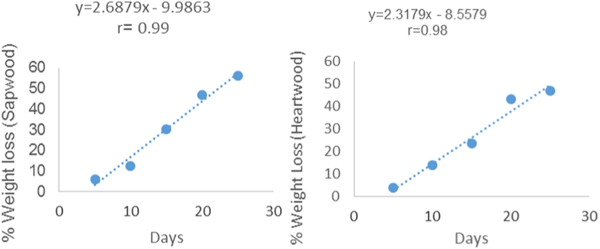
Linerar relationhsip of weight loss with number of days in sap and heart wood of A. nilotica
Effect of seasoning on weight loss
A significant difference among weight losses in sap and heart wood after sun drying at different times was recorded. The woods sundried for 60 days showed minimum weight loss in both types of woods that in turn had non-significant difference with weight loss observed after 45 days of sun drying (Fig. 2). The minimum per cent weight loss in sap wood (14·4) and heart wood (10·4) was found in oven drying treatment at 100°C for 15 days and these losses had significant differences with other treatments where both woods were kept at lower temperatures and lesser number of days (Fig. 3).
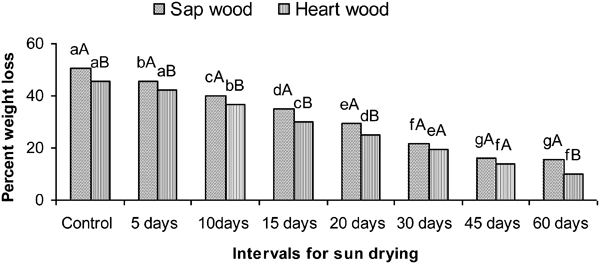
Per cent weight loss in sap and heart woods of A. nilotica exposed to termites after sundrying at various intervals: means with small similar letters in column are not significantly different at p<0·05; capital letters represent difference between sap and heartwood at each time point
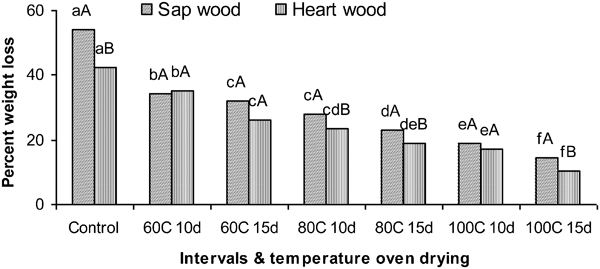
Per cent weight loss in sap and heart woods of A. nilotica exposed to termites after oven drying at various intervals: means with small similar letters in column are not significantly different at p<0.05; capital letters represent difference between sap and heartwood at each time point
Submerged sap and heartwood at different intervals showed significant difference among these points; however, 20 and 40 days submergence of heart wood had non-significant difference between each other. The minimum per cent weight loss of 29·4 and 27·1 in sap and heart wood respectively was found at 60 days submergence (Fig. 4).
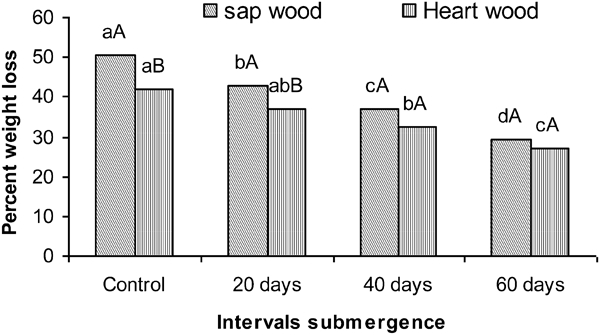
Per cent weight loss of sap and heart woods of A. nilotica exposed to termites after submergence in water at various intervals: means with small similar letters in column are not significantly different at p<0·05; capital letters represent difference between sap and heartwood at each time point
Effect of oil treatment on weight loss
Brushing different concentrations of oil on the surface of sap and heart wood showed significant difference of weight loss at different concentrations (Fig. 5). The minimum per cent weight loss in sap and heart wood was 14·03 and 10·23 respectively. In the dipping method, all the treatments were significantly different from one another. The minimum per cent weight loss in sap (8·91) and heart wood (7·62) occurred in treatment of 20% oil concentration (Fig. 6). Different concentrations of oil used to impregnate wood had significant difference for weight loss among themselves. The higher the concentration, the less the weight loss, in both types of woods. Similar trend of weight loss in relation to concentration of oil was observed in vacuum pressure impregnation as in the case of brushing and dipping (Fig. 7); however, pressure application brought weight loss to 3·35 and 2·55 in sap and heart wood in 20% oil concentration as compared to 50·31 and 42·76% respectively.
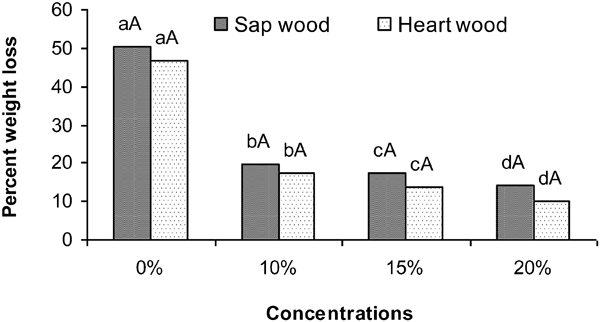
Comparison of means for weight loss in sap and heart woods of A. nilotica exposed to termites after surface application of oil at different concentrations: means with small similar letters in column are not significantly different at p<0·05; capital letters represent difference between sap and heartwood at each time point
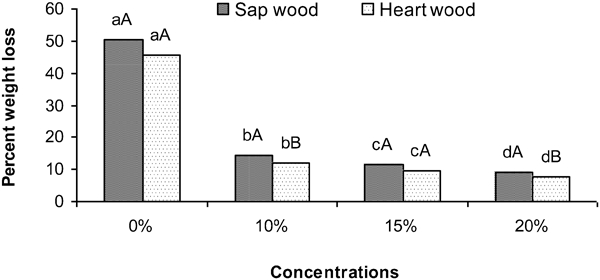
Per cent weight loss in sap and heart woods of A. nilotica exposed to termites after dipping of wood in oil at different concentrations: means with small similar letters in column are not significantly different at p<0·05; capital letters represent difference between sap and heartwood at each time point
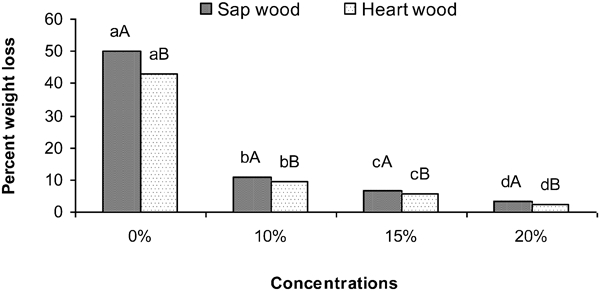
Per cent weight loss in sap and heart woods of A. nilotica exposed to termites after pressure application of oil at different concentrations: means with small similar letters in column are not significantly different at p<0·05; capital letters represent difference between sap and heartwood at each time point
It is interesting to note that weight loss in heart wood was less than sap wood consistently in all experiments, and difference of weight loss in heart and sap wood in each experiment is represented by capital letters in the Figs. 2–7.
Discussion
Unseasoned sap and heart wood of A. nilotica showed high correlation between exposure time and weight loss. It has been generally observed that unseasoned wood was more vulnerable to termite attack. A significant and very low count of O. obesus in seasoned wood stakes in comparison to unseasoned or control was observed (Upadhyay et al. 2010).
Contrarily, Termitidae such as genera Odontotermes and Macrotermes have been reported to cause severe damage in seasoned and dry timber both within buildings and extramurally (Mitchell 2002). It is possible that characteristics of wood such as age, diameter, height, felling season, seasoning method, etc. may also have an effect on termite attack (Mishra and Thakur 1998). Though little information on infestation of the Odontotermes spp. on seasoned woods is available, it is a common observation that dry wood is likely to be infested in rainy season as compared to the rest of the months of year, when these fire woods are not infested with termites.
Subterranean termites prefer to feed on high moisture content food resources, while moulds, fungi and other biological degradation agents are active when wood moisture content is above 20% (Nakayama et al. 2005).
The seasoning of wood at 100°C in oven and 60 days under the sun resulted in minimum weight loss by termite exposure in the present studies. These results are in contrast to a situation where woods treated at high temperature (135 or 150°C) or even at 100°C showed large weight loss percentages than those treated at lower temperatures (Momohara et al. 2003, Manzoor et al. 2009; Aihetasham and Iqbal 2012). In these experiments, moisture contents were not taken into account and further termites, Coptotermes formosanus and Microcerototermes championi (Snyder) exposed had preference for dry woods. However, our results are supported by Sheikh et al. (2010) who reported that termites (O. obesus) preferred wood containing less moisture and the wood treated at specific temperature for a specific period became less palatable to the termites. Delaplane and La Fage (1989) reported that in higher moisture wood blocks, damage by C. formosanus was associated with loss of block moisture, but in lower-moisture blocks, damage was associated with gain of moisture, indicating importance of moisture contents of wood, which has to be controlled.
Drying under sun for 60 days had non-significant difference with that at 45 days, indicating an exposure limit of wood to bring down moisture to less than 20%; however, weathering effects (colour, cracks, etc.) on woods were not observed. Drying reduces the likelihood of insect infestations, mould, stain and decay during storage and use. Fungi and termites cannot grow in wood with a moisture content of less than 20% (lbach 2013). Water seasoning reduces the oxygen content and temperatures necessary for the growth of fungi (Fengel 1991). This method has not been reported for wood seasoning against termites especially and in the present case, water weight loss was not prevented by this method of seasoning as compared with sun and oven drying. This needs further evaluation of use of water seasoning for termite prevention, though moisture contents at the time of exposure to termites was less than 20% in all methods of seasoning.
Among the three application methods, pressure application in the vacuum was the best method for castor bean oil application as it showed minimum weight loss after the treated stakes were exposed to termites. The obvious advantage of wood pressure treatment is to force preservative chemicals deep into the cellular structure of the wood, which is not obtained with other methods of application like brushing or dipping. Vacuum pressure impregnation method has also been found the best method for preservation of dry (12% moisture content) rubber wood, but it is less effective in green condition (Abeysinghe and Amarasekera 2011). The combinations of copper and cashew nut shell liquid and copper and Neem in a pressure treatment have resulted in discernibly high protection against termites on rubber woods (Venmalar and Nagaveni 2005). Similarly, Nakayama and Osbrink (2010) have also reported the effectiveness of pressure to prevent Formosan termite (Coptotermes formosanus) on Kukuli oil-treated wood at >27 wt-% kukui oil. These examples support our results of superiority of pressurised oil treatment over other methods of oil application.
The timber has to be seasoned in order to achieve adequate penetration of the preservative and its uniform distribution. Maximum weight loss in unseasoned wood in the present studies envisages seasoning of wood before treatment with preservatives. This is verified by studies where seasoning preceded oil/preservative application (Ssemaganda et al. 2011; Thlama et al. 2012). Furthermore, additional studies are required to exploit effect of castor bean oil on physical and chemical properties of A. nilotica.