







Abstract
The resistance of thermally modified Canadian Pinus banksiana against four wood decaying fungi was evaluated. Wood samples were treated at different temperatures (190, 200 and 210°C) and exposed to three brown rot fungi as well as to a white rot fungus. Results showed that the untreated wood samples lost more weight when exposed to P. placenta, T. versicolor and G. trabeum compared to the weight loss observed in case of C. puteana. Thermal modification at 210°C improved the resistance of Pinus banksiana against G. trabeum and T. versicolor fungi as evident from the fact that reduction in weight loss of wood was found to be 98·3 and 96·3% respectively.
Introduction
Biological degradation including attack by fungi, termites and marine borers is the main cause of deterioration of lignocellulosic materials such as Pinus banksiana lamb. Among these biodeteriorations, fungi cause the greatest financial losses of wood materials (Bowyer et al. 2003; Goodell 2003). The wood decay fungi can be classified as decay fungi brown rot, white rot and soft rot fungi. Wood decay fungi secrete various enzymes including cellulase, hemecellulase, lignin peroxidases, manganese dependent peroxidises and laccase, to depolymerise cellulose, hemicelluloses and lignin (Suziki et al., 2006; Yelle et al. 2008).
The environmental awareness in some European and American countries resulted in elimination of some preservatives containing inorganic metals in several areas (Preston 2000). The US Environmental Protection Agency (EPA) banned the use of wood treated with copper-chrome-arsenic (CCA) for residential purposes in 2003. Alternative products such as wood-plastic composites (WPC), chemically modified wood, and thermally modified wood grew rapidly (Baysal and Yalinkilic 2005; Kartal et al. 2006, Chang and Chang 2006; Clausen and Yang 2007; Boonstra et al. 2007; Lekounougou et al. 2008). Thermal modification is an eco-friendly technology which can improve the wood durability. This technology is non-toxic and does not require the use of chemicals. The utilization of thermal modification and the production of thermally modified wood have increased considerably during the last decade (Hill 2006; Bächle et al. 2010, Khalid et al. 2010). Thermal modification of wood at temperature from 160°C to 230°C leads to the degradation of hemicelluloses and lignin (Kocaefe et al. 2008a). This process modifies the chemical composition of the wood and reduces its hygroscopicity. Thus, the thermally modified wood tends to be dimensionally more stable than the untreated wood of the same species (Hill 2006; Shi et al. 2007; Korkut 2012). The thermal modification brings new business opportunities for many species of hardwoods and softwood such as P. banksiana. The market value of a species can be increased by treatment with improved dimensional stability, appearance and durability (value added product).
The decrease in hygroscopicity, improvement of dimensional stability and loss of mechanical properties of wood treated at high temperature have been studied by several authors (Militz 2002; Weiland and Guyonnet 2003; Kocaefe et al. 2008b; Gunduz and Aydemir 2009; Calenego et al. 2010; Tumen et al. 2010; Xianjun et al. 2011; Lekounougou et al. 2011). Numerous investigations have been conducted on the resistance against fungal decay using laboratory tests (Hakkou et al. 2006; Boonstra et al. 2007; Lekounougou et al. 2008). However, the fungal resistance of thermally modified P. banksiana has not been studied in detail.
In this study, P. banksiana was thermally modified at different temperature using the Perdure technology in the prototype furnace of University of Quebec at Chicoutimi (UQAC). The aim of this study was to assess the efficacy of thermal modification temperature on the biological resistance of this species against the brown and white rot basidiomycete fungi. The molecular reasons behind the improvement of the resistance of thermally modified wood against fungal attack were studied.
Materials and methods
Experimental design and statistical analysis
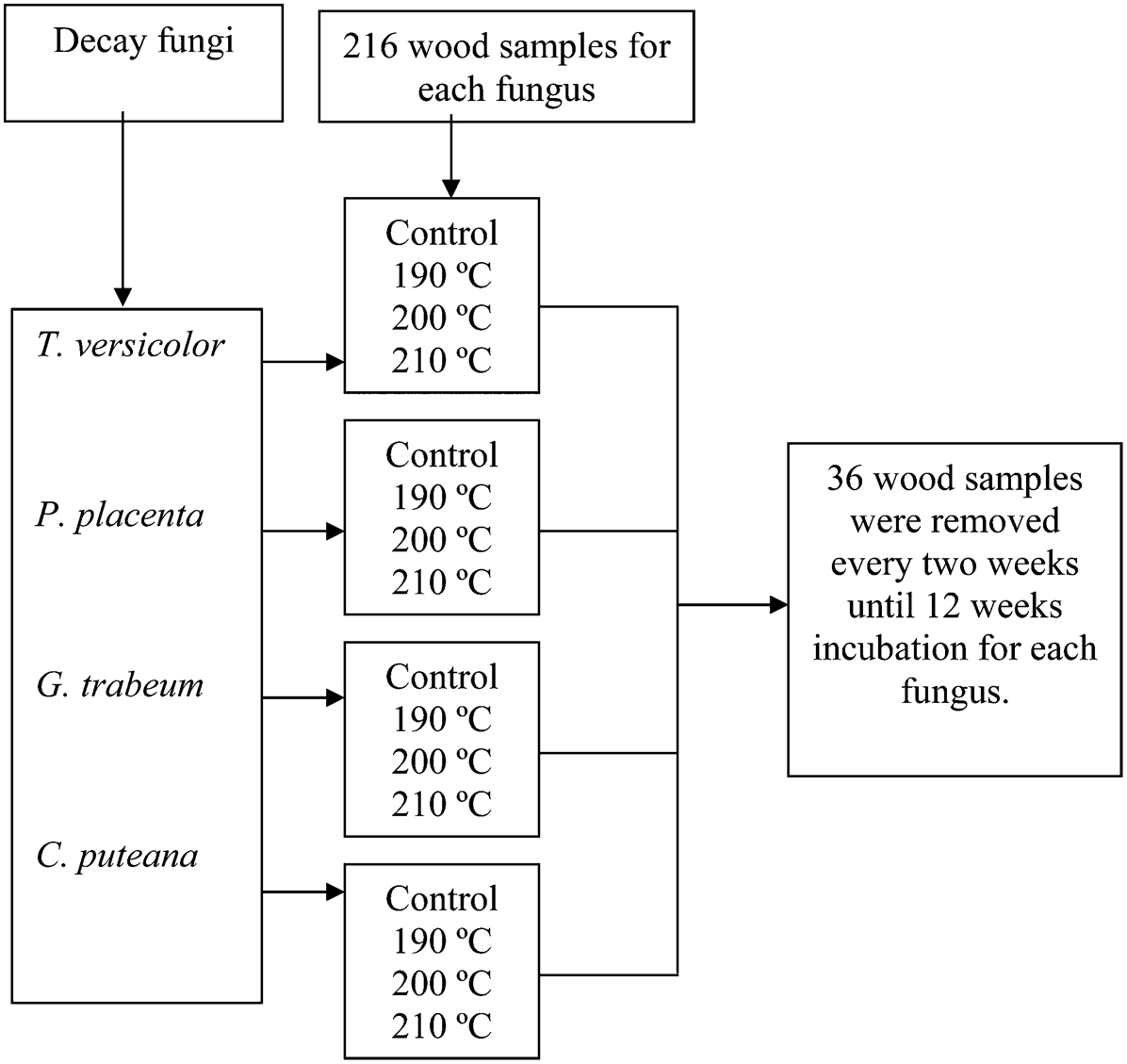
Figure 1 shows durability tests performed on P. banksiana samples exposed to four decay fungi during 12 weeks incubation.
Tests diagram performed in this study
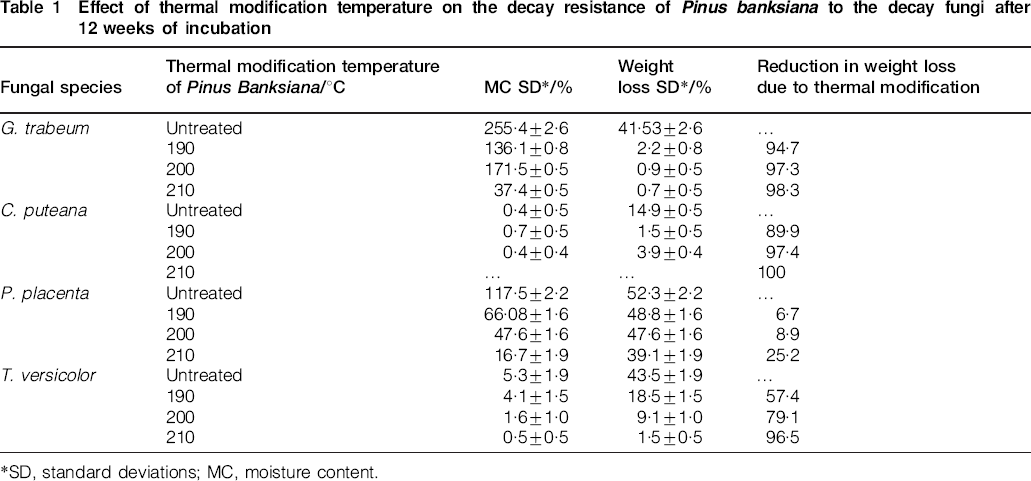
Diagram was shown the thermally modified and unmodified wood degradation at different temperatures (190, 200 and 210°C) by decay fungi T. versicolor respectively, P. placenta, G. trabeum and C. puteana. The prototype furnace of University of Quebec at Chicoutimi (UQAC) method had been used for conducted the all wood thermal modifications of wood. About 36 wood samples were removed every two weeks for each fungus and at each treatment condition. Also 216 wood samples were taken in count including thus involved in the statistical results for each fungus used in the study. The standard deviations data were shown in Table 1.
Effect of thermal modification temperature on the decay resistance of Pinus banksiana to the decay fungi after 12 weeks of incubation
*SD, standard deviations; MC, moisture content.
Thermal modification of P. banksiana
Wood samples
P. banksiana boards were sawed in a local sawmill at Saguenay-Lac-St-Jean (Quebec, Canada). 35 boards were dried in the air. The final moisture boards were about 15–17% after drying. Then, they were thermally modified. Wood samples required for fungal tests were prepared as described in the diagram (Fig. 1). Sapwood boards were used for this test.
Thermal modification process
The prototype furnace of University of Quebec at Chicoutimi (UQAC) was used for testing thermal modification of P. banksiana. Dimensions of boards were 0·015×0·045×2·44 m in the radial, tangential and longitudinal directions respectively. In this furnace, propane was used as fuel gas and wood was thermally modified in a non-oxidising environment composed of hot combustion gas (CO2 and H2O). The wood samples were treated at different temperatures (190, 200 and 210°C) at a heating rate of 15°C h−1 and humidity of the gas was 100 g of water m−3 of dry gas. Samples were treated according to the method proposed by Poncsák et al. (2006).
Durability tests
Wood samples preparation
Pinus banksiana specie was subjected to four decay fungi during this study. 216 thermally modified and untreated wood samples with dimensions of 0·015×0·005×0·035 m in the radial, tangential and longitudinal respectively, were cut per fungus. Wood samples were conditioned in a furnace at 103°C for 48 h (Mburu et al. 2007; Lekounougou et al. 2009) until they reach a constant weight and this weight was recorded as initial weight (WI) of the wood samples. A modified version of ASTM D-2017 standard was followed during the experiment. This standard is similar to the EN-113 (1986) standard, except the size of the wood samples that has been reduced as described by Lekounougou et al. (2009) and Bami and Mohebby (2011), to accelerate fungal decay and reduce testing time from 16 to 12 weeks.
Preparation of biological decay tests, fungi inoculation and incubation
Three species of brown rot fungi, Poria placenta (Frees) Cooke (FTK120E), Gloeophyllum trabeum (Pers: Fr) Murrill (FTK45D) and Coniophora puteana (Frees) Karten (FTK9B) and a white-rot fungus Trametes versicolor (FTK105D) were used in this study. These fungi were obtained from stock culture provided by FPInnovation Forintek, Quebec, Canada. The re-isolation was performed on Petri dishes and they were incubated for two weeks before inoculation.
Malt agar substrate was used as a nutrient medium for the cultivation of fungi in Petri dishes. It was prepared by mixing 30 g agar and 40 g of malt extract dissolved in 1 L of distilled water. The medium was sterilised for 35 min at 121°C (105 KPa). 30 mL of medium was poured into sterile Petri dishes for inoculation.
A disc of 5 mm of fungus was cut from the mother culture with the scalpel and placed in Petri dish for inoculation. It was then incubated at a temperature of 22±1°C and relative humidity (RH) of 70±4% for two weeks or until the samples were completely covered by the mycelium. Every 2 weeks (this time interval was chosen to follow the progressive degradation of wood samples over time), 36 thermally modified and untreated wood samples were taken out and the mycelium was scraped carefully with the help of scalpel. Finally, the wood samples were conditioned in a furnace at 103°C until their weight remained constant. This weight was recorded as the final weight (WF). Three sets of both thermally modified and untreated wood samples were placed in different Petri dishes and exposed to fungi as explained above. Each experiment was performed three times to ensure that the reproducibility of results. The percentage of weight loss was calculated as follows

The percentage of weight loss of wood sample was used to measure the relative susceptibility to decay, or to contrast, resistance to decay of thermally modified wood.
The moisture content (MC, %) wood samples was determined after fungal decay using the following formula

Results
The weight loss due to fungal degradation at different times of incubation is shown in Fig. 2. This figure shows that the weight loss caused by G. trabeum, T. versicolor and P. placenta fungi increased gradually every two weeks up to 12 weeks of incubation. At the beginning of the colonisation process, the weight loss was relatively low (2, 4 and 6 weeks), however, it increased noticeably starting from 8 weeks of colonisation. In the case of C. puteana fungus, the evolution of degradation was different at the beginning of the colonisation (Fig. 2). The weight loss trend was the same as that observed with other fungi used in this test between 2 and 4 weeks. Thereafter, the weight loss remained constant (4 and 8 weeks), followed by a slight increase towards the end of the colonisation process (weeks 10 and 12). P. placenta, T. versicolor and G. trabeum fungi were the most virulent with weight losses of 52·3, 43·5 and 41·5% respectively, after 12 weeks of incubation (Table 1). C. puteana fungus was less effective resulting in lower weight loss of 14·9% compared to other fungi. By contrast, tests conducted by Rowell et al. (2009) showed the virulence of C. puteana against the attack of P. sylvestris with a weight loss of 47·5% and Douglas fir with a weight loss of 27·4%.

: P. placenta; : G. trabeum; : T. versicolor; : C. puteana
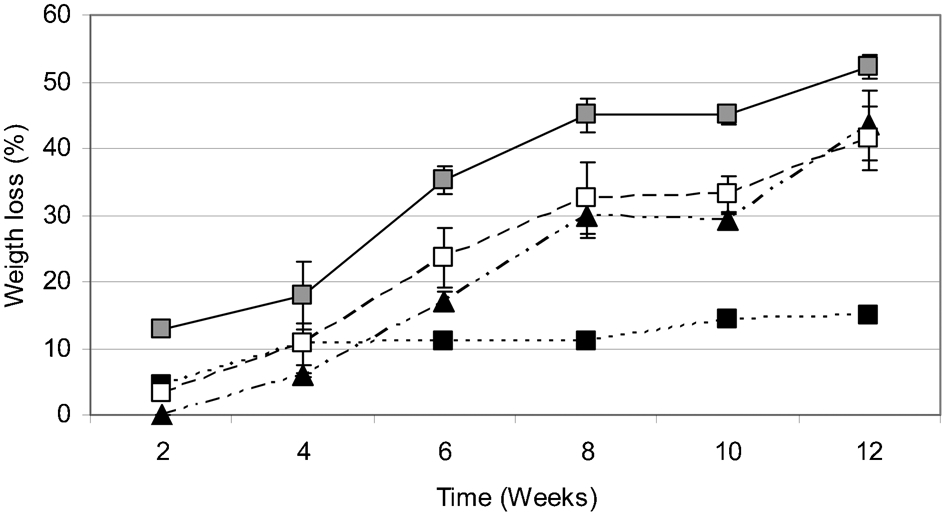


According to durability criteria proposed by Van Acker et al. (2003), if the weight loss is between 15 and 30%, the species are defined as slightly durable (class 4), and if the weight loss is more than 30%, the species are defined as non durable (class 5). Therefore, weight loss data in Table 1 and Fig. 2 showed that the Canadian wood P. banksiana can be considered as non-durable against P. placenta, T. versicolor and G. trabeum fungi, but durable against the attack of C. putaeana for the same period of incubation (12 weeks).
Figure 3 shows the effect of the maximum thermal modification temperature on the resistance of P. banksiana against fungal decay attack after 12 weeks of incubation. The results indicated an improvement in the resistance of thermally modified P. banksiana wood against fungal attack. In the case of T. versicolor and G. trabeum fungi, the results showed that the weight loss decreases with increasing thermal modification temperature (Fig. 3 and Table 1), consequently, the resistance against these two decay fungi improves. Weight losses of thermally modified wood obtained at 210°C were 1·5 and 0·7% for T. versiolor and G. trabeum fungi respectively (Table 1), which were lower than that of untreated wood. Weight losses of control (untreated wood) were 43·5 and 41·53% for the above fungi indicating a percentage reduction of 96·5 and 98·3% respectively, in the weight loss due to thermal modification (Table 1). With this weight loss percentage, thermally modified P. banksiana becomes resistant to T. versicolor and G. trabeum according to the classification of Van Acker (2003). Untreated P. banksiana was already resistant to C. puteana fungus. As seen with a slight weight loss (14·9%) observed when it was exposed to the fungus before thermal modification. However, with the thermal modification, the weight loss was completely eliminated.

: Untreated wood; : 190°C; : 200°C; : 210°C
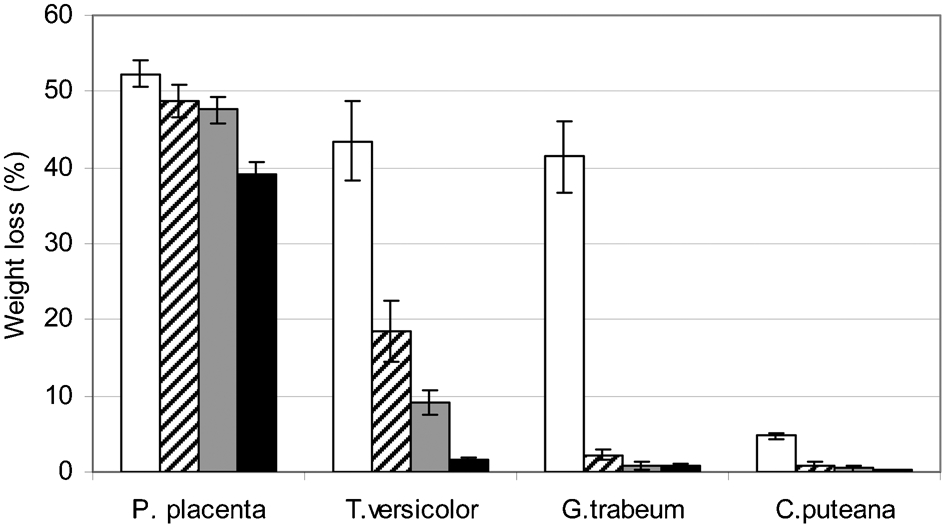


In the case of P. placenta fungus, the thermal modification temperature had a limited effect. Indeed, there was a slight decrease in the weight loss of wood treated at different temperatures compared to control (52·3%), however, this decrease was not sufficient. Because the weight loss obtained at the highest temperature (210°C) was 39·1%, with a smaller percentage reduction of 25·2% (Table 1) compared to the other fungi studied.
Discussion
The data of this study indicated that thermal modification improved resistance of wood against decay fungi (Fig. 3 and Table 1). These results are in agreement with previous studies on a number of other decay fungi and wood systems (Boonstra et al. 2006; Calenego et al. 2010; Juanito et al. 2011; Lekounougou and Kocaefe 2012). The reduction of weight loss observed during the thermal modification can be attributed to the degradation of amorphous carbohydrates, mainly hemicelluloses, which are thermally sensitive polymers which are major components of wood (Bourgois and Guyonnet 1988; De Groot et al. 1988; Zaman et al. 2000; Juanito et al. 2011). Brown rot fungi preferentially degrade polysaccharides and partially lignin oxide, whereas, white rot fungi degrade lignin and polysaccharides simultaneously or successively (Zabel and Morrell 1992; Jensen et al. 2001; Koyani et al. 2011; Monrroy et al. 2011). Among the carbohydrates, it is assumed that the hemicelluloses are degraded easier than cellulose, with the increasing temperature, probably due to the shorter chain length and an exhibition of cellulose microfibrils in the wood cell walls (Zabel and Morrell 1992). Hemicelluloses degradation during thermal modification may reduce the availability of substrate for fungi. In addition, the degradation of hemicelluloses, which is the most hydrophilic compounds in the cell wall, could reduce the hygroscopicity of wood (Kamdem et al. 2002). The presence of moisture is essential for the development of fungal growth. Therefore, decreasing hygroscopicity and the lack of nutrient availability improve the decay resistance of thermally modified P. banksiana as evidenced by the results shown in Table 1. Furthermore, chemical changes of wood cell walls take place during the thermal modification (Tjeerdsma et al. 1998; Tumen et al. 2010). Changes in the structure of the wood cell wall make the degradation difficult and eliminate substrate recognition by the oxidative enzymes of fungus (Perez et al. 2002; Hakkou et al. 2006). This could be the reason for the observed increase in durability of thermally modified P. banksiana compared to that untreated wood.
This study showed that the beginning of the colonization process was characterised by a slow degradation of untreated P. banksiana samples by four decay fungi, P. placenta, T. versicolor, G. trabeum and C. puteana (Fig. 2). This could be explained by the fact that during the initial stage of the colonisation, the fungi use a readily available carbon source present in the malt-agar medium for growth (Aro et al. 2005; Lekounougou et al. 2009). After 6–8 weeks of inoculation, nutrients become scarce in the culture medium and, fungi begin to degrade the compounds present in the wood, which causes an increase in the weight loss, as observed for T. versicolor, G. trabeum and P. placenta. In addition, during the initial stage of wood degradation, enzymes are known not to be involved because of their larger size than the pores of the cell wall (Garote et al. 2001; Bami and Mohebby 2011). Cullen and Kersten (2004) as well as Machuca and Ferraz (2001) were both hypothesised that brown and white rot fungi used low molecular weight mediators such as Fe2+ ions and hydrogen peroxide that were responsible to generate highly reactive free radicals which undergo a complex of spontaneous cleavage. The depolymerisation of cellulose takes place which makes it accessible to further degradation (Wang and Gao 2003; Bami and Mohebby 20011). However, the degradation of P. banksiana by C. puteana is different compared to its decay by other decay fungi. The works carried out by Tremblay and Lihra (2005) showed the use of perdure process on the thermal modification of Pinus banksiana (Jack pine) treated at 210°C. In that study, the data showed an improvement in the thermally modified Pinus banksiana (Jack pine) against G. trabeum and P. placenta fungi. While unmodified jack pine was resistant to the T. versicolor fungus. In the case of G. trabeum fungus, the thermally modified wood data confirmed the results obtained in this study. However, P. placenta and T. versicolor fungi results were not the same. That can be explain by the type of furnace used in the perdure technology. The tests performed in the present study used a prototype furnace inspired from perdure technology. At this point, a patent has been filed and in process. While the study carried out by Tremblay and Lihra (2005) used the perdure technology at great scale in an industrial furnace. On the other hand, the origin and the size of the wood samples can explain the differences obtained. Changes in biological resistance of P. banksiana against the four basidiomycete decay fungi observed in the present study were also observed by Jesus et al. (1998), Paes et al. (2004) and Calenego et al. (2010). They had all shown that different wood species frequently exhibited differences in their own resistance to various decay fungi, and ASTM D-2017 (1994) had cited that in the same kind of wood had not have necessarily the same class of resistance against all types of decay fungi.
This investigation provides some information for a better understanding of the degradation of thermally modified Canadian wood by brown and white rot fungi. The other complementary tests are planned to study the different enzymes involved in degradation of the compounds of the wood cell wall and the mechanism of degradation of thermally modified P. banksiana by decay fungi.
Conclusion
This study showed that the increasing thermal modification temperature between 190 and 210°C improves the biological resistance of P. banksiana against decay fungi, T. versicolor, G. trabeum and C. puteana. The reduction in the weight losses of 96·5, 98·3 and 100% respectively were obtained compared to that of the untreated wood. However, the thermal modification was not found to prevent effectively the degradation of wood when exposed to P. placenta fungus shown by 25·2% reduction in weight loss of wood thermally modified at 210°C.
Footnotes
Acknowledgements
The authors thank Dr Yasar Kocaefe, Dr Noura Oumarou, Dr Dipankar Bhattacharyay and Claire Fournier for their collaboration during the thermal modification trials and fungal tests. The financial support of NSERC, UQAC (University of Quebec at Chicoutimi) and FUQAC (Foundation of University of Quebec at Chicoutimi) is greatly appreciated.