







Abstract
The ISO 9001 quality system is being advocated as a management tool to boost the performance of wooden furniture manufacturers in the South East Asian region. A study was therefore conducted to evaluate the status and challenges of the ISO 9001 quality system adoption among wooden furniture manufacturers in Malaysia and Vietnam. The data were compiled through direct-interviews of 100 wooden furniture manufacturers (of which 25 were ISO 9001 certified companies) using a structured questionnaire, which had four parts. The results found that ISO 9001 adoption was relatively low among furniture manufacturers due to its high implementation cost and lack of market demand, although the ISO 9001 certified companies were much more productive than their non-certified counterparts. It was also apparent that the certified furniture manufacturers were focused on producing quality furniture cost effectively, derived primarily from their lower degree of operational inefficiencies. Nevertheless, the demand for ISO certification is market-specific, as Japanese, Korean, European and Middle Eastern furniture buyers show preferences for dealing with certified companies. Therefore, the benefits of ISO 9001 quality system through greater market access and increased productivity in the mills must become more apparent, before significant adoption among wooden furniture manufacturers can be realised.
Introduction
With increasing global competition, the wooden furniture manufacturing industry in the South East Asian region is forced to improve manufacturing productivity, which is fast becoming the source of competitive advantage in the industry (Ratnasingam and Ioras 2003). Generally, the furniture manufacturing industry has been receptive to management tools that could increase productivity, such as statistical process control, total quality management and lean manufacturing. Increasing productivity has been the main driver of competitiveness in the price-sensitive furniture market in many parts of the world (Ratnasingam and Ioras 2003).
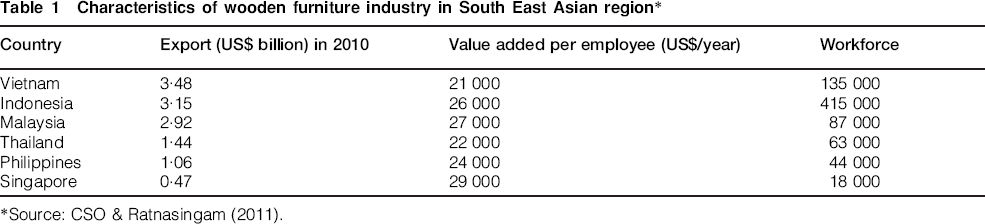
The wooden furniture industry, despite being tagged as a cottage-based industry, has been transformed into a high volume, production-oriented industry in the South East Asian region over the last two decades. Nevertheless, the furniture industry is one of the most competitive manufacturing industries in the region, with fierce competition in terms of market, product development and cost-cutting measures (Ratnasingam 2011). In this context, the wooden furniture manufacturing capacity among the nations in the region can be ranked in terms of volume export in the following order: Vietnam>Indonesia>Malaysia>Thailand>Philippines>Singapore. With the rapid pace of development in the global supply chain, the wooden furniture industry which used to be highly dependent on the availability of factor inputs, such as raw materials and labour, is increasingly reliant on timely delivery and good logistic support. It has been estimated that almost 60% of the total wooden furniture production in the region capitalises on the good logistics support for the intra-region trade of furniture parts and components (Ratnasingam and McNulty 2010). Such supply chain models which are increasingly apparent among furniture multinationals operating in the wooden furniture industry in the region, has further boosted the socioeconomic importance of the sector, especially in the role it plays in employment creation as well as entrepreneurship development.
Table 1 provides the status of the wooden furniture industry in selected countries in the South East Asian region. It must however be noted that export figures do not necessarily reflect the inherent production capability of the industry, as value-addition per employee is a better indicator of the innovative and creative capacity (Ratnasingam and Ioras 2003). Research on value chain and innovative capacity within the wooden furniture industry in the South East Asian region is grossly lacking, but studies conducted elsewhere, suggest that value chain and innovation within the industry is a function of the competitive workforce and the quality system in place (Ratnasingam and McNulty 2010). In this context, it must be emphasised that the workforce within the wooden furniture industry is highly mobile, and the extensive use of foreign contract workers in the industry is prevalent throughout the region. Unfortunately, the mobile workforce affects the long-term skills retention within the industry that affects the capacity to innovate and value-add (Ratnasingam and McNulty 2010). From a regional perspective, it is only in Vietnam, Thailand, Indonesia and the Philippines, where the proportion of foreign workers in the wooden furniture industry is marginal (i.e. less than 20%) when compared to the other furniture producing nations in the region. In order to curb the free-flow of the unskilled workers within the region, skills and knowledge assessments have been introduced, but its implementation is strongly resisted by wooden furniture manufacturers who are hard-pressed for labour (Ratnasingam 2003, 2011).
Characteristics of wooden furniture industry in South East Asian region*
*Source: CSO & Ratnasingam (2011).
The other option to propagate innovation and value addition in the wooden furniture industry is through the implementation of a quality management system. However, the benefits of quality systems are often misconstrued as being related to increasing customer satisfaction, with little reference made to its influence on product development and innovation capacity within the organisation (Lamprect 1999). Hence, there is a need to examine the influence of quality management systems on the innovative and value adding capacity of wooden furniture manufacturing enterprises, in order to provide insights into the benefits of the adoption of such systems.
Quality management systems in the furniture industry
Every organisation strives to improve the way it operates, whether that means increasing market share, driving down costs, managing risk more effectively or improving customer satisfaction. A quality management system provides the framework that is required to monitor and improve performance in any area within the organisation. The ISO 9001 is by far the widely recognised quality framework, currently being used by 1 109 905 organisations in 178 countries worldwide, and sets the standard not only for quality management systems, but management systems in general. It helps all types of organisations to succeed through improved customer satisfaction, staff motivation and continual improvement (APC 2011).
Two of the most relevant quality management systems for the furniture industry are the ISO 9001 Quality Management System and the Environmental Management System, ISO 14001. The ISO 9001 standard is based on a number of quality management principles including a strong customer focus, the motivation and implication of top management, the process approach and continual improvement. The standard helps ensure that customers get consistent, good quality products and services, which in turn brings many business benefits (Ratnasingam et al. 2010). Although the adoption and implementation of the quality management systems are gaining momentum in East Asia, particularly in South Korea and Japan, the same cannot be said of the furniture manufacturing industry in the South East Asian region. Of the total 17 890 registered furniture manufacturing enterprises in the region, only 7% have implemented one or both of these systems (APC 2011). One of the most common reasons cited for the low adoption of the quality management system is that fact that quality management is inherent and is built into the manufacturing organisation, which does not necessarily require a formal system (APC 2011).
In a study by Ratnasingam and McNulty (2010), 76% of the respondents to a mail-survey of the Malaysian wooden furniture industry suggested that furniture manufacturing is a fashion trade and therefore, it defies formal standardisation required by the quality management system. Although this argument has its proponents, in the fashion driven garment and shoe manufacturing industries it has been reported that the quality management system plays an important role in ensuring that the manufacturing processes are both efficient and effective, so as to consistently meet customer expectations (Curkovic 1999; Ratnasingam et al. 2008). It was reported that quality management systems can influence the product development, management, marketing, pricing and manufacturing activities within the organisation, although its impact is closely related to the scope of system adopted. Therefore, the merits in adopting the quality management system are proven, and have to be revisited by wooden furniture manufacturers who are increasingly under pressure to compete in the globalised furniture sector.
Against this background, there is a need to examine the current state of adoption of quality management systems, particularly the ISO 9001 system, within the wooden furniture manufacturing industry in the South East Asian region. The factors that influence the adoption and implementation of the system among wooden furniture manufacturers will also have to be established, in order to formulate the necessary policy tools that could pave the way for a wider adoption of the system. Therefore, a study was conducted to evaluate the adoption of the ISO 9001 quality management system among wooden furniture manufacturers in Malaysia and Vietnam, and subsequently to identify the factors that influenced manufacturers to adopt the system.
Materials and methods
Direct interviews of 100 medium-sized (i.e. with an average workforce of 100) wooden furniture manufacturers in Malaysia and Vietnam were carried out between May and October in 2011. These countries were selected because of their large wooden furniture exports among the regional countries. The samples (which included 25 ISO 9001 certified-companies in each country) were selected based on the listing of the respective national furniture trade associations and their agreement to participate in the study was obtained, prior to the interview. The interview was conducted using a structured questionnaire, which was trialled on 15 companies in both Malaysia and Vietnam, in order to identify and remove ambiguities surrounding the questions and to address structure and wording.
The questionnaire used had four parts. Part I of the questionnaire was applicable to non-certified companies only, while Part II and III were targeted at certified companies. Part IV was applicable to both certified and non-certified companies.
Part I required the respondents to select from eight assertions, each referring to a deterrent to adopting the ISO 9001, quality management system. A six-point Likert scale from one (strong disagreement) to six (strong agreement) was used to ascertain the level of agreement by each respondent. The scale used was selected to avoid neutral responses. This compels the respondents to position their companies. The responses were analysed and the factors that deterred the adoption of the ISO 9001 among wooden furniture manufacturers, were ranked in the order of importance.
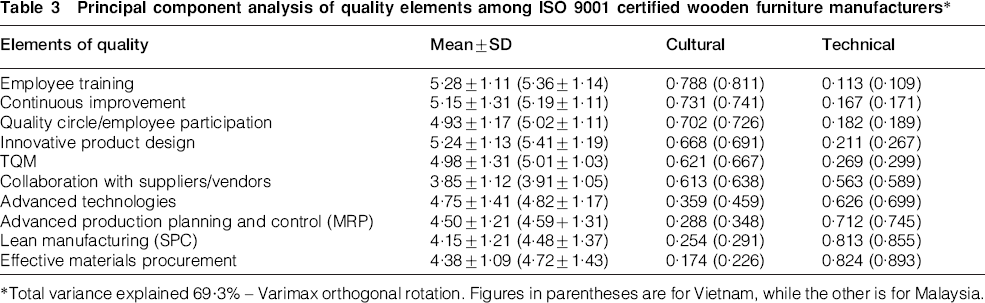
Part II of the questionnaire required the respondent to choose the degree of agreement with 10 assertions referring to the implementation of 10 quality elements that was related to the ISO 9001, which include elements, such as training, quality circle, innovative product design, total quality management, collaboration with suppliers, advanced technologies, advanced production planning, lean manufacturing, materials procurement and continuous improvement. A six-point Likert scale from 1 (strong disagreement) to 6 (strong agreement) was used for each. Principal components analysis of the 10 quality elements was performed in order to identify the underlying importance for the implementation of these elements and two factors with eigen-values higher than 1·0 which explained 69·3% of the variance resulted from this analysis, were identified. One of the factors with a high score was the one, which suggested that the company thinks of employees as resources, instead as costs, considers their suppliers as collaborators and promotes dynamism and continuous improvement. This factor seems, therefore, to capture the more cultural side of manufacturing and was labelled as cultural manufacturing factor. The second factor mainly took in account the tools and techniques used in furniture manufacturing, such as quality control, quality circle, etc. and were consequently labelled as technical manufacturing factor. Nonetheless, it must be taken into account that some elements cannot be strongly allocated to the factor in which they show the higher loading, because their loading on the other factor is not much lower. Thus, the labels given to the factors represent main trends and should not be interpreted in a strict manner.
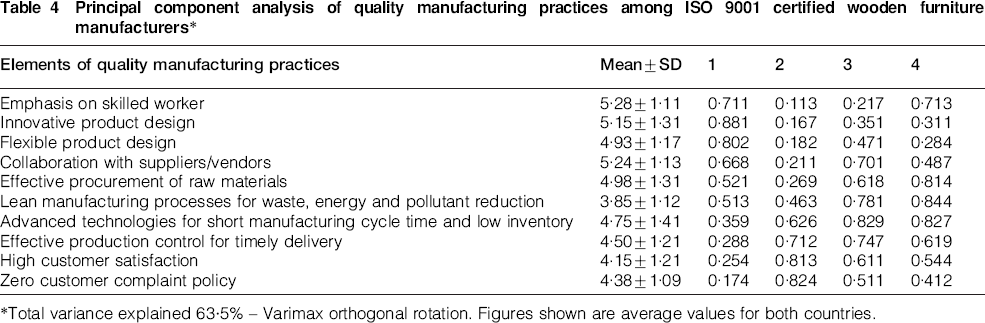
Part III measured the implementation of quality manufacturing practices in the furniture enterprises. It consisted of a broad list of quality practices built from the previous studies by Kozak and Maness (2003) and also from consultations with industrial experts. The respondents were asked to rate the degree of implementation of each of these practices on a six-point Likert-scale (1 – not at all; only what the regulation/standard requires and 6 – to a great extent; it has been the priority of the company). To identify the main reasons for the implementation of the quality practices, principal components analysis was applied and three factors with eigen-values higher than 1·0, which explained 67·5% of the variance, were obtained. The first factor primarily takes into account those practices related to the design of furniture products, the second factor distinguishes the implementation of quality practices in marketing processes, the third factor refers to the quality transformation of the internal production processes, in relation to productivity and management improvements, and the fourth relates to the cost competitiveness arising from the implementation of the quality practices. However, some factors do not clearly load on a single factor and hence, factor labels should only be viewed as representing major trends.
Part IV of the questionnaire required the respondents to provide the average values of processing wastage, rejection/rework rate, downtime loss and other operational inefficiencies related to the furniture manufacturing processes.
Further to the questionnaire-based survey, direct interviews with 1000 foreign furniture buyers at the international furniture fairs in Malaysia and Vietnam were conducted in 2012, to establish the motivation and preference of dealing with ISO 9001 certified furniture manufacturers as opposed to non-certified furniture manufacturers. The buyers were interviewed after obtaining permission from the fair organisers, using a simple structured questionnaire to evaluate their experiences when dealing with certified and non-certified suppliers.
Results and discussion
Factors deterring wooden furniture manufacturers from adopting ISO 9001 quality system
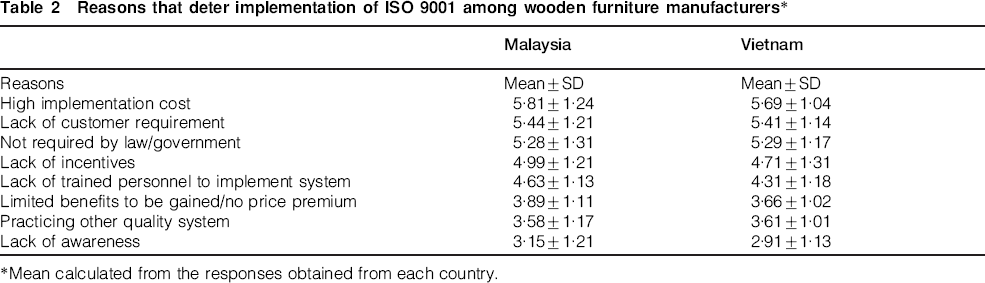
Although the adoption of the ISO 9001 quality management system was higher among the Vietnamese wooden furniture manufacturers, a majority of the respondents from both Malaysia and Vietnam (5·79) reported that the high implementation cost of the ISO 9001 standard prevented their companies from adopting the standard (Table 2). This was followed by the lack of customer demand (5·43), no government regulation (5·25), the lack of government incentives (4·94) and the lack of trained personnel to implement and maintain the system at the companies (4·33), as the other reasons that deterred wooden furniture manufacturers from adopting the ISO 9001, quality management system. The results clearly suggest that the cost-benefit factor related to management was not a pressing issue among wooden furniture manufacturers in Malaysia and Vietnam, which is consistent to the finding reported by Martinez-Costa et al. (2009). Furthermore, the wooden furniture industry is not affected by standards due to varied demands by the different market segments throughout the world (Kozak and Maness, 2003), which also serves as a strong deterrent to the adoption of the ISO 9001 certification. Therefore, until sufficient incentives and market demand exist, the adoption of the ISO 9001 quality management system among wooden furniture manufacturers in Malaysia and Vietnam will be limited.
Reasons that deter implementation of ISO 9001 among wooden furniture manufacturers*
*Mean calculated from the responses obtained from each country.
Adoption of quality elements among ISO 9001 certified wooden furniture manufacturers
Generally, ISO 9001 certified wooden furniture manufacturers showed high cultural manufacturing and technical manufacturing factors. Table 3 shows that these companies paid greater attention to employee training and were focused on continuous improvement, both from the perspective of the product as well as the manufacturing practices. As a result, these companies also showed greater willingness to adopt high technology production methods, which contributed towards better manufacturing practices. The results from this study support the notion that the adoption of ISO 9001 ensures that the company keeps in line with the latest and advanced manufacturing practices, as previously reported by Kozak and Maness (2001) and Tzelepis et al. (2006). Consequently, the ISO 9001 certified companies were better at making the best use of all available resources, to improve their competitive advantage. This confirms the notion that ISO 9001 quality system has an indirect bearing towards improving the manufacturing productivity of the organisation.
Principal component analysis of quality elements among ISO 9001 certified wooden furniture manufacturers*
*Total variance explained 69·3% – Varimax orthogonal rotation. Figures in parentheses are for Vietnam, while the other is for Malaysia.
Adoption of quality management practices among ISO 9001 certified wooden furniture manufacturers
The results shown in Table 4 suggest that ISO 9001 certified wooden furniture manufacturers are proactive in undertaking quality management practices. The practices adopted could be broadly divided into four major categories, namely (i) design of furniture, (ii) marketing processes, (iii) productivity and management improvements and (iv) cost competitiveness. The product design factor was geared towards better specification for the raw materials used, well defined manufacturing processes and clear packaging instructions. On the other hand, the marketing process is geared towards ensuring zero customer complaints, short delivery time as well as maximising customer satisfaction. The productivity and management improvement techniques among ISO 9001 certified wooden furniture manufacturers include the use of high-technology equipment to ensure less wastage and energy efficiency (Ratnasingam et al. 2012). Furthermore, the production planning and control functions focused on reducing wastage and rejections. The cost competitiveness factor was related to the manufacturing process design which ensured built in quality which contributed to a more cost-efficient production process of acceptable quality levels.
Principal component analysis of quality manufacturing practices among ISO 9001 certified wooden furniture manufacturers*
*Total variance explained 63·5% – Varimax orthogonal rotation. Figures shown are average values for both countries.
Against this background, it appears that ISO 9001 certified wooden furniture manufacturers are geared towards the production of quality furniture in a cost-effective manner. This result, which is in line with the finding by West et al. (1999) and Martinez-Costa et al. (2009), highlights the fact that contrary to common belief, the adoption of the ISO 9001 system contributes towards cost-effective furniture manufacturing processes. This is particularly important for wooden furniture manufacturers who are faced with increasing production costs and reducing profitability (Ratnasingam and Ioras 2003).
Operational inefficiencies among wooden furniture manufacturers
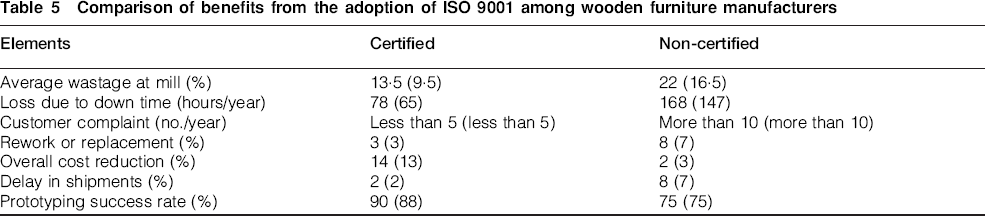
The results of the survey reveal that ISO 9001 certified-companies had much lower operational inefficiencies than their non-certified counterparts. The application of high-technology and efficient production processes results may contribute to the cost-effective operation, as suggested previously in this study. This finding provides ample evidence to support the argument that the adoption of ISO 9001 system among wooden furniture manufacturers leads to cost-effective manufacturing practices (Table 5). This finding is contrary to the common belief that adopting the ISO 9001 standard is not cost-beneficial, as the operational competitiveness gained may off-set the initial implementation cost. Lamprect (1999) and Evangelos et al. (2011) have shown that the primary motivation for implementing the ISO 9001 in manufacturing industries has been the anticipated cost-benefits and in this context, this study shows that adopting the ISO 9001 system does contribute toward economic benefits.
Comparison of benefits from the adoption of ISO 9001 among wooden furniture manufacturers
Perspectives of furniture buyers towards ISO 9001 quality management system
Table 6 provides an insight of the furniture buyers and merchandisers to the ISO 9001 quality management system. It is apparent that Japanese, South Korean, European and Middle Eastern furniture buyers show a high degree of preference for doing business with ISO 9001 certified companies, while North American, Australian and buyers from other regions have no special preference for ISO 9001 certified companies. The results reveal that ISO 9001 is indeed a marketing tool to penetrate the East Asian, European and Middle Eastern markets, as suggested by the strong cultural affiliations to quality management in these nations as reported by Tzelepis et al. (2006). In fact, ISO 9001 certified companies are perceived to be more reliable and consistent as suppliers, although their cost may not be the most competitive as suggested by the respondents. These intangible benefits gained through the adoption of ISO 9001 quality systems must be promoted to wooden furniture manufacturers who have yet to adopt 9001 certification (Ratnasingam et al. 2011).
Customer preferences for ISO 9001 certification*
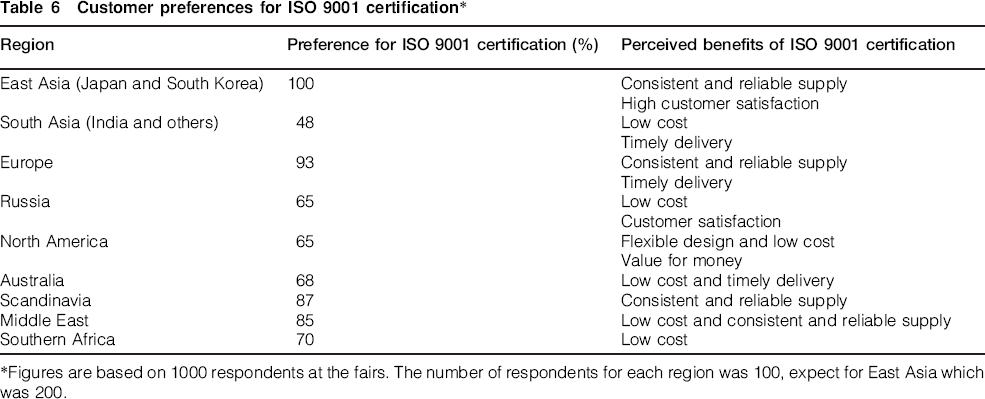
*Figures are based on 1000 respondents at the fairs. The number of respondents for each region was 100, expect for East Asia which was 200.
Industrial implications
Despite the benefits to be gained from the ISO 9001 quality system, its adoption among wooden furniture manufacturers in Asia remains limited. In this context, concerted effort must be taken to increase the awareness of the system, highlighting its direct benefits in terms of cost reduction and productivity improvement. Nevertheless, it must be recognised that the system must be accepted company-wide, if the quality culture is to be successfully embraced. This is the biggest challenge faced by wooden furniture manufacturers, as the ISO 9001 quality system is often perceived to be a marketing tool, when its philosophy is not widely accepted to bring out a long-lasting change towards quality culture (Ratnasingam and McNulty 2010). It may also be construed that as furniture manufacturing becomes increasingly competitive, the need for a systematic approach towards manufacturing such as the ISI 9001 quality system, would gain wider acceptance among manufacturers (Viadiu et al. 2006).
Conclusion
Despite the growing worldwide interest in the ISO 9001 quality management system, its adoption among wooden furniture manufacturers in the South East Asian region is relatively low. The high cost and lack of market demand associated with its implementation are the primary impedance to its wider adoption, although the benefits to be gained through productivity improvement are apparent. Furthermore, the demand for certification which is market specific does not encourage manufacturers to adopt such a system, if their products are not intended for such markets. Therefore, the potential benefits of adopting the ISO 9001 quality system must be promoted and made aware to manufacturers as they strive to increase their competitiveness in the global furniture market.