







Abstract
Growth characteristics and wood properties were investigated for 26-year-old Eucalyptus alba trees grown in Ambon, Indonesia. The mean stem diameter and tree height were 27·9 cm and 19·5 m, respectively. In addition, the mean stress-wave velocity (SWV) of trees and basic density (BD) of outer wood (2 cm from the bark) were 3·23 km s− 1 and 0·67 g cm− 3, respectively. The mean BD of outer wood was almost the same in fast-growing and medium-growing trees. No significant correlations were found between stem diameter and SWV of trees and BD of outer wood. Based on the results, trees with faster-growing characteristics of E. alba do not always have the lower wood properties. Radial profiles in relation to relative distance from pith to bark were almost the same among three growth categories, suggesting that xylem maturation in E. alba might depend on cambial age.
Introduction
Eucalyptus alba Reinw. ex Blume is distributed in northern Australia, Papua New Guinea, Timor, and eastern Indonesia. It is extensively planted in Malaysia and the mainland of Southeast Asia. Uses for its wood include heavy-duty construction, boat building, and furniture (Soerianegara and Lemmens 1994). Density at 12% moisture content, green compressive strength parallel to the grain, modulus of rupture, and modulus of elasticity in static bending in the green condition were 1·01 g cm− 3, 43 MPa, 86 MPa, and 14·2 GPa, respectively (Soerianegara and Lemmens 1994). However, information on wood properties of plantation-grown E. alba trees remains limited. Therefore, detailed information on growth and wood properties of plantation-grown E. alba trees is needed.
Evaluation of wood properties by non- or semi-destructive tests without cutting trees is very important, because cutting trees for the analysis of wood properties is sometimes difficult in tropical countries. In hardwood species, stress-wave velocity (SWV) in the stem is positively correlated with Young's modulus of wood (Dickson, Raymond, Joe and Wilkinson 2003; Ishiguri et al. 2013). Dickson et al. (2003) reported that SWVs of stems in 9- and 25-year-old E. dunni are positively correlated with modulus of elasticity in small clear specimens. On the other hand, wood properties can be also evaluated by using core samples obtained with a core borer (Chiu et al. 2006; Lin, Wang and Chiu 2007; Matsumoto et al. 2008; Ishiguri et al. 2012; Makino et al. 2012). Matsumoto et al. (2008) reported that compressive strength of core samples measured by strength-testing equipment for cores were positively and significantly correlated with that of small clear specimens [20 (R) by 20 (T) by 60 (L) mm] determined by static testing according to Japan Industrial Standard (JIS).
Recently, the xylem maturation process in tropical hardwood species has been clarified on the basis of radial variation of anatomical characteristics and wood properties (Honjo, Furukawa and Sahri 2005; Kojima et al. 2009; Nugroho et al. 2012; Ishiguri et al. 2012; Makino et al. 2012). As a result, the xylem maturation process in some fast-growing species, such as Acacia mangium, Falcataria moluccana, and other species depends on diameter growth, while in Shorea accuminatissima, which is a relatively slower growing species, depends on the cambial age (Honjo et al. 2005; Kojima et al. 2009; Nugroho et al. 2012; Ishiguri et al. 2012; Makino et al. 2012). To obtain wood of stable quality for furniture making and construction lumber production, it is important to clarify the xylem maturation process in plantation species.
In the present study, to obtain the high valued woods for furniture making and construction lumber production from E. alba plantations in Indonesia, growth characteristics (stem diameter and tree height), stem SWV, and wood properties [basic density (BD) and compressive strength parallel to the grain] were investigated for 26-year-old E. alba planted in Indonesia. In addition, the radial variation of wood properties was examined to determine the effect of radial growth rate on wood properties.
Materials and methods
The E. alba Reinw. ex Blume plantation was located at Gunung Nona, Education Forest, Pattimura University, Ambon, Maluku, Indonesia (03°43′ S, 128°11′ E). Seedlings of E. alba were planted with an initial spacing of 3 × 3 m in 1985. The seed was supplied by the Ambon office, Department of Forestry, Indonesia. After planting, thinning and pruning treatments were not conducted. However, some trees were cut down owing to illegal logging. A total of 20 trees with straight stems were selected from the plantation site for this experiment.
Stem diameter at 1·3 m above ground level, tree height, and SWV of stem were measured for all 20 trees. Stress-wave velocity of trees was measured using a hand held stress-wave timer (FAKOPP, Fakopp Enterprise) according to the method described in previous reports (Ishiguri et al. 2007, 2012). Sensors for the stress-wave timer were set at 0·5 and 1·5 m above ground level. Stress-wave propagation time between the sensors was measured 10 times at each stem position. Stress-wave velocity of trees was calculated by dividing the distance between sensors by the averaged stress-wave propagation time.
Core samples (5 mm in diameter and 2 cm in length) were collected from the outer wood of all trees at 1·3 m above the ground level to determine the BD. Basic density was calculated by dividing the oven-dried weight by the green volume determined using the water-displacement method.
To examine the effect of growth on wood properties, sample trees were grouped into the following three growth categories according to the mean stem diameter (d, 27·9 cm) and the standard deviation (SD, 5·7 cm) (Ishiguri et al. 2007, 2012): fast-growing (more than mean +1 SD = d>33·6 cm), medium-growing (within mean ± 2 SD = 22·2 cm < d < 33·6 cm), and slow-growing (less than mean − 1 SD = d < 22·2 cm) trees. Two core samples (5 mm in diameter) from pith to bark were collected from one randomly selected tree at 1·3 m above the ground level in each category to analyse the radial variation of wood properties. One core sample was used for measuring the radial variation of BD at 1-cm intervals from pith to bark. The other core sample was used for determining the compressive strength parallel to the grain at green condition. The core sample was successively cut into specimens of 5 mm in length from pith to bark. To avoid the specimen damage caused by drying, the specimens were kept in the green condition. The compressive strength at green condition was measured using a strength-testing machine for core samples (Fractometer II, IML) (Matsumoto et al. 2008; Ishiguri et al. 2012; Makino et al. 2012). A significant positive correlation was found between compressive strength determined by core sample with Fractometer II and small clear specimen with standard static test (Matsumoto et al. 2008). The mean values at 2-cm intervals were calculated to analyse the radial variation of BD and compressive strength from pith to bark. In addition, to evaluate the effect of cambial age on xylem maturation, the radial variation in relation to relative distance from pith to bark was analysed according to the method reported by Chowdhury et al. (2009, 2013).
Results and discussion
Table 1 shows the statistical values of growth characteristics and wood properties. The mean stem diameter, tree height, and SWV were 27·9 cm, 19·5 m, and 3·23 km s− 1, respectively. Medium-growing trees showed the highest mean SWV of trees (3·30 km s− 1). Non-significant or weak negative correlations were found between stem diameter and SWV of trees in several hardwood species (Dickson et al. 2003; Ishiguri et al. 2007, 2011, 2012; Makino et al. 2012). In the present study, a significant correlation (r = 0·851, 99% level) was found between stem diameter and tree height, whereas no significant correlations were found between stem diameter and SWV (Fig. 1). The results that were obtained are similar to those reported in previous researches (Dickson et al. 2003; Ishiguri et al. 2007, 2011, 2012). Furthermore, as shown in Table 1, no significant differences in SWV were observed among three growth categories. Based on the results, it can be considered that SWV of stem is independent of growth characteristics. In softwood species, a significant positive correlation was found between SWV of stem and modulus of elasticity of air-dried lumber (Ishiguri et al. 2008). In addition, Wang et al. (2004) reported that stress-wave time in maple logs was significantly correlated with stress-wave time in green lumber and dry lumber. Thus, Young's modulus of wood in this species might also be independent of growth characteristics, suggesting that in E. alba, the fast-growing trees do not always have a lower Young's modulus of wood.
Statistical values of growth characteristics and wood properties
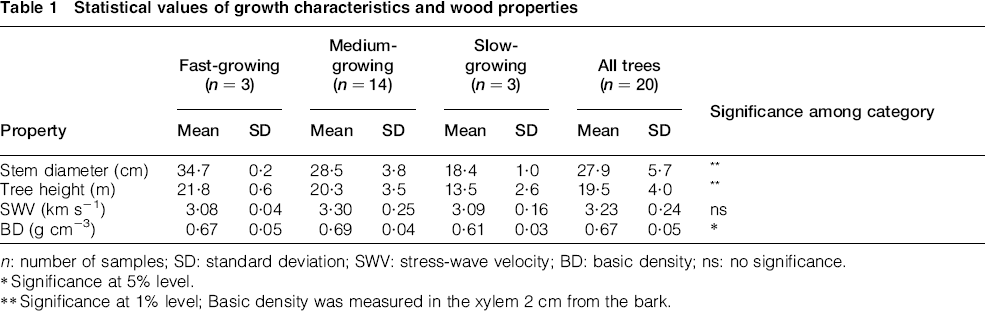
n: number of samples; SD: standard deviation; SWV: stress-wave velocity; BD: basic density; ns: no significance.
Significance at 5% level.
Significance at 1% level; Basic density was measured in the xylem 2 cm from the bark.
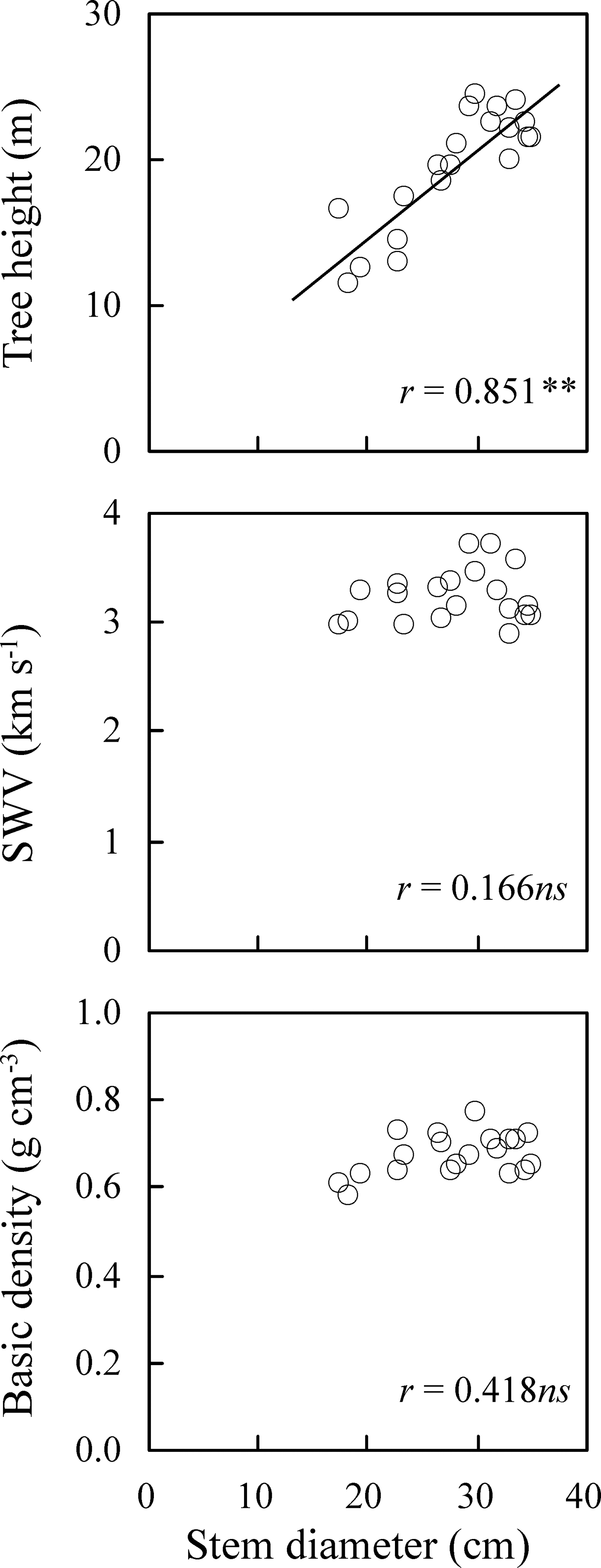
Relationships between stem diameter, tree height, and wood properties: number of sample = 20: r: correlation coefficient; ns: no significance: **significance at 1% level
Figure 2 shows the radial variation of BD and compressive strength parallel to the grain in relation to radial distance from pith. Basic density gradually increased outwards from the pith, reaching peak values near the bark. Subsequently, BD gradually decreased towards the bark. Although the positions (at a distance from the pith) at which the peak values occurred were not the same among growth categories, radial profiles were almost similar among growth categories. It has been reported that BD increases from pith to bark in E. camaldulensis (Veenin et al. 2005), E. saligna (Ohbayashi and Shiokura 1990; DeBell et al. 2001), E. nitens (Evans et al. 2000), E. albnes, E. bancroftii, E. dealbata, E. goniocalyx, E. macrothyncha, and E. sideroxylon (Wilkes 1984). In contrast, in E. tereticornis, Sharma et al. (2005) reported that specific gravity was almost constant from pith to a certain position and then gradually decreased towards the bark. Basic density profiles from pith to certain positions in E. alba trees with different growth rates were similar to those obtained in many other Eucalyptus species, and decreases of BD towards the bark were similar to those in E. tereticornis (Sharma et al. 2005). As shown in Fig. 3, a significant correlation was found between BD and compressive strength of E. alba in the present study. In general, these two properties are positively related in many species (Kollman and Côté 1984). Therefore, radial variation of compressive strength was similar to that of BD in this study.
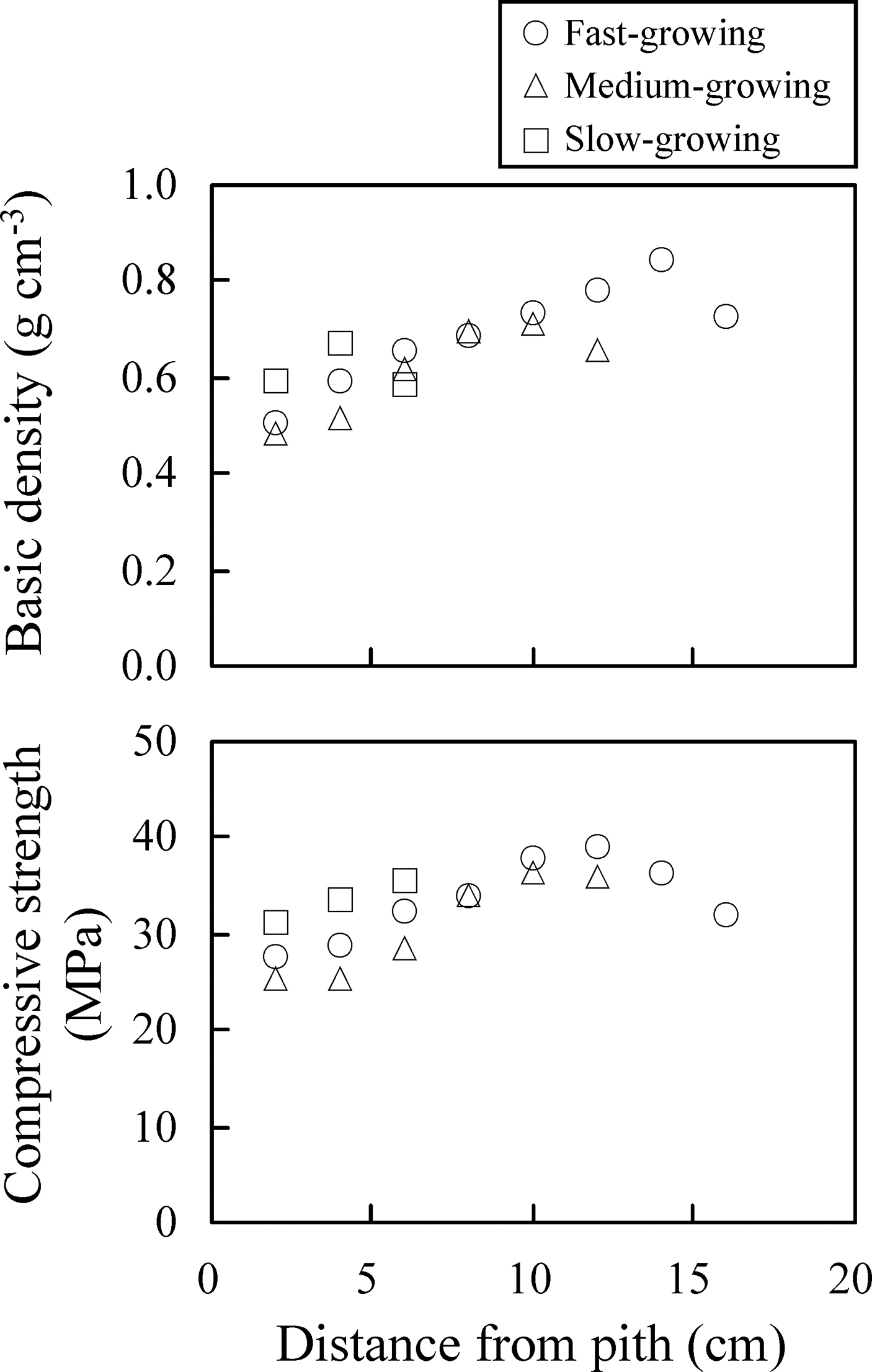
Radial variation of basic density (BD) and compressive strength parallel to the grain in relation to distance from the pith
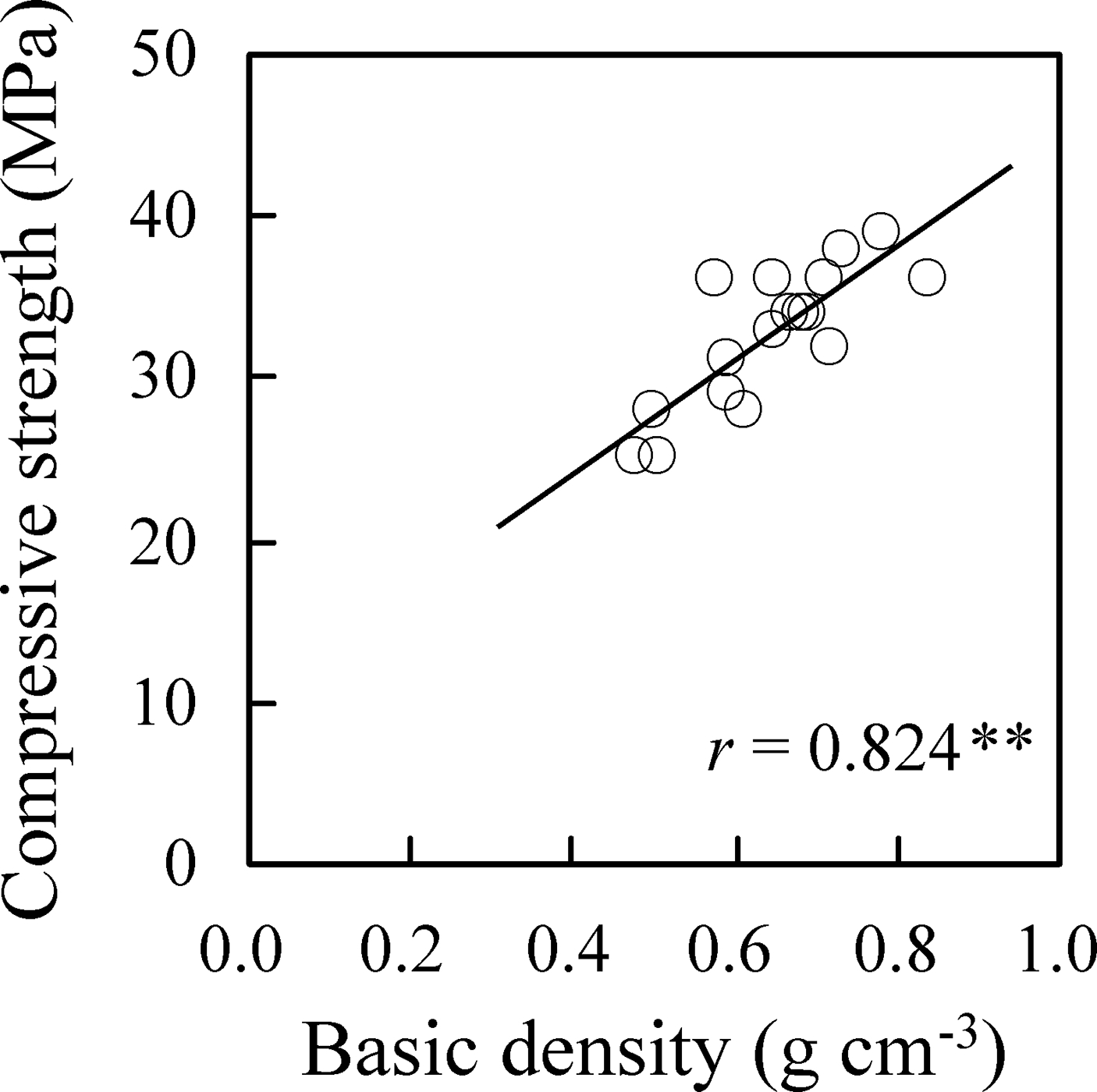
Relationship between basic density (BD) and compressive strength parallel to the grain: number of sample = 17: r: correlation coefficient; **significant at 1% level
The statistical values of wood properties of 20 sample trees are also listed in Table 1. The mean BD of outer wood was 0·67 g cm− 3. Medium-growing trees showed the highest mean BD of outer wood (0·69 g cm− 3). The mean values from pith to bark in fast-, medium-, and slow-growing trees were 0·68, 0·61, and 0·62 g cm− 3, respectively (Table 2). In addition, the mean compressive strength in fast-growing trees (33·5 MPa) was almost the same as that in slow-growing trees (33·4 MPa). In 4-year-old E. saligna, Ohbayashi and Shiokura (1990) reported that the oven-dried density in slow-growing trees (0·59 g cm− 3) was higher than that in fast-growing trees (0·47 g cm− 3). In contrast, Bamber et al. (1982) reported that no significant difference in BD was observed between fast-growing and medium-growing trees of 2·5-year-old E. grandis. In the present study, a significant difference in BD of outer wood was observed among three growth categories (Table 1). However, the mean values in medium-growing and fast-growing trees were almost the same, while the mean value in slow-growing trees was lower than that in medium-growing and fast-growing trees. As shown in Fig. 2, BD near the bark was higher than that near the pith. Therefore, the faster growth characteristics of trees resulted in the increase of wood volume with higher density. In addition, no significant differences in the mean BD from pith to bark were observed among growth categories (Table 2). Furthermore, no significant correlation was found between stem diameter and BD of outer wood (Fig. 1). Therefore, the authors conclude that trees with faster-growing characteristics of E. alba may not have always lower density of wood.
Basic density (BD) and compressive strength at green condition of a tree from each growth category †

n: number of samples from pith to bark of a tree; SD: standard deviation; Min: minimum; Max: maximum; ns: no significance.
Values of BD and compressive strength in each category were obtained from a tree.
Recently, several researchers reported that xylem maturation determined by anatomical characteristics and wood properties in some tropical fast-growing tree species depends on the increase in diameter (Honjo et al. 2005; Kojima et al. 2009; Nugroho et al. 2012; Makino et al. 2012). In contrast, in tropical plantation species such as Shorea accuminatisima, which has a slower growth rate compared with fast-growing species, xylem maturation depends on the cambial age (Ishiguri et al. 2012). In Eucalyptus species, DeBell et al. (2001) examined the wood density of 15-year-old E. saligna trees of different diameters and found a trend of increase in wood density with cambial age that was similar among trees of different diameters. Furthermore, Kojima et al. (2009) reported that in E. globulus and E. grandis, xylem maturation determined by wood fibre length is controlled by cambial age: formation of mature wood starts once a certain cambial age is attained. In the present study, as shown in Fig. 4, radial profiles were almost the same among three growth categories, indicating that xylem maturation in E. alba may also depend on cambial age.
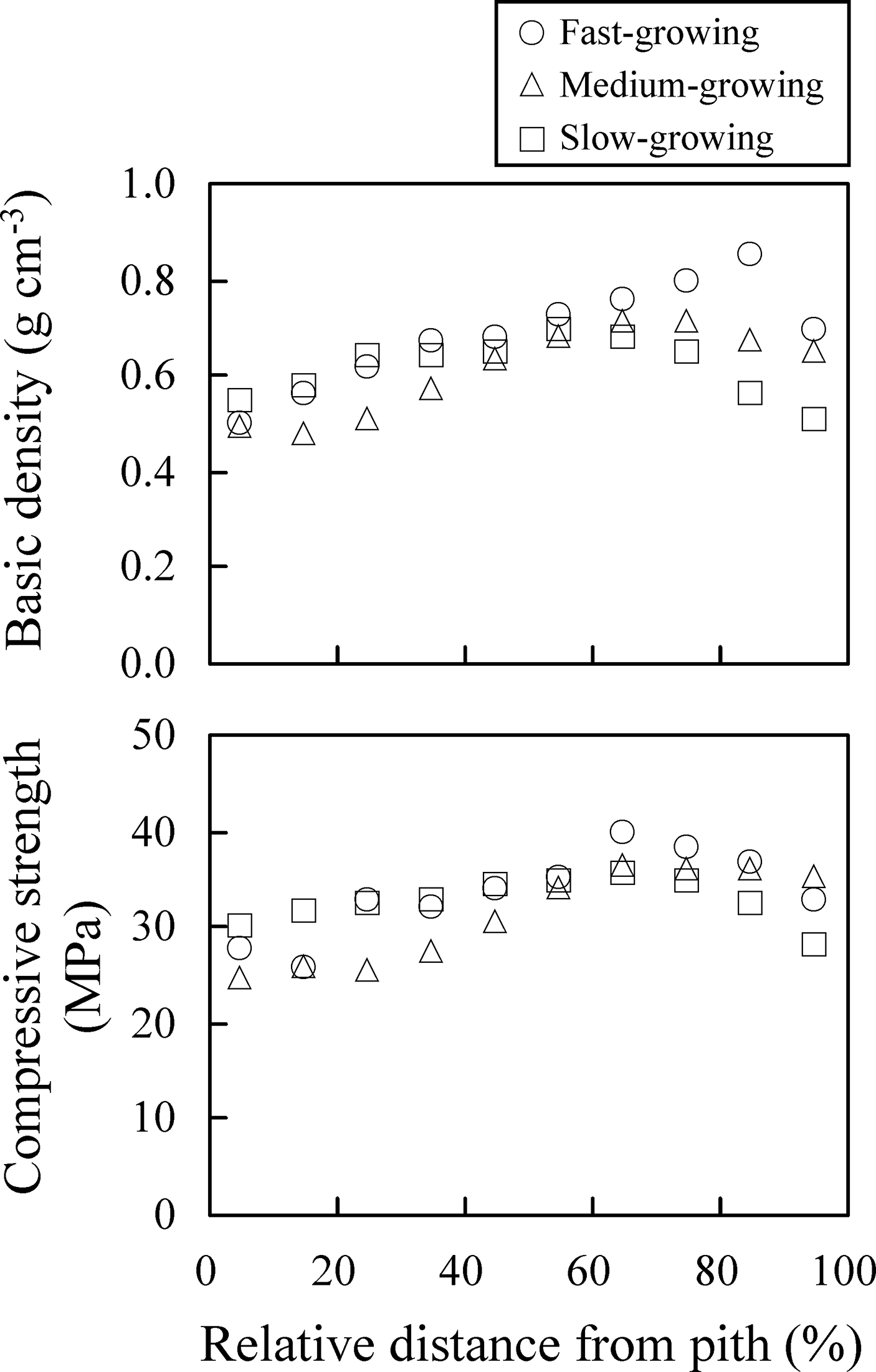
Radial variation of basic density (BD) and compressive strength parallel to the grain in relation to relative distance from the pith
Conclusion
As shown in Table 1, significant differences in stem diameter, tree height, and BD of outer wood were observed among three growth categories, suggesting that these characteristics can be improved by tree breeding programmes. In addition, SWV of trees was not significantly correlated with stem diameter. In the previous study, SWV of stems or logs was positively correlated with modulus of elasticity of green or dry lumber (Wang et al. 2004; Ishiguri et al. 2008). Therefore, Young's modulus of wood in E. alba may be independent of growth characteristics, suggesting that when wood with high mechanical properties is needed, Young's modulus should be included in the selection criteria for elite trees in tree breeding programs. Furthermore, BD gradually increased towards the bark and reached to maximum value, and then it decreased, suggesting that values of wood density may became lower values in aged trees. Thus, rotation age should be considered in silvicultural practices for this species planted in Indonesia. As shown in Fig. 4, xylem maturation process in this species might depend on cambial age. Therefore, tree growth at initial stage of growth should be controlled. And then, after starting the formation of ‘matured xylem’, volume of wood with stable quality should be increased by silvicultural practices, such as thinning treatment.